Human Editing Workflows for AI-Drafted Content
Editors must catch hallucinations and strategic drift AI generation misses.

Almost no published AI content is pure AI output. It's human-AI hybrid content, which means the editing question is never "should we use this draft?" It's nearly always "how do we fix this draft without missing what's actually broken in it?" Those are different problems, and the second one is harder than most teams expect when they first start using these tools.
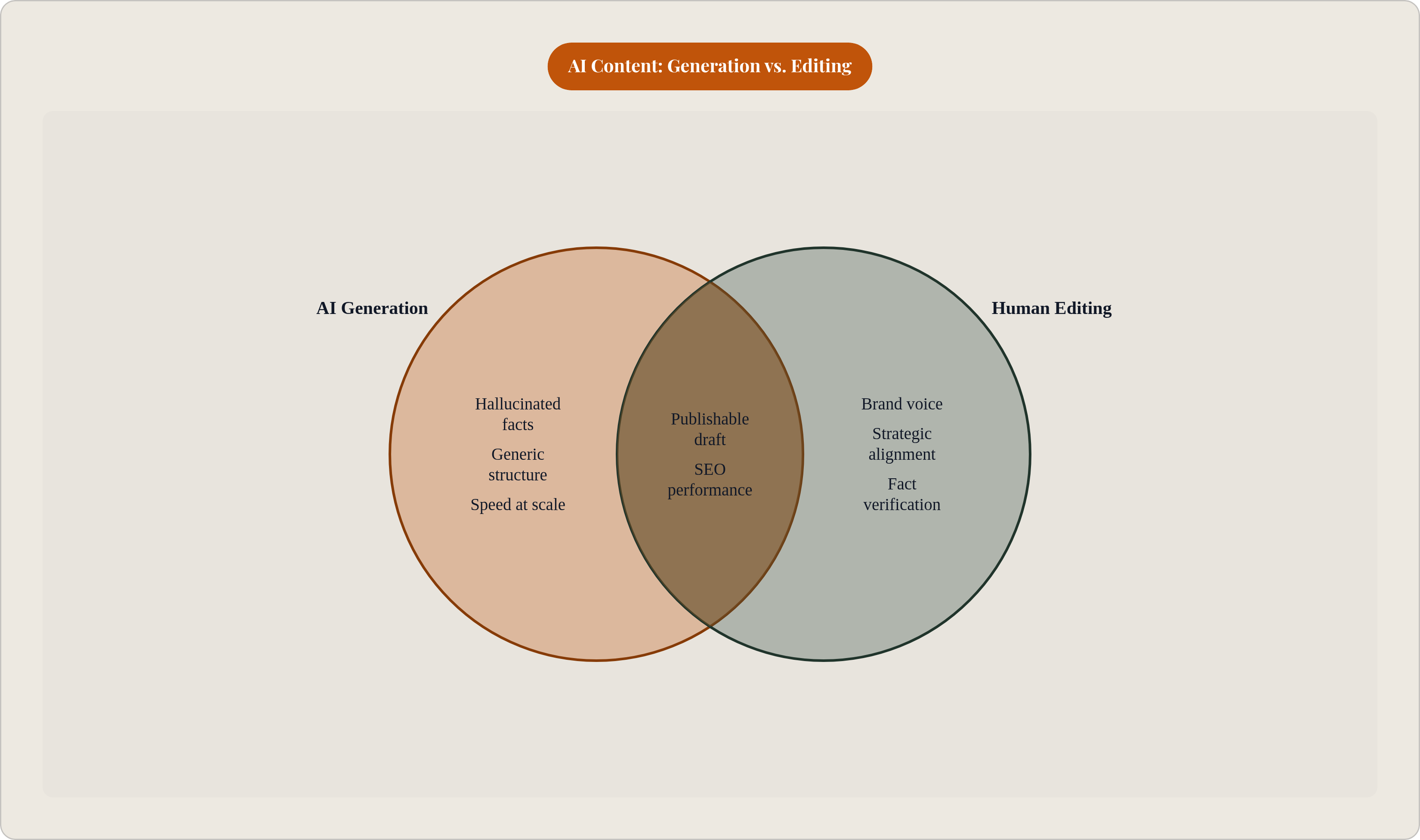
Four failure modes show up with enough consistency to treat as defaults. Hallucinated facts and citations: sources that sound authoritative, cite plausible journals, and simply don't exist. Generic structure: logically ordered, competently organized, completely indistinguishable from the other twelve articles on the same topic. Voice flatness: grammatically clean prose with no personality and no brand signal. Strategic drift: content that answers the question but doesn't serve the funnel stage, the audience, or any conversion goal worth caring about.
The Stanford HAI 2025 AI Index Report documented hallucination rates across leading models, and the variance by model and content type is wide enough to matter. You cannot assume your tool sits at the favorable end of that range without actually testing it. Statistics, attributed quotes, named studies, specific dates, niche technical claims: these categories hallucinate at higher rates than general prose. A functional workflow targets those clusters deliberately rather than hoping a quick skim will catch everything.
One pattern worth flagging, because it caught me off guard the first time I encountered it in a client's draft: models optimized for deeper reasoning have, counterintuitively, hallucinated more on factual benchmarks in some evaluations. The more confident the output sounds, the more carefully it needs checking. Confidence is not accuracy. In AI drafts, it can be the opposite.
The hidden cost of unstructured editing
A Workday and Hanover Research survey of roughly 3,200 respondents found that a meaningful share of time saved through AI is lost to rework: correcting, clarifying, or rewriting low-quality outputs. A separate GoTo and Workplace Intelligence survey found that 66% of reviewers say reviewing AI-generated content creates additional work. Not occasionally. Structurally.
That's the paradox. AI saves time at the generation stage; unstructured editing burns it at the review stage. Net gain depends entirely on how the editing is run.
Time-per-piece savings are frequently cited in industry surveys, but those figures assume the editing doesn't spiral into a full rewrite, which it frequently does when there's no process governing how the review actually happens. Every team I've seen that experiences AI as a net time sink is dealing with the same structural problem: generation speed that isn't matched by editing discipline. The draft ships faster. The cleanup takes longer. Sometimes longer than it would have taken to write the thing from scratch, which is its own kind of demoralizing.
The fix isn't adding more process overhead. It's replacing reactive cleanup with a designed checklist that runs proactively, before the draft drifts too far from its original shape to salvage efficiently. Different kind of work, but faster.
Stage one — fact-checking before anything else
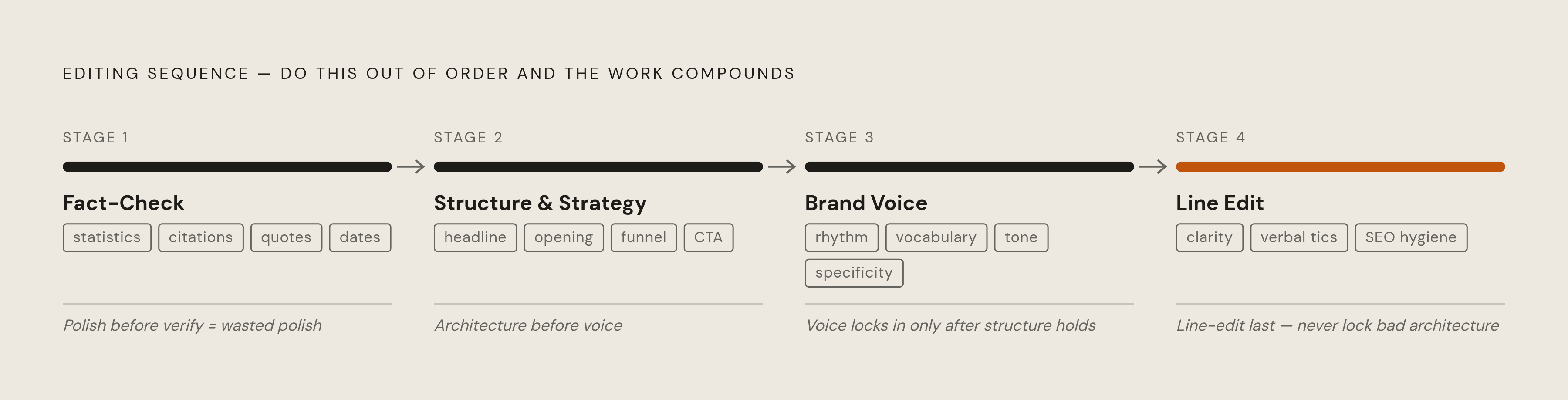
Sequence matters more than people think. Polishing prose that contains a fabricated claim wastes the polish entirely. When the claim gets pulled, the work done around it goes with it.
What to check, specifically: statistics and percentages, traced to a primary source; named studies and reports, verified both to exist and to actually say what the draft claims they say; quotes attributed to named individuals, confirmed in original context; specific dates, product versions, and any legal or regulatory claims. AI drafts generate plausible-sounding citations that appear in other AI outputs but nowhere credible.
A practical test: copy the exact claim and its cited source into a search engine. A real citation surfaces across multiple independent credible sources. A hallucinated one appears primarily inside other AI-generated content. That asymmetry is usually detectable within two minutes, which is a reasonable price to pay for not publishing a fabrication under your byline.
The decision rule: if a claim can't be traced to a primary source, remove it. A missing statistic is preferable to a published fabrication. On the first pass, flag rather than delete outright. Some hallucinated claims can be replaced with a verified alternative. Deletion is the fallback, not the default.
Retrieval-Augmented Generation and web-grounded generation reduce hallucination rates substantially in vendor benchmarks. Using them at the prompt level reduces fact-checking load. It does not eliminate it. Anyone who tells you otherwise is selling something, and they're probably using AI to write their sales copy.
Stage two — structural and strategic review
After facts, structure. AI drafts are logically ordered but often strategically inert, which is a subtler problem and, in some ways, a more damaging one. A piece can be factually accurate and coherently organized while still being completely useless for the business goal it was supposed to serve.
The specific failures cluster predictably: a generic opening that doesn't match the reader's actual entry point; sections that are logically sequential but don't build toward anything; a conclusion that summarizes instead of directing next action; funnel mismatch, where a top-of-funnel framing lands on a piece meant for decision-stage readers, or a late-stage conversion push appears on content where the reader isn't ready for it. These are structural problems, not sentence-level ones, and a typo pass won't catch any of them.
The diagnostic questions: Does the headline match what the piece actually delivers? Does the opening earn continued attention within the first two paragraphs? Is every section pulling its weight, or is some of it padding that AI generated to approximate a target word count? Does the piece end with a clear next action?
Substantive human revision tends to land in the range of 25 to 40 percent of the original draft, per established practitioner guidance. Less than that suggests under-editing. More suggests the prompt is broken and needs to be fixed upstream rather than rebuilt by hand in every single draft, which is an exhausting way to spend an afternoon.
Strategic review is also where internal linking, CTA placement, and references to supporting assets get added. These require context the model wasn't given. That's not a model limitation; it's a brief limitation. It belongs in the editing layer.
Stage three — restoring brand voice
AI defaults to a generic register because it optimizes for clarity and correctness across an enormous training distribution. The output sounds like no brand in particular, which is functionally the same as sounding like every brand at once. That's a brand problem, but it's also a trust problem: a substantial share of consumers report being able to identify AI-generated messaging, and recognition of that kind rarely improves conversion rates.
What brand voice actually means in editing terms: sentence rhythm and length, vocabulary choices and aversions, tone calibration (authoritative versus conversational, direct versus discursive), and specific personality markers that make the brand identifiable on sight. Abstract style guide language doesn't transfer across a team. Concrete before-and-after examples do. I've seen teams spend months on a voice document that nobody internalized because it described the voice instead of demonstrating it.
Three things must be in place for voice editing to hold. A detailed brand style guide embedded into prompts, so voice issues are reduced before editing begins rather than corrected entirely in post. A post-processing review checklist specific to voice, not just grammar. Annotated examples showing writers what the voice edit actually looks like in practice, not just what it's supposed to feel like in principle.
Voice editing is also where human experience enters the draft: observations from real client conversations, specific product details, the kind of grounded specificity that AI cannot generate unless it was given that information explicitly. No prompt fully solves this. It requires a human who actually knows the subject matter and is willing to put it on the page.
Stage four — line editing and readability
Line editing comes last for a reason. Clarifying a sentence's meaning after the facts have been verified and the structure has been confirmed is safe. Doing it before risks introducing a new inaccuracy, or polishing over a structural problem that still needs to be resolved. Sequence is error prevention, not bureaucracy.
This pass covers sentence-level clarity, cutting redundancy, breaking up run-ons, and eliminating the verbal habits that mark unedited AI output: "it is important to note that," "it is worth mentioning," "as we can see." These constructions do no work. They're AI filling space, and readers notice, even when they can't articulate why. It's the prose equivalent of someone clearing their throat before every sentence.
Transition quality is a line-editing concern that often goes unaddressed. AI connects paragraphs with generic connectors that signal continuity without actually carrying the argument forward. A real transition moves the reader somewhere. A generic one gestures at movement and hopes no one checks.
Passive voice is worth calibrating deliberately. AI over-indexes on passive constructions, which diffuses agency and softens claims that should be direct. Active voice is generally more precise, and more honest about who is doing what to whom.
A practical list of verbal tics worth flagging: "delve into," "it's worth noting," "in conclusion," "leverage" used as a verb, lists that open with "firstly." These are reliable signals of unedited AI output, and both readers and search engines are increasingly competent at recognizing them.
This is also the pass for SEO hygiene: keyword placement, meta description, alt text. Mechanical checks that belong at the end, once the content is otherwise final and stable.
Closing the loop — prompt refinement as the real workflow upgrade
The most expensive failure mode in AI-assisted content production is editors manually correcting the same recurring mistake across every single draft. If the same issue appears consistently, it is a prompt problem, not a draft problem. Fixing it at the draft level every time is a compounding inefficiency that will never stop compounding unless someone addresses the source.
That raises an important question: why don't more teams close this loop? In my experience, because it requires someone to sit with the pattern long enough to name it, which is hard to prioritize when there's a publication queue and a deadline breathing down your neck. So the corrections keep happening at the draft level, week after week, and nobody quite notices how much time it's absorbing until the quarterly review.
Prompt refinement in practice: track which edits recur across drafts; add specific prohibitions to the system prompt ("avoid using 'leverage' as a verb," "do not include statistics without a named source"); build brand voice examples directly into the generation step so the voice pass becomes lighter each cycle. The compounding logic is straightforward. Each editing cycle that feeds back into the prompt reduces the editing burden on the next cycle. The workflow improves itself, but only if it's designed to close that loop deliberately.
Content platforms that embed style guides, brand voice parameters, and editorial checklists into the generation step reduce the gap between raw output and publishable draft. Manifesto is one example, combining AI generation with strategy-first workflows so that editing stages are spent on genuine judgment calls rather than recurring mechanical corrections. The distinction matters: human editors making strategic and creative decisions is a different job than human editors fixing the same AI habits every Tuesday morning. One scales. The other just accumulates.
How the workflow holds up against SEO and performance benchmarks
Purely AI-generated content holds the top SERP position only 9% of the time, per a Semrush study of 42,000 blog posts. That's not a reason to abandon AI-assisted content production. It's a reason to take the editing workflow seriously, which is, frustratingly, the lesson hiding inside most of the "AI is failing us" complaints you'll encounter.
Human editing's SEO effect operates across multiple dimensions simultaneously. On ranking: AI-assisted content with substantive human editing performs close to fully human-written content in ranking benchmarks, per Digital Applied's multi-month tracking study. On click-through: AI-detected content draws lower CTR even at equivalent rank positions, because voice and title quality are editorial decisions that don't emerge from generation alone. On engagement: bounce rate and session duration gaps between edited and unedited AI content are substantial. Users notice when content reads like it was never touched by anyone who cared about it, even when they can't explain exactly why it feels that way.
Claims about Google's 2026 core update and its treatment of scaled AI publishing should be verified against Google's official communications before citing; indexing is not the same as lasting traffic, and the policy landscape shifts frequently enough to make secondhand summaries unreliable.
But what if the SEO logic feels too narrow? Consider the newsroom parallel. AP, BBC, and The Guardian have all codified human oversight into formal editorial policy. Not because AI isn't useful, but because the review layer is what makes the output trustworthy enough to publish under a masthead. That's a reputational argument, but it maps cleanly onto a performance argument: the review layer is what makes the output perform. The two aren't in tension; they're the same claim made in different registers.
The teams still fixing AI messes after the fact aren't slower because AI let them down. They're slower because they never built the workflow that makes AI fast. That's a solvable problem, and it doesn't require more technology. It requires more deliberate process, which is, somehow, the answer to most problems in content production regardless of what tools are involved.