Brand Voice Training in AI Writing Platforms
Distinguish voice from tone to build AI systems that maintain your brand's identity at scale.
Voice and tone are not the same thing, and conflating them is where most teams lose coherence before they even start. Voice is stable identity: who the brand is, regardless of context. Tone is situational modulation: how the brand sounds in a product launch versus a crisis statement. The skeleton stays the same whether you're dressed for a boardroom or a barbecue. Training the AI on voice gives you a durable foundation. Training it on tone alone gives you a set of moods with no underlying character to anchor them.
In practice, training means supplying the model with enough structured signal (style examples, explicit rules, approved language, corrective feedback) that its output reliably reflects your identity without heavy manual editing after every generation. It is not a one-time setup. Voice evolves, products change, and the training inputs have to evolve with them.
The most common practitioner error I've seen: providing adjectives instead of behavioral examples. Descriptors like "trusted," "bold," and "human" give the model nothing to imitate at the sentence level. Effective voice definition operates at a more granular register: sentence rhythm, certainty level, vocabulary range, phrases to avoid categorically, and real examples that demonstrate the voice under an actual assignment. Brands that get this right treat their style guide less like a manifesto and more like a technical specification.
How Prompt Engineering Carries Brand Voice — and Where It Breaks Down
A well-structured brand voice prompt bundles several distinct elements: a role assignment, audience definition, objective, structural constraints, approved terminology, banned phrases, and a handful of live examples demonstrating the target voice. That last component, called few-shot prompting, matters more than most practitioners realize. Showing the model two or three sentences written in the brand's actual voice outperforms describing that voice in abstract terms. Examples carry behavioral information that descriptions simply cannot.
Prompt engineering is a fast path to basic voice consistency. A competent team can establish a functional brand prompt in hours or days, no technical infrastructure required. For individual contributors working on bounded content types, it often holds well enough.
But the ceiling is lower than people expect, and you hit it faster than you'd like. For long-form content (landing pages, case studies, executive messaging) the longer the output, the more opportunities the model finds to drift back toward default assistant language. Coherence degrades as token distance from the prompt increases. And there is no persistence across sessions. Every new conversation resets the context entirely, which means every team member running their own conversations is effectively starting from scratch unless they are each maintaining the same prompt discipline. That rarely holds at scale. The prompt length required to carry full brand context (role, audience, rules, examples) often crowds out the actual task instructions.
Prompt engineering is necessary. It is insufficient for brands producing content at volume across multiple content types and authors.
How Retrieval-Augmented Generation (RAG) Grounds AI Output in Brand-Specific Material
RAG solves a different problem than prompt engineering. Instead of encoding brand knowledge inside the prompt itself, the system retrieves relevant documents from a curated knowledge base at generation time and surfaces them into context automatically. The prompt stays lean. The brand intelligence lives in the knowledge base and gets pulled in as needed.
What goes into that knowledge base for voice purposes: style guides and editorial standards, approved messaging and positioning documents, high-quality sample content that demonstrates the voice under real assignments, product documentation, and terminology glossaries. The structural advantage is updatability. When brand rules evolve, you update the documents, not the model. The AI always retrieves from the current version without requiring any retraining of underlying weights.
Menlo Ventures' State of Generative AI in the Enterprise found that a majority of enterprise AI deployments now use RAG in production, making it the dominant deployment pattern at scale; RAG-backed systems perform better on domain-specific accuracy than unconstrained generative AI, particularly on factual business content, though the degree of improvement varies by deployment.
The constraint is the quality of the source material, and this is where teams consistently underestimate the work involved. Poorly structured or inconsistent source material produces inconsistent retrieval, which produces inconsistent output. RAG is best suited for brands that already have a substantive content library and clear brand documentation that can be organized into a retrievable knowledge base.
What Fine-Tuning Adds — and When It's Worth the Investment
Fine-tuning operates at a fundamentally different level than prompt engineering or RAG. It updates the model's weights on brand-specific examples, encoding the voice into the model itself rather than injecting it at runtime. The result is a model that defaults to your brand's register without being explicitly told to on every generation.
Three conditions justify the investment. The brand has a highly distinctive voice that departs substantially from the model's default (technical humor, unconventional syntax, a niche register that no amount of prompting reliably reproduces). The team is running high-volume, repeating content types where prompt engineering has a documented and measurable failure rate. The brand needs consistent voice across many users without relying on prompt discipline, which does not scale.
The data requirements are real. Fine-tuning typically requires hundreds to thousands of labeled examples, a threshold most mid-market marketing teams cannot clear without deliberate curation effort. Per Menlo Ventures' State of Generative AI in the Enterprise, only around 9% of enterprise AI deployments rely primarily on fine-tuning, and the infrastructure and maintenance burden explains the gap with RAG adoption. Parameter-efficient methods like LoRA and QLoRA have lowered the compute cost since their broader adoption in 2023 and 2024, so fine-tuning is less prohibitive than it once was. The data curation problem, though, remains largely unchanged.
The maintenance dynamic is also different from RAG. As the brand evolves, a fine-tuned model requires periodic retraining. Unlike a knowledge base where you swap a document, the weights cannot be updated by editorial action alone. That ongoing investment is the cost of the deeper integration it provides.
How These Layers Combine in Practice — and What Actual Results Look Like
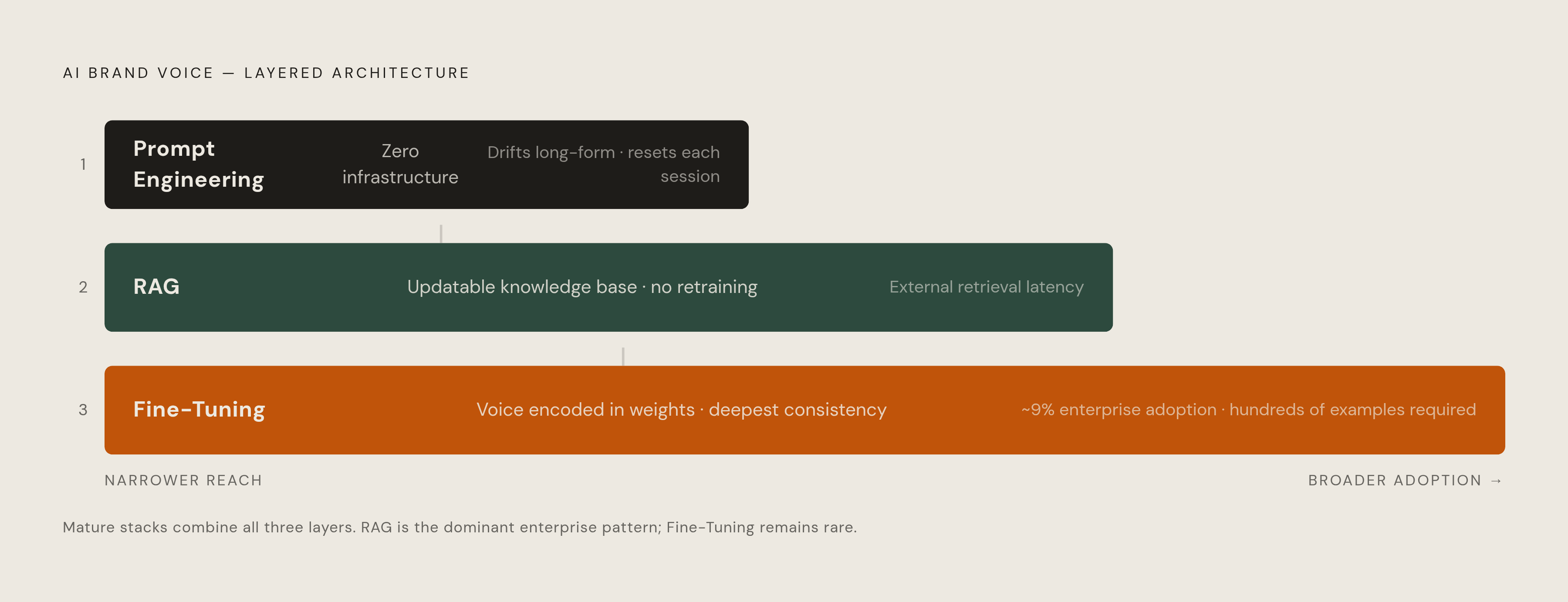
These mechanisms are not mutually exclusive, and production deployments rarely rely on just one. The typical architecture stacks them: a fine-tuned model or a strong system prompt, combined with RAG retrieval, governed by ongoing feedback loops that surface corrections and refine inputs over time.
A documented case from a Singapore-based fashion retailer partnered with Hashmeta illustrates what a hybrid deployment can produce. The team fine-tuned on 200 hand-crafted examples for voice and integrated RAG for factual accuracy. Results included a 75% reduction in production time, a 92% brand alignment score, and a 34% improvement in SEO performance, as reported by Hashmeta. The number worth pausing on is 200 examples, not thousands, because those examples were curated specifically for voice quality rather than ingested from an undifferentiated archive. Curation beat volume.
The sequencing logic most mature teams follow: start with prompt engineering to establish a baseline and identify where it fails; build a RAG knowledge base as the content library grows and brand documentation matures; evaluate fine-tuning only when volume and voice-distinctiveness justify the data curation and maintenance investment. Each layer addresses the gap the prior one exposes.
MIT research on generative AI pilots found that roughly 95% deliver no measurable P&L effect; the cited source for this figure is MIT Sloan Management Review. What separates the productive minority from the rest is not the mechanism. It is tight governance, real workflow integration, and iterative improvement. The technical architecture is table stakes; the operational discipline around it is what actually moves the number.
What Platform-Level Brand Voice Features Look Like Across Major Tools
Platforms differ meaningfully in how they operationalize voice training, and those differences matter when teams are evaluating fit. Letterstory, for instance, handles voice as part of an end-to-end content lifecycle that runs from drafting through publishing and monitoring.
Jasper approaches voice governance by flagging off-brand passages and recommending adjustments. It is designed to scale across multiple brands, audiences, geographies, and languages, which matters for enterprise teams managing several brand identities simultaneously.
Typeface sets explicit content thresholds: a high minimum word count for long-form voice capture, with up to 15 examples sufficient for short-form. URL-based web scraping allows it to ingest existing site content automatically, which reduces the manual upload burden for teams with substantial published archives.
Grammarly Business functions more as a voice enforcement layer than a generation layer. Style guide upload feeds real-time tone consistency feedback across all communications, catching drift as it occurs rather than generating to a voice from the start. For teams where the problem is editorial consistency across human writers as much as AI output, that distinction is significant.
Marketplan pairs voice training with editorial frameworks and human review workflows, addressing a gap that surfaces repeatedly in practitioner feedback: lack of emotional resonance as a failure mode in AI-generated content. Platforms built around strategy-first workflows treat human editorial judgment as a structural component, not a fallback.
When evaluating any platform, the questions that matter most are: how is voice ingested; does it persist across content types and team members; how does the platform handle governance at scale (proactive flagging versus passive suggestions); and what is the underlying mechanism (prompt-based, RAG-based, or fine-tuning-based), because the mechanism determines how the voice degrades under edge cases.
Building the Source Material That Makes Brand Voice Training Work
This is the step most teams underinvest in, and it sets the ceiling for everything else.
Strong training material starts with a style guide written at behavioral specificity. Not "we are conversational" but "we use second person, contractions throughout, and sentences under 20 words in explainer content." The difference is operational. Vague adjectives describe an aspiration. Behavioral specifications give the model something to imitate.
Beyond the style guide: a curated sample library of the best-performing, most on-brand content across multiple formats, not the average of everything ever published. A banned phrases and avoided patterns list, because negative examples train avoidance as effectively as positive examples train imitation. And, ideally, annotated examples: passages marked for why they are on-voice, not just that they are. That annotation layer carries the tacit editorial knowledge that no style guide fully articulates.
Research consistently finds that marketing materials frequently fail to conform to brand guidelines even when those guidelines are documented; one frequently cited source is a Lucidpress study finding that brand inconsistency is widespread even among organizations with documented standards. This means most existing content libraries contain off-brand material. Ingesting them uncurated trains the AI on the noise as readily as on the signal. The practical step before any ingestion: audit the sample pool for voice quality, not just topic relevance.
For teams starting from scratch, a focused set of hand-crafted exemplars written specifically to demonstrate the voice is more effective than a large volume of inconsistent historical content. The Hashmeta case makes this concrete: 200 curated examples outperformed what a larger, undifferentiated corpus would have produced.
Iterative Feedback as the Mechanism That Keeps Voice Consistent Over Time
Any static training configuration drifts. Brand language evolves. Products change names, positioning shifts, audiences age into new preferences. A voice profile configured once and left alone becomes a portrait of the brand as it was, not as it is.
The feedback loop works at three levels. Human editors review AI output and flag specific off-voice passages (not just "this is wrong" but "this phrase is too formal, this sentence structure is not ours"). The specificity of the flag determines whether the correction is learnable. Those flagged examples are then corrected and fed back into the system: added to the RAG knowledge base, used to refine prompt examples, or queued for a retraining cycle. Voice profiles are versioned as the brand evolves, and old training data that reflects a previous brand era is retired rather than allowed to dilute current positioning.
The human editorial role does not disappear in a well-trained system. It shifts. From writing from scratch to governing consistency and catching edge cases the training configuration did not anticipate. That shift in function is still labor, still expertise, still consequential.
Consumer research has found that a substantial proportion of consumers report that brands fail to adequately tailor communications to them; Salesforce's State of the Connected Customer report is one frequently cited source for this finding. That is a signal that generic output is not a neutral outcome — it is an actively negative one. Teams that treat the feedback loop as an editorial discipline rather than a technical maintenance task are better positioned to close that gap. Salesforce research found GenAI users reporting nearly 45% faster campaign development, a figure cited in Salesforce's State of Marketing report. That productivity is only sustainable if the output stays on-brand without constant manual correction. Without the feedback loop, the speed is borrowed time.