AI Writing Tools for Enterprise Marketing Teams
Four capabilities separate enterprise AI writing tools from consumer ones.

Enterprise-grade is not a synonym for expensive or feature-rich. It describes what doesn't break when you scale AI writing across dozens of writers, multiple channels, and geographically distributed teams. Most early AI writing adoption was driven by individual productivity tools, general-purpose assistants designed for a single user generating a single output. Fine for a freelancer. Compounding problems for a coordinated content operation.
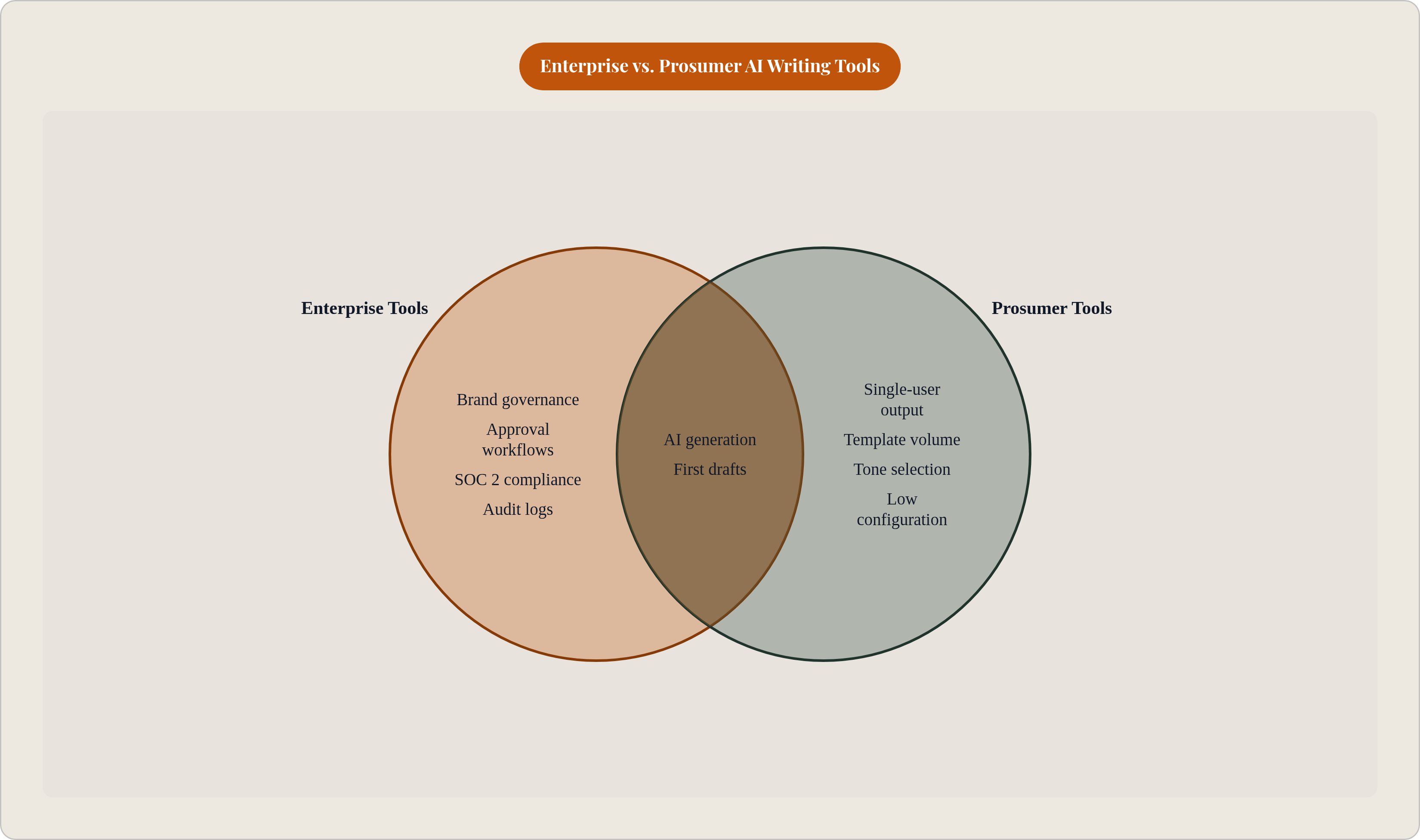
Four things separate enterprise tools from prosumer ones.
Brand governance. The tool must encode brand voice, terminology, and messaging hierarchy into the system itself, not rely on individual contributors remembering to prompt correctly. There is a real difference between tools that check brand consistency after content is generated and tools that enforce it during generation. The former is an editorial step. The latter is infrastructure.
Workflow integration. Enterprise marketing teams run content through multi-stakeholder review: writers, editors, channel specialists, legal, compliance, senior approvers. A tool that generates content but doesn't support that review chain doesn't eliminate workload; it relocates it somewhere harder to track.
Security and compliance. Data residency, access controls, IP ownership clarity, and certifications like SOC 2 Type II are not differentiators for regulated industries. They are threshold requirements. A tool either clears them or it isn't evaluated further.
Strategic content support. The most underserved capability in most tool comparisons is the ability to support content briefs, campaign architecture, and performance feedback, not just generate faster first drafts.
Raw generation speed, template volume, and the number of available "tones" matter for individual contributors. They are largely irrelevant for coordinated enterprise teams.
Brand Consistency at Scale: The Capability Most Teams Underweight in Their Initial Evaluation
Brand drift is the most common and least-measured cost of scaling AI writing without governance. Outputs that are technically correct but tonally inconsistent, that use deprecated product names, or that violate messaging hierarchies set by brand strategy don't announce themselves as failures. They look like normal content. The damage accumulates before anyone notices it, and by the time it shows up in a brand audit, the correction is expensive.
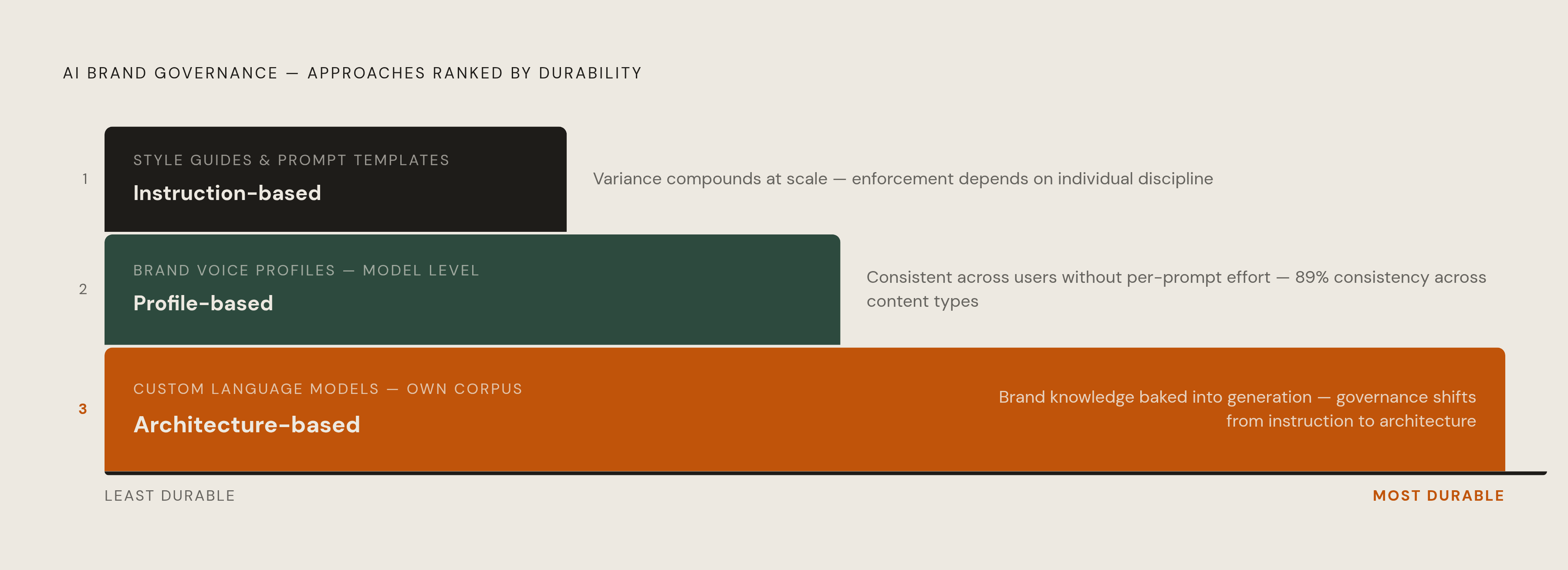
Tools take three distinct approaches to brand consistency.
The lightest approach is style guide uploads and prompt templates. This puts the burden of brand enforcement on individual discipline. A writer who forgets to engage with the style guide, or who uses a slightly different prompt than the standard, produces different output. At scale, that variance compounds into something genuinely corrosive.
The more reliable approach is brand voice profiles applied at the model level, so consistency is maintained across users without requiring per-prompt effort. Jasper's brand voice feature claims 89% consistency across content types; verify that independently before using it as a procurement benchmark.
The most durable approach is custom language models trained on the brand's own content corpus. Some enterprise platforms operate this way, training custom models on the brand's own content, terminology, and style. Brand knowledge becomes architectural rather than instructional. It's baked into how the model generates, not layered on top of a generic foundation.
None of these approaches fully resolves nuanced judgment in novel situations. When a brand faces a sensitive topic, a crisis response, or a category it has never addressed before, no trained model substitutes for an experienced brand strategist. Consistency tools also have no authority over human edits made outside the tool after generation. That remains a governance gap worth naming plainly.
The practical evaluation method here is straightforward: avoid reviewing only feature lists. Run the same content brief through the tool with five different users and compare the outputs. That test tells you more than any demo.
Workflow Integration and Approval Chains: Where Most AI Writing Implementations Quietly Fail
Industry data indicates marketers recover an average of roughly six hours weekly through AI writing tools. Real and meaningful. But that gain is partly offset when the tool sits outside the team's existing content pipeline, because time saved in generation gets spent in coordination overhead: copying content between systems, tracking approvals via email, reconciling versions across platforms. The net recovery is smaller than it looks, and harder to see.
What workflow integration actually requires in an enterprise context is specific. API access and native connectors to CMS, DAM, and marketing automation platforms. Role-based permissions that map to actual organizational roles, because a junior writer, a compliance reviewer, and a senior brand approver need different levels of access to different things. Approval workflows built into the tool, not handled as an external process. Audit logs covering who generated what, when, and what changed before publication. That last requirement becomes increasingly non-negotiable in regulated industries and for legal review.
There is also the multi-tool reality. Most enterprise content teams currently run two or three tools in combination: a general-purpose generation layer, a specialized tool for their primary channel, and an editing or quality layer. Integration between those tools matters as much as integration with external systems. Jasper's MCP server approach addresses this directly; it allows brand context to travel into other AI tools the team uses, so the governance layer isn't abandoned when a writer switches applications.
Where tools most commonly fail in enterprise workflows: no versioning or change history on AI-generated drafts; content generated in the tool doesn't carry metadata into the CMS; approval notifications don't surface in the platforms reviewers already live in. These are the friction points that cause teams to abandon the tool or route around it entirely, creating exactly the shadow usage problem the enterprise adoption was supposed to prevent.
Demo the approval and publishing path end-to-end with a realistic enterprise content type before making a selection. Assessing only the generation interface is insufficient.
Security, Compliance, and Data Governance Requirements Enterprise Teams Can't Negotiate Away
For large organizations, particularly those in financial services, healthcare, legal, and pharma, compliance requirements function as eliminatory criteria. A tool either clears the bar or it is not evaluated further. This isn't bureaucratic posture; it reflects genuine exposure, the kind that shows up in legal liability and regulatory review, not just internal policy.
The core requirements that enterprise procurement teams apply consistently: SOC 2 Type II certification; data residency controls specifying where content and prompts are stored and whether customer inputs are used in vendor model training; role-based access controls and SSO/SAML integration; IP ownership clarity establishing who owns AI-generated content.
Some enterprise platforms position compliance and security as a primary value proposition, with SOC 2 Type II, enterprise knowledge retrieval with access controls, and cross-department deployment governance built in. Real-world enterprise deployments illustrate what cross-department governance looks like in practice: consistent tooling across marketing, communications, legal, and HR, with centralized administrative control.
The hidden governance risk is shadow AI. Per the Content Marketing Institute's 2026 data, 95% of B2B marketers report their organizations use AI-powered applications, but enterprise security teams have vetted only a fraction of those tools. Tools adopted bottom-up by individual contributors often bypass procurement security review entirely. The exposure is real: brand IP, client data, and unreleased campaign information can enter vendor training pipelines through unsanctioned tool use.
Shadow AI use is a compliance exposure, not an IT inconvenience. The security questionnaire should be a gate in the evaluation process, not a final step.
Strategic Content Support Versus Faster Blank-Page Generation: A Meaningful Distinction for Enterprise Teams
Most AI writing tool marketing emphasizes generation speed: more content, faster, at lower cost. That framing is accurate for what the tools deliver at the execution layer. It is also incomplete for enterprise marketing teams, because the constraint for most enterprise content operations is rarely "not enough content." It is more commonly: content that lacks strategic coherence, measurable effectiveness, and differentiation from what competitors are producing with the same tools.
What enterprise teams more commonly need is campaign architecture, an understanding of how assets relate to each other and what the narrative arc is across touchpoints. Content briefs grounded in audience and competitive context, not just keyword inputs. Performance feedback loops that inform how the tool scaffolds new work. And governance of the content mix, ensuring that AI-generated volume doesn't dilute the high-investment editorial work that earns brand authority over time.
The use-case data is telling. The top AI writing applications among marketers are topic brainstorming, content summarization, and first-draft writing. All execution-layer tasks. Strategic planning and campaign architecture remain predominantly human. The tools getting the most adoption are solving a real but relatively narrow problem; the larger strategic challenge remains largely unaddressed by the technology.
The ROI measurement problem reflects this gap. Only roughly a third of organizations report being able to measure AI content ROI with confidence, even as the large majority report operational productivity gains. Speed is measurable. Strategic impact is not. Tools that close this gap do so through strategy-first brief templates that force objective and audience clarity before generation starts, campaign-level organization that treats assets as a system rather than individual documents, and editorial quality layers built into the workflow rather than offered as optional features.
This is where the market is actively differentiating: tools built for content strategy versus tools built for content volume.
How the Leading Enterprise AI Writing Platforms Compare on the Criteria That Matter
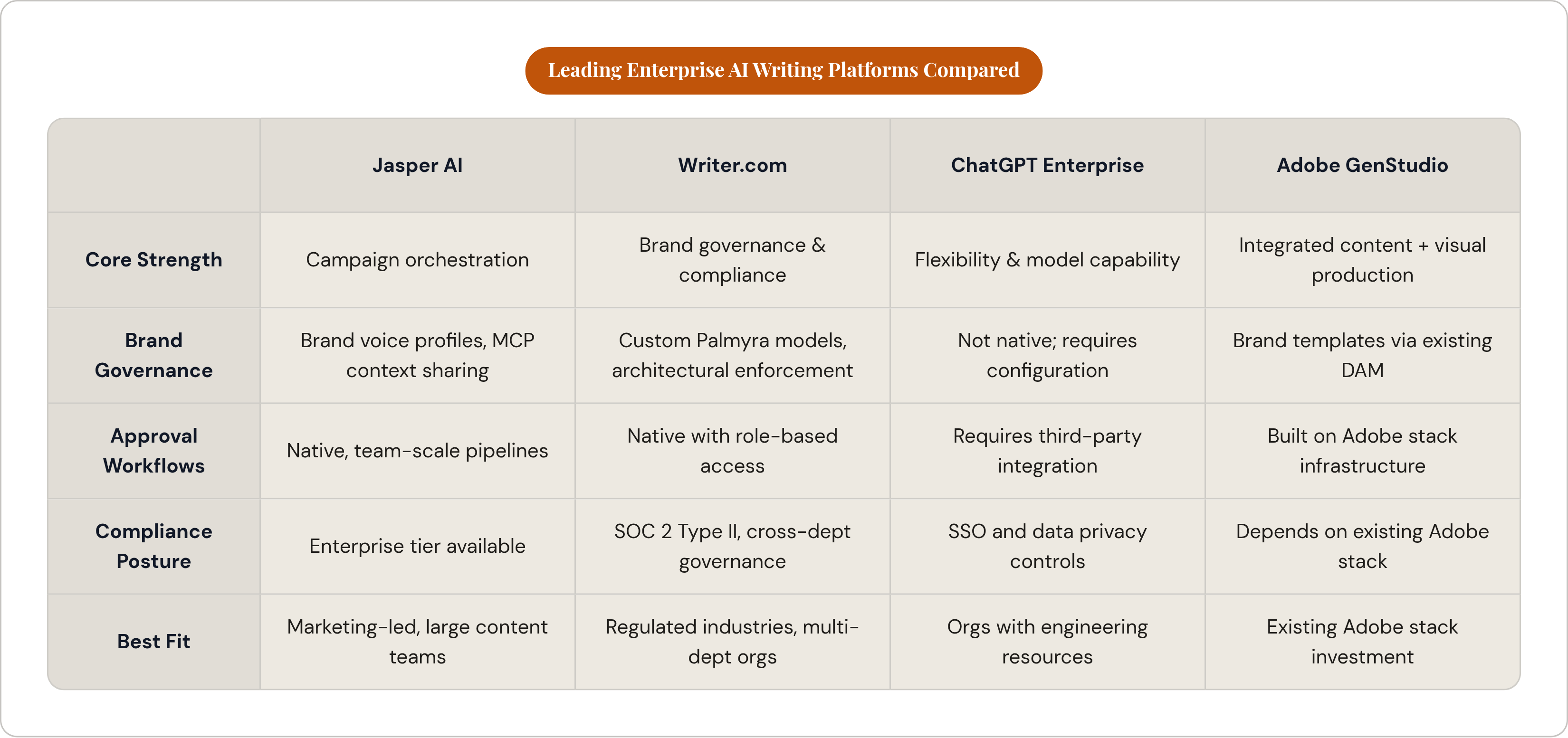
The tradeoffs across platforms are real and worth surfacing directly, because they are meaningful enough to affect which tool belongs in which organization.
Jasper AI
Jasper is built for enterprise marketing teams, with campaign orchestration, marketing-specific agents, and team-scale content pipelines as core architecture. The MCP server approach allows brand context to travel into other tools the team uses, which addresses the multi-tool coordination problem directly. Image Pipelines extend brand consistency into visual production at enterprise scale. Pricing runs at a published per-seat monthly rate billed annually for the Pro tier, with Business pricing at custom rates. Best fit: marketing-led organizations that need campaign orchestration and brand governance across a large content team.
Writer.com
Writer.com is built around governance and operational control. Custom Palmyra models trained on brand content, terminology, and style make brand knowledge architectural rather than instructional. Compliance and security are primary value propositions: SOC 2 Type II, enterprise knowledge retrieval with access controls, and cross-department deployment governance. Approval workflows and role-based access controls are native, not configured through third-party integration. The Qualcomm deployment illustrates what cross-department scale looks like in practice. Pricing is custom, typically structured per user. Best fit: large organizations, particularly in regulated industries, that need strict brand governance and compliance across multiple departments.
ChatGPT / OpenAI Enterprise
ChatGPT is the most widely adopted AI writing platform globally. The Enterprise tier adds data privacy controls, SSO, and admin management. Its strengths are flexibility, model capability, and broad API integrations. Brand governance, approval workflows, and campaign architecture are not native features; they require significant configuration or third-party integration. Best fit: organizations with engineering resources that want a foundation layer to build custom workflows on top of.
Adobe Experience Cloud (Firefly and GenStudio)
Adobe's integrated platform approach combines AI writing and visual generation within the same ecosystem as campaign management and analytics. For organizations already in the Adobe stack, the brand template, asset library, and approval workflow integrations are genuine advantages, because they build on existing DAM infrastructure rather than replicating it. Teams without existing Adobe infrastructure face meaningful added complexity and cost. Best fit: marketing organizations with existing Adobe stack investment and a need for tightly integrated content and visual production.
Typeface and Purpose-Built Enterprise Content Platforms
An emerging category of enterprise-only tools built from the ground up for brand-safe AI generation treats brand kit ingestion, audience segmentation, and channel-specific output as core architecture rather than configurable add-ons. These platforms reflect where the market is moving for large-scale content operations that have outgrown general-purpose tools.
Letterstory
Letterstory treats brand governance and approval workflows as structural features of the tool itself rather than add-ons layered on top of generic generation, so enforcement happens at the point of creation rather than as a downstream compliance check. For teams that have experienced the cost of enforcing brand standards after content has already moved through a pipeline, that architectural decision has practical consequences.
The pattern across this field is consistent. Tools built from the beginning for enterprise marketing, with brand governance and workflow integration as architectural decisions rather than feature additions, perform more reliably on the criteria that matter at scale. Tools adapted from general-purpose foundations offer more flexibility but require more configuration to reach equivalent governance outcomes.
What the Productivity Numbers Don't Capture About AI Writing at Enterprise Scale
The productivity case is real. The data on recovered hours is consistent with what practitioners report. But the gains are unevenly distributed in a way that doesn't surface in aggregate figures. Senior practitioners recover more time than junior staff, likely because junior writers spend a meaningful portion of their time correcting and editing AI outputs rather than simply generating them. That is a different category of labor than AI writing tools are typically marketed around, and worth accounting for honestly.
The ROI measurement problem compounds this. The majority of organizations report operational productivity gains from AI writing, but only roughly a third can measure AI content ROI with any confidence. Speed is measurable. Business impact, the kind that shows up in brand equity, pipeline contribution, or customer retention, is not. Teams that optimize for output metrics, publishing cadence, content volume, generation speed, are counting the thing that is easy rather than the thing that matters.
Three risks that productivity metrics don't surface deserve direct attention.
Content homogenization is the most consequential long-term risk. When competing brands use the same tools with similar prompts, outputs converge in voice, structure, and framing. Differentiation erodes at exactly the moment volume increases. The brands that built authority through distinctive editorial voice find that voice harder to maintain when the underlying generation infrastructure is shared across an industry.
Quality dilution follows from that. High-volume AI content can crowd out or devalue the high-investment editorial work that builds brand authority, earns trust, and supports organic distribution. The math on content volume is seductive. The math on content authority is slower and harder to see until it has already shifted.
Measurement displacement is the third. Teams that reorganize around output metrics optimize for the measurable at the expense of the meaningful. The editorial judgment required to decide what to leave unpublished, what deserves significant human investment, and what strategic topics to own over time is difficult to operationalize in an AI-augmented workflow. That difficulty doesn't make the judgment less valuable. It makes it easier to skip, which is precisely when it matters most.
The enterprise marketing teams navigating this most successfully have adopted AI writing tools with a clear architecture for what the tools govern and what remains under deliberate human control. Maintaining that distinction is harder than it looks, and the tools reviewed in this piece make it more or less possible depending on where your operation has the most at stake.