Prompt Engineering Techniques for Marketing Copywriters
Teach copywriters how to instruct AI models, not just use them.

Most marketers using generative AI are solving the wrong problem. They spend time finding the right tool, learning the interface, figuring out which button does what. Then they type "write a product description for our project management software" and get back a paragraph that is grammatically correct, structurally sound, and completely unusable. The real problem was never access. It was knowing how to instruct.
Prompt engineering is not a developer skill bolted onto a copywriter's workflow. It is a strategic communication skill that copywriters already practice every time they translate a brief into copy. The shift is simply this: instead of writing the copy, you write the instructions that produce it.
Before a prompt touches a language model, it needs three things. Clarity: define what "good" looks like, because a model cannot infer your standard unless you state it explicitly, and without that definition it defaults to adequate. Context: the full briefing document, business model, audience segment, channel, competitive position, brand constraints, everything a well-written creative brief would contain. And specificity, which is where most prompts fall apart even after the first two are addressed. Scope, format, length, tone register, what to avoid. The model fills every unspecified dimension with the most generic pattern it knows.
The practical test is blunt. If a sharp but junior copywriter read only your prompt and nothing else, would they know exactly what to produce? If the answer is no, the model will fill the gaps with the average of marketing copy that already exists, and the average fails to convert.
A complete prompt for marketing work contains four elements: an audience definition (who is reading, what they already believe, what objection they are walking in with); a conversion intent (the single action the copy is meant to drive); format and output constraints (word count, structure, CTA placement, what this piece is explicitly not); and brand voice indicators (vocabulary, register, what the brand sounds like and what it does not). Every technique that follows is a different mechanism for delivering these four elements. The framework stays constant. The technique determines how you get it there.
Zero-Shot Prompting: What It Handles Well and Where It Runs Out of Road
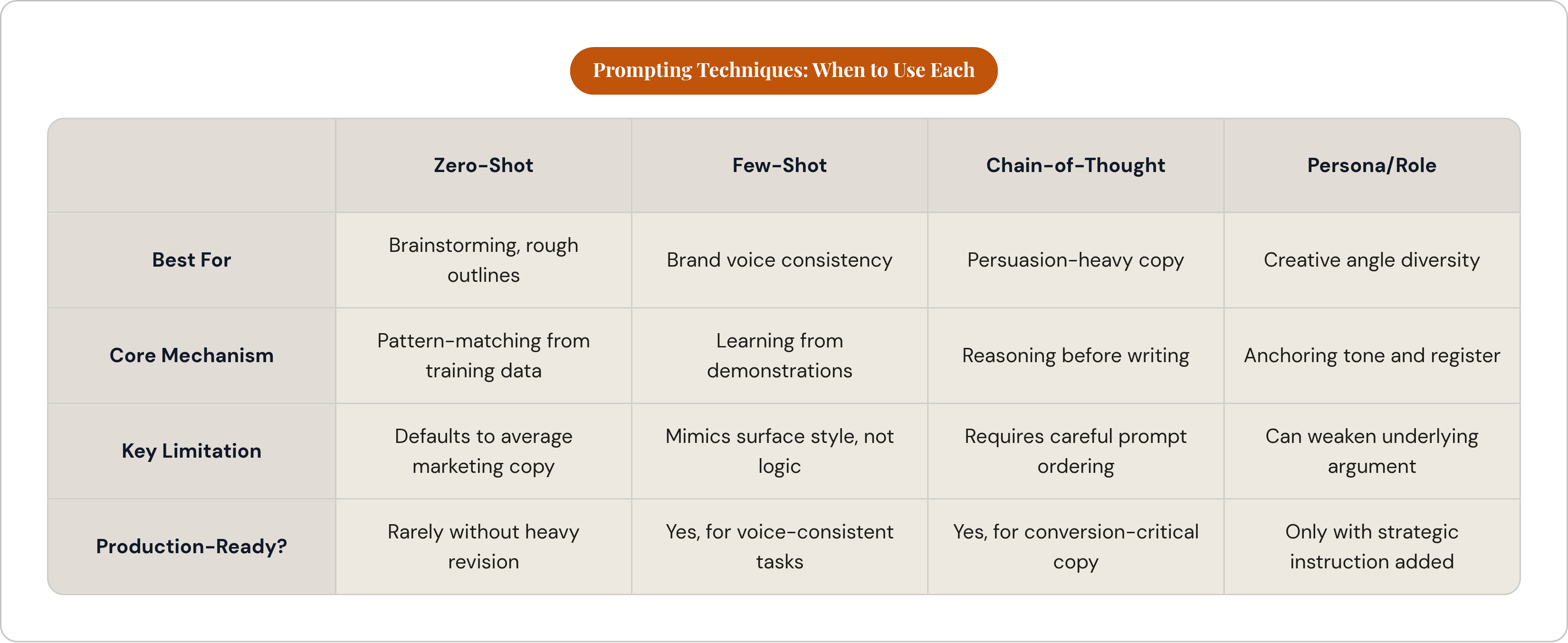
Zero-shot prompting is the default mode: a single instruction, no examples, no reasoning scaffolding. You tell the model what to produce and it produces it from pattern-matching against its training data. For certain tasks in a copywriter's workflow, that is exactly the right tool, and for others it is a reliable way to generate output that wastes everyone's time.
Early-stage brainstorming benefits from zero-shot's lack of constraints. When you need a wide spread of angles, hooks, or headline directions before you have committed to a direction, the model's tendency to draw from varied patterns works in your favor. Same with low-stakes, familiar formats: social captions, rough outline structures, a first-pass blog introduction. Tasks where range matters more than precision, and where the output will be substantially rewritten anyway.
The ceiling becomes apparent the moment the task requires brand specificity or real conversion logic. Vague prompts on judgment-heavy tasks produce something that sounds like average marketing copy because it is. The model predicts the most statistically common pattern for that task type. If your brand sounds nothing like average marketing copy, zero-shot will still give you average marketing copy, and that is a flaw in the instruction, not in the tool.
There is no mechanism in a zero-shot prompt to enforce voice, audience-specific language, or persuasion logic. The model has no awareness of your customer's primary objection. It has no awareness that your brand never uses the phrase "unlock your potential." It does not know that the CTA needs to appear before the third paragraph because your audience skims.
Use zero-shot as a first draft to react against, not as a production method for copy that needs to perform. The moment precision matters, give the model more to work with.
Few-Shot Prompting as the Primary Tool for Brand Voice Consistency
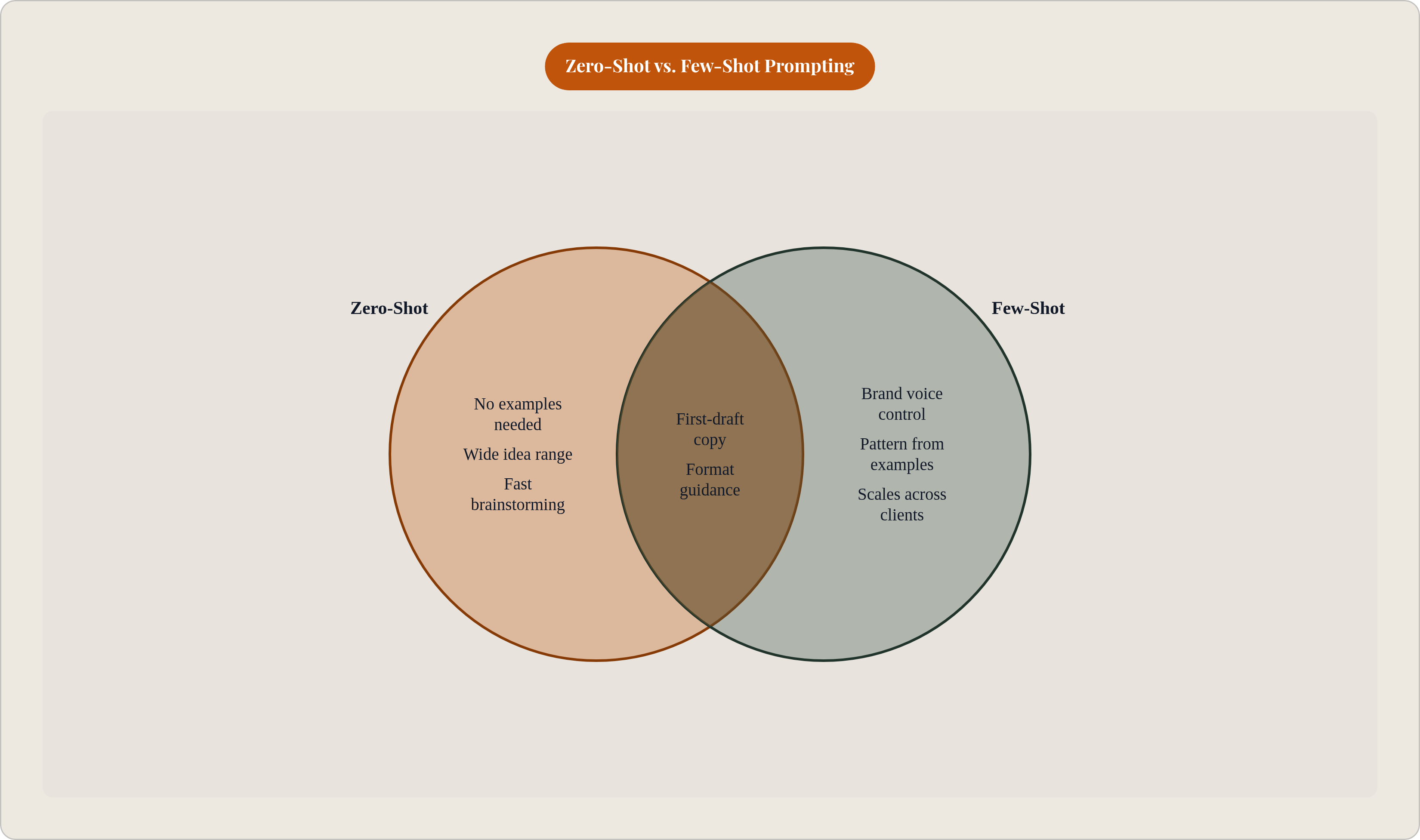
Few-shot prompting means providing a small set of examples alongside the instruction, so the model learns the target pattern from demonstration rather than from description. For brand voice work specifically, it is the most consistently reliable technique available. If you have ever sat through a brand audit, you will understand immediately why.
"Write in a confident, conversational tone" is an instruction that three competent writers will interpret in three different ways. Show those same three writers five examples of copy that lives in that brand's voice and the target becomes legible. The model works exactly the same way. Examples outperform adjectives because adjectives are abstract and examples are not.
A practical few-shot set for a brand voice task needs enough examples to establish a clear pattern without exceeding the context window or introducing contradictory signals through careless example selection. Three to five examples works for most marketing applications, though the optimal number shifts by task and model. Fewer than three produces inconsistent tone. Beyond a certain point, additional examples yield diminishing returns and occasionally create confusion when the examples were not carefully curated.
The strategic value for agencies and in-house teams running copy across multiple brands is significant here. A well-structured few-shot prompt is essentially a template with a swappable example set. Build one prompt structure, populate it with the right examples for each client brand, and the same logic scales across your entire portfolio without rebuilding the reasoning from scratch every time.
The examples you choose matter as much as the technique itself, maybe more. Pull the pieces where the brand's voice is most distinctly itself, the work that could not be mistaken for a competitor. Those are the examples that carry the pattern the model needs to replicate. Pulling middle-of-the-road copy trains middle-of-the-road output.
One real limitation: few-shot is a pattern-matching tool. It works for tone, format, and stylistic register. For reasoning-heavy tasks, building a competitive positioning argument or sequencing a multi-step persuasion structure, examples can actually constrain rather than guide. The model will mimic the surface structure of your examples without engaging with the underlying logic. When the task requires reasoning before writing, a different technique earns its place.
Chain-of-Thought Prompting for Copy That Requires Persuasion Logic
Chain-of-thought prompting instructs the model to reason through intermediate steps before producing the final output. Instead of jumping directly from prompt to headline, the model articulates the audience's state of mind, identifies the core objection, surfaces the emotional trigger, and evaluates the competitive angle first. Then it writes.
The practical difference is not subtle. A zero-shot headline for a B2B software product gets generated from pattern-matching against similar headlines. A chain-of-thought headline gets generated from a reasoned argument about what a specific audience segment fears, wants, and already believes about this category. That specificity shows in the copy and in the conversion data.
This technique earns its place most clearly in copy types where persuasion architecture determines performance. Ad headlines require a precise understanding of the emotional trigger that makes a specific audience stop scrolling. Email subject lines depend on hitting the right note for the right funnel stage; the wrong emotional register can reduce open rates regardless of how good the body copy is. Landing page hero copy needs its argument sequenced correctly, and sequence is something a model cannot infer without reasoning through it first.
The mechanics are straightforward: reasoning instruction first, writing instruction second. "Before drafting the headline, identify the audience's primary objection, the emotional trigger most likely to overcome it, and the competitive claim that differentiates this offer. Then write the headline." That ordering is not incidental. Reversing it produces a headline and then a post-hoc rationalization of why it works, which is the opposite of what you want.
There is also a quality control benefit that gets underappreciated. The model's reasoning output is readable before the final copy appears. If that reasoning reveals a misunderstanding of the audience or the offer, you catch it before the copy gets written, not during a revision cycle. In any process where late-stage revisions are expensive, that is a structural advantage.
Persona and Role Prompting: Where It Helps and Where It Misleads
Assigning the model a role, "You are a direct-response copywriter with fifteen years of B2B SaaS experience," is among the most widely used prompt techniques in marketing contexts. The premise is that a well-defined persona anchors vocabulary, register, and judgment. I have watched teams lean on this technique as a substitute for strategic instruction, and the results are predictably underwhelming, because the premise is only partially true.
Research on persona prompting, including work by Cheng et al. (2023) examining role-play prompting effects on large language models, suggests it can improve output on open-ended creative tasks where surface-level qualities carry a lot of the work: tone, narrative, stylistic distinctiveness. For accuracy-based and reasoning-heavy tasks, results are more mixed. The risk is not that the persona does nothing. The risk is that it biases the model toward a surface style while quietly degrading the quality of the underlying argument. The copy sounds more authoritative. The logic underneath it gets weaker. That combination can be difficult to catch in review, which makes it a more insidious failure mode than output that is obviously bad.
The more productive move is to specify the audience rather than only the role. "You are a marketing consultant writing for a non-technical operations manager who has never evaluated SaaS before" gives the model something it can execute against. Audience definition shapes vocabulary, assumed knowledge level, and what registers as a persuasive point. Role definition shapes tone. Tone matters, but it is secondary to argument, and conflating the two is how teams end up with copy that feels compelling and fails to convert.
That said, persona prompting earns its place in specific applications. Creative brainstorming benefits from assigning a perspective the model would otherwise be unlikely to adopt, surfacing angles a standard prompt structure would never reach. Multi-channel differentiation is another legitimate use: separate personas for email, social, and long-form can keep tone calibrated to each format without rebuilding underlying logic from scratch. For teams with multiple contributors, a shared "brand copywriter" persona embedded in a prompt library creates consistency across writers who otherwise produce notably different output from the same brief.
One framework worth knowing for building personas with enough precision to be useful is W-I-S-E-R: Who (role and personality traits), Instructions, Show (examples), Expectations, Refinement. Each component tightens what would otherwise be a vague role assignment and turns a persona into something the model can actually execute against. The central caution remains: assigning a persona is not a substitute for strategic instruction. The persona shapes how the copy sounds. What the copy argues still requires explicit direction.
Structured Prompt Frameworks That Encode Strategy Into Repeatable Templates
The difference between an experienced prompt engineer and a competent one usually comes down to whether they are constructing prompts from scratch each time or working from documented templates that encode strategic decisions once and reuse them indefinitely. The template approach wins, not primarily because it saves time, though it does, but because it makes expertise transferable and makes failure diagnosable. When copy underperforms, a template tells you exactly where the instruction was weak. An ad-hoc prompt tells you nothing except that something was off, somewhere.
The TRIM method is a practical starting structure for marketing prompts. Task defines what is being produced and why. Relevant context supplies audience, brand, offer, and competitive position. Intent specifies the conversion action this copy is meant to drive. Measurable criteria articulate what good output looks like: tone, format, length, what the copy must and must not do. A prompt that covers all four dimensions consistently produces output at a higher starting quality than a prompt that leaves gaps.
For iterative copy development, the Pyramid method offers a different structural logic: start with a broad creative direction, add audience segment, then funnel stage, then specific format and CTA. Each layer narrows the output incrementally toward usable copy, rather than attempting to specify everything simultaneously in a prompt that becomes unwieldy before it gets useful.
There is something structured templates do that ad-hoc prompts fundamentally cannot: they encode conversion principles so those principles are not abandoned under deadline pressure. A writer working at speed makes different choices than a writer working carefully. A template makes the careful choices the default, which means quality does not degrade when the calendar gets compressed.
For high-volume formats like email sequences, the compounding value of a well-designed template is significant. A sequence template that encodes the narrative arc, the escalation of CTAs, and the progressive information structure across a multi-email campaign replaces a substantial amount of manual drafting time without sacrificing strategic coherence. The teams that get the most out of this treat the prompt library as a shared strategic asset, maintained and refined across creative, analytics, and media functions, rather than a loose collection of personal shortcuts that disappear when someone leaves.
Prompt Chaining for Complex Copy Projects That Cannot Be Solved in a Single Pass
A single prompt cannot simultaneously develop a strategic argument, enforce brand voice, optimize for a specific CTA, and adapt output for multiple audience segments without degrading across at least one of those dimensions. Prompt chaining solves this by breaking complex work into a sequence where each output becomes the input for the next, and each individual prompt does one thing well.
A practical chain for a B2B landing page: the first prompt asks the model to identify the audience's most significant objections to the offer. The second takes those objections as input and builds a persuasion sequence that addresses them in order of importance. The third writes the hero headline and subhead that lead into that sequence, constrained to the brand voice. The fourth writes the body copy sections corresponding to each objection-response pair. The fifth produces CTA variants matched to the conversion intent and the tone established in the preceding output. Each prompt inherits the work of the one before it, and the chain is where quality control actually happens. A flawed objection identification in prompt one produces a flawed persuasion sequence in prompt two, and you catch it before the copy gets written rather than during a revision that everyone is already tired of.
The discipline that separates teams that improve from teams that plateau is treating the chain itself as the artifact, not just the prompts within it. Review chains against copy performance. Update them based on what fails. A team that refines its chains regularly against real outcomes will consistently outperform a team running on a static prompt that has gone unrevised for eighteen months, even if both teams are using the same model.
Chaining is also the correct structure for multi-persona campaigns. A B2B sale involving a technical evaluator, a budget owner, and an end user requires separate branches of the chain that share strategic context but diverge at the audience-specific copy level. The shared context ensures message coherence. The divergent branches ensure each piece of copy speaks to the specific concerns of the person reading it, rather than producing a single piece of copy that attempts to address everyone and persuades no one.
The Risks That Structured Prompting Does Not Automatically Solve
None of the techniques above eliminate the three most persistent risks in AI-assisted copy production. Good prompt engineering reduces them. It does not remove them.
Hallucination
Language models predict plausible text, and plausible is not the same as accurate. Any copy containing statistics, product claims, regulatory language, or attributed research must be verified against primary sources before it publishes. This is not a theoretical concern. In 2023, lawyers submitted AI-generated citations to a U.S. federal court in Mata v. Avianca (S.D.N.Y. 2023); the citations were fabricated, and they cleared initial review. That is a legal filing, not a marketing blog, but the mechanism is identical, and the professional consequences of publishing a fabricated statistic or a misattributed study are real. Every number, every attribution, every named research finding gets checked against a verifiable source. No exceptions, including under deadline pressure.
Brand Voice Erosion at Scale
Language models produce output that reflects the center of their training distribution. That center, for marketing copy, is the aggregate of every acceptable, middling, inoffensive piece of marketing content the model has encountered. It is not your brand. Over time, teams relying heavily on AI-generated copy without regular stress-testing against their most distinctive source material will experience a gradual drift toward homogeneity. Individual outputs pass review. The body of work starts to sound like everyone else's, and by the time the pattern is visible it has usually been accumulating for months.
The mitigation is structural: translate abstract brand personality traits into concrete linguistic rules the model can execute, active voice, specific vocabulary, defined register, particular constructions to avoid.
Content Saturation
A large and growing share of web content now contains detectable AI text. Audiences, particularly in B2B categories where buyers are sophisticated and skeptical, are increasingly fluent at recognizing copy that sounds pattern-matched rather than considered. The reputational cost of publishing copy that reads as generic AI output is a real concern among content strategists, and the commercial impact varies by brand and audience but trends in one direction.
The mitigation is not avoiding AI; it is using AI in ways that produce specificity. Audience-specific language, brand-specific claims, examples drawn from real customer experience, genuine competitive differentiation: these are all things prompts can be designed to generate. Generic copy is the failure mode of generic prompting. The techniques covered in this piece exist precisely to prevent it.