Content Brief Templates That Produce Consistent Writer Output
A template that clarifies purpose, audience, and structure ensures consistent output across writers.

Inconsistent writer output usually comes down to brief design. The fix is a template that tells writers exactly what to produce instead of trusting them to guess it.
Most content teams diagnose their consistency issues the same way: someone on the team just isn't that good, or maybe the freelancer doesn't get the brand, or the new hire needs more ramp time. That's the easy answer, and it's usually wrong. Writers do what their instructions tell them to do. Give someone a brief that says "write about our new feature, keep it on-brand," and you'll get back exactly what you asked for: something. Vague inputs produce variable outputs, every time, and no amount of writer talent fixes a broken instruction set.
A study from Demand Metric and MarcomCentral found that close to a quarter of organizations admit they're inconsistent in how they express their branding and key messages. For four out of ten organizations, content is fragmented across the different touchpoints a buyer moves through on their way to a purchase. Across four in ten companies, that points to a systems gap, and it shows up as revision cycles that eat time on both sides of the desk, voice drift that makes a blog post from March sound like it came from a different company than the one from June, and content that can't scale because quality depends on which specific person happened to write it that day.
The brief is the fix, but only if you build it right. Get the template correct and the output holds steady no matter who's typing. Get it wrong and you're back to hoping. This piece walks through what actually belongs in a content brief, where teams get the balance wrong, and how tools and AI fit into building one without letting either replace the judgment a good brief still requires.
What a content brief actually is and what it is not
A content brief is a document that spells out purpose, audience, tone, angle, structure, target keywords, and length for one specific piece of content. That's the working definition, and it's worth being precise about the distinction between this document and its neighbors, because the confusion between these documents is where a lot of teams start going sideways.
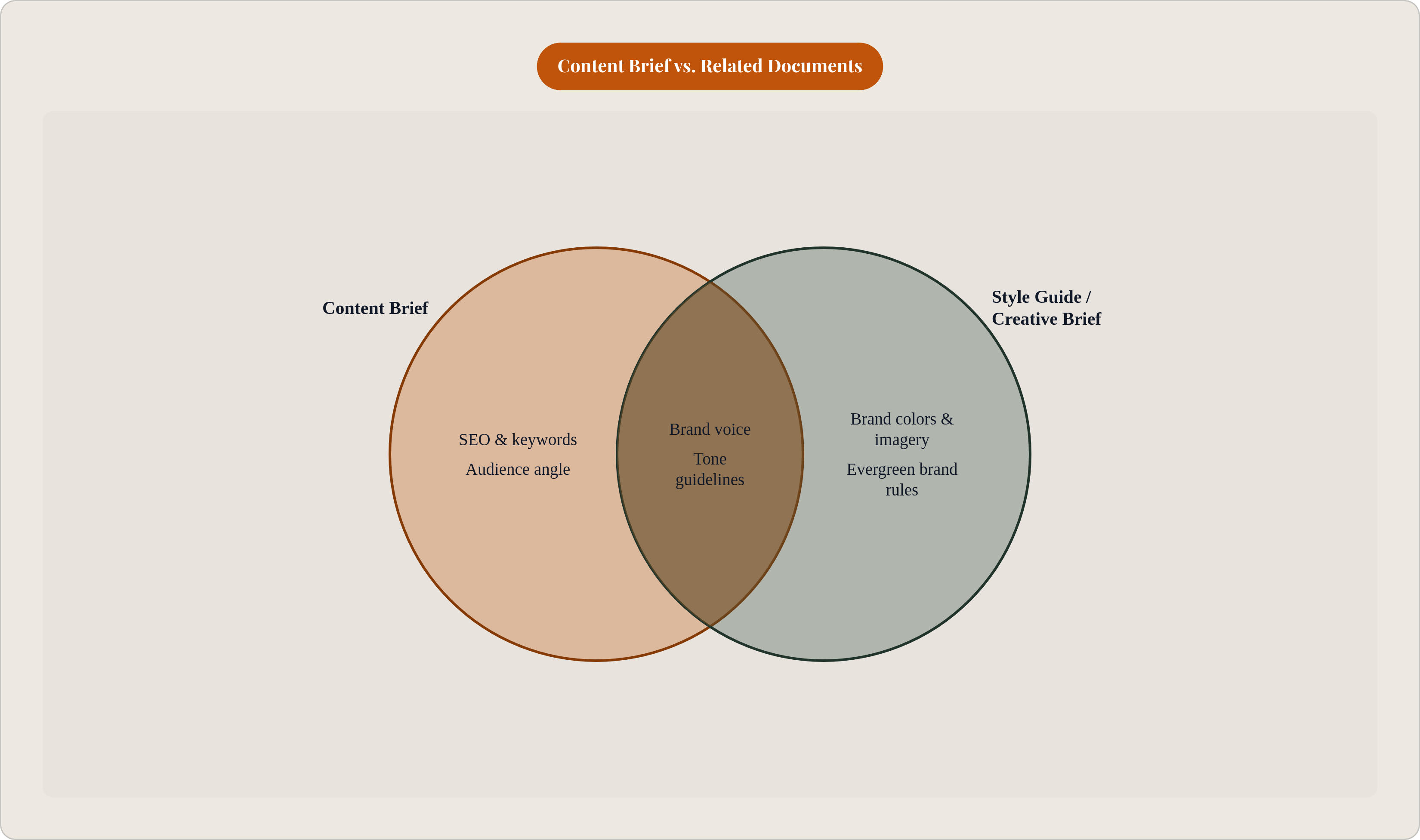
A creative brief guides visual design and brand expression: colors, imagery, campaign concept. A content brief governs messaging, information architecture, and SEO. Different jobs, different fields, and trying to cram both into one document usually means neither gets done well.
A style guide is evergreen, brand-level, the kind of thing you write once and revisit maybe twice a year. A brief is piece-specific and campaign-level; it expires the moment the piece ships. An outline organizes a draft that's already underway, headers and subpoints for content that exists in some form. A brief sets the conditions before a single word gets written. The job of the brief is to make sure the writer fully understands the assignment so the final piece meets the bar without needing a translator in between.
Scope-wise, keep it reasonable. A standard blog post brief runs one to three pages. Whitepapers, campaign briefs, anything with more moving parts, naturally needs more detail; monday.com's guidance on this tracks with what most editorial teams land on through trial and error anyway.
What well-designed briefs demonstrably change for content teams
Backlinko has said its brief discipline plays a real role in pulling over 635,000 organic visitors to the site every month. That number matters less as a flex and more as a signal: brief quality compounds. A hundred consistently good briefs make a content library that performs as a system, and that's a different kind of win than any single post going viral.
The operational gains are worth naming individually, because they're easy to feel and hard to measure. Fewer revision rounds, for one: when a brief answers the questions a writer would otherwise have to ask, those questions never get asked, and the back-and-forth email chain doesn't exist. Faster onboarding is another. A new or contract writer, handed a brief that actually specifies voice and sourcing and structure, can produce on-brand work on their first assignment instead of their fifth. And scalability holds up whether the work happens in-house, across offices on different continents, or through outside partners; Siteimprove's research on content operations points at the same pattern.
Here's the reframe worth sitting with: the brief functions as the production system for the whole team, with the writer executing it.
There's a catch, and it's worth naming honestly. Building good briefs takes upfront time. Someone has to fill in strategic fields, pull competing URLs, define the audience beyond a demographic label. That's real cost, paid before the piece exists. The case for paying it rests entirely on downstream savings in revision time and consistency, and most teams never actually track that math. They feel the benefit but couldn't tell you the number if you asked. Worth asking yourself: does your team know how many revision rounds a typical brief saves? If not, that's a gap worth closing before you argue for more brief infrastructure internally.
The strategic anchor fields every brief needs before the SEO layer
Why does strategy have to come first? Because SEO fields and structural guidance are useless if the writer doesn't know what the piece is actually for. You can hand someone a perfect keyword and a flawless H2 outline, and they'll still produce something off-target if they don't know whether this piece is meant to build awareness or close a sale.
Start with the project overview and purpose. What does this piece need to achieve: brand awareness, lead generation, ranking for a specific term that's been bleeding traffic to a competitor? Where does it sit in the funnel, top, middle, or bottom? Does it connect to a broader campaign or series, or is it a standalone?
Then the audience. Real specificity matters more than a demographic label like "marketing managers, 30-45": who is this reader, what keeps them up at night, what have they already searched for before landing here, how much do they already know about the topic. Enough detail that a writer can calibrate tone and depth without guessing. If there's existing persona research or audience data sitting in a shared drive somewhere, this is where it gets surfaced, not left for the writer to dig up on their own time.
Last, the messaging and angle. What does this piece say that the ten other articles ranking for the same term don't say? What approved claims or proof points need to show up? And, just as important, what should this piece explicitly not say or concede? That last one gets skipped constantly, and it's often the field that saves the most editing time later.
Get these three right and you've closed off most of the interpretation drift before the writer even opens a blank document.
The SEO and structure fields that turn strategy into a rankable piece
Once the strategic layer is set, the SEO fields turn that strategy into something that actually shows up in search.
Primary keyword comes first: one term, the single thing this piece has to rank for. Everything else in the brief supports that term rather than competing with it. Secondary keywords come next, related terms that round out topical coverage, not strong enough on their own to justify a separate page but worth folding into this one; Backlinko's guidance on this distinction is a good gut check when a brief writer starts listing fifteen "important" keywords instead of five real ones.
Competing URLs matter too, and the point is to find what the top-ranking pages are missing rather than to copy them. Stellar Content's approach here is useful: read the top five results for your primary keyword and ask what gap is sitting there unaddressed. That gap is often the entire reason your piece needs to exist.
Beyond that, a few fields that don't get enough attention: meta description guidance, internal linking targets so the piece doesn't become an orphan page, structured data requirements if the format calls for it.
Word count deserves its own mention because it does double duty. It tells the writer how deep to go on any given subtopic, keeping scope from ballooning mid-draft into a 4,000-word piece nobody asked for. It's also just practical for anyone paying per word or per piece; a contract without a word count is a contract waiting for a dispute.
Structural guidance closes the loop. At minimum, every brief should include the top-level H2s and H3s, the skeleton of the piece. Some teams go further and hand writers a full outline with talking points under every header; others give just the required points and a short list of things to avoid, trusting the writer to build the rest. Both approaches work. The H2/H3 level acts as a floor, and any brief that skips it is asking for a structural rewrite down the line.
The voice, tone, and source fields that prevent brand drift in execution
This is where brand voice either holds together or falls apart, and it's harder to specify than keywords, which is exactly why teams skip it.
A link to the brand style guide is a start, but it's not enough on its own. The brief needs to name the piece-specific tone register: is this authoritative or conversational, formal or loose? Should the writer use contractions? What's the house policy on the Oxford comma, on header capitalization, on all the small mechanical choices that quietly signal whether a piece feels like it belongs? And here's a trick that beats describing tone in the abstract: link to two or three published pieces that already nail it. Showing is faster than describing, every time.
Source materials need the same care. Don't just paste a list of links and call it done; note how each source connects to this piece's angle, and where this piece needs to diverge from what those sources already say. If there's internal data, proprietary research, or an expert quote worth working in, name it here. And it's worth naming sources to avoid too: competitors, outlets with shaky credibility, studies that have aged out of relevance. That negative list saves more embarrassment than people expect.
Then CTA and success metrics. What should a reader do after finishing this piece: download something, subscribe, get in touch, click through to a related post? And what KPIs will this piece actually get judged against? A writer who knows the piece will be measured on time-on-page writes differently than one who knows it's judged on conversion clicks. Skip this field and you're asking the writer to guess what winning looks like, which is a strange thing to leave out of an assignment.
Where brief templates break down in practice
Two failure modes show up constantly, and they sit at opposite ends of the same problem.
The first is over-specification. Too many mandatory fields slow production down and, frankly, insult experienced writers who don't need a field explaining what a topic sentence is. Notion's guidance on content briefs names three recurring failure patterns: overly complex structures, goals nobody actually defined clearly, and mandatory fields piled on past the point of usefulness. Long briefs get skimmed. Skimmed briefs might as well not exist.
The second is under-specification, and it's sneakier because it looks like it's doing the job. A brief that lists "tone: professional" as its entire tone guidance has technically filled the field, but it's given the writer nothing to actually work with. Writers fill that gap with their own defaults, and everyone's defaults are different. That's fragmentation walking right back in through the front door.
Then there's the revision loop, which breaks down for a different reason entirely: nobody defined it. A brief without a stated revision policy leaves everyone guessing how many rounds are included and what counts as a fair ask. Jasper's guidance on this is blunt and correct: put the feedback format and the number of revision rounds directly in the brief, not in a separate email three weeks later when the writer's already annoyed.
Here's a diagnostic worth running on your own briefs: if writers keep asking the same clarifying question across multiple assignments, that's a signal pointing directly at which field in your template needs tightening.
How much structure to prescribe and how much to leave to the writer
More prescription cuts down on drift, but push it too far and you flatten out voice, killing the creative judgment that made a writer worth hiring in the first place. More autonomy protects that voice, but it opens the door back up to the inconsistency this whole exercise is trying to close. So where's the line?
Some things hold regardless of how much freedom you're giving elsewhere. The top-level H2s and H3s should show up in every brief, full stop. That skeleton stays clear of dictating a single sentence of prose. Required brand messaging and the list of things to avoid are similarly non-negotiable. Everything in between those anchors is the writer's territory to work.
From there, treat autonomy as a dial you turn depending on content type rather than a single fixed setting. High-volume, keyword-driven posts do better with tighter structure, because consistency across dozens of similar pieces matters more than any one of them sounding distinctly like its author. Thought leadership and brand journalism work the opposite way; they need latitude. The brief should specify the angle and the emotional hook it's going for, and then get out of the way.
Backlinko's operating principle is worth stealing wholesale here: treat the brief as a starting point for a conversation. Expect it to shift as it moves from brief to outline to final draft. A brief calibrated correctly is one where writers rarely need to ask for clarification and rarely turn in something that needs a structural rebuild after the fact. That's the test. Everything else is tuning.
How AI fits into brief creation without replacing the judgment it requires
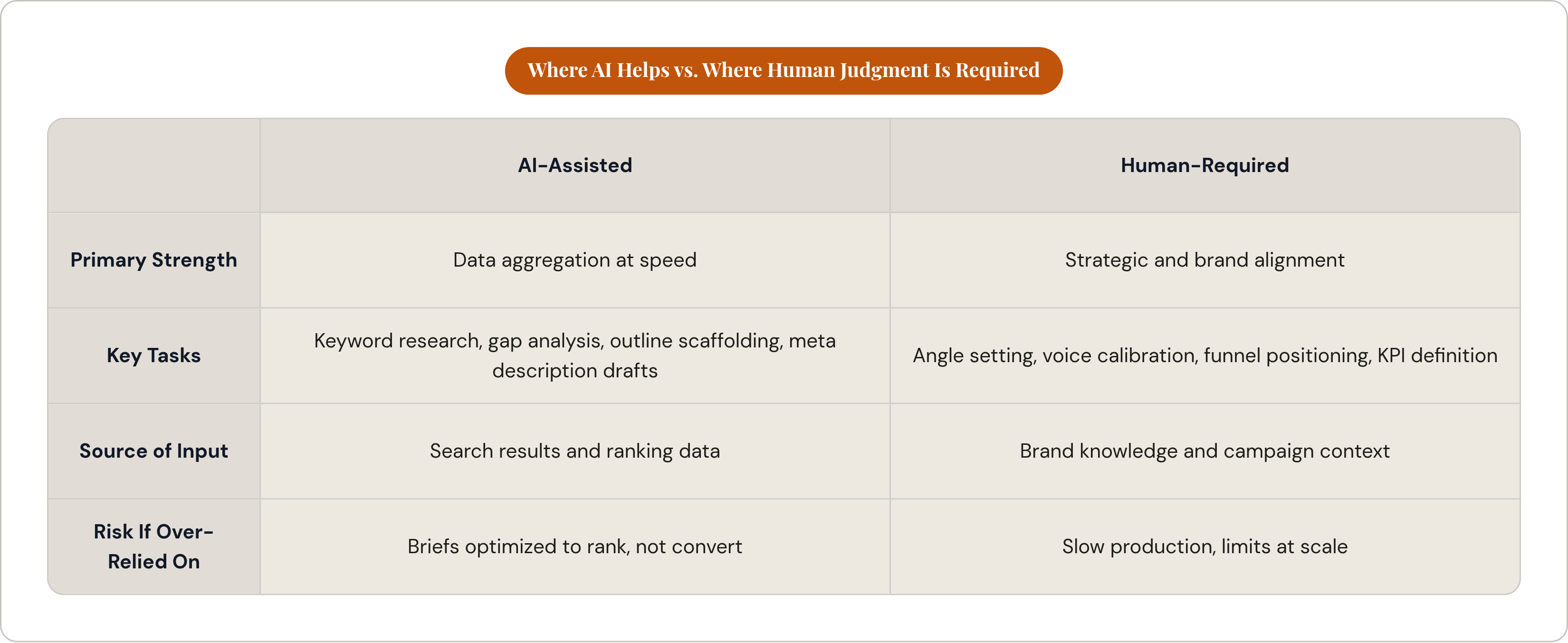
AI is genuinely good at parts of this job, and genuinely bad at others, and the line between the two is worth drawing clearly instead of hand-waving over it.
Where it helps: keyword research and pulling secondary terms, aggregating competing URLs and flagging where the gaps sit, suggesting an outline shape based on what's currently ranking, drafting the boilerplate fields like meta description options or a rough word count estimate off a topic input. All of that is data aggregation, and AI is fast at it in a way a human doing it by hand simply isn't.
Where it falls short: strategic alignment with a specific campaign or a specific stage of the funnel. Brand voice nuance, the kind that reflects how a company actually positions itself against competitors rather than how it generically describes itself. Contextual judgment about what a particular audience already believes walking in, which shapes what needs explaining and what can be assumed. None of that lives in a search results page, and AI tools trained on the open web don't have access to it.
Diane Hammons, director of digital engagement at WG Content, has made a point worth repeating here: AI makes richer briefs possible, ones that would've taken too long to build by hand before, and richer briefs lead to better work from creative partners. The word doing the heavy lifting there is "richer," a word worth distinguishing carefully from "automated." Treating the two as interchangeable is where a lot of teams go wrong.
The hybrid that actually works splits the labor cleanly. AI handles the research aggregation and the structural scaffolding: pull the keywords, find the gaps, draft the skeleton. A strategist or editor supplies the angle, the voice calibration, the differentiating messaging, the KPIs, everything that requires knowing the brand rather than knowing the search results. Speed and quality move together in that setup, because each side is doing the part it's actually suited for.
The tools content teams use to build and scale briefs in 2025
The tools on the market split pretty cleanly by which stage of brief-building they're actually solving for, and it helps to know which lane you're shopping in before you commit budget.
For SEO-led brief building, Surfer SEO is a solid pick for constructing a detailed brief straight from current search results, and it sits in the mid-tier on pricing, which makes it accessible without a huge procurement fight. For topical completeness, Clearscope tends to be the stronger option when a team wants to turn one editorial format into a repeatable template across a roster of writers, the exact situation where quality drifts hardest in the handoff between contributors. A Brafton test across nine blogs in 2025 found Clearscope re-optimization drove an average increase in total clicks above 80%, with a comparable jump in ranking keywords, according to Rankability's writeup of that test. For teams focused on modeling the actual questions searchers are asking, Frase fits that use case well. And for larger organizations running content through many hands, both MarketMuse and Clearscope serve that enterprise layer, with Clearscope's unlimited-user pricing model fitting teams where a large number of contributors all need to write against the same standard.
Worth being honest about the shared limitation across all of them: these tools optimize for topical coverage and SEO signal. Funnel alignment and brand positioning still require a human hand. That strategic layer, the fields covered earlier in this piece, still needs a person to fill in, no matter how good the tool is at pulling keywords.
A platform like MarketMuse sits a bit differently from strategy-first content workflows in this respect. SEO tools, by design, produce briefs optimized to rank. Strategy-first approaches produce briefs optimized to rank and convert, and the difference between those two outcomes lives entirely in what gets specified beyond the keyword list, the stuff this whole piece has been walking through. Teams that pair AI-assisted brief generation with an actual editorial framework, one built on the strategic and voice fields covered above, close the gap between churning out volume and producing work that's consistently good. That combination is what makes the whole system hold up at scale.