Content Production Workflow from Brief to Published Post
Seven stages transform chaotic handoffs into a repeatable system that actually ships.
Here is the edited text:
This is a workflow problem before it's a content problem. Most marketing teams rank content creation near the top of their priorities, but a lot of them still run it without documented steps or dedicated tooling, which means quality swings wildly from one post to the next and deadlines slip for reasons nobody can quite name. Content ships late, or it ships uneven, or it just doesn't ship, and it's rarely because anyone slacked off. The handoff between "someone wrote it" and "someone else needs to check it" depended on a Slack message that got buried. This piece walks the seven stages that turn that mess into something repeatable, from the first keyword search to the moment a post goes live.
How the full workflow fits together before diving into each stage
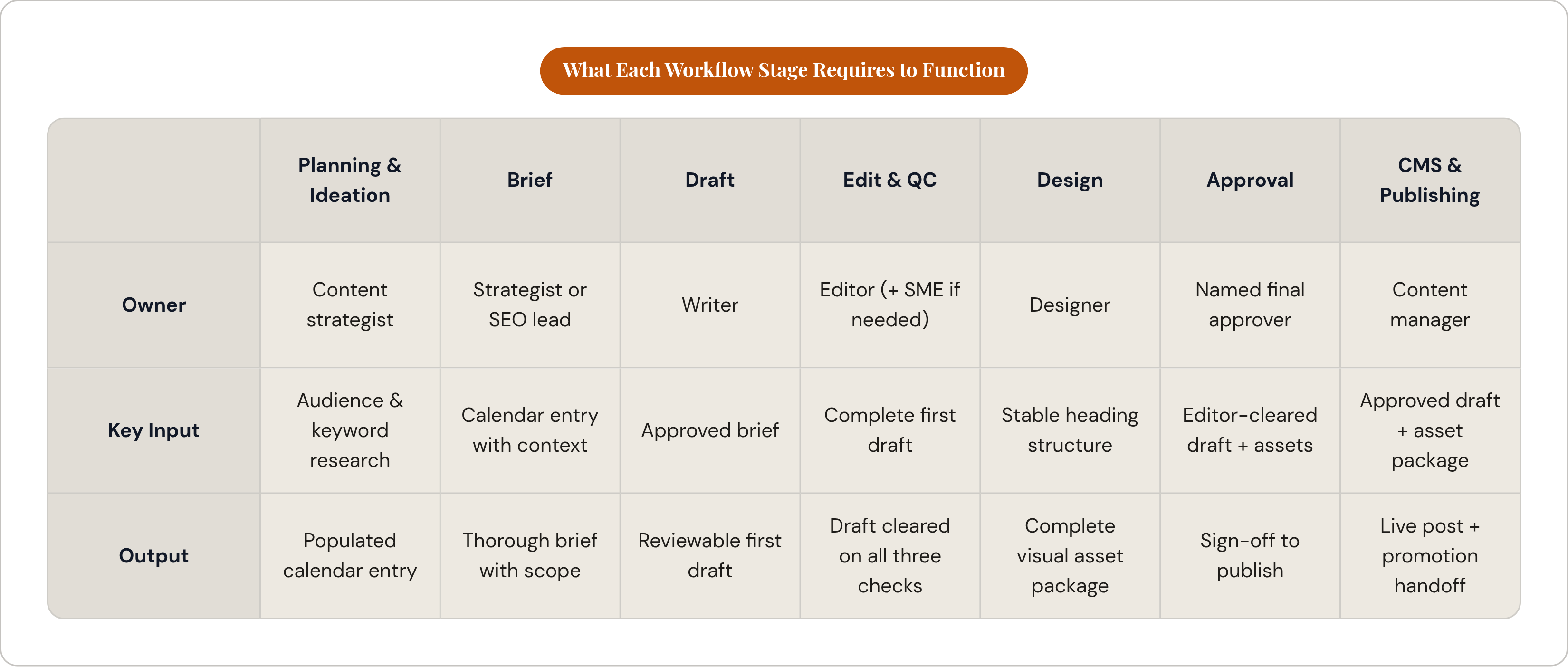
Seven stages, in order: planning and ideation, brief, draft, edit and quality control, design, approval, then CMS prep and publishing. Simple enough to say out loud. The hard part is that each stage needs three things to actually function: someone who owns it, an input handed off from whoever came before, and an output clear enough that the next person doesn't have to guess what they're working with.
Miss any one of those three and the stage turns into a bottleneck, and a literal one at that: a pile of drafts sitting in someone's inbox because nobody was told they're the one who signs off. Team size changes who's covering which role, not whether the role exists. A three-person team is going to have one person wearing the strategist hat, the writer hat, and the editor hat, sometimes all in the same afternoon. The stages don't collapse just because the org chart is small.
Worth naming two different ways teams track this before we go stage by stage. Task-based workflows track individual steps: "submit draft to editor," "editor sends back comments," each one a checkbox. This suits teams that need accountability spelled out because people are remote, or junior, or the content volume is high enough that nothing survives on memory alone. Status-based workflows track which bucket a piece sits in: "in editing," "in design," and trust the team to sort out the details inside that bucket themselves. Neither one wins by default. A five-person team of veterans who've worked together for years does fine with status-based tracking. A twenty-person team spread across three time zones probably needs the task-based version, or things fall through cracks nobody knew existed.
Stage 1: Turning audience and keyword research into a publishing plan
Planning is where research turns into a calendar entry: taking whatever you know about your audience and what they search for, and turning it into a topic, a format, a deadline, and a name attached to the deadline. Every calendar entry should have enough on it that a stranger could pick it up cold. Topic, format, target audience, writer, editor, publish date. If someone new joined the team tomorrow, could they read the calendar and know what's expected of them? If not, the calendar's not doing its job yet.
Two inputs decide whether the resulting content actually performs, and they answer different questions, so don't treat them as the same research pass. Audience research tells you who's reading, what they already know walking in, and what problem sent them looking for an answer in the first place. Keyword research tells you what phrase they typed into Google, how crowded that search result page already is, and what they're actually hoping to find when they click. Skip either one and the writer ends up picking an angle because it's interesting to them, rather than because it's what the reader came looking for. That's the drift you see in a lot of underperforming blog content: technically well-written, aimed at nobody in particular.
By the end of Stage 1, that calendar entry should carry enough context that whoever writes the brief in Stage 2 isn't starting from a blank page.
Stage 2: What a content brief must contain and why it controls quality upstream
Here's a distinction that gets lost constantly: a brief and an outline serve different purposes. An outline organizes the flow of a piece, section by section. A brief explains why each section needs to exist and what job it's doing, both for the search engine and for the person actually reading it. Confuse the two and you'll hand a writer a skeleton with no muscle on it.
A solid brief covers the target keyword and a handful of secondary ones, plus a classification of search intent (informational, navigational, commercial, or transactional), since that single label changes the tone and depth of everything that follows. It needs a reader profile: who they are, what they already know, what they need walking away. A suggested heading structure, not locked in stone but enough to frame the argument. Internal linking opportunities flagged in advance rather than bolted on after the fact. Tone guidelines that point back to actual brand documentation, not vague adjectives like "punchy." An estimated word count, because that sets scope and budget both. A CTA, spelling out what action the piece is supposed to prompt. And finally, an owner, a deadline, and the name of whoever's editing it.
Usually the content strategist or an SEO specialist writes this. On a smaller team it might fall to the editor or the content manager, whoever's closest to both the strategy and the writer. Either way, a brief that's actually thorough kills off the most common source of revision cycles before a single word gets drafted: wrong angle, wrong depth, missing SEO elements. Teams that skip this step tend to rediscover its value the hard way, during editing, when fixing the problem costs three times what preventing it would have.
Stage 3: How drafting works when a brief is doing its job
The writer's job starts with actually reading the brief, not skimming it for the keyword and winging the rest. Treat it like a contract, because functionally that's what it is.
A workable timeline: brief lands on Day 1, draft comes back by Day 3, editor has eyes on it by Day 5. That keeps a standard long-form piece under a week from start to review, which sounds obvious until you've watched a draft sit untouched for eleven days because nobody set a date.
AI's role here has narrowed, and it's narrowed in an interesting direction. Full AI-generated drafts have fallen out of favor among teams that do this professionally; what's grown instead is AI use for outlining, for research synthesis, for knocking out five headline options in thirty seconds so a human can pick the least terrible one and improve on it. Teams pairing AI for that scaffolding work with a human doing the actual writing report meaningfully faster production, and they don't report losing their voice in the process, which is the thing everyone worried about two years ago.
So the practical split looks like this: AI speeds up the framework, while a person still owns the argument, the specific examples, the editorial judgment calls that make a piece sound like it was written by someone who's actually done the thing they're writing about. And nearly every professional content team keeps a formal review process specifically for AI-assisted work, because accuracy and brand voice don't take care of themselves.
What comes out of Stage 3 is a complete first draft: it hits the brief's scope, word count, and heading structure. Not polished. Reviewable.
Stage 4: What editing actually covers and how to keep it from becoming a second draft
Editing isn't one pass, and treating it like one pass is where a lot of confusion creeps in about who's responsible for what. Most content needs at least two rounds. First pass looks at structure and argument: does this piece deliver what the brief promised, in the right order, for the right reader? Second pass checks voice and brand alignment: does it sound like the brand, not like whichever writer happened to draft it that week? A third, often lighter pass handles SEO mechanics: keyword placement, meta description, internal links, heading tags all present and accounted for.
Technical or regulated content needs a subject matter expert review on top of all that, and here's the part teams forget: build the SME's availability into the schedule from day one, not as a scramble once the draft's already sitting there waiting on someone in legal who's out until Thursday.
The most common editing failure looks like this: an editor rewrites so much of the piece that what goes back to the writer is functionally a new brief in disguise. When that happens repeatedly, a better editor won't fix it. The problem lives upstream, back in Stage 2, and no amount of heavy editing downstream repairs a brief that never set the right scope.
Clear entry and exit criteria keep editing from becoming an open-ended loop. A draft enters editing once it's complete against the brief. It exits once the editor signs off on structure, voice, and SEO, all three, not "mostly there." The output is a draft cleared to move forward, full stop.
Stage 5: Where design fits into the sequence without becoming a bottleneck
A typical post needs a header image, some in-body visuals or diagrams, screenshots where relevant, a social share image, and custom graphics for anything built around data. That's a real list of deliverables, and none of them show up automatically.
Here's the scheduling trick most teams miss: design can start before editing wraps up, as long as the content's structure has stabilized. Waiting for a fully polished, fully approved draft before briefing the designer just adds dead time to the calendar for no real benefit. If the headings aren't going to move, the designer doesn't need to wait for the last comma to be fixed.
Visuals aren't decoration, either. Posts with frequent in-body images earn noticeably more social engagement than text-heavy walls of paragraphs, which means design choices affect how far a piece actually travels once it's live, not just how it looks sitting on the page. The brief should specify what's needed here too, spelling out what type, where they go, and whether stock photography is fine or the piece actually needs a custom chart. Give design a scope, not an open-ended assignment they have to guess at.
Output: a complete asset package delivered before CMS prep starts, so nobody's holding up publication because the thumbnail's still "in progress."
Stage 6: Why approval is the most schedule-sensitive stage and how to control it
Approval is where schedules go to die, and it's almost always for the same reason: the approver is the busiest person in the entire chain, and "send for approval" quietly turns into "wait indefinitely" the second there's no structure around it.
Approval routinely takes longer than teams plan for, and for anything tied to a campaign launch or a seasonal moment or a trending topic, that lag is the difference between good content and irrelevant content. A piece about a news event that clears legal review nine days later isn't really about that news event anymore.
The single biggest fix: one named final approver per piece, rather than a committee or "whoever's free" — one person whose name is on the sign-off. Approval by committee reliably produces the slowest turnaround and, ironically, the most watered-down editorial decisions, since everyone's trying to satisfy everyone else's version of "fine."
Beyond that, every review stage needs three things: what has to be true before it enters, what has to be true before it leaves, and a deadline attached to both. Skip any one of the three and content either moves before it's ready or stalls with nobody quite sure why. A reasonable target is getting from draft to approval in under 48 hours; if a team consistently blows past that, the fix usually is redefining what the approval tier is actually checking for, rather than writing faster. Hybrid setups, where automated checks catch mechanical problems (missing meta description, a flagged compliance term) before it ever reaches a human, cut approval time substantially compared to routing everything manually through email. Teams using that kind of structured or automated routing finish approval in a fraction of the time fully manual routing takes, and that gap compounds fast once you're publishing at real volume.
Worth mentioning too: agile-style approaches, iterative review, sprint-based planning, a Kanban board that shows everyone where things stand, cut down on approval pile-ups by breaking one big scary final gate into several smaller, lower-stakes check-ins.
Stage 7: CMS prep and the hidden delay between approved and live
CMS prep covers formatting the post inside the platform, adding metadata, dropping in images, setting internal links, configuring the slug and canonical tag, and either scheduling the piece or hitting publish. It sounds mechanical because it is mechanical, which is exactly why teams underrate it.
Here's the trap: a lot of teams treat "approved" as the finish line. The piece drops into a publishing queue, gets manually scheduled for "sometime next week," and sits there while everyone's attention moves to the next fire. For time-sensitive topics or competitive search terms, that gap between approval and going live is a real cost, measured in traffic that goes to whoever published first. The piece that could have caught a search trend now publishes after the trend's already cooled off.
Treat CMS prep as its own stage, with its own owner, its own checklist, its own deadline. A pre-publish checklist catches the errors that otherwise turn into post-publish fixes: title tag and meta description filled in, target keyword sitting in the slug, the H1, and the first paragraph, every internal link actually tested and not just assumed to work, images compressed with alt text written, social share image set, publish date and author both confirmed. None of this is glamorous. All of it is the difference between a clean launch and a quiet scramble two days later.
And publishing needs to feed straight into promotion. The marketing team needs the exact go-live date ahead of time, not a Slack message after the fact saying "hey, that's up now."
Roles across the workflow and what happens when they overlap
The standard cast: a content strategist or lead owns planning, the calendar, and the brief. The writer drafts against that brief. The editor checks structure, voice, and SEO. An SME reviews for accuracy where the content is technical or regulated. A designer delivers the visual assets. One named approver signs off. A content manager or publisher handles CMS prep and pushes the piece live.
A large share of B2B companies have at least one dedicated content marketing role sitting on the team; the ones that don't usually spread these tasks across other departments instead, which doesn't make the workflow disappear, it just makes accountability foggier. Someone's still doing the work. It's just less clear whose job it actually was when something slips.
On small teams, one person frequently covers strategist, writer, and editor all at once, and the workflow compresses without vanishing entirely. The risk there is specific: self-editing tends to skip exactly the structural check a second set of eyes would have caught, because you're too close to your own reasoning to spot where it doesn't hold up. The discipline worth keeping, even at a headcount of one covering three roles, is treating each role's output as its own separate deliverable with its own checkpoint, rather than one continuous blur from brief to publish.
Tool categories that support each stage, and the fragmentation problem they create
Sort tools by the stage they support, not by brand name, and the picture gets a lot clearer. For planning and the content calendar, something like Notion, Airtable, or honestly a shared spreadsheet does the job; the goal is visibility for the whole team, not fancy features nobody uses. For project management and task tracking, tools like Asana, Trello, or Monday.com map the stages, assign owners, and set deadlines that people can actually see.
For SEO research and brief-building, tools like Frase, SurferSEO, or MarketMuse analyze search intent and competitor content to shape what goes into the brief before a writer ever touches it. For AI-assisted drafting and outlining, tools like Jasper, Writesonic, or Copy.ai earn their keep on scaffolding work: outlines, headline options, pulling research together. For approval routing, dedicated tools like Kissflow, or a purpose-built content operations platform, get rid of the email chain that has no clear owner and no clear end. And for CMS publishing, tools that push a finished document directly into WordPress or another platform, something like Wordable, cut out the manual copy-paste-reformat step that eats far more time than it should.
Here's the catch nobody advertises: every one of these tools solves its own stage well, and none of them talk to each other by default. The calendar lives in one tool, the brief in a doc somewhere else, the SEO research in a third tab, approval routing in a fourth system entirely. That's the fragmentation problem, and it's worth sitting with for a second: teams don't fail at content production for lack of tools so much as for lack of coordination between them. They've got five or six tools each solving one slice of the problem, and the actual work of stitching those slices into one visible process is a job nobody assigned to anyone. Which, if you've read this far, is exactly the kind of gap this whole workflow was built to close in the first place.