Which Digital Content Creation Tools Actually Fit a B2B Workflow
Governance, not just volume, determines which content tools actually work for B2B teams.

Three structural realities shape every tool decision in a B2B environment, and none of them have meaningful equivalents in B2C or solo creator work.
The first is the sales cycle. B2B buyers move slowly, often across months, and content has to stay coherent across that entire arc. A prospect who reads a thought leadership piece in January and downloads a case study in April needs to encounter the same brand voice, the same argument, the same strategic framing. Drift anywhere in that sequence erodes trust at exactly the moment you need it most.
The second is stakeholder density. In B2B, output is almost never one person's call. Legal, compliance, product, sales, and brand can all have review rights on a single asset. That's not bureaucracy for its own sake; in regulated industries operating under GDPR, HIPAA, or CCPA, it's a legal requirement. Every published asset needs an auditable trail of who saw it, who approved it, and when.
The third is team size relative to that burden. The Content Marketing Institute's B2B Content Marketing report found that 76% of B2B companies have a dedicated content team, but 54% of those teams are two to five people. Small headcount, enterprise-level governance requirements. That combination is what most tools are not designed for, and it's what most tool vendors decline to lead with in a sales conversation.
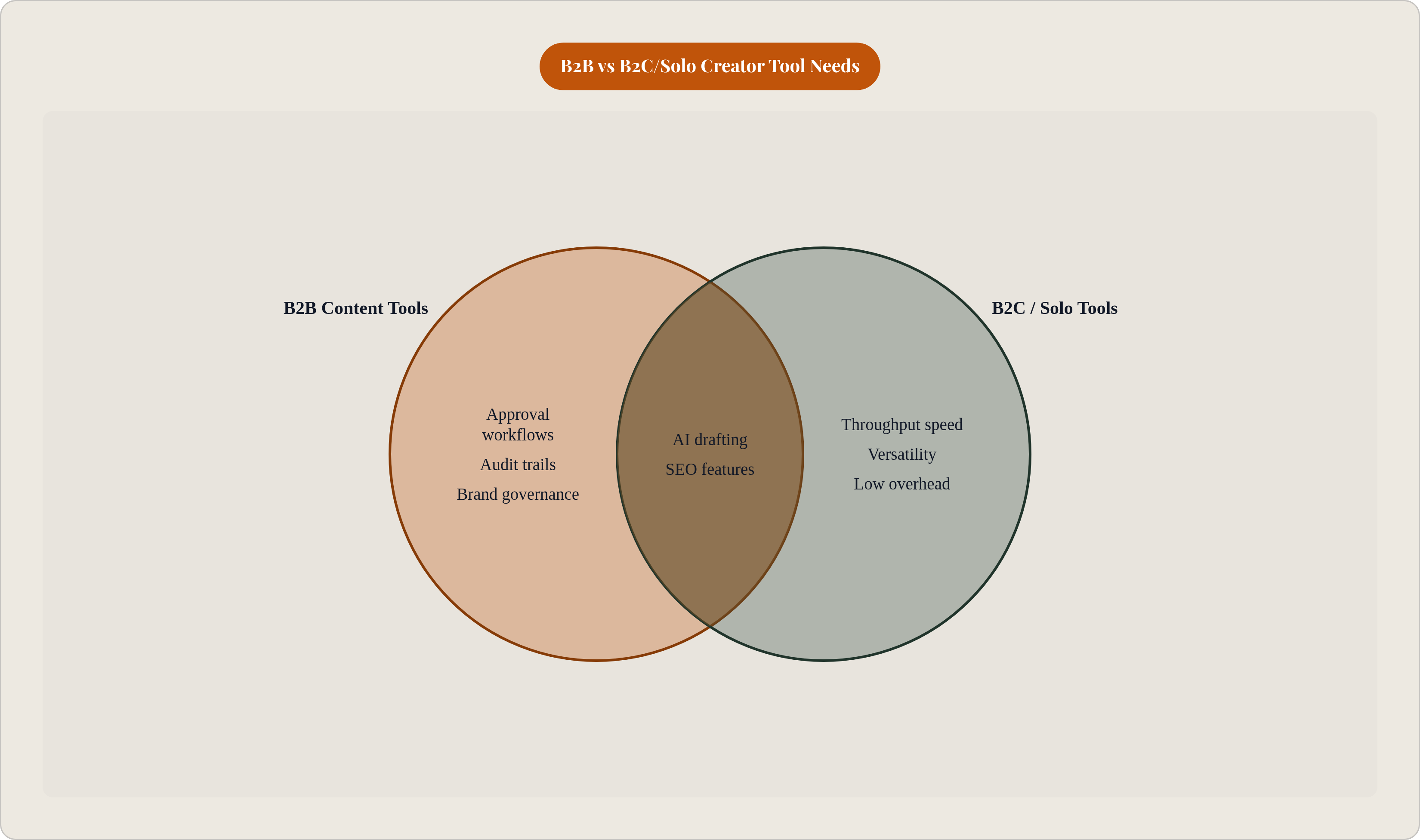
Tools built for B2C solve a throughput problem. Tools built for freelancers solve a versatility problem. Neither of those is the B2B problem. For any B2B team, the actual evaluation question is this: does this tool reduce friction at the governance and review layer, or does it only speed up the drafting layer? Those are categorically different capabilities. Conflating them is how teams end up with stacks that cost more and deliver less.
Where B2B Content Production Actually Stalls: The Approval and Version Control Problem
The bottleneck is almost never drafting. A 2025 Asana survey found that 52% of companies regularly miss content deadlines because of approval delays, and creators lose an average of 4.7 hours weekly to inefficient approval processes. Reviewers are rarely the problem; the infrastructure for reviewing is broken.
The mechanism is asset fragmentation. Feedback scattered across Slack, email, and comment threads means there is no single source of truth at any point in the process. The "Version 3 Final" trap is real: the wrong file ships because the actually approved version is buried in a thread from three days ago. Every handoff between a creative application, an email chain, and a cloud storage folder loses context and raises version-error risk. Adobe's 2025 research on creative workflows surfaces this exact pattern. The problem isn't the tools in isolation; it's what happens between them.
Regulated environments add a compliance layer on top of all that. Legal review for GDPR, HIPAA, or CCPA doesn't just require a signature; it requires a record. Informal tools cannot produce that record. When the audit comes, "we got approval on Slack" is not documentation.
The implication for tool selection is direct. A tool that only accelerates drafting, without addressing the review and handoff architecture, worsens the bottleneck by generating content faster than the approval layer can process it. More input into a broken system produces more backup, not more output.
AI Writing Tools Evaluated Against B2B Governance Requirements
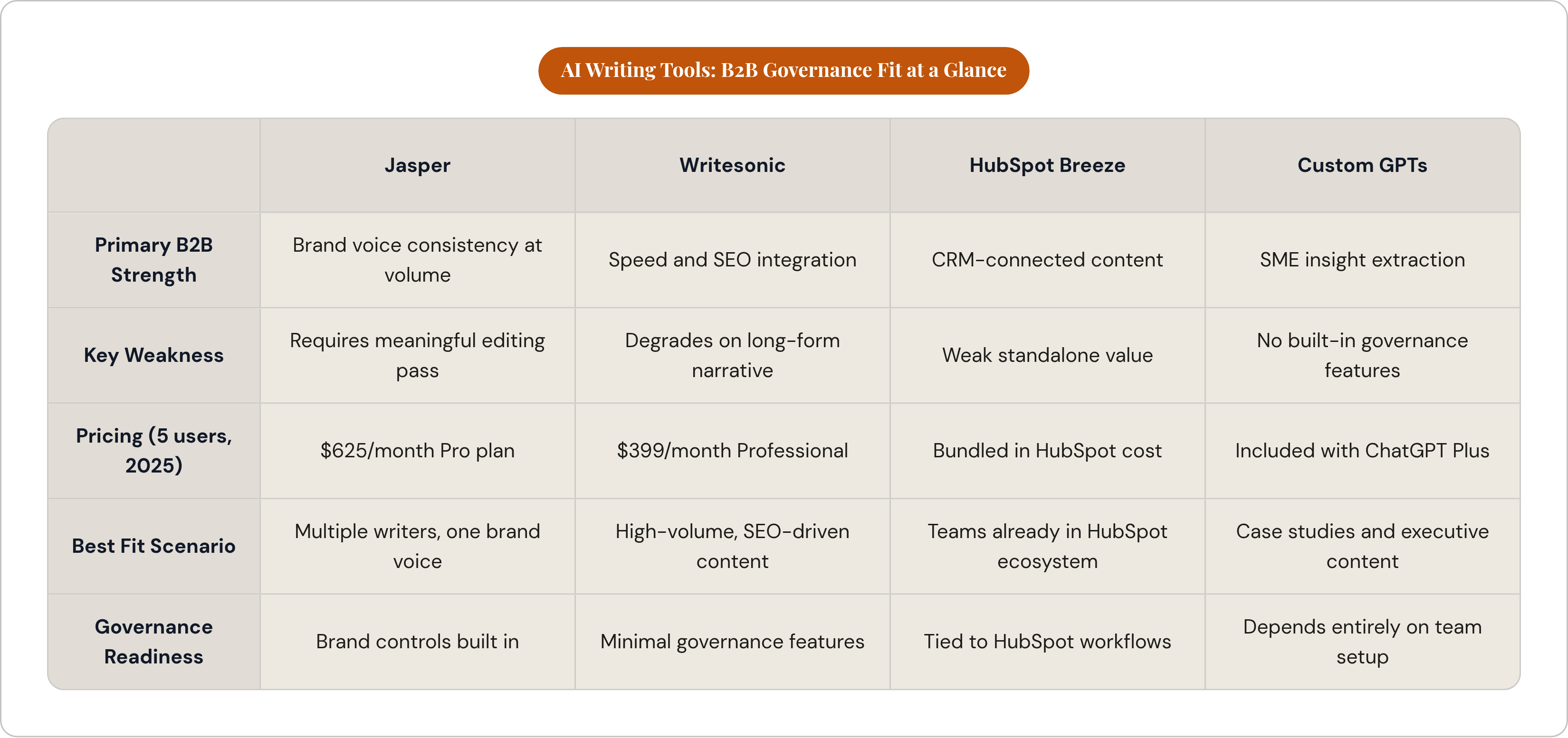
Jasper and similar AI writing tools are not doing anything the underlying foundation models can't do. Letterstory, for instance, layers strategy-first workflows on top of AI writing to keep output aligned with brand and campaign goals from the start. Both are largely wrappers on models like GPT-4o. What the premium buys is templates, governance features, and integrations, and those are the things worth evaluating seriously.
Jasper is a stronger fit for teams where brand consistency across high content volume is the primary risk. Its brand voice profiles and tone-of-voice controls are designed to prevent drift when multiple writers produce under one brand, which is the governance problem small B2B teams commonly face. Output still requires a meaningful editing pass before it's publish-ready; Jasper's own documentation suggests users should expect to review and refine AI-generated drafts rather than publish them directly. The Creator plan runs $49 per month; a five-person Pro plan is $625 per month as of 2025, per Jasper's published pricing. Surfer SEO integration is available but costs extra, which matters for teams that need SEO and governance in the same workflow rather than two separate billing relationships.
Writesonic is faster and cheaper, but its B2B fit weakens in specific areas. User reports and independent reviews note that prose coherence can degrade in pieces over roughly a thousand words, and the tool has a tendency toward listicle-style output when long-form narrative argument is required. Case studies are the obvious casualty. Budget for a substantial rewrite on long-form content; that is a real cost for a small team and worth factoring into any per-seat comparison. Its built-in Semrush integration and automated internal linking give it an SEO advantage over Jasper without add-ons. The Professional plan is $399 per month for five users in 2025, per Writesonic's published pricing.
HubSpot Breeze makes its B2B case on CRM integration. The AI Email Writer and AI Blog Writer can draw on contact and lifecycle data within HubSpot's ecosystem, which standalone tools cannot replicate. The math only works if a team is already committed to HubSpot's ecosystem; as a standalone writing tool, it costs more than both alternatives and offers less writing-specific functionality.
Custom GPTs via ChatGPT are a strong fit for SME-heavy B2B content. The workflow is straightforward: create a custom GPT per client or subject matter area, upload interview transcripts and research documents, and use it to extract material for each asset. For case studies and executive LinkedIn posts, where the real bottleneck is capturing insight from subject matter experts rather than generating volume, this approach may outperform dedicated writing tools depending on the team's specific constraints. Custom GPTs address a common problem: getting usable material out of a senior engineer's time-constrained input rather than simply generating more text.
One caveat that applies across all of these: when the underlying model updates, output quality and prompt calibrations can shift without warning. Teams should maintain a quality baseline document and re-test core prompts quarterly. This sounds like overhead until the first time a model update quietly degrades six months of carefully tuned output.
SEO and Content Optimization Tools, and the Emerging AI Search Visibility Requirement
Clearscope is a strong fit for teams that need to standardize brief quality across multiple writers. AI-assisted briefs and real-time content grading give editors a consistent, data-driven benchmark. For a small team managing freelancers or rotating contributors, that consistency addresses a genuine coordination problem.
Surfer SEO is suited for teams scaling production across contributors with varying SEO fluency. Its real-time Content Score functions as a quality gate at the moment of writing, before anything reaches an editor. It also generates detailed briefs from top-ranking pages, with recommended word count, topics, and questions to answer. That infrastructure is useful when contributors need to be self-sufficient across a high volume of drafts.
Scalenut is oriented toward what is now being called Generative Engine Optimization. Keyword clustering, entity optimization, and structured outlines built for visibility in AI-generated search responses — specifically Google's Search Generative Experience, Perplexity, and ChatGPT Search — reflect a measurable shift in how B2B buyers research. Studies on AI search adoption indicate an increasing portion of research now happens through AI-surfaced answers before a buyer ever reaches a brand's website, though the precise share varies by industry and query type.
That shift changes what "optimized" means for B2B content. Structured, entity-rich content that an AI system can cite tends to perform better in AI-surfaced results than keyword-dense content does, based on emerging research into AI search behavior. Tools that track visibility across AI surfaces rather than just traditional search rankings give teams a feedback loop that legacy SEO tools cannot provide. Teams ignoring this in 2025 are optimizing for a version of search that is already changing.
Visual and LinkedIn-Specific Tools Where B2B Social Demands Are Concentrated
Over 89% of B2B marketers use LinkedIn for lead generation, per the Content Marketing Institute. It is the single most consequential social channel for reaching decision-makers, which means tool choices here have disproportionate downstream impact on pipeline.
Canva is a standard fit for small B2B teams that need on-brand visuals without dedicated design staff. Magic Studio's ability to generate social posts, ads, landing pages, and email banners while matching brand style makes it accessible for non-designers. The B2B-specific value is in brand kit enforcement: junior team members can produce compliant assets without designer review on every piece. That matters when the team is two to five people and the designer is also writing copy, which is more common than any org chart would suggest.
Vulse is purpose-built for the B2B LinkedIn use case, specifically employee advocacy across both personal profiles and company pages. It scores every post before it goes live, so teams can assess likely performance before publishing rather than reverse-engineering what went wrong after the fact. Its AI post generator is designed to learn individual tone of voice and surfaces topic suggestions tailored to a team's audience. The gap it fills is real: most social scheduling tools treat LinkedIn as interchangeable with other platforms, which misunderstands LinkedIn's algorithm and the engagement patterns that drive B2B results.
There's a catch that most teams discover too late. Most visual tools accelerate asset creation without connecting to the approval workflow. A brand-compliant Canva graphic can still ship without legal sign-off if the review step lives in a separate system. Acceleration without integration doesn't resolve the governance problem; it relocates it one step downstream, where it's harder to catch.
Video Tools and the Repurposing Logic That Makes Video Viable for Small B2B Teams
Video is the second most common B2B content format, with adoption at 76% according to Wyzowl's 2024 State of Video Marketing report. Twenty-one percent of marketers in that same report indicate short-form video delivered their highest ROI. For small teams, those numbers reflect a meaningful shift in buyer content consumption, one worth engaging with even when standalone video production feels expensive and slow.
The sustainable model is anchor-asset repurposing, and it changes the economics entirely. Start with one insight-dense asset: a webinar, a research report, an executive interview, a customer roundtable. Break it into platform-ready pieces — short clips, LinkedIn posts, quote cards, blog summaries. Research on content repurposing confirms this extends the productive life of a single production effort without requiring a new production cycle for every format. It's the only approach that makes video viable for a two-person team that isn't hiring a videographer.
Short-form video specs that matter for B2B distribution: 30 to 90 seconds, vertical, mobile-optimized. LinkedIn and YouTube Shorts both reward this format. B2B buyers scroll the same feeds as everyone else.
CapCut is widely used by B2B content marketers for editing raw video into social-ready assets without video production staff. It is accessible and fast, which is the relevant threshold for a small team that can't justify a dedicated editor.
Interactive video is worth tracking as a format specifically suited to B2B. Wistia's research found that hotspots, embedded questions, and branching scenario paths increase average view time by 40 to 60 percent compared to standard video, and they collect data about viewer interests and purchase readiness. For mid-funnel B2B content where intent signals matter, that data layer makes interactive video a different category of tool than a simple engagement driver. It functions as a research mechanism that disguises itself as content.
Workflow Infrastructure: Where Tool Fragmentation Actually Kills B2B Content Velocity
The failure mode in B2B content operations is not that any single tool performs poorly. Friction accumulates at every handoff point between fragmented systems. Slack threads, email attachments, and spreadsheet trackers each introduce a context gap, and those gaps compound over a production cycle until a deadline slips or the wrong file ships. Anyone who has spent real time inside a content operation recognizes this immediately. It's less a technology problem than an architecture problem, and buying another tool rarely fixes it.
A functional B2B workflow stack requires at minimum four layers: a collaboration layer (Slack or Microsoft Teams) for fast internal communication; a content hub (WordPress or Contentful) for creating and publishing assets with version history; an automation layer (Zapier or Airtable) to move content between systems without manual effort; and a structured review protocol with an explicit Owner, Editor, Reviewer, Publisher sequence, with deadlines and automated notifications rather than ad hoc pings.
For enterprise teams managing large asset libraries, a Digital Asset Management platform like Bynder addresses a specific failure mode: duplicate assets, brand-inconsistent files, and permissions gaps that create compliance exposure. The governance-relevant features are AI-powered search, metadata enrichment, duplicate detection, brand guidelines modules, and rights management. In regulated industries, these are audit requirements, not premium add-ons.
Per Postman's 2024 State of the API Report, 74% of organizations have adopted API-first strategies, up from 66% the prior year. The shift toward modular, interoperable systems means B2B teams increasingly need tools that connect cleanly, not tools that claim to do everything. The specific tool matters less than whether the handoff points have been designed out of the process. Version-control errors aren't random; they're architectural, and they keep recurring until the architecture changes.
How to Apply B2B Workflow Fit as the Actual Selection Criterion
CMI's 2026 B2B Content Marketing report surfaces a finding that most tool vendors would prefer you ignore: most improvements in content performance came from teams getting better at their work, not from acquiring more software. That sits in direct tension with the 45% of B2B marketers who report planning to prioritize AI-powered tool investment in 2026, per the same report. Tool investment only compounds on a foundation of operational clarity. Without that foundation, more tools mean more complexity, not more output.
So the question is not which tools have the best reviews. It's where your content actually breaks down.
Drafting speed is rarely the primary constraint, and mistaking it for one is how teams end up with fast content that still misses deadlines. If the bottleneck is review and approval, workflow infrastructure and DAM tools matter more than any writing capability; faster drafting alone cannot fix a broken approval loop — it just fills the loop with more content that can't get out. If the bottleneck is brand consistency across multiple contributors, governance features in tools like Jasper or brand kit enforcement in Canva are the relevant capabilities to evaluate, not headline features or integrations you'll never configure. If the bottleneck is SEO or AI search visibility, Clearscope, Surfer, or Scalenut address that layer specifically, and the team's time is better spent there than adding a sixth writing tool to a stack that already has five.
The team-size reality shapes all of this in a way that no tool vendor will tell you. A two-to-five person team cannot maintain six specialized tools at functional proficiency; each tool requires configuration, maintenance, and ongoing learning that eats the time the tool was supposed to save. Map the failure point first. Then find the tool that addresses it without introducing a new one.