Best Content Creator Tools for B2B Marketing Teams in 2025
Find the right tool category for your team before comparing specific products.

Before you open a single product page, you need to know which category of tool you're actually shopping for. Storyteq's analysis identifies four platform categories that B2B teams typically operate within: all-in-one marketing suites, suited to smaller teams with integrated needs; specialized content management systems, which trade breadth for depth; creative automation platforms, built for scale and repetitive production tasks; and hybrid assembled stacks that combine elements of all three.
Most teams skip the integration question entirely, and that's where things get expensive. Does this tool connect to your CRM, marketing automation platform, and CMS, or does it create a manual data handoff? Native integrations are what make lead scoring, nurturing sequences, and attribution reporting function without a dedicated operations person stitching spreadsheets together every week. A tool that requires manual data reconciliation creates a bottleneck at the reporting layer, which is precisely where leadership starts asking uncomfortable questions about content ROI.
Three variables should determine your category priority before you evaluate any specific product: who is creating content, approving it, and distributing it; where the workflow bottleneck actually lives, whether that's ideation, production, or distribution; and the maturity of your existing MarTech stack, specifically where the gaps hurt most. If you cannot answer all three with specificity, you are not ready to evaluate products yet.
Teams should also account for scale from the start: a platform that works for three people may require complete re-platforming when headcount doubles and multi-brand governance, role-based permissions, and approval workflows become operational necessities. That inflection point can arrive faster than anticipated. Build with it in mind.
What follows covers each functional category in workflow order, starting where strategy begins, in research and ideation, and ending where content reaches buyers.
Research and ideation tools that give B2B content a strategic starting point
According to SeoProfy's 2025 data, a significant share of B2B marketers now use AI to brainstorm content ideas, and a meaningful portion use it to draft content directly. Brainstorming without audience and competitive data produces ideas that feel good internally and miss externally. Research tools are the bridge between editorial instinct and verifiable demand.
Semrush
Semrush is a research tool for content teams where organic search is a primary acquisition channel. Its Content Marketing Platform guides teams from topic ideation through performance measurement using search data. The AI Visibility Toolkit, available within the Semrush One bundle, tracks brand appearances in AI-generated results from ChatGPT, Perplexity, and Gemini, and benchmarks that visibility against up to nine competitors. As AI answer engines increasingly intercept search intent before a user ever clicks a result, tracking whether your brand appears in those answers is becoming a relevant visibility metric.
Pricing runs from $129.95 per month for the Pro plan. Content Marketing Platform features become available at the Guru tier, at $249.95 per month. Semrush One starts at $199 per month. This tool is suited to teams where organic search drives a significant portion of pipeline and content topics require data justification before investment is approved.
Ahrefs
Ahrefs offers comparable depth, with its core strength in backlink database analysis and keyword research for competitive gap work. The Brand Radar feature tracks AI answer visibility in a manner parallel to Semrush's toolkit. If your team is already invested in link-building programs alongside content production, or if competitive backlink analysis is a recurring workflow requirement rather than an occasional exercise, Ahrefs may fit more naturally.
Neither tool replaces a content strategist. They surface what audiences are actively searching for, not what no one has thought to ask yet. Editorial judgment still has to be layered on top of the data, and that judgment cannot be outsourced to a platform. For teams earlier in their SEO maturity, Google Trends paired with either platform serves as a practical and low-cost entry point.
AI writing tools for B2B content production, and where each one actually fits
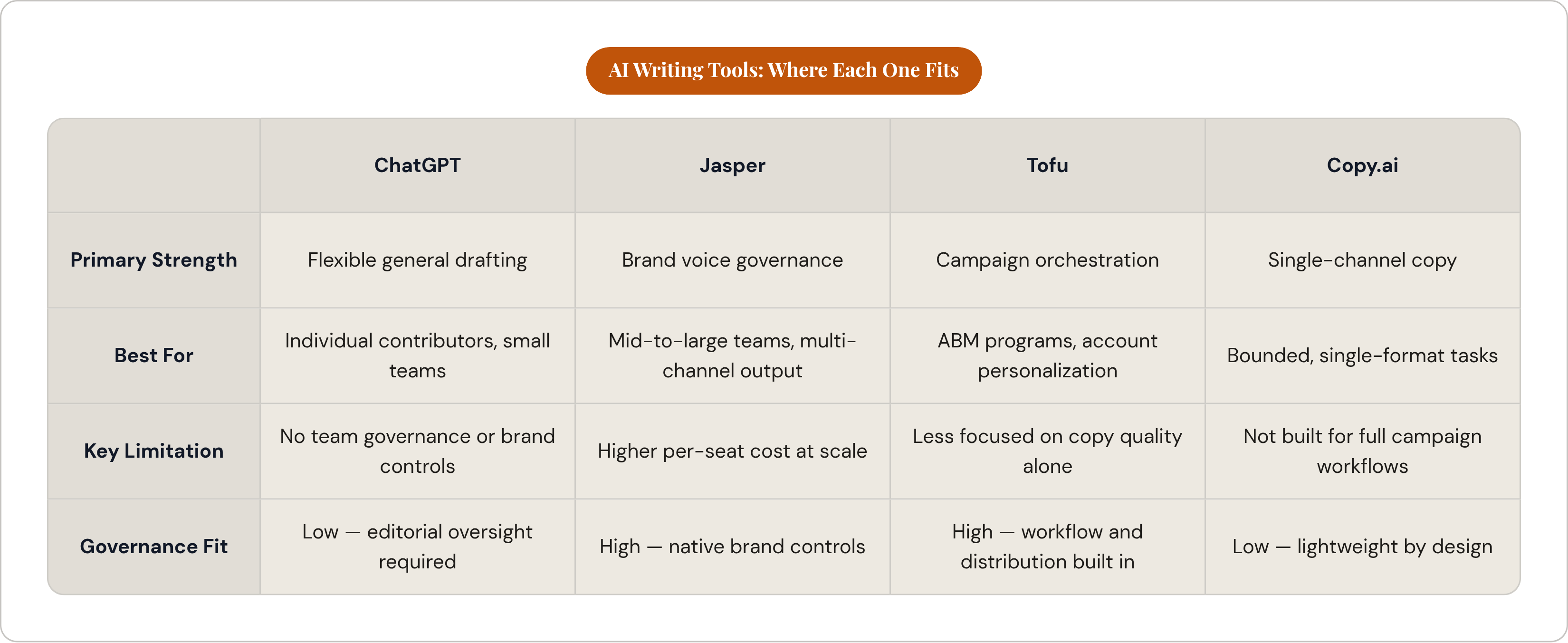
Per a CMI survey of 1,015 B2B marketers conducted through August 2025, 89% of B2B marketers were using AI content creation tools for generating or optimizing marketing copy. CMI's same data found that 54% of B2B teams take an ad hoc approach, experimenting without systematic application. Picking the right writing tool matters less than building a consistent workflow around whichever one you choose, which is the gap Letterstory, an end-to-end content automation platform, was built to close.
ChatGPT
ChatGPT is a general-purpose writing tool. It handles a broad range of formats, from SEO blog posts to technical whitepapers to audience-segment-specific drafts, with reasonable flexibility. What it lacks natively is brand voice enforcement, campaign workflow structure, and governance for teams producing at volume. At $20 per month for Plus, it suits individual contributors or small teams with strong editorial oversight who want flexible drafting capability. It is not a governed team production environment, and using it as one can create brand consistency problems that compound over time.
Jasper
Jasper is built for marketing teams that need consistent brand voice across high output. Brand voice controls, campaign workflows, multilingual support across more than 30 languages, and AI image generation are all native. Per HelloOperator's 2025 reporting, Jasper saved over 10,000 hours for Cushman and Wakefield and accelerated campaign creation by 93% for Bloomreach. Pricing starts at $49 or $69 per month per seat depending on plan. For a mid-to-large B2B marketing team producing content across multiple channels where brand consistency is a governance requirement, Jasper is a more appropriate choice than a general-purpose tool.
Tofu
Tofu is purpose-built for B2B multi-channel campaign execution. It combines AI content creation with channel distribution in a single platform, supporting formats from long-form thought leadership to account-personalized landing pages and sales emails. The distinction from Jasper matters: Tofu's emphasis is on campaign orchestration and channel distribution, not primarily on brand-consistent copy generation. A B2B team running account-based marketing programs, where content must be personalized by account or segment across multiple touchpoints, will find Tofu more relevant than a writing-focused platform.
Copy.ai
Copy.ai is suited to bounded tasks: blogs, social posts, specific single-channel copy needs. It is not built for full campaign workflows or enterprise governance. For teams that need fast copy for a single channel without the overhead of a larger platform, it works well within those constraints.
SEO content optimization tools that close the gap between a draft and a ranking page
Research tools tell you what to write about. Writing tools help you produce a draft. SEO content optimization tools tell you whether that draft is actually structured to rank. These are distinct workflow stages, and conflating them is one of the most common reasons teams end up with content that is well-written but invisible.
Surfer SEO
Surfer SEO focuses specifically on on-page content optimization using data from top-ranking pages. Its content editor provides real-time suggestions on keyword density, content structure, and a proprietary Content Score. Per Averi.ai's 2026 reporting, the correlation between Content Score and actual rankings carries a coefficient of 0.28. Surfer-optimized content consistently outperformed non-optimized content in that analysis. At $89 per month, this works best for a team producing SEO content at a regular cadence where writers need in-editor guidance during drafting, not a separate post-draft audit step.
Frase
Frase is a streamlined option for smaller teams or tighter budgets. It surfaces target keywords and provides a native drafting interface in one lightweight tool, with less comprehensive data than Semrush but lower friction for writers who want research and drafting in the same place. For a content team of one to three people who do not need the full Semrush research layer but want more structure than a blank document, Frase is a proportionate choice.
Regarding AI-generated search results, the same ones Semrush and Ahrefs now track through their brand visibility features: they are expected to reduce the payoff of traditional on-page SEO over time. The degree and timeline remain unclear, but teams should monitor AI answer visibility alongside traditional keyword rankings rather than instead of them.
All-in-one platforms for teams that need strategy, creation, and CRM to share the same data
HubSpot with Breeze AI
HubSpot with Breeze AI is an integrated platform for B2B teams that need content activity to flow directly into pipeline reporting without manual reconciliation. HubSpot states that over 80 AI tools are embedded across the platform, covering email subject line generation, content optimization, lead scoring, experience personalization, and analytics summarization. Content Hub pricing runs from $25 per month at Starter to $500 per month for Professional and $1,500 per month for Enterprise. Marketing Hub pricing starts at $20 per month for 1,000 contacts at Starter, scaling to $890 per month for Professional and $3,600 per month for Enterprise. An AEO module for competitor benchmarking and AI citation analysis is available from $50 per month as a standalone and is included in Marketing Hub Professional and Enterprise tiers.
The core advantage is CRM-connected content and marketing data. Content performance flows directly into pipeline and revenue reporting without a separate data operation to maintain it. The limitations are real: costs scale sharply with contact database size, Breeze AI features are still maturing relative to standalone tools in each individual category, and the platform rewards teams already operating within the HubSpot ecosystem. Migrating from a different stack is a different proposition.
The trade-off that category choice forces
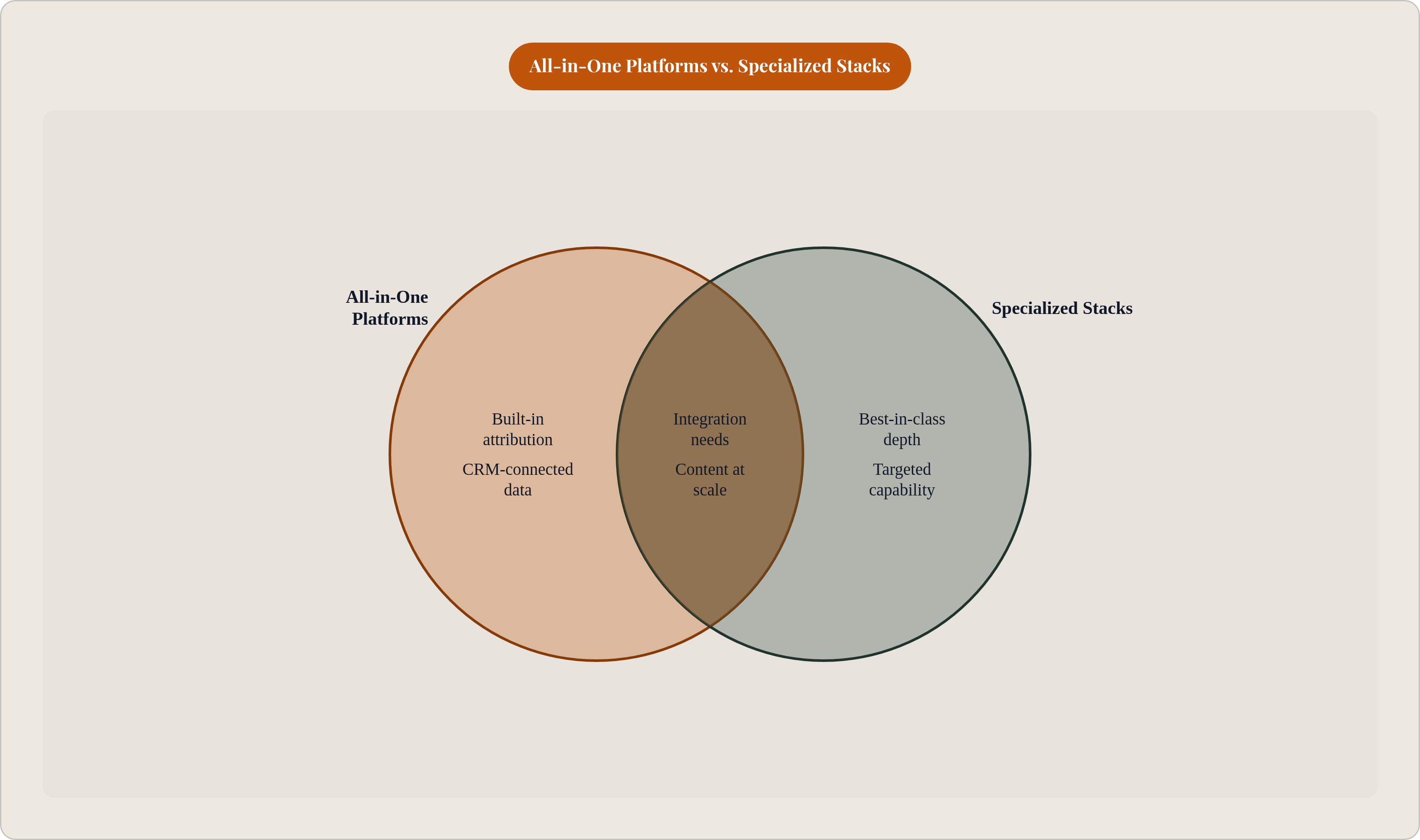
All-in-one platforms offer integration and attribution at the cost of best-in-class depth in any single function. Specialized stacks offer depth but require deliberate integration work and create attribution complexity. The choice isn't about which approach is philosophically superior. It's about which constraints your team can actually absorb.
The case for all-in-one is strongest when the team is small, the MarTech stack is new, or leadership requires content-to-revenue attribution without a dedicated operations function to build it. The case against is clearest when one functional area, such as SEO or brand governance, is a primary competitive lever. A specialized tool will typically outperform the integrated module at that specific task, and the gap may be larger than the integration convenience is worth.
Design and visual content tools that keep brand consistency without a dedicated design team
Per CMI's survey of 1,015 marketers conducted through August 2025, 53% of B2B marketers were using AI-powered creative asset tools for generating and editing images and visual materials. The relevant question is whether what they have actually enforces brand standards or simply accelerates production of inconsistent assets.
Canva
Canva is an accessible option for non-designers. It covers social graphics, blog images, infographics, presentations, and video content, with Magic Studio AI features including background removal, image expansion, and text-to-image generation. The free plan and the Pro plan at approximately $12.99 per month make it a low-barrier entry point in this category. For a content team without a dedicated designer that needs fast visual production across multiple formats, Canva is a practical option.
The limitation is real at team scale, though. Template freedom produces brand drift. When anyone can edit anything, brand standards become harder to enforce, and that gap widens as team headcount grows.
Marq
Marq, formerly Lucidpress, addresses that governance gap. Template locking protects core brand elements including logos, fonts, and colors while allowing editors to populate variable content within defined parameters. Smart fields auto-populate data, reducing repetitive design tasks across high-volume production environments. For a B2B team producing localized or account-specific marketing materials at scale where brand consistency is a compliance requirement, Marq is a more appropriate choice than an open-template tool. It trades design flexibility for brand control, and whether that trade-off is correct depends on whether the team's primary risk is creative stagnation or brand inconsistency.
One structural limitation applies to this entire category. Visual tools produce assets, but without a content brief or editorial strategy upstream, they accelerate production of the wrong materials. The workflow dependency runs in one direction only, and ignoring that sequence is expensive.
Building a tool stack that functions as a repeatable content engine, not a collection of subscriptions
The compounding problem a well-chosen stack solves is this: as teams grow, running disconnected tools creates coordination overhead that cancels out the efficiency gains each tool delivers individually. You end up with six subscriptions, four workflows, and no single source of truth for what content exists, how it performed, or what to produce next.
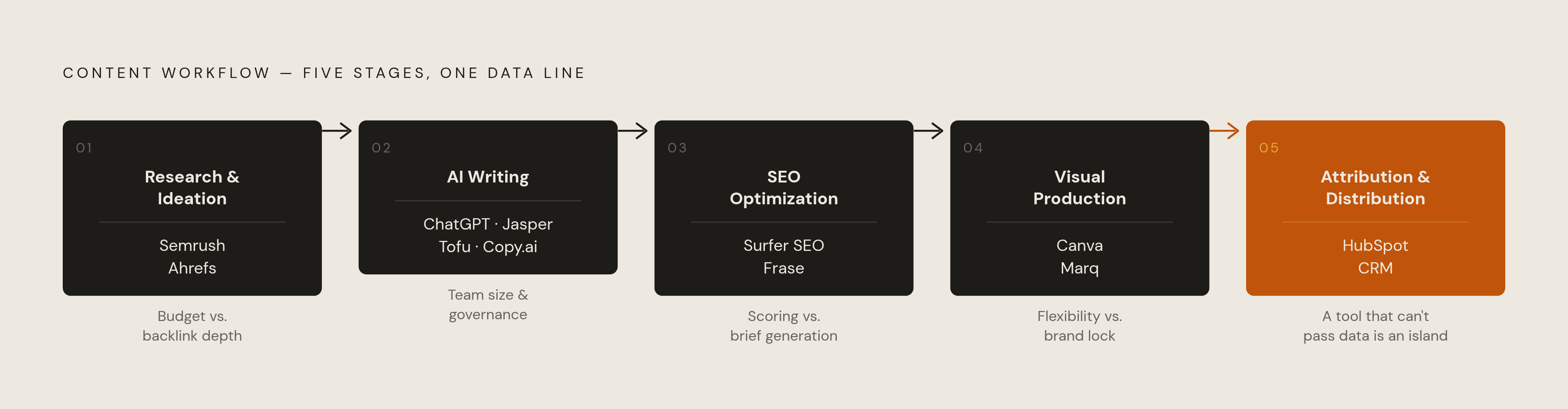
Build by workflow stage, not by feature comparison or vendor pitch. Map your workflow from ideation through distribution. Identify the stage where the bottleneck is most acute right now. Choose the tool that solves that specific problem first, and confirm it integrates with what you already have before you purchase. Add the next layer only when the prior stage is functioning consistently.
The research and ideation layer, anchored by Semrush or Ahrefs, should be informing the writing layer, whether that is ChatGPT for a lean team or Jasper for a team with governance requirements. The writing layer should feed directly into SEO optimization, through Surfer SEO or Frase, before anything is published. Visual production, through Canva or Marq depending on governance needs, should be triggered by a completed content brief. And all of it should connect to whatever platform provides attribution reporting, whether that is your CRM or another reporting tool, so that content activity translates into pipeline visibility.
A tool that cannot pass data to the next stage in the workflow isn't a useful tool. It's an island that someone has to manually bridge every week, and that manual bridging is where both accuracy and scalability quietly erode.
The part that gets skipped most often: tools do not create a repeatable engine. Documented workflows do. The tools are what make the workflows executable at speed. If the workflow doesn't exist in writing before you buy the tool, the tool will be used inconsistently, and inconsistent use is how a well-intentioned strategic investment becomes a line item that nobody can justify at budget review. Workflow first, tool second.