What Growth Marketing Teams Actually Need From Content
Most content programs fail because they lack strategic architecture and sales alignment.

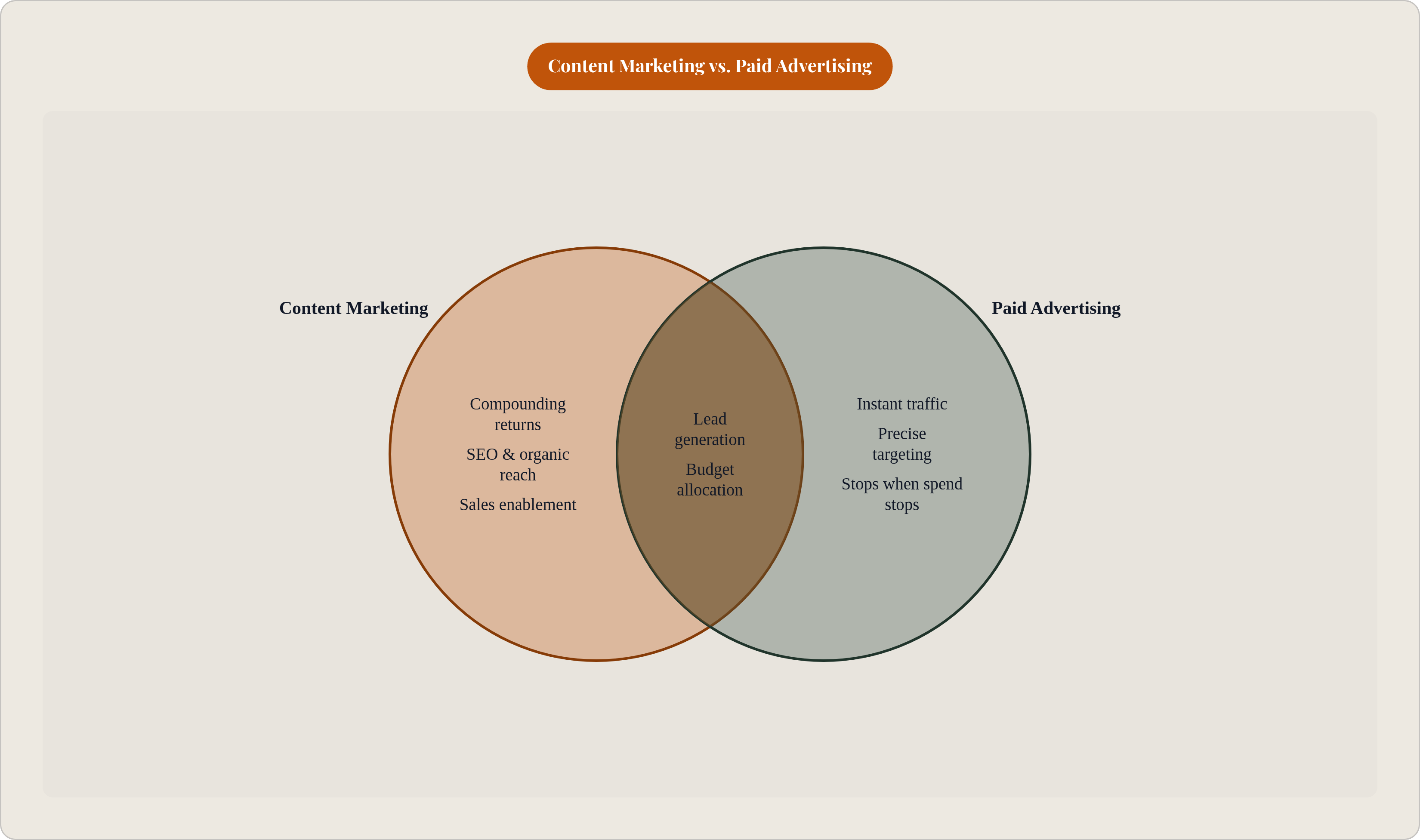
Content marketing is widely reported to outperform paid advertising on return, and the structural logic isn't complicated: paid media stops producing the moment spend stops, while content keeps generating returns long after publication. That compounding dynamic is the real economic argument for investing in quality and strategic architecture rather than raw output.
The lead generation math reinforces it. Content marketing generates more than three times the leads outbound does, at dramatically lower cost per lead, according to Demand Metric. Budget is following that evidence: content marketing's share of total marketing spend rose to 26% in 2026, and nearly half of B2B marketers planned to increase their content budgets in 2025 compared to the prior year, per CMI's 2025 report.
One caveat, and it matters: averages obscure a brutal distribution. The aggregate ROI case is compelling. Most individual content programs aren't capturing it.
The execution gap that explains why most content doesn't pay off
Content performance doesn't distribute like a bell curve. A small minority of content generates the overwhelming share of returns, and which side of that line a program falls on is largely a function of strategic architecture, not how hard the team works.
The CMI 2025 data makes the pattern hard to ignore. Fifty-eight percent of B2B marketers rate their content strategy as only moderately effective. Nearly half cite a lack of clear goals as the primary reason. Only one in three say they have a scalable content creation model. These teams are publishing. They just aren't publishing against documented outcomes that would let them diagnose what's working and adjust with any precision.
The documented-strategy multiplier is real. Organizations with a documented content strategy generate three times more leads per dollar than those without one. Why? Because documentation forces you to name which audience segment, which funnel stage, which buyer question, which measurable outcome you're actually targeting. Without that specificity, you don't have a content program. You have a collection of articles that happen to live on the same domain.
The gap isn't budget, and it isn't effort. It's the absence of strategic architecture that ties each piece to a result someone in leadership actually cares about.
The sales-content misalignment problem that quietly kills pipeline impact
Sixty-five percent of marketing content is never used by sales teams, per RWS. Most of what content teams produce never enters a sales conversation, and that's not purely a content quality problem. It's a structural alignment failure, and it's expensive.
Look at the incentive structures and the problem explains itself. Marketing typically optimizes for traffic and engagement. Sales optimizes for pipeline and revenue. When those teams operate in silos, content gets built for metrics that don't connect to closed deals. The gap between those two sets of priorities is where content goes to die.
The cost is measurable. Companies with strong sales and marketing alignment achieve significantly higher win rates and close deals more efficiently. LinkedIn's "The Art of Winning" report cites a 38% improvement in win rates and up to 67% improvement in closing efficiency among aligned organizations. Those are real revenue numbers, not operational tidiness.
What alignment actually looks like is less abstract than most frameworks suggest. Sales surfaces the objections and questions they're encountering in the field. Marketing builds content that directly addresses those specific concerns. Goals shift from "increase blog traffic by 20%" to "increase sales-qualified leads from content by 20%." Content gets evaluated on whether sales can use it to advance a real conversation, not on how many impressions it generated.
Content that doesn't map to sales conversations isn't a growth asset. It's overhead.
What it means to engineer content for pipeline velocity across the full funnel
B2B buyers conduct extensive online research before speaking to a salesperson; most engage with multiple pieces of content before initiating contact. Gartner and others have documented this consistently enough that it's no longer a nuanced finding. It's baseline buyer behavior. Every touchpoint in that pre-sales journey is a pipeline asset, which means every gap in your content coverage is a place where a buyer loses confidence or drifts toward a competitor.
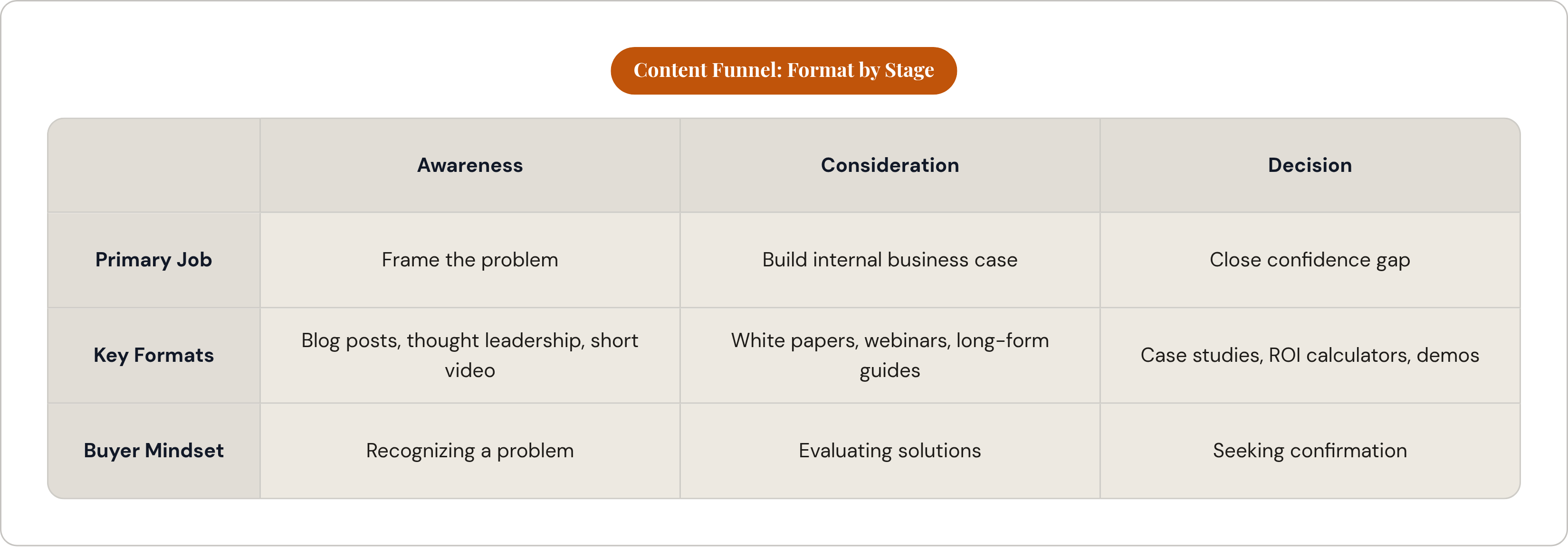
Each stage requires content doing a genuinely different job. Awareness content frames the problem in terms that resonate with how buyers already experience it: educational blog posts, thought leadership, short-form video. Consideration content provides depth, because buyers are now building an internal business case and need the material to do that: white papers, webinars, long-form guides. Decision content closes the confidence gap: case studies, ROI calculators, product demonstrations.
One concept worth building into your operational playbook is what some teams call pipeline acceleration bundles, curated content packages sales can deploy when deals stall, combining customer success stories, third-party validation, and implementation roadmaps in a single handoff. The goal is shortening the distance between "still evaluating" and "ready to commit."
There's also a dark matter problem most content strategies still ignore. An increasing share of buyer research happens in channels invisible to analytics: private Slack communities, LinkedIn direct messages, internal discussions among buying committees, peer recommendations that never touch a vendor's website. You can have perfect funnel coverage and still lose deals that were decided in a Slack thread you'll never see. Content strategy needs to account for word-of-mouth amplification and community presence, not just SEO and paid traffic.
Every piece should have an explicit job, defined by stage, buyer question, and desired next action, before it gets created.
Which content formats growth teams should actually be prioritizing right now
Production convenience has long driven format selection. That's a reliable path to content that doesn't perform. Short articles are the most commonly produced format in B2B marketing by a wide margin; they don't rank among the top performers for driving business results. The format-to-outcome mismatch is well documented and widely ignored.
CMI's 2025 data is specific. Video delivers the best results for the majority of B2B marketers who name a top-performing format. Case studies and customer stories follow closely. At the decision stage in particular, case studies carry meaningfully higher pipeline conversion rates than most other formats, because a buyer who's almost ready to commit isn't looking for more information; they're looking for confirmation.
Interactive content is the most underutilized category in B2B tech: ROI calculators, total cost of ownership comparison tools, maturity assessments, diagnostic quizzes. A buyer who inputs their own data gets a personalized output that reflects their specific situation. No static blog post can replicate that. The output feels earned rather than generic, which is precisely why buyers trust it more and share it internally with their buying committees.
Email, when driven by meaningful personalization, returns roughly $42 for every dollar spent, according to the Data & Marketing Association. In-person events and webinars rank as the most effective distribution channels for B2B content, and LinkedIn delivers strong value as a social platform for B2B audiences, per CMI's 2025 data.
None of this means stop writing articles. It means format selection should follow funnel stage and buyer behavior, not what's easiest to produce this week.
Why quality and substance have become the differentiating variable as AI raises volume for everyone
The majority of marketers now use generative AI tools, and AI-assisted production has dramatically reduced the cost per unit of content. The consequence is obvious once you say it out loud: if every team can produce more content cheaply, volume stops being an advantage. It becomes noise.
Greg Kogan, VP of Marketing and Growth at Pinecone, has noted that he wants more material going out faster, but it has to have substance. His "WABL" test, asking whether anything would be lost if a given piece didn't exist, is a practical quality filter that cuts through the production-for-production's-sake instinct that AI tooling can easily amplify. Most content fails it.
A significant portion of businesses worry that AI-generated content lacks originality, and a comparable share finds it difficult to incorporate a distinctive voice into AI-assisted work. Both concerns point to the same conclusion: human oversight at the strategic and editorial layers isn't a nice-to-have. It's where the differentiation actually lives.
Teams using AI for research, outlining, and first drafts while maintaining human ownership of strategy, voice, and final editing produce substantially more content at equivalent quality, and generate meaningfully more leads per month than purely human workflows, according to recent data. The speed comes from the machine. The judgment comes from the people.
Gartner's CMO Spend Survey found that marketing budgets declined to 7.7% of revenue in 2024, the lowest level in a decade, while the number of channels requiring coverage has tripled since 2019. That math doesn't work without AI in the workflow. Sixty-five percent of effective content teams cite relevance and quality as their primary driver of results. That's the variable that separates programs generating outsized returns from the majority that don't recoup their investment, and it's the one AI can help with but cannot supply on its own.
How growth teams close the measurement gap and connect content to revenue
More than half of B2B marketers cannot accurately attribute ROI to their content efforts, per CMI's 2025 report. If you can't connect content to revenue, you can't make the case for more resources, and you can't diagnose which specific decisions drove results. You're flying without instruments and hoping the direction feels right.
The attribution challenge in B2B is structural, not just a tooling problem. The average B2B buying cycle runs more than ten months, with buyers reporting sixteen or more interactions with the winning vendor before a deal closes, per 6sense's 2025 report. A guide a buyer reads in month one will not appear as closed revenue until month eleven. Single-touch attribution models aren't built for that reality, and most teams are still using them.
Measurement also has a budget dimension that gets underappreciated. Teams that track revenue attribution receive higher budget increases than those that don't, per CMI's 2025 report. Marketers who calculate ROI are substantially more likely to receive budget increases in the following cycle. This is not a peripheral concern; measurement is how the next investment gets funded.
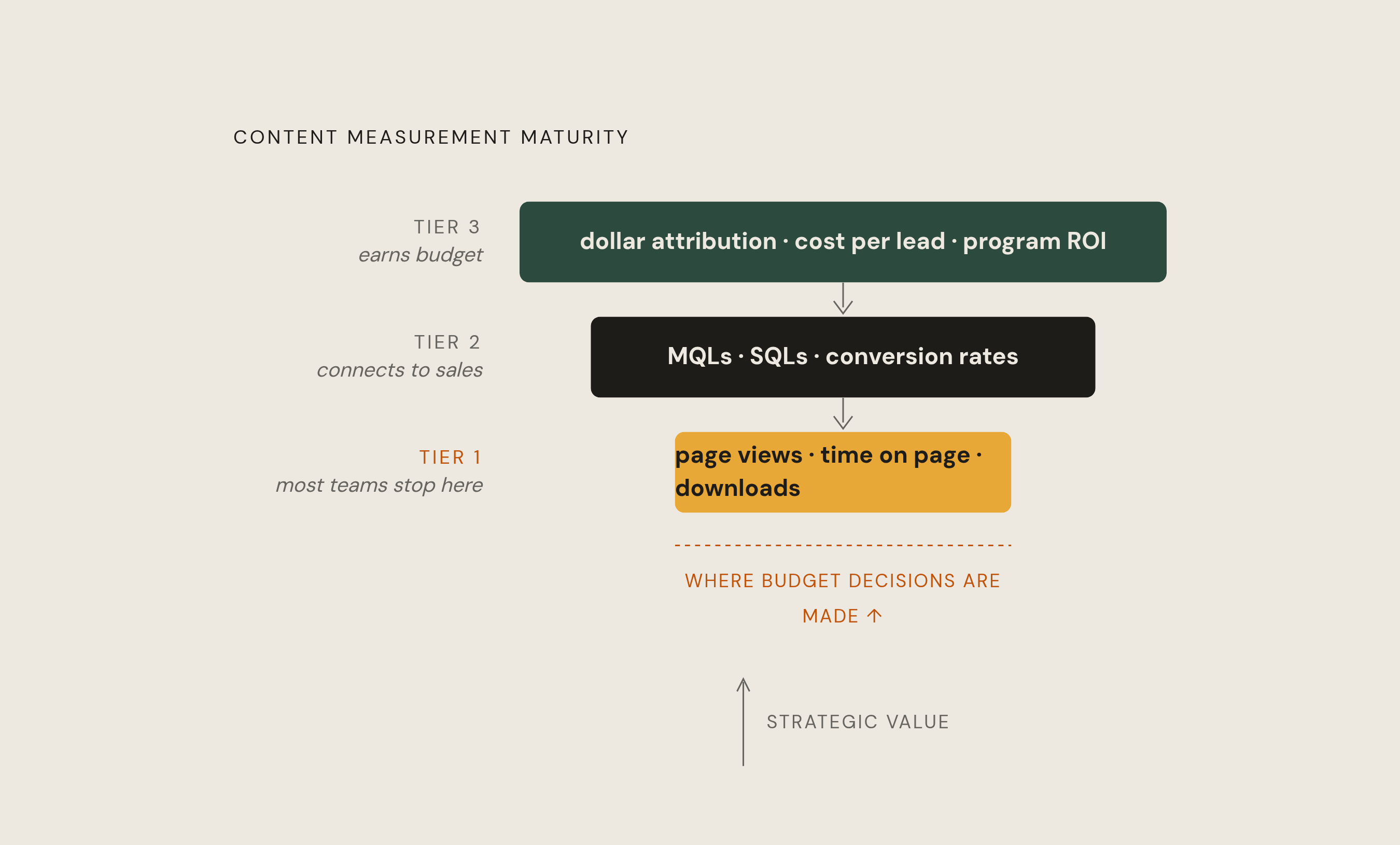
The framework that works for growth teams operates across three tiers, and most marketers are stuck on the first one. Engagement metrics, things like page views, time on page, and downloads, are diagnostic indicators. They tell you something happened; they don't tell you whether it mattered. Pipeline metrics, marketing-qualified leads, sales-qualified leads, conversion rates, are the connective tissue linking content activity to sales outcomes. Revenue metrics, the dollar amount attributed to specific content, cost per lead, overall program ROI, are the layer that earns budget and earns trust from leadership.
Most teams measure the first tier and call it attribution. Closing that gap requires treating measurement as part of the content system from the start, not an appendix you write during quarterly reporting. Instrument the full pipeline from the moment a piece is created and something counterintuitive follows: the rigor of measurement improves performance. You find what's working and do more of it. You find what isn't and stop. The teams who figure this out early are the ones who keep getting resources while everyone else is explaining why content is hard to measure.