Content Strategy Frameworks That Actually Map to a B2B Funnel
Buyers need different content for each funnel stage—and most B2B teams get the middle one wrong.

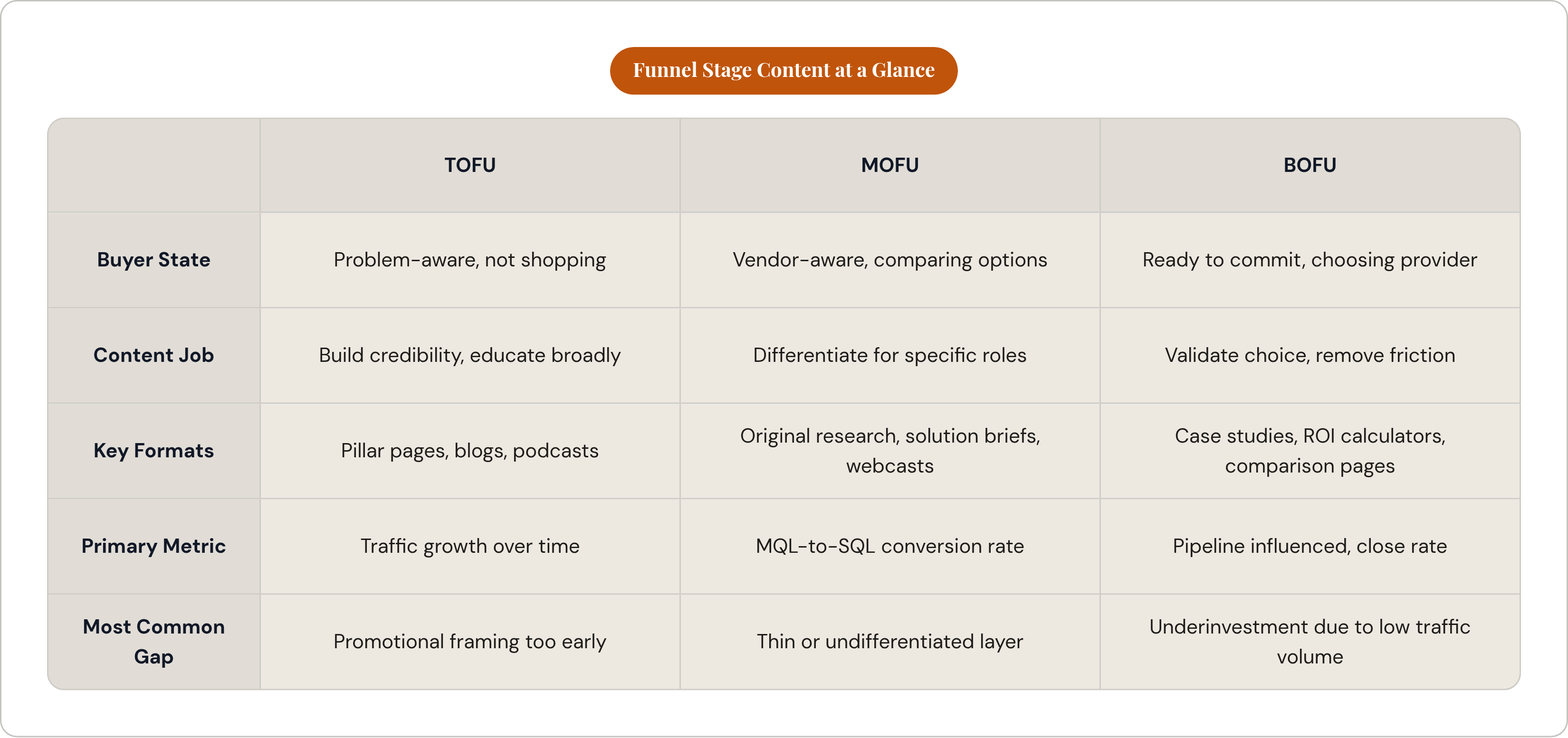
The three stages describe buyer behavior, not marketing categories. TOFU is where a buyer understands they have a problem but hasn't started shopping for solutions. They're consuming content broadly and are not evaluating you yet. MOFU is where the buyer has become vendor-aware and is actively comparing options. They need differentiation, not more education. BOFU is where the buyer has decided they want to solve the problem and is now determining which solution earns the commitment. At that point, they need confidence and friction removal, not another persuasive pitch.
B2B forces you to take this framework seriously in ways B2C simply doesn't. Sales cycles stretch for months. The typical buying group includes six to ten decision-makers, each carrying different questions, different risk tolerances, and genuinely different definitions of what success looks like (Gartner, "The New B2B Buying Journey," 2019). Most of that committee's evaluation happens before any vendor ever enters the room. B2B buyers consume, on average, around thirteen pieces of content before making a purchase decision (FocusVision, "Content Matters Research Report," 2019). Each of those pieces is doing a funnel-stage job whether the publisher intended it that way or not.
The framework's real value is interrogative, not taxonomic. Before any piece goes into production, it forces a single question: what is this buyer actually trying to figure out right now? That reframe sounds simple; it is the entire shift. Everything downstream follows from it. Think of it as a map drawn by the buyer — your job is to read it accurately, not redraw it to suit your messaging calendar. Most teams get this backwards: they treat the funnel like a megaphone when it's actually a compass.
TOFU frameworks: building awareness without burning trust
The TOFU objective is to reach buyers who don't yet know you exist, or who haven't yet framed their problem in a way that makes you relevant. The trap most teams fall into here is producing content that describes the product rather than the buyer's problem. Promotional framing at the awareness stage signals to buyers that they're being sold, not helped. That signal ends the relationship before it starts.
The structural backbone of effective TOFU content is the pillar-cluster model. A comprehensive pillar page covers a broad topic at genuine depth and is supported by cluster articles addressing specific subtopics, all internally linked. This signals topical authority to search engines and, increasingly, to the AI recommendation layers that are beginning to mediate how buyers find content. A pillar piece can take several months to gain traction; once it ranks, it pulls consistent inbound interest for years. That's a different return profile than a one-off post, and the compounding advantage is genuinely hard to replicate quickly once a competitor has it.
Educational formats that earn traction at TOFU include blog posts addressing common category-level problems, educational video, and podcasts. Podcasts in particular are underrated at this stage because they build trust and establish a point of view without triggering the promotional alarm bells that more direct formats do. The tone across all of it should be authoritative and useful. The buyer is trying to understand their problem. The more completely you help them do that, the more credibility you've accumulated before you ever mention what you sell.
Website traffic is the most commonly tracked TOFU metric, which is useful and dangerously incomplete without downstream conversion context. Measure improvement over time against realistic baselines, not against BOFU performance. Comparing the two is a category error that quietly distorts investment decisions.
One thing attribution models almost never capture: TOFU content travels. Educational pieces get shared inside buying committees, cited in Slack threads, forwarded in LinkedIn DMs. That circulation generates commercial influence with no form fill attached. Design TOFU content for human shareability, not just search crawlability. Those are genuinely different briefs, and conflating them is one of the more common and costlier oversights in content planning.
The MOFU gap: where most B2B funnels quietly collapse
Teams invest in TOFU traffic generation and BOFU sales materials, then leave the middle thin. You can see it clearly when you audit an asset inventory: fifteen blog posts, two case studies, and a product sheet that's eighteen months out of date. Pipeline goes quiet at the consideration stage, and most teams don't realize it until they're staring at an MQL-to-SQL rate that refuses to move. It's like pouring water into a funnel with a hole in the middle and wondering why the cup stays empty.
MOFU content has one job: move a buyer from "I know you exist" to "I believe you are the right fit for my specific situation." That's harder than it sounds. Generic messaging that worked fine at TOFU actively hurts at MOFU because it dissolves into competitive noise. Buyers at this stage are comparing vendors side by side. If your content reads like everyone else's, the differentiation mandate has already failed before the sales team gets involved.
The formats that earn the MOFU job demonstrate a genuine point of view and address the buyer's specific role and concern. Original research positions the brand as a trusted advisor rather than another vendor with a feature list. Solution briefs connect capabilities to pain points directly rather than describing features in the abstract. Webcasts and virtual events build relationship and context before a sales conversation is ever scheduled.
Role-specific asset variation is one of the most underused tactics available at this stage. A technical buyer needs to see integration capabilities and security certifications. A financial buyer needs total cost of ownership and a defensible ROI story. An operational buyer needs to understand workflow impact and what change management actually looks like on the ground. Producing one generic asset and hoping it resonates with all three is a decision that guarantees the deal stalls somewhere in the committee. No single stakeholder sees their specific concern addressed, and the deal dies of diffuse ambiguity rather than an explicit objection anyone could argue against.
The metric that surfaces the MOFU gap most clearly is MQL-to-SQL conversion rate. Teams using behavioral scoring and stage-specific content consistently outperform those running undifferentiated nurture. The distance between a mediocre conversion rate and a strong one is, almost without exception, a MOFU problem.
BOFU frameworks: validating the decision and removing friction
BOFU content is not closing copy. The buyer at this stage has already decided they want to solve the problem. What they need is confidence that your solution is the right one and enough reassurance that the risk of choosing you is defensible to their CFO, their board, or procurement. The real function of BOFU content is validation, not persuasion.
Competitor comparison pages address the evaluation buyers are already conducting independently. Better to shape that comparison than leave it entirely to a third-party review grid where you have no editorial input. ROI calculators give financial buyers a defensible number to carry into internal approval conversations, and that internal approval conversation is often the actual blocker at this stage even when it doesn't look like one from the outside. Case studies are the primary social proof vehicle, and specificity matters far more than production polish: industry, use case, measurable result. A tightly scoped case study from a recognizable company in the buyer's vertical with a concrete outcome does real work; a vague success story with no numbers does almost nothing, regardless of the brand name attached.
Short video testimonials belong prominently on the site, not buried in a resource library. Implementation guides directly address perceived switching costs and post-purchase anxiety, which often constitute the real objection at BOFU even when buyers articulate something else entirely.
BOFU is also where sales enablement and content production must be developed jointly rather than sequentially. Case studies get forwarded in sales emails. Pricing pages get visited before demo calls. ROI calculators end up embedded in proposals. If content and sales are misaligned on what BOFU assets exist and how to deploy them, those assets underperform regardless of their quality.
BOFU keywords carry low search volume, which looks unimpressive in traffic reports. This is precisely why BOFU is chronically under-resourced. But a page generating fifty monthly visitors who are genuinely evaluating vendors produces more pipeline than a page generating five thousand visits from people who were never close to buying. The consistent underinvestment in this stage, driven by vanity traffic metrics, is one of the more expensive habits in B2B content.
How ABM reconfigures funnel-stage content for named accounts
ABM doesn't replace funnel-stage content. It personalizes which version of each stage's content reaches which account and in what sequence. The buying committee reality is what makes ABM worth the operational complexity: multiple stakeholders, most of them conducting research anonymously, each carrying a different question the funnel needs to answer.
The three execution tiers carry different content implications. Tier 1, a small set of high-priority named accounts, demands custom landing pages, personalized video outreach, and bespoke content built to address the full buying committee at a specific company. Every MOFU asset is written for that account's actual context, not a persona archetype. Tier 2 uses vertical-specific messaging with personalized sequences that reference company-specific context rather than generic industry observations. Tier 3, the programmatic layer, relies on intent-triggered advertising to named account lists with minimal customization. It is funnel-mapped content delivered to a filtered audience rather than the open web, which is a meaningful distinction even when the content itself isn't heavily personalized.
ABM creates the most measurable commercial impact at MOFU. The consideration stage is where the full buying committee is most actively engaged simultaneously, where multiple stakeholders at the same account are each evaluating different dimensions of the same decision. TOFU is wide by nature; BOFU narrows to one or two decision-makers in a relatively focused conversation. MOFU is where personalized, role-specific content changes outcomes most visibly, and where generic content fails most expensively.
The dark funnel's effect on how funnel-mapped content should be built and measured
Buying committees are privately discussing and validating vendors in channels tracking tools cannot reach: private Slack workspaces, LinkedIn DMs, industry Discord servers, internal email threads. The evaluation starts in private, well before it surfaces in any search query or review site visit. A buyer who reaches you through a demo request has often spent weeks consuming your content in channels that recorded nothing. The last measurable touchpoint gets the credit; the foundational work that shaped the shortlist gets ignored. Most of what actually drove the decision is invisible by the time anyone looks at the data. Think of it as an iceberg: the demo request is the tip, and everything that shaped the decision sits silently below the waterline.
AI-assisted research adds a newer layer of invisible influence. Adoption of LLMs for vendor research among business decision-makers has grown, and content that fails to surface in AI-generated answers is invisible to a growing share of the market. This is a current concern worth acting on, not a future one worth merely monitoring.
The attribution distortion this creates is structural, not accidental. Last-touch models systematically over-credit the final measurable touchpoint and under-credit the TOFU brand and thought leadership work that actually shaped the shortlist. Most teams know this. Most continue using last-touch models because the alternatives are harder to implement and harder to explain to leadership. That's an organizational incentive problem, not a measurement technology problem.
Two practical adjustments follow from this. First, design TOFU content for shareability within buying committees. Content that travels in private channels is doing commercial work even when it generates no form fill. Opinionated, well-structured, genuinely useful content travels; generic content sits. Second, stop evaluating TOFU purely on direct lead attribution. Pipeline influence, branded search lift, and self-reported attribution captured in CRM notes are better proxies for the actual work brand content is doing in channels you can't see. They're imperfect; they're still better than crediting the demo request page for everything that happened in the six weeks before it.
Reddit deserves a specific mention here. A meaningful share of B2B leaders now report using it for unfiltered peer feedback before making a final vendor choice (Demand Gen Report, "B2B Buyer Behavior Survey," 2023). That's a signal that third-party credibility and earned presence matter at BOFU, not just owned content on your own domain.
Allocating content investment across funnel stages based on where the gaps are
Start with an inventory audit. Map every existing asset to a funnel stage. Most teams find the same pattern: heavy TOFU skew, thin MOFU layer, a BOFU that consists of a few dated case studies and a product demo page. That imbalance is often the direct explanation for why traffic grows while revenue doesn't.
A reasonable reallocation for most B2B programs shifts investment toward MOFU and BOFU, the stages where conversion decisions actually happen, and pulls back from continued TOFU volume accumulation. What that split looks like precisely depends on where your specific conversion gap appears. The audit tells you; don't guess.
If visitor-to-lead rate is low, TOFU content is either too promotional or too thin to earn trust. If MQL-to-SQL rate is low, buyers aren't getting enough differentiated content to choose you over alternatives. If sales cycle length is long and close rates are lower than expected, BOFU validation content is the shortage. Read the conversion data, identify the stage where momentum stalls, and direct investment there rather than continuing to add volume at the top of a funnel that's already full.
The factors most consistently associated with improving content effectiveness are relevance and quality, team capability, and alignment with sales. All three require knowing which stage a piece is built for. You cannot produce relevant content without clear stage-specific intent. You cannot align with sales without knowing which assets belong at which point in the buying process. Funnel-stage mapping converts "produce more content" into "produce the right type at the right stage." Volume without that structure just accelerates the same misalignment, faster and at greater expense.
Build the framework, get it working, then add speed.