Content QA Process for Brand Consistency Across Large Teams
Ninety-five percent of companies have brand guidelines, but only twenty-five actively enforce them.

This piece is about the gap between having brand standards and actually enforcing them, and why that gap costs real money once you're publishing at volume with dozens of contributors and, increasingly, an AI model in the mix. Consistent brand voice correlates with revenue increases of 23-33%, according to Lucidpress's 2019 State of Brand Consistency Report and a 2016 Demand Metric partnership study. Poor consistency does the opposite: 52% of senior professionals at mid-sized and large businesses report it costs their companies more than $6 million a year. The mechanism connecting the two isn't aesthetics, it's trust, and trust breaks the moment your packaging, your rebrand, or your customer-facing copy contradicts itself.
Trust is a fragile currency. Edelman's 2024 Trust Barometer found 71% of global consumers treat trust in a brand as a "buy or boycott" factor, and PwC research puts the exit rate at 32% of customers leaving after just one bad experience. Inconsistency counts as a bad experience. It tells the customer that nobody's driving.
The 2024 examples are almost too on the nose. Mattel's Wicked-branded packaging pointed consumers to an adult website instead of a movie tie-in page, a mistake that triggered a $5 million class action lawsuit and forced product pulls from major retailers. Jaguar launched a rebrand campaign that didn't feature a single car, and European sales dropped to 49 units in one month. Neither failure happened because nobody had a style guide. Both happened because nothing was checking whether the thing that shipped matched the thing that was supposed to ship. That's the whole article, really: not "why brand consistency matters," which everyone already nods along to, but what actually stops the gap between the guide and the output.
Why having a style guide is not the same as having a QA process
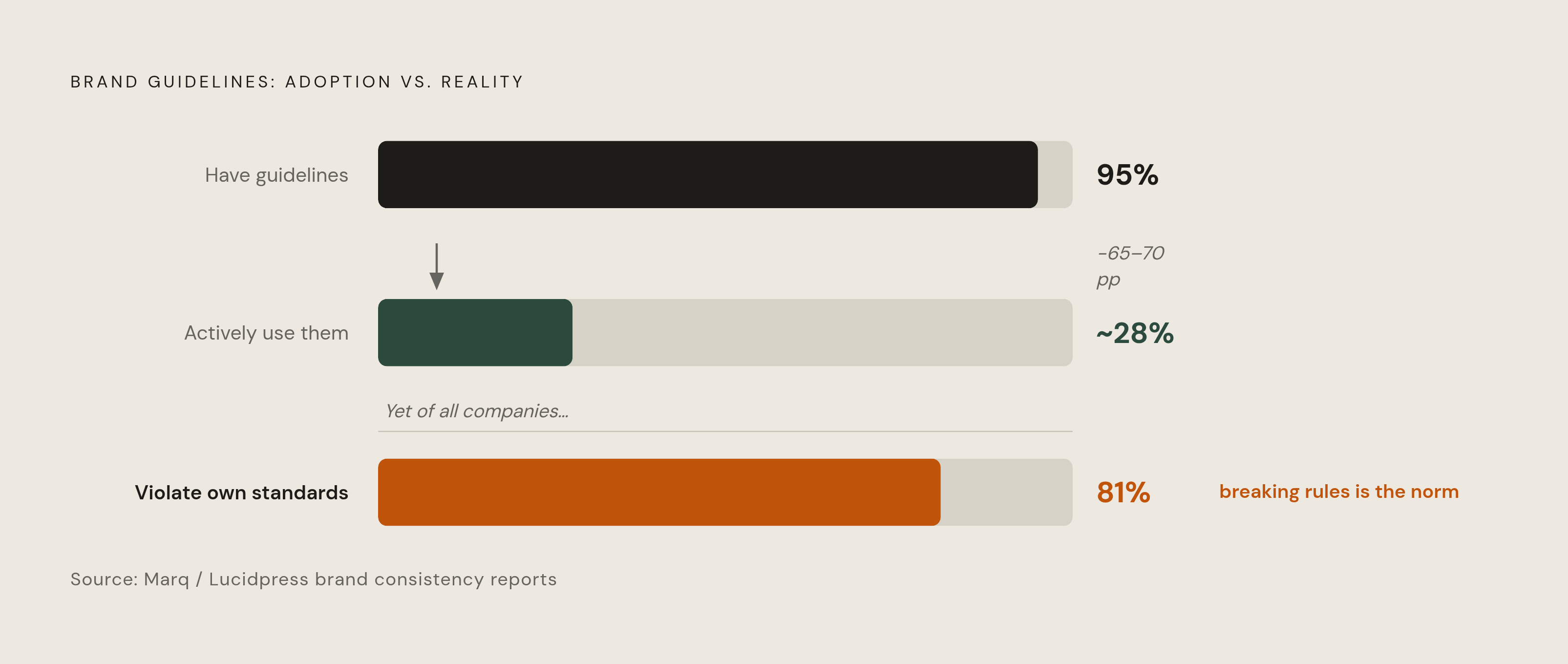
Here's a number that should bother you more than it probably does: 95% of companies have brand guidelines, but only 25 to 30% actively use them across the organization, according to 2024 research from Capital One Shopping. That's not a small gap. That's most of the iceberg sitting below the waterline while everyone congratulates themselves on the tip.
And it shows up in the work. The 2019 Lucidpress report found 81% of businesses regularly produce content that violates their own brand standards. Not competitors' standards. Their own. Imagine writing the rulebook and then losing four out of five games to it.
This isn't a motivation problem. Nobody's stress-testing brand guidelines by defying them on purpose. The failure is structural: a style guide documents what good looks like, but documentation doesn't enforce anything by itself. It's a photograph of a destination, not a car. When one editor holds the whole brand voice in her head and reads every draft before it ships, things stay consistent, sort of by accident, because she's the QA process, whether anyone calls her that or not. The moment headcount grows past what one person can personally read, that accidental system collapses, and new contributors are left trying to reverse-engineer expectations nobody wrote down.
Org charts make this worse before they make it better. The Content Marketing Institute's Enterprise Benchmarks report for 2025 found 61% of enterprise marketers cite organizational silos as a top non-creation challenge, and 47% cite managing content workflow and approval as a challenge in its own right. Marketing, e-commerce, and customer service teams working from different playbooks don't produce inconsistency because someone dropped the ball; they produce it because nobody built a shared ball to begin with. Marketing leaders report spending roughly a fifth of their time correcting off-brand materials, which is a tax, not a fluke, and it's the tax you pay for treating a reference document like a control system.
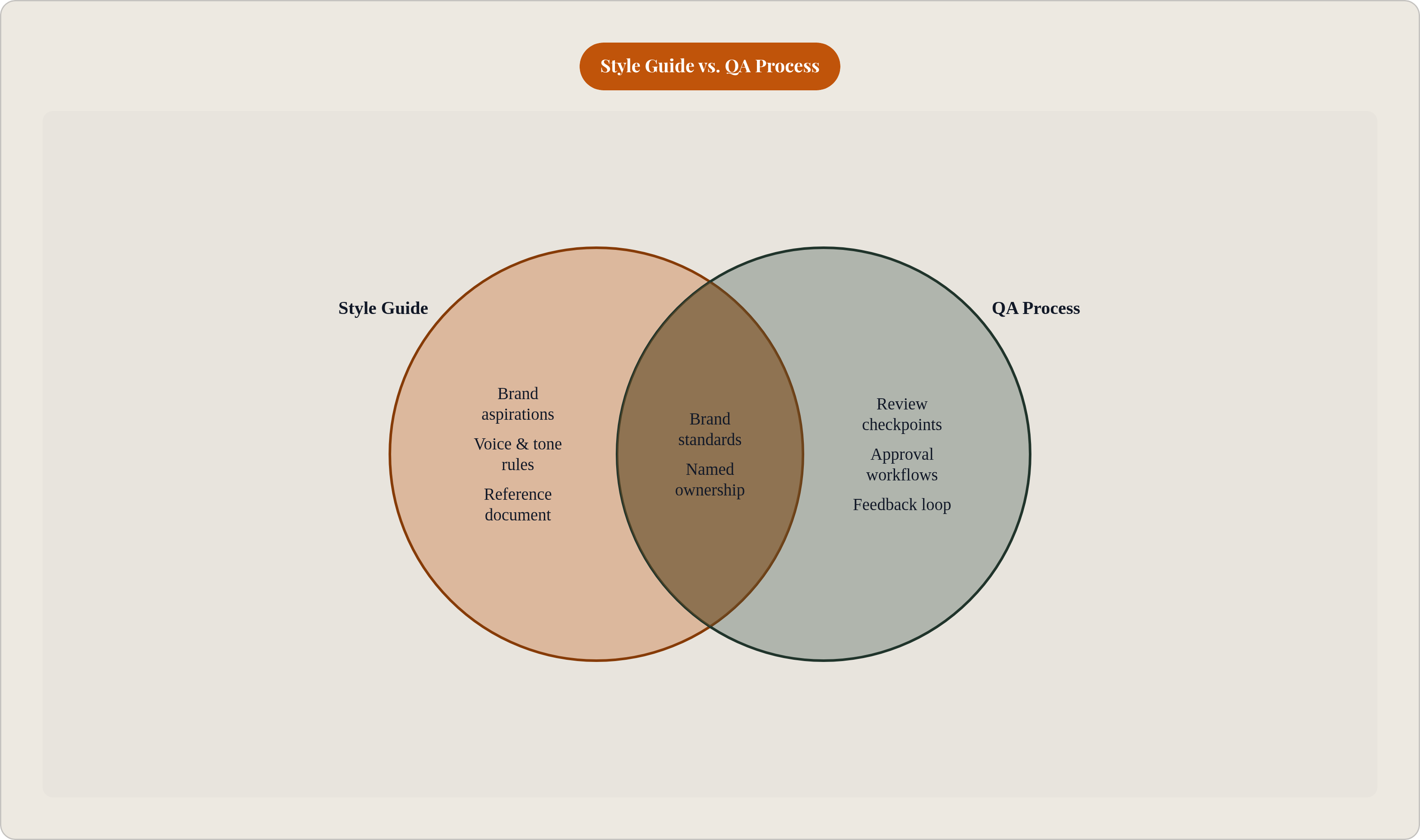
So here's the distinction worth sitting with before we go further: a style guide is a reference. A QA process is a system with owners, checkpoints, and a feedback loop that actually closes. The rest of this piece is about building the second thing, on the assumption that you already have the first.
How AI content generation raises the governance stakes
AI writing tools stopped being optional years ago. CMI's 2026 B2B research puts adoption at 89% of B2B marketers using AI to generate or optimize written content, and Bynder's 2026 State of DAM research estimates three-quarters of all content produced now is AI-touched in some way. That's not a trend anymore. That's the water everyone's swimming in.
Governance hasn't caught up, and the gap is wide enough to notice from space. A 2026 survey from the American Arbitration Association found 87% of large organizations have some form of AI governance in place, but only 22% believe those systems actually work. Sixty-two percent of enterprise organizations have written generative AI usage guidelines, according to CMI's enterprise research, yet only 1% of enterprise marketers call their AI output quality excellent. So most companies have rules on paper and almost nobody trusts what the rules are supposedly governing. That combination should feel familiar; it's the style-guide problem all over again, just with a faster, more confident culprit.
Here's the part that trips people up: AI doesn't lie to sound bad. It optimizes for plausibility, and plausible is not the same thing as on-brand. A sentence can be grammatically flawless, factually adjacent to correct, and still sound like it was written by nobody in particular, which is its own kind of failure when your entire brand promise is sounding like somebody in particular. Sixty percent of marketers using generative AI say they're concerned it could damage brand reputation through bias, values misalignment, or plain inconsistency. Misattributed facts. Tonal drift that creeps in a sentence at a time. Claims stated with total confidence that don't reflect what the brand actually believes. None of that gets caught by a standard proofreading pass, because proofreading checks whether the sentence is correct, not whether it's true to anything.
Which raises an obvious question: if the failure mode is different, why would the review process stay the same? AI-generated content needs a dedicated human QA pass built for this specific kind of error, and it needs to be designed in from the start of your workflow, not bolted on after the Jaguar-sized mistake already happened. We'll get concrete about where that pass sits in a couple sections.
The role structure that makes QA work before content is written
Three jobs get conflated constantly in content organizations, almost always to their detriment. The content strategist owns the topic map and the brief; she decides what gets made and why. The managing editor owns editorial standards and the actual editing function; he decides whether the thing that got made clears the bar. The content ops lead owns tooling, workflow, and measurement; she decides whether the whole system holds up once volume triples. Put all three hats on one head, and watch all three jobs get done at 60%.
Two roles get chronically understaffed or skipped outright: the editor and the operations lead. Both gaps produce the exact same symptom, which is output that's inconsistent in quality and unpredictable in timing, even when the writing itself is fine on a sentence level. CMI's 2025 B2B benchmarks found 54% of B2B marketers with dedicated content teams run teams of just two to five people, and 24% have no dedicated content staff at all. Role clarity matters more, not less, when everyone's already stretched across three functions and answering to two different bosses.
At scale, how you govern matters as much as who's on the chart. Federated governance, meaning shared templates and training and automated QA tooling paired with local execution by individual teams, is the model that tends to balance central control with the flexibility that distributed teams need to move fast. It works right up until the guardrails stop being enforced, at which point standards erode quietly and nobody notices until the quarterly content audit turns into a horror movie. Forrester Consulting's 2024 research for Hyland found organizations investing in more mature content services report governance challenges at 34%, compared to 48% among less mature teams. That's not a marginal difference. That's roughly a third fewer fires to put out.
CMI's 2025 enterprise research lands on a finding worth anchoring the whole section to: what separates high-performing enterprise content programs isn't how much they publish. It's how tightly governed the process is, meaning clearer roles, stronger execution of strategy, and smarter coordination at each stage of the pipeline. Volume is a vanity metric here. Governance is the actual scoreboard.
Building the editorial standards document that the QA process can actually enforce
A working editorial standards document is not a brand book, and treating it like one is where most companies go wrong first. A brand book is aspirational; it lives in a PDF nobody reopens after onboarding. An editorial standards document is operational: contributors open it while they're actually writing, because it answers the question they have right now.
Voice and tone guidance needs concrete before-and-after examples, not adjectives. Telling a writer the brand voice is "confident" tells that writer approximately nothing; showing a weak sentence next to its confident rewrite tells them everything. Formatting conventions should differ by content type, because what a blog post needs and what a product page needs and what a sales email needs are three different animals wearing the same brand colors. Heading hierarchy, citation standards, a list of preferred and avoided terms: all of it belongs here, along with an update cadence that has a named human attached to it. A style guide with a quarterly review trigger and an owner stays alive. An unowned one goes stale within two quarters and starts costing you credibility every time a contributor catches it being wrong.
Timing matters more than people expect. Document the standards while the team is small, because it's far easier to write down what one good editor already does instinctively than to reconstruct a baseline from ten editors who've each drifted a little differently over eighteen months. Retroactive standardization requires you to first identify the drift, which requires a documented baseline to measure drift against, which is exactly the thing you skipped. It's a circular problem, and the only way out of the circle is to have started earlier than felt necessary.
None of this is about trust, and it's definitely not a leash on creativity. A standards document exists to take things off a writer's plate, not put things on it. Contributors should be spending their attention on argument and judgment, the stuff that's actually hard, not burning cycles remembering whether the product name takes a capital letter or how the brand formats a citation. Checklists exist so editorial judgment can go where it's actually needed.
The QA checkpoint structure: what gets reviewed, by whom, and at what stage
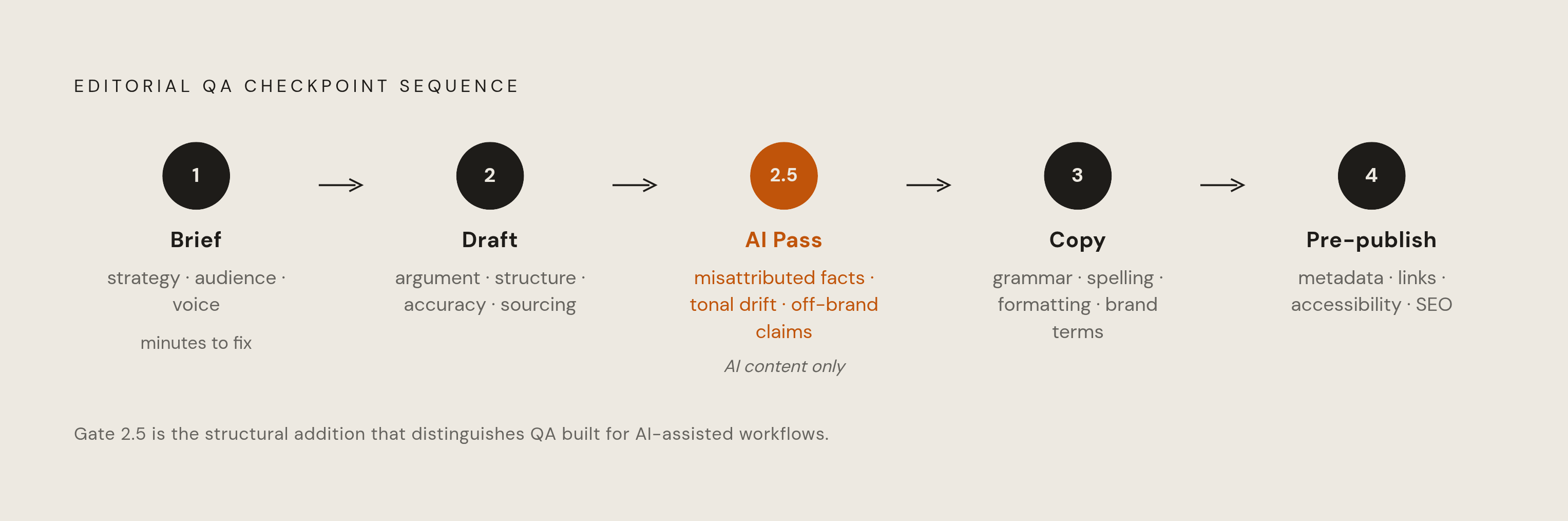
QA isn't one review that happens at the end, right before publish, like a final boss. It's a sequence of gates spread across the whole production process, and each gate is built to catch a different category of mistake before it compounds.
The brief-level gate comes first: does the brief reflect the actual strategy, the right audience, the correct voice guidance? Problems caught here cost minutes to fix. Problems that slip through this gate cost hours of rework three stages later, which is the whole argument for catching them early. The draft-level gate is substantive editorial review, meaning argument, structure, voice, accuracy, and sourcing, not a light proofread; this is where the managing editor role earns whatever budget line it's sitting on. The copy-level gate handles grammar, spelling, formatting, and brand terminology, and tool-assisted review belongs here, though it isn't sufficient by itself. The pre-publish gate covers metadata like titles and descriptions and schema, link testing internal and external, accessibility checks including alt text and heading structure and color contrast and mobile readability, and SEO requirements around headers and keywords and URL structure.
For AI-generated content, add a dedicated pass between the draft and copy gates. This pass checks specifically for misattributed facts, tonal inconsistencies, and confident-sounding claims that don't actually reflect the brand's position on anything. Fluent phrasing that doesn't sound like your brand slips right past a copy-level gate, because grammatically the sentence is fine; it's just fine in somebody else's voice. This pass needs a reviewer who actually knows what the brand sounds like, not just someone checking the rulebook.
Every contributor, regardless of experience, should be working off the same publishing checklist: grammar and spelling checked by a human and a tool, brand voice confirmation, complete metadata, tested links, accessibility requirements, SEO requirements. This isn't about distrust of the writer. It's about not asking one person to hold every requirement in their head while also making good editorial calls, because that's two full-time jobs pretending to be one. Issues that start upstream, in a bad brief or a flawed template or an AI draft nobody double-checked, tend to surface only after real work has already gone in downstream. That's precisely why the gates exist in sequence: catch the problem at the cheapest possible moment, not the most expensive one.
Designing approval workflows that don't become bottlenecks
Picture the manual review chain that's probably familiar to you: a designer finishes an asset, sends it to a manager, the manager forwards it to legal, legal suggests three edits, the edits go back to the designer, and the whole loop starts again. Every handoff is a delay, and every handoff is also a chance for something to get lost or misread. This pattern doesn't fail because the people in it are slow. It fails because the routing is implicit and sequential when it could be explicit and running in parallel.
Not every piece of content deserves the same depth of review, and pretending otherwise is how bottlenecks get built. A social post might need one approval. A white paper might need three. A product page making legal claims needs a compliance review the social post never will. The tier should come from content type, audience, channel, and actual risk, decided in advance, not from whoever happens to be at their desk when the file lands. Define the tiers before the fire drill, and you avoid both over-review, which is slow, and under-review, which is how the Wicked packaging happened.
Workflows that survive scale share a few traits. Routing happens automatically to the right reviewer at the right stage, with no manual forwarding required. Status is visible to everyone involved, so nobody's sending a "just checking in" message on day three. Comments, suggested edits, and approvals all happen in one place instead of scattered across email threads and shared drives that three people forgot to check. And each review stage has a defined service window; if a reviewer doesn't respond in time, the process escalates instead of just sitting there.
Here's the underlying principle, and it's worth stating plainly: a QA process people route around because it's too slow is worse than a lighter process they actually follow. Compliance only happens when the system is faster than the workaround. Speed and quality aren't in tension when the workflow is designed well; that tradeoff only shows up when the process itself is the problem. Firework's omnichannel research found only a small fraction of retailers believe they've fully mastered consistency across channels. That gap between what companies want and what they actually deliver is, almost every time, a workflow problem wearing a standards-problem costume.
How tooling supports the QA system without replacing editorial judgment
Tools do three different jobs in a content QA system, and mixing them up is how gaps open. Standards enforcement tools, meaning style and grammar checkers, brand voice linters, terminology managers, catch rule violations at a scale human reviewers can't sustain once fatigue sets in around draft forty of the week. Workflow management tools handle assignment, routing, approval tracking, and status visibility, replacing the implicit forward-and-hope handoff with something explicit and auditable. Asset governance tools, digital asset management systems and template libraries and brand portals, make sure contributors are grabbing the current logo and not the one from three rebrands ago.
Forrester's 2023 research found 65% of customer content goes unused because of findability, relevance, or quality problems. That's not purely a creation issue. It's a governance and tooling issue, because content nobody can find or trust is content your team is quietly going to make a second time, at full cost, without realizing the first version already exists somewhere in a folder nobody labeled properly.
AI-powered tools are increasingly good at the rules-based layer: automated terminology checks, metadata completeness, the kind of pattern-matching that's tedious for a human and trivial for software. That's genuinely useful, and it's worth adopting. But it's worth being honest about where it stops. A tool can tell you a sentence is grammatically sound and the metadata field isn't empty. It cannot tell you whether the argument holds up, whether the tone matches what your brand actually believes about itself, or whether a claim is one a compliance officer would want to see before it ships. That judgment call still belongs to a person, the same way it always has, and no amount of tooling changes that math. The tools clear the fog so the humans can see the actual decision in front of them; they were never going to be the ones making it.