In-House Content Team vs Content Marketing Agency Tradeoffs
In-house teams win on long-term cost, agencies on short-term speed.
This piece is about the actual tradeoffs between building an in-house content team and hiring a content marketing agency, and why the choice isn't the clean either/or that most planning meetings pretend it is. Outsourced marketing work rose from roughly a quarter of the total in 2020 to nearly half by 2024, and yet the majority of large organizations surveyed by the ANA in 2023 said they also run an in-house content operation. Both facts are true because most companies aren't choosing one lane; they're running two, and the interesting question isn't which model wins but which parts of the job belong where.
The three models actually in play, not just two
Everyone talks about this like it's a two-horse race, but it rarely plays out that way in practice.
A traditional agency owns production end to end and hands you finished work; you get the output but rarely a window into how the sausage got made. An in-house team owns everything, strategy, drafting, editing, the accumulated memory of every campaign that flopped and why. And then there's a third thing that doesn't fit neatly into either box: managed content platforms and AI-assisted production layers, where the brand keeps strategic control and governance while a vetted specialist network or a software workflow handles the actual production.
That third model matters more than it gets credit for, because it changes what "cost" and "control" even mean in the comparison. It carries less overhead than a full hire, and less opacity than a traditional retainer. Companies citing a lack of internal resources as their top reason for seeking outside help make up a large share of the market, but "outside help" now covers a wider spectrum than it did five years ago. Get the model wrong before you start comparing numbers, and you'll spend the rest of the analysis optimizing for a question you didn't mean to ask.
What an in-house team actually costs once you count everything
Salary is the number everyone quotes and the number that misleads everyone. Content marketers average somewhere in the six-figure range a year as of the most recent data; content marketing managers run higher, somewhat higher. Senior marketing managers and directors, per federal labor data from 2024, sit at a considerably higher median. Those are just the numbers on the offer letter.
Now add the stuff that never makes it into the budget slide. Benefits typically tack on another 20 to 30% over base salary, and recruiting fees, if you're using outside help to fill the role, run 15 to 20% of first-year pay. Tools, software licenses, onboarding time where the new hire is more or less shadowing someone instead of producing anything, all of it adds up fast. An $80,000 hire, once you add it all up, lands closer to $105,000 to $115,000 in year one, before they've published a single piece of content that a customer will ever read.
Scale that to a team and the number stops being quaint. A four-person content team runs $450,000 to $550,000 a year in salary alone, according to a 2025 analysis from MarketerHire; tack on $30,000 to $60,000 in software subscriptions and another $20,000 to $40,000 in recruiting costs per role filled, and you're well north of half a million before anyone asks about ROI. Here's the part that doesn't show up on any spreadsheet: management overhead, the three-month ramp where output is thin, and the fact that when your best writer leaves for a competitor, so does two years of institutional context about what your brand voice actually sounds like. You can't put that on a line item, but you'll feel its absence the day it walks out the door.
What agencies actually cost and what drives the range
Retainers for content marketing agencies typically run $3,000 to $15,000 a month for a mid-market program. Full-service shops with a dedicated account team start higher, often $10,000 to $20,000 a month or more. That's a wide range, and it's wide for a reason that has nothing to do with agency size.
Scope is what moves the number, not scale. A retainer that covers strategy, SEO, production, design, and distribution looks nothing like one that just covers blog posts. In a study sourced from Moz that looked at 30 content agencies, 70% sold monthly retainers rather than one-off projects, which tells you something important: most agency relationships are ongoing fixed costs dressed up to look flexible.
What actually drives the price up? Adding channels like video or social, requesting a dedicated account manager instead of a shared one, needing proprietary research or first-party data, and volume spikes around launches. The genuine advantage here is that agency spend is variable in a way headcount never is; you can dial it up for a launch quarter and dial it back in January. Around 48% of companies outsource some content marketing to agencies or third parties, per Forbes Advisor, but satisfaction with that spend correlates heavily with whether the scope was nailed down before the contract was signed, not after the first invoice showed up.
When the cost math flips depending on time horizon and volume
For a mid-market team producing a moderate, steady volume of content, an agency usually wins on cost-per-asset in the first six months. That makes sense, since nobody's ramping, nobody's onboarding, and the machine is already built and running somewhere else.
But the math flips somewhere past the twelve to eighteen month mark. An in-house person who's fully ramped knows the brand cold, needs no onboarding, and their effective cost per piece drops as output climbs, since the fixed salary gets spread across more work. Adweek reported that companies who moved creative production in-house cut their content production costs by more than 30%, though that number assumes the team is fully up to speed and volume is high enough to actually justify the fixed cost sitting on the books.
Three variables decide where you land. Monthly volume matters first: low and sporadic favors agency, high and consistent favors in-house. Complexity matters second: technical or regulated content tilts toward in-house judgment, general awareness content tilts toward whoever can turn it around fastest. Time horizon matters third, since short campaigns want agency flexibility and multi-year programs want the compounding return of a team that gets cheaper per piece the longer it sticks around. Leaders who treat this as a one-time fork in the road, decided once and never revisited, are almost certainly paying the wrong rate for whatever stage they're actually in now.
Speed to market cuts differently depending on what kind of speed you need
Which kind of "fast" are you actually asking for? Because there are two, and they point in opposite directions.
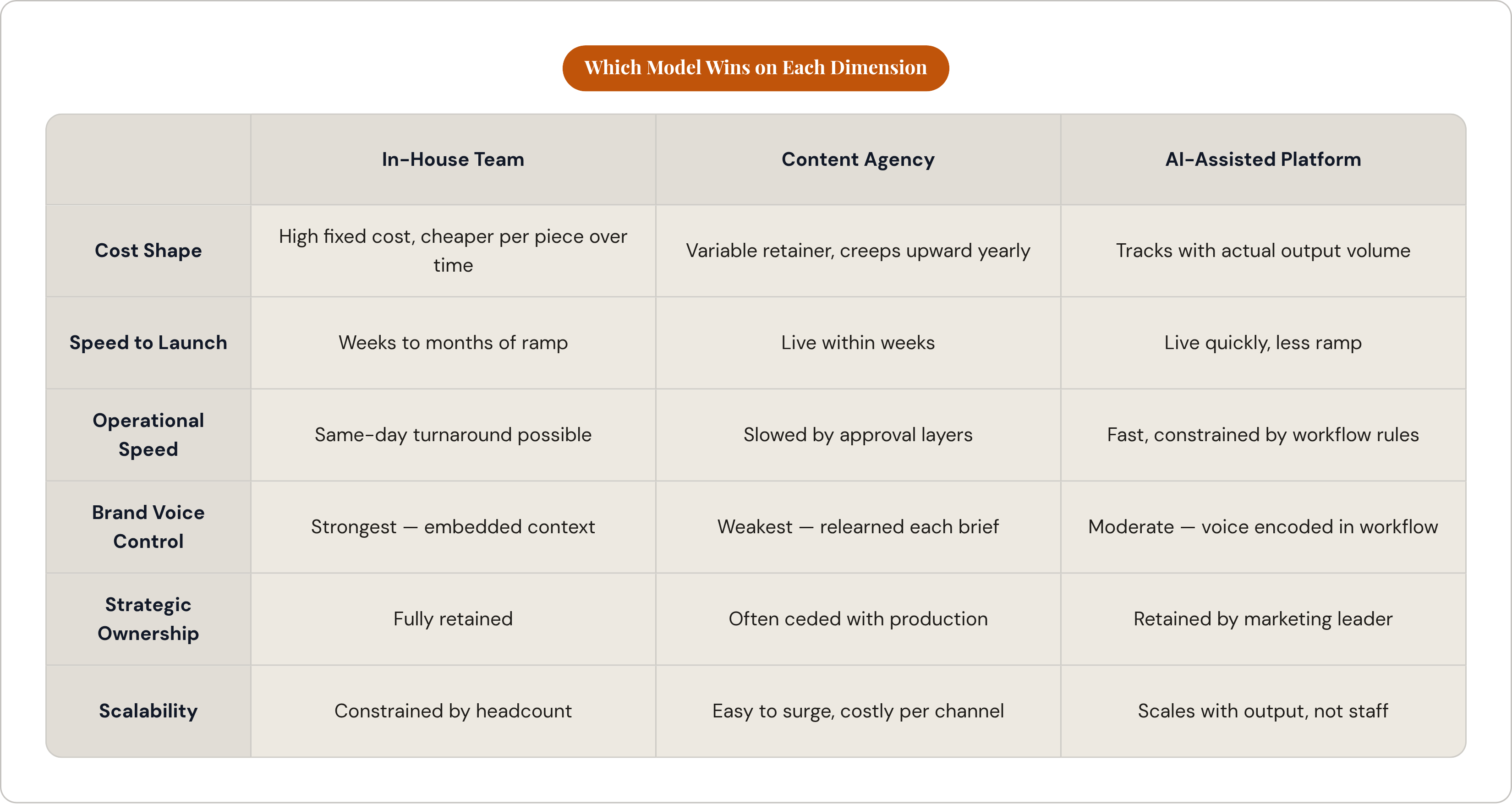
Startup speed favors the agency, no contest. The average time to hire for a marketing role runs around 50 days, and that's just for one seat; building a four-person team out means the better part of a year before everyone's onboarded and producing at full clip. An agency, by comparison, can be live in weeks and should be delivering first drafts within one to four weeks of the contract getting signed. A brand-new in-house hire, meanwhile, typically isn't producing anything a customer would see for two to three months.
Operational speed is where the tables turn completely. Once an in-house writer knows the brand's voice and the product roadmap, they can turn a breaking news moment into a published piece the same day. Try getting that through an agency's approval chain; the layers of review that exist specifically to protect the client relationship become the exact thing that makes same-day turnaround structurally difficult. News-driven brands, companies iterating fast on product, categories where being first is the whole competitive edge: these get a durable speed advantage from in-house that no service-level agreement will ever replicate. Agencies win the sprint to get started, while in-house wins the sprint to respond. Which one is faster depends entirely on which clock you're racing against.
Brand voice and specialized knowledge favor in-house, but the gap is narrower than it used to be
In-house teams have a structural head start on brand voice, and it's not close. They sit in on product meetings, absorb the inside jokes and the customer complaints and the reason the last rebrand happened, and they aren't relearning the company from scratch every time a new campaign kicks off.
The scale of the off-brand content problem is bigger than most leaders assume: 81% of companies say they struggle with content that drifts off brand, and that number gets worse, not better, once you add distributed teams, freelancers, and agency handoffs into the mix. This isn't just an aesthetic complaint either. Companies that keep their brand voice consistent see revenue gains between 23% and 33%, according to the Lucidpress study, which makes brand consistency a line item on the P&L, not a nice-to-have.
There's a specific gap worth naming: CMI's 2026 research found that a large majority of B2B marketers say they create thought leadership content, but only a small minority report real, substantial input from the people inside the company who actually hold the specialized knowledge. That's a gap an agency structurally cannot close, because they don't have a badge that lets them walk into the engineering team's Tuesday standup. For regulated industries or technical products where credibility is the whole game, this in-house edge compounds year over year. The honest caveat, though: an agency that specializes deeply in one vertical can match or beat a generalist in-house team on craft, especially on format and execution. The in-house advantage is strongest when the content is genuinely proprietary, weakest when it's just broad category education anyone with a good brief could write.
Scalability looks like an agency advantage until you examine what actually scales
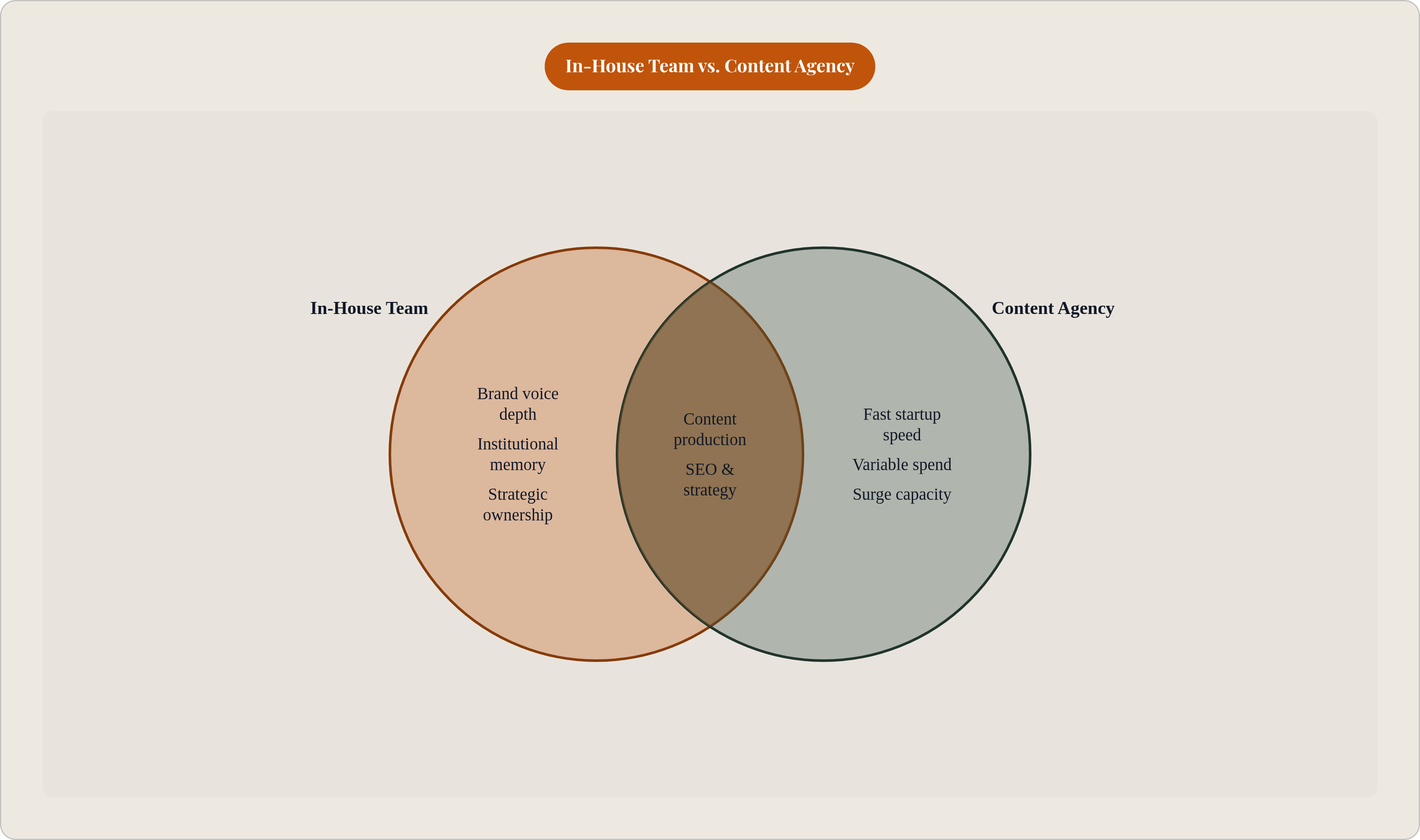
On paper, agencies scale better. You can bump a retainer without opening a single req in your HR system, and surge capacity for a launch doesn't require interviewing anyone.
Meanwhile, the in-house constraint is real and it's getting worse: a large majority of in-house marketers report their workload has gone up, and a majority of those say it's gone up significantly. A small team can't double its output without something breaking, whether that's quality or the people themselves.
But look closer at where the agency scalability story actually falls apart. Every new channel or format you bolt onto the scope, video, say, or a social push, raises the retainer; there's no volume discount the way there is with an in-house team once it's fully ramped and cranking. Retainers also tend to climb year over year rather than get cheaper as the relationship matures, which is the opposite of how in-house cost curves behave. And strategic work, the planning, the measurement, the research that actually shapes what gets made, almost never scales through an agency well; CMI's data shows these functions stay in-house even among companies that outsource heavily everywhere else. The resolution most mature programs land on is really a split: in-house owns the strategy and the steady publishing cadence, while a freelance or specialist bench handles the surge. They divide the labor sensibly rather than compete for the whole job.
Strategic control and transparency are the dimension that most leaders underweight
Here's the thing nobody puts in the RFP: agency work often means losing visibility into how decisions actually got made. What got tested, why the strategy pivoted midway through the quarter, what the data actually said before someone summarized it into a slide. When the work happens in your own building, you see the reasoning, but when it happens somewhere else, you get the output and have to take the reasoning on faith.
There's also a confidentiality question that's easy to wave away until it isn't. Content production sometimes means sharing roadmaps, customer data, or pricing logic with people who don't work for you, and that's a real exposure that in-house production simply doesn't carry.
CMI's data on how large organizations actually split their work is telling: among companies with more than 1,000 employees, roughly three-quarters of content marketing activity gets outsourced, but planning, measurement, and research stay almost entirely in-house regardless of company size. That's not an accident, and it's a pattern that reveals exactly where sophisticated marketers believe control actually matters: outsource the making, keep the deciding. A Typeface survey found that 60% of senior US marketing leaders said they're spending less on agencies in 2025 specifically because of AI, which suggests production is getting commoditized faster than strategic judgment is. Any in-house versus agency debate ultimately turns on who owns the thinking behind the content, not just who's producing it. Handing that over is a different category of risk than handing over the typing.
Where AI-assisted platforms change the tradeoff calculation
The old framing assumed you had two buckets to choose from: pay agency rates for outside production, or eat the fixed cost and the ramp time of building a team. AI-assisted content platforms with real editorial guardrails, more disciplined than a chatbot with a brand name slapped on it, break that binary in half.
Brand voice and strategic context can now live inside the workflow itself instead of depending entirely on one person's memory of how the CEO likes things phrased. That matters most for the control question raised in the previous section: a marketing leader using a strategy-first platform still owns the brief, the editorial direction, and the final approval, even as production speeds up and the dependency on a fully staffed team goes down.
It changes the cost shape too. The spend tracks with actual output instead of a flat monthly number regardless of volume, avoiding both the fixed cost of a full team and the creep of an escalating retainer. Tools like Percolate sit somewhere in this middle layer, and the honest question to ask any platform in that category is whether it enforces real strategic discipline, or just makes it easier to publish more of the same undifferentiated stuff, faster. No platform, however well-built, replaces the judgment calls that belong to an actual human leader: sensitive positioning, thought leadership that has to sound like a specific person, editorial calls that carry real reputational weight. The production layer keeps getting better, but the judgment layer is still, stubbornly, a person's job.
A decision framework for choosing the right model at your current stage
Four variables decide this, and none of them are "what feels impressive in a board deck." Time horizon comes first: anything under six months leans agency or platform, anything multi-year leans in-house, because that's where the compounding kicks in. Volume and consistency come second: sporadic output favors staying external, steady high volume favors bringing it in-house once you can stomach the ramp. Specialization comes third: technical, regulated, or deeply proprietary content wants someone who lives inside the company; broad awareness content can be produced well by people who don't. And appetite for strategic ownership comes fourth. If you want to actually own the direction and the measurement, not just sign off on deliverables someone else made, the in-house or hybrid path is the more honest answer.
For most programs that have been at this a while, the answer ends up being some version of a hybrid: in-house owns strategy, core brand publishing, and measurement, while external capacity handles surge, specialist formats, or one-off channels. The most common mistake is picking based on this quarter's budget snapshot instead of the eighteen-month trajectory, since a decision that looks efficient in month three often looks like a mistake by month fifteen. A large share of ANA member marketers, 70% by their own recent count, shifted work from agencies back in-house over the past three years. The ones getting the most consistent return tend to share one habit: deliberateness about which half of the job moved, and which half never should.