AI Writing Tool Accuracy on Technical and Regulated Topics
Fluent-sounding AI outputs hide accuracy gaps that widen dramatically in regulated work.
AI writing tools now touch most of the content produced in regulated industries, and the accuracy of what they produce depends almost entirely on how they're used, not just which model sits underneath. That's the whole piece in two sentences. Everything below is about where the risk actually lives, what drives it, and which habits close the gap between a fluent draft and a correct one.
Adoption crossed a real threshold sometime in the last two years. McKinsey found 88% of companies reported regular AI use in at least one business function by the fourth quarter of 2025, up from 78% the year before. Cherryleaf's 2025 survey put the number at 55% among technical communicators specifically, which matters because that's a profession built entirely on the premise that accuracy is the product. The tools promise fluency, and nobody reads the fine print closely enough to notice that factual reliability is a separate skill entirely. A model can write a sentence that sounds like it was reviewed by three attorneys and a compliance officer while being completely wrong. In a marketing email, that's an awkward Slack message to your manager. In a drug interaction summary or a court filing, it's a different kind of problem entirely. So where does the risk actually peak, what causes it, and what habits close the gap? That's the question this piece works through, section by section.
What hallucination rates actually look like across models and domains
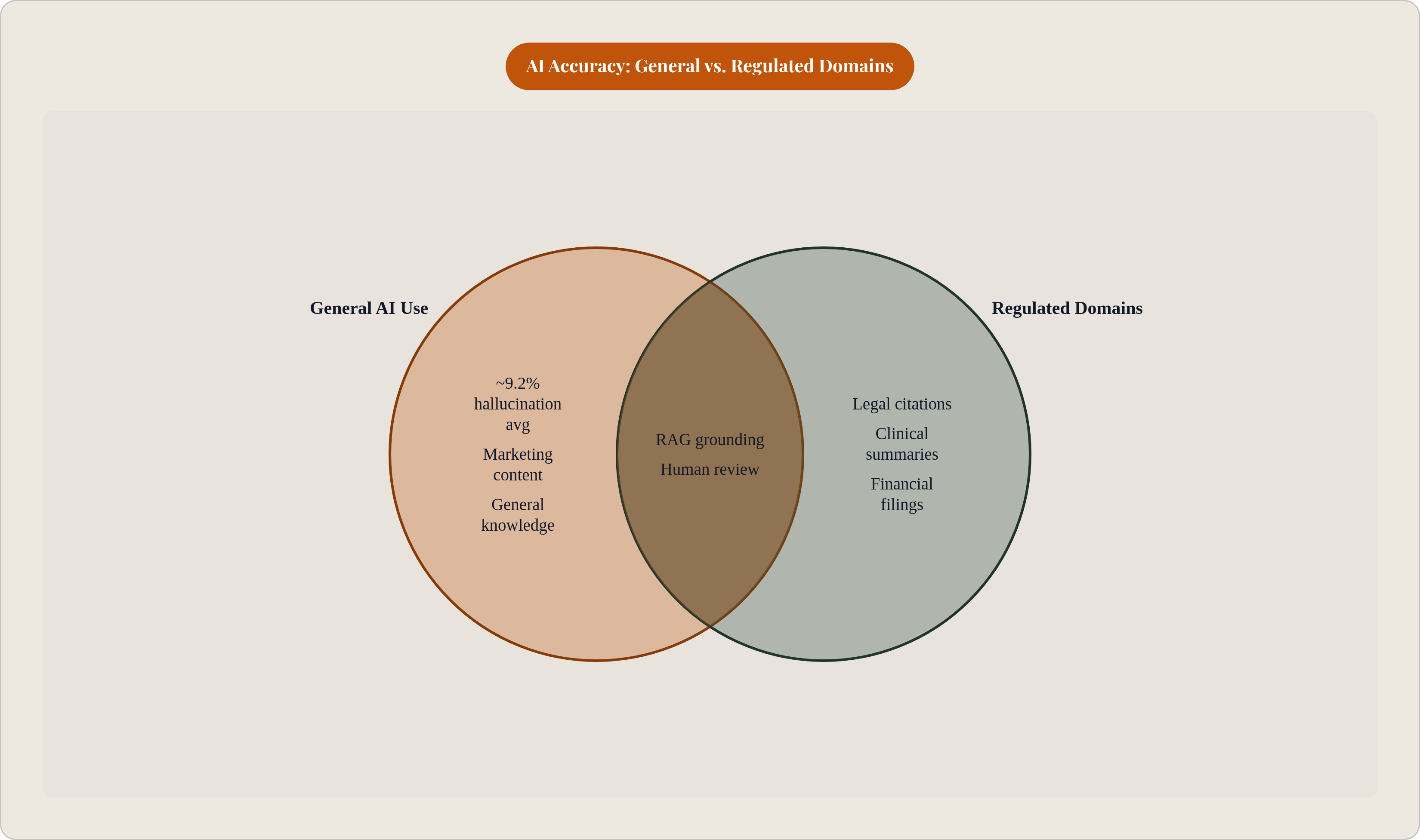
Start with the best number in the room: Google's Gemini-2.0-Flash-001 hallucinated in just 0.7% of responses on general knowledge benchmarks as of April 2025, the lowest rate recorded in that round of testing. Now the other end: TII's Falcon-7B-Instruct hallucinated in nearly 29.9% of its answers, which means almost one in three responses contained something invented. The average across models on general knowledge sits around 9.2%. That number feels useful until you notice what it's actually measuring.
General knowledge benchmarks test models on facts the internet has repeated a thousand times. Regulated and technical domains are a different animal. Domain-specific evaluations, covering scientific, medical, and regulatory content, report hallucination rates of 10 to 20% or higher, according to Cheilli et al. (2024). Legal information is a clean illustration of the gap: a hallucination rate of 6.4% even among top-performing models, compared with 0.8% on general knowledge questions asked of the same systems. That's roughly an eightfold jump, just from changing the subject matter.
Stanford HAI's 2026 AI Index makes the picture worse, or at least more honest. Under a new accuracy benchmark run across 26 top models, hallucination rates ranged from 22% to 94% depending on the model and the test conditions. GPT-4o's accuracy fell from 98.2% to 64.4% once the evaluation regime got harder. DeepSeek R1 dropped from over 90% to 14.4%. Read that twice. It means the accuracy number you quote for a model depends heavily on how you tested it, and real-world regulated work, messy, adversarial, full of edge cases, probably resembles the harder test more than the easy one.
Here's the part that no amount of engineering fixes: Xu et al. (2024) proved, mathematically, that hallucination can't be eliminated given how large language models generate text. They predict statistically probable sequences, and probable is not the same as true. Sometimes the most fluent-sounding continuation is also fiction. The real question, then, is which domains need the most active management, and why some need dramatically more than others.
Where medical and clinical content sits at the extreme of the risk spectrum
Over 40 million people ask ChatGPT health questions every day, and a recent American Medical Association report found more than 80% of physicians now use AI professionally, mostly to summarize research or draft clinical documentation. Do the arithmetic on that first number for a second: even a 1% error rate across 40 million daily queries works out to 400,000 wrong answers a day. Scale turns a small failure rate into a public health footnote.
A 2025 MedRxiv study on clinical case summaries found a hallucination rate of 64.1% when models were given no mitigation prompts at all, meaning close to two-thirds of AI-generated summaries contained something fabricated. Apply the best mitigation techniques available and the rate for the best-performing model still sat at 23%. That's the number worth sitting with: mitigation shrinks the problem considerably, but a residual risk this size still needs a human backstop.
Stanford and Harvard researchers found top AI models produced what they called "severely harmful clinical recommendations" in up to 22.2% of cases tested. The best-performing models still made 12 to 15 errors per 100 cases; the worst-performing ones erred 40 times out of 100, which is closer to a coin flip than anyone in a hospital should be comfortable with. Even OpenAI's Whisper, a speech-to-text tool rather than a text generator, hallucinated in about 1.4% of transcriptions in a 2024 study, at one point fabricating entire sentences and medication names that were never spoken. This failure mode shows up anywhere a model has to fill in a gap, chatbot or otherwise.
There's a small, almost funny detail buried in Mount Sinai's 2025 "fake-term" study that's worth pulling out. Researchers fed models a made-up medical term, something that doesn't exist in any textbook, and the models responded with detailed, confident, entirely fictional explanations anyway. No hesitation, no "I've never heard of this." Just a fluent little essay about a disease nobody has. But add one safety reminder to the prompt, something as simple as telling the model to flag unfamiliar terms, and the error rate nearly halved. That result suggests prompt design functions as a real, measurable control rather than a cosmetic step.
Institutions have noticed. ECRI named AI chatbot misuse the number-one healthcare hazard heading into 2026. The World Health Organization has said plainly that general-purpose AI tools aren't validated for clinical use. The FDA has cleared over 950 AI-enabled medical devices as of 2025, and not one of them relies solely on an LLM's output for a clinical decision; human oversight is already baked into how these tools get approved. For anyone writing medical content with AI assistance, the practical lesson is to treat every output as a first draft that needs a clinician's eyes before it reaches a patient or a practitioner.
How legal AI hallucination became a documented and rapidly escalating court problem
Law is the one domain where hallucination has left a paper trail, because courts write everything down. As of April 2026, researchers had documented 1,313 court proceedings where AI-generated fabricated content showed up in filings, and 496 of those involved licensed attorneys, not pro se litigants who might not know better. Law lecturer Damien Charlotin's running catalog has grown to 1,459 legal decisions citing inaccurate AI-generated content, and the pace has gone from two or three incidents a month to roughly five a day. About 90% of all documented cases happened in 2025 alone. This is an active, growing pile, not old wreckage being cleared out.
Sterne Kessler's 2025 analysis sorts the failures into three categories, and they get progressively harder to catch. First, citations to cases that simply don't exist, invented out of nothing. Second, fabricated citations attached to real cases or documents, a kind of mismatch between a real source and fake content. Third, and this one is the sneaky one, real quotes from real cases that don't actually support, or flatly contradict, the argument they're cited for. A fact-checker who only confirms that a case exists will sail right past that third category, because everything checks out on paper. The argument is just wrong underneath it.
General-purpose LLMs answering legal questions posted error rates between 69% and 88% in Dahl et al.'s 2024 evaluation of federal court case questions, with ChatGPT-4 at 58% and Llama 2 at 88%. Even the tools built specifically for legal research, marketed as retrieval-grounded and sometimes even "hallucination-free," produced incorrect or misgrounded answers on more than 17% of queries in Stanford RegLab and Stanford HAI's 2025 testing, published in the Journal of Empirical Legal Studies. One major tool exceeded 34%. Retrieval grounding helps, but it doesn't get you to zero, and marketing copy that implies otherwise is, at best, optimistic.
The financial consequences have escalated fast. Sanctions against attorneys for citing fabricated cases rose from modest amounts in 2023 to tens of thousands of dollars in individual matters by 2025, roughly an elevenfold jump in eighteen months. The U.S. District Court for the District of Oregon fined one attorney thousands of dollars in December for citing cases that didn't exist. The takeaway for legal writers and editors: citation verification catches the first two failure categories, but the third, the real quote applied wrong, needs a lawyer reading for substance, not a tool checking for existence.
What financial services content adds to the picture: regulatory citation failure and AI-washing risk
Financial writing has two accuracy problems stacked on top of each other. One is models inventing numbers and citations. The other is firms overselling what their AI actually does. Both are live regulatory issues right now, not hypotheticals.
On the fabrication side, GPT-4-Turbo paired with retrieval got a large majority of curated SEC filing questions wrong or simply refused to answer, according to Islam et al.'s 2023 evaluation, with systematic fabrication of financial metrics showing up across multiple models tested. Regulatory filings are precise in a way that punishes approximation: a number pulled from the wrong quarter, or the wrong exhibit, isn't a rounding error. It's just wrong, even if retrieval grounding was supposedly in place.
On the AI-washing side, the SEC fined two investment advisory firms a combined $400,000 in March 2024 for making false and misleading statements about their own AI capabilities. Securities class actions alleging AI-related misrepresentation doubled between 2023 and 2024, and nothing about 2025 suggests that trend cooled off. FINRA's Regulatory Notice 25-07, issued in April 2025, raises a question nobody's fully answered yet: does an AI chatbot's output, or an AI-generated call transcript summary, count as a regulated "business communication" under existing recordkeeping rules? Between 2022 and 2024, the share of firms flagging AI risk in their SEC 10-K filings grew sevenfold, and a substantial share of firms now disclose AI-related risk somewhere in their filings. That pattern reflects compliance departments reading the room correctly, not excess caution.
Where AI-assisted regulatory writing genuinely performs well, and why
Not every regulated writing task carries the same exposure, and pharma regulatory submissions make the case for cautious optimism. Merck, working with McKinsey, cut the time to produce a first-draft clinical study report from roughly three weeks down to three or four days, and cut error rates in half at the same time. McKinsey's broader 2025 benchmarking found leading pharmaceutical companies compressing submission timelines substantially relative to 2020 standards, with generative AI as one contributing factor among several process changes.
So why does this work when clinical chatbot advice so often doesn't? A few things line up here that don't line up in the medical chatbot scenario. The input data is known and bounded: trial results, protocol documents, prior regulatory feedback. The model is templating and synthesizing material that already exists, not inventing facts from a vague prompt. The workflow also builds in mandatory review checkpoints, so a regulatory scientist checks the draft before it goes anywhere near a submission. And the prompting itself is domain-specific enough to narrow what the model is even allowed to generate, which cuts down its room to wander off and confabulate.
Takeda said in 2025 that it was piloting generative AI for regulatory submissions, describing the submission package itself as "often the bottleneck" standing between a finished drug and the patients waiting for it. The FDA's 2025 draft guidance on AI in submissions points toward companies formally documenting their AI methodologies as part of the package itself, which suggests regulators are steering toward governed adoption rather than a ban. The pattern worth remembering: AI does the heavy lifting on structured, source-grounded work, and humans hold the pen on judgment calls and regulatory interpretation. That division of labor is what medical chatbots and legal citation tools are still missing.
What technically drives higher hallucination rates in specialized domains
Underneath all of this sits the same architectural fact: large language models generate text by predicting statistically probable sequences from patterns learned in training. Xu et al. (2024) showed this mathematically guarantees some rate of hallucination, because probable and true are related but not identical concepts. Specialized domains just amplify that baseline tendency in a few specific ways.
Training data is thinner here. Legal case law, clinical trial reports, and pharmaceutical filings make up a tiny fraction of what these models trained on compared to general web text, so the model has less signal to draw from and more room to interpolate, which is a polite way of saying "guess." Precision requirements also bite harder: a drug dosage, a financial ratio, a case citation is either correct or it isn't, and there's no partial credit for a fluent-sounding approximation the way there might be in a blog post about company culture. Add temporal drift on top of that. Regulations change, case law updates, drug labels get revised, and a model trained on a snapshot of the internet has no built-in way to know its information just expired.
None of these models flag their own uncertainty, either. That's the part people underestimate. A confident tone and a correct answer feel identical from the outside, so the reader has no signal to go on besides the fluency of the sentence, and fluency was never the thing that needed verifying.
There's a counterintuitive wrinkle with reasoning-focused models that's worth pausing on. OpenAI's o3 and o4-mini, both built around longer chains of internal reasoning, pushed error rates up to 33% and 48% respectively on person-specific questions. More reasoning steps should mean more chances to self-correct. Instead, it looks like more chances for an early mistake to compound, the way one wrong turn on a road trip gets worse the longer you keep driving before checking the map. The AI Incident Database logged 362 AI-related incidents in 2025, up from 233 the year before, a trend that lines up neatly with more deployment in higher-stakes settings without matching safeguards. The practical conclusion here has less to do with picking the fanciest model and more to do with constraints: a modest model wrapped in tight input constraints and real human review will beat a powerful model used carelessly, every time.
The guardrails that actually reduce error rates in practice
Three controls show up again and again across every domain in this piece, and none of them is a silver bullet on its own.
Retrieval-augmented generation, giving the model actual source documents (trial data, filings, case law, earnings reports) instead of asking it to recall from memory, narrows the space where invention can happen. It's the closest thing to giving the model open notes on a test. But the caveat matters: even purpose-built legal retrieval tools still exceeded 17% error rates in Stanford RegLab's 2025 testing. Grounding reduces hallucination, but the need for a human who actually knows the subject to read the output before it goes out the door remains, whether that's a regulatory scientist checking a CSR draft, a physician reviewing a clinical summary, or an attorney confirming that a real quote actually supports the argument it's attached to. Mitigation, prompting, sourcing: all of it moves the needle, and all of it still depends on the person whose job is to know when the fluent sentence in front of them happens to be wrong.