AI Content Tools Compared for B2B Marketing Teams
Choose the right AI tool based on your content complexity, not just features.

B2B marketing teams have sorted themselves into recognizable usage patterns, and where a team sits in that hierarchy determines almost everything about which tools deserve serious evaluation.
The lowest-stakes tier is also the highest-frequency one: brainstorming, summarizing research, drafting short social copy. Most teams started here, and for good reason. The lift is immediate and the downside is negligible. Industry surveys suggest B2B marketers save somewhere in the range of 20 hours per week when AI is applied across content, research, and campaign management workflows. Treat that figure as an order of magnitude, not a precise benchmark. Nobody has audited those hours.
The mid-complexity tier is where production volume actually lives: blog drafting, email sequencing, sales enablement copy. A large majority of B2B teams, per Digital Marketing Institute data, are using generative AI for at least one workflow here. Most organizations are camped in this tier right now, using AI to push content out faster without having fully confronted what that acceleration costs them in brand consistency or editorial quality.
The high-complexity tier is smaller by volume and more consequential: whitepapers, technical thought leadership, ABM content, multi-format repurposing programs. This is where tool choice has genuine teeth. A team drafting nurture emails can absorb inconsistent AI output and edit around it. A team producing a 3,000-word technical piece for a competitive category cannot rebuild it from scratch every cycle. At some point, someone asks whether the tool is actually helping or just creating more work in a different format — like hiring a sous chef who keeps rearranging the pantry instead of cooking.
Everything that follows in this piece matters most for teams working at mid-to-high complexity, where the gap between a well-fitted tool and a poorly-fitted one shows up in quality first and, eventually, in pipeline.
The Four Criteria That Actually Determine Whether a Tool Works for B2B Teams
Feature lists obscure more than they reveal. Every tool in this category generates text. Evaluating AI writing software by whether it produces sentences is about as useful as evaluating accounting software by whether it handles addition. What actually separates useful tools from expensive distractions is a narrower and considerably harder set of questions.
Strategy and editorial quality. Can the tool support content that requires a genuine point of view? Not fluent sentences. A point of view. Long-form B2B content underperforms commercially and competitively when it is generic, and most general-purpose AI tools are optimized for fluency, not argument. For teams producing content in technically complex markets, this is the first thing to assess, not the last.
Brand governance and consistency. B2B brands operate with style guides, approved terminology, audience profiles, and, in many industries, compliance requirements that are not optional. These constraints have to travel with every piece of content regardless of who drafts it. Multi-author teams amplify the drift risk substantially. Five people working in the same platform does not guarantee consistent output unless governance is built into the tool itself. Technical accuracy is a separate and harder problem: no current tool validates claims about complex product categories. That burden stays with human subject matter experts, full stop.
Workflow fit and integrations. Where does AI actually live in the team's production process? At the brief stage, the draft stage, the approval stage, all three? Does it connect to the CRM, the CMS, the SEO platform, the sales stack? Workflow gaps force manual handoffs, and manual handoffs quietly consume the time savings AI was supposed to deliver. A tool that produces excellent copy but requires the writer to paste between four systems is a tool that will either get abandoned or get worked around in ways that introduce their own inefficiencies.
Total cost relative to measurable return. Pricing in this category is deliberately opaque. Per-seat fees, usage credits, add-on charges, and enterprise negotiation all move the real number well past what any pricing page advertises. More importantly, ROI is uneven and time-lagged. Productivity gains appear fast. Measurable pipeline contribution takes longer and requires attribution infrastructure that many teams have not built. A tool that saves hours but does not improve content quality is a productivity investment. A tool that improves content quality is also a revenue investment. B2B leaders need to know which they are buying before they commit the budget.
General-Purpose AI Assistants: ChatGPT and Claude as B2B Writing Tools
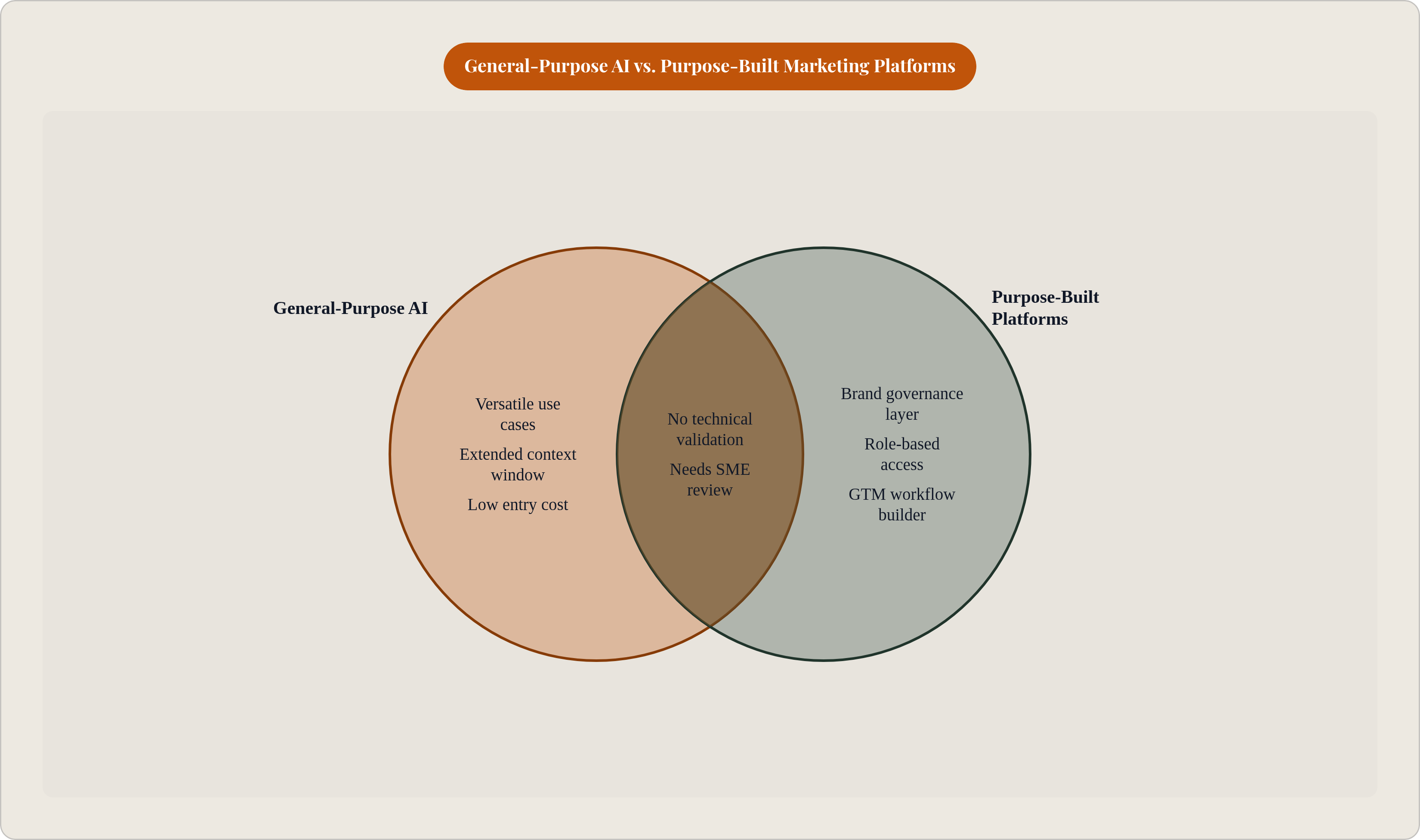
Both are conversation-first, model-first products. They were not built for marketing workflows, and that origin shows when teams try to scale them. They are capable of genuinely high-quality output when given sufficient context, but that context has to come from the user, every time, which is either a minor inconvenience or a serious operational problem depending on how the team is structured.
ChatGPT is the default starting point for a large share of B2B marketing professionals. Its strength is versatility: brainstorming, outlining, drafting, editing, and light data analysis all live in one interface. Custom GPTs allow teams to embed brand tone and editorial preferences into repeatable workflows, which partially addresses the consistency problem. The Team plan runs $25 per user per month, which makes it accessible for teams at most budget levels.
The limitation for B2B is structural, not cosmetic. Consistency degrades in multi-author environments unless Custom GPTs are carefully maintained across the team, and that maintenance is not trivial. Brand voice requires manual reinforcement in each session when those systems slip. For a lean team with someone who genuinely owns the prompt engineering, this is manageable. For larger content operations, it becomes a recurring coordination tax that is surprisingly easy to underestimate until you are three months in and the output has drifted — like a game of telephone where everyone started with a style guide and ended up with lorem ipsum.
Claude is where B2B teams land when editorial quality and depth are the primary requirement: thought leadership, long-form SEO articles, proposals, sales enablement documents that need to survive fewer editing passes. Its extended context window matters for certain B2B use cases in a way that is not just a spec comparison. Loading brand guidelines, competitor content, a style guide, and relevant case studies into a single conversation can genuinely hold voice across length in a way that session-limited models cannot.
Like ChatGPT, Claude is a model, not a workflow. Teams build their own production process around it. Neither tool validates technical accuracy, and for B2B categories with real domain complexity, human expert review is required regardless of which assistant a team uses.
Both tools are best suited to lean teams or individuals who can invest meaningfully in prompt engineering and workflow design. Neither is the right primary tool for teams that need consistent branded output at volume without that infrastructure already in place.
Purpose-Built Marketing Platforms: Jasper and Other Purpose-Built Tools Compared on What Matters for B2B
These three platforms share a marketing-team orientation but have diverged substantially in which problem each one solves first. That divergence is more useful to understand than any feature table, which will look roughly equivalent across all three until something breaks in production.
Jasper is a marketing-focused AI platform whose core value is consistent branded output at production scale without requiring the user to re-brief the tool each session. Its brand intelligence layer applies brand voice, style guides, audience profiles, and product knowledge across blog posts, social copy, ads, and emails. For teams that have struggled with brand drift in multi-author environments, that is a real operational improvement, not a marketing claim.
Vendor-sourced case study materials from Jasper's own clients point to time savings and campaign speed improvements for enterprise marketing teams. Weight those accordingly. The Creator plan runs $39 per month on annual billing; Pro is $59 per user per month; enterprise features require a Business tier conversation.
Two real limitations for B2B teams: brand voice consistency does not equal domain accuracy, so content about technical products still requires SME review; and SEO optimization is not native to Jasper. Teams that depend on organic search need to layer in a dedicated SEO tool, which changes the total cost calculation in ways that are not obvious from the per-seat pricing alone.
Writer is built for enterprise teams where governance is as important as generation. Its approved terminology databases, role-based access controls, collaborative editing environment, and Brand Voice system are designed to hold consistency across large, distributed content teams. For tech, legal, financial, and compliance-heavy B2B organizations, that governance layer is a genuine requirement that most other platforms in this category do not seriously address.
Enterprise pricing is not publicly listed; market data suggests deployments at scale run approximately $180 per user per month after negotiation, making it one of the higher per-seat investments in this category. That cost level requires a clear governance use case to justify it, and that case is usually not hard to make for organizations in regulated industries.
Copy.ai has repositioned from a short-form copy tool to a Go-to-Market AI platform. Its multi-agent workflow builder chains content steps, web research, brand formatting, and human-approval gates into reusable templates that can span marketing, sales, and customer success workflows. The best fit is content-operations teams that build and maintain their own workflows, particularly where content needs to move fluidly between departments.
The Chat plan runs $24 per seat per month on annual billing, but unlocking the automated GTM workflows that define the platform's actual differentiated value requires the Growth plan at roughly $1,000 per month. That pricing step change significantly alters the ROI math for smaller teams. Raw content quality on long-form writing is also less consistent than what Jasper or Claude produce. Copy.ai's value is strongest when the workflow logic, not the prose quality, is the primary return.
None of these three platforms solves the technical accuracy problem. All require human editorial judgment for complex B2B subject matter. That is the current state of the technology, not a product deficiency specific to any one of them.
Where SEO-Focused and CRM-Integrated Tools Fit Into a B2B Content Stack
SEO tools. Surfer SEO and Frase serve the same underlying need: content that ranks in competitive search environments. They sit at different points in the workflow.
Surfer SEO's value is in post-draft optimization and SERP alignment. It scores and refines content against competitive search results, but it depends on a separate writing tool to generate that content in the first place. Frase combines SEO research and AI drafting in a single environment, which is useful for teams producing high volumes of search-optimized content where moving from keyword research to a working draft without switching tools saves real time across the week.
The practical implication: if organic search is a primary acquisition channel, budget explicitly for both a writing platform and an SEO layer. Jasper paired with Surfer SEO, which adds $49 to $99 per month, is a common combination. That add-on cost belongs in the total stack calculation from the beginning, not as a surprise in month four.
CRM-integrated AI. HubSpot Breeze and Salesforce Einstein operate on a different value premise than the writing-focused tools in this comparison. Their differentiator is not prose quality but CRM-aware personalization: content and outreach informed by customer data accumulated across touchpoints.
Breeze integrates AI across HubSpot's platform, covering content optimization, predictive lead scoring, automated email personalization, and AI agents for prospecting and customer workflows. Einstein operates similarly within the Salesforce ecosystem. Both are most relevant for organizations already committed to their respective CRM environments. If a team is not already in that ecosystem, the integration advantage largely disappears and the comparison reverts to writing quality, where neither tool leads.
Specialized tools solve specific bottlenecks well but rarely replace a core writing platform. The evaluation question is which bottleneck the team hits most often, and whether solving it justifies another line in the monthly stack cost.
How to Read B2B AI Content Tool Pricing Honestly
The sticker price almost never reflects total cost. Published rates are the floor, not the ceiling.
ChatGPT runs $25 per user per month on the Team plan. Jasper is $39 per month for a single creator on annual billing, $59 per user per month at the Pro tier, and custom pricing for enterprise. Some workflow-focused platforms start at around $24 per seat per month for a base plan, but the GTM workflow automation that defines their actual value requires a higher tier at roughly $1,000 per month. Enterprise governance platforms in this category, after negotiation for large deployments, can run approximately $180 per user per month. Surfer SEO adds $49 to $99 per month as a stack component. These figures reflect publicly available pricing at time of writing; verify directly with each vendor, because pricing in this category changes more often than most people expect.
The hidden cost pattern is consistent across organizations: teams that want brand voice, SEO optimization, and workflow automation in combination end up running more than one tool. The real monthly spend is the aggregate of a writing platform, an SEO layer, and potentially a workflow tool on top. Teams that account for this upfront avoid the most common budget surprise in the category. Teams that skip this step tend to discover it three months in, after integrations have already been built and workflows are embedded and nobody wants to revisit the decision.
A platform that combines strategy-first workflows with editorial quality in a single environment can reduce both stack complexity and the coordination overhead of managing multiple tools. That reduction in operational friction does not show up in a per-seat comparison, but it compounds at volume for teams managing content operations at any meaningful scale.
What ROI from AI Content Tools Actually Looks Like in B2B, and When to Expect It
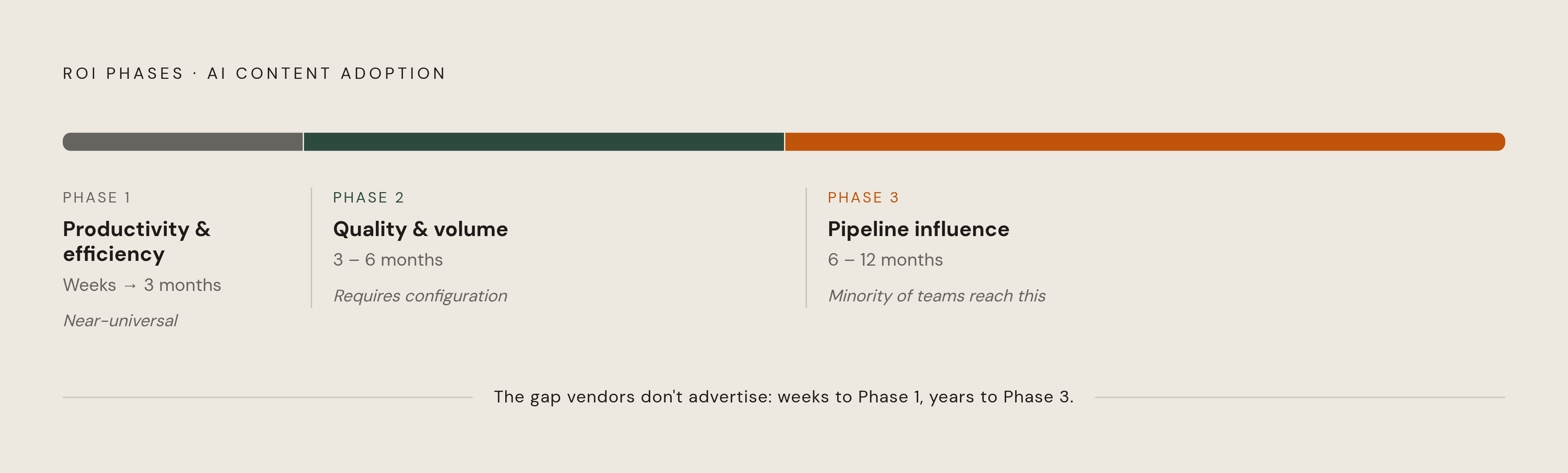
There is a gap most vendors do not advertise: productivity gains from AI content tools are widespread and documented; pipeline contribution is harder to establish and takes longer to appear.
The majority of B2B marketing teams using AI report improved productivity. Measurable ROI tied to pipeline, however, is reported by a minority of teams within the first year of adoption, per Cognism's 2024 research. The teams that reach pipeline-level ROI fastest are not necessarily the ones with the most sophisticated tools. They are the ones with a coherent content strategy in place before AI entered the workflow. Think of AI as an amplifier: it turns up the volume on whatever strategy is already playing, but it cannot write the song.
Time savings are the most consistent and fastest-realized benefit, typically appearing within weeks of adoption. Quality improvements require more deliberate investment: better prompting, stronger governance, deeper integration with the team's editorial process. Pipeline contribution requires all of that, plus enough content at sufficient quality to actually influence buyer decisions across a full B2B sales cycle, which is not a short window.
A reasonable expectation for a typical B2B content team: productivity and efficiency gains in the first one to three months; measurable improvement in content quality and output volume in the three to six month range, assuming real investment in configuration; demonstrable pipeline influence in the six to twelve month range, assuming the content is sound and an attribution model exists to capture it. Actual timelines vary by team size, tool choice, and workflow maturity.
Two things shorten that timeline. Choosing a tool that fits the team's actual complexity tier rather than the one with the most impressive demo is the first. Treating AI configuration as an ongoing operational investment rather than a one-time setup task is the second. Teams that spend real time on brand voice training, workflow design, and editorial governance consistently extract more value over time than teams that adopt at default settings and wonder why the output feels generic. For teams where editorial quality and strategic coherence drive the decision, some are evaluating purpose-built platforms like Letterstory, which embeds strategy-first workflows and editorial frameworks directly into the writing process rather than requiring teams to build governance layers separately around general-purpose models.
The productivity return comes quickly for most teams. The quality return requires configuration work that many teams skip. The revenue return requires both, plus a content strategy that was worth executing in the first place.