Content Funnel Mapping for Long B2B Sales Cycles
Buyers research 70% before contacting sales; map content to messy, nonlinear journeys.
The average B2B sales cycle now runs approximately ten months, per 6Sense's 2025 research. Enterprise deals with larger committees routinely stretch past twelve. Over the last five years, average cycle length has grown roughly 25%, driven by more stakeholders, sharper CFO scrutiny, and a generalized institutional wariness around software spending. Gartner puts average deal involvement at 6.8 stakeholders, up from 5.4 in 2020. Forrester's 2024 SaaS Purchase Survey found CFO involvement in software purchases has risen 40% over the same period.
More decision-makers multiplied by longer timelines equals more discrete moments where a buyer can stall, go dark, or quietly redirect budget without saying a word to your team. Think of it like a relay race where the baton keeps getting handed to someone new — and none of them agreed to run.
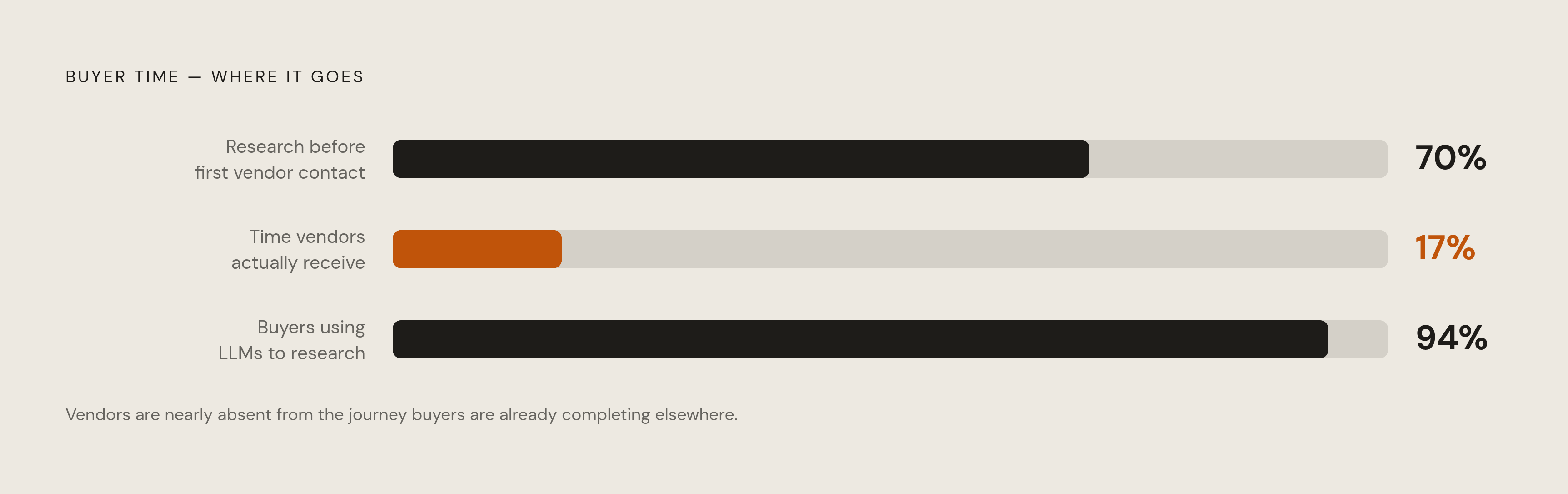
Here is the part that should genuinely unsettle you: Gartner estimates buyers complete roughly 70% of their research before first contact with sales. Across the entire cycle, vendors collectively receive about 17% of a buyer's total time. The average buyer consumes around thirteen pieces of content during a purchase journey, a mix of vendor-produced material and third-party sources, and nearly all of that happens before a rep ever enters the conversation.
6Sense also found that 94% of buyers now use large language models during their buying process. Perplexity grew from roughly 26 million to nearly 180 million monthly visits between January 2024 and December 2025. Buyers are querying AI for vendor shortlists before they visit a single website. A meaningful share of vendor selection now happens in channels that generate zero trackable activity on your side. And per 6Sense, roughly 80% of the time, the vendor a buyer contacted first ultimately won the deal, with nearly four out of five vendors on the average shortlist already known to the buyer before any outreach began.
The dark funnel (deals seeded in private Slack communities, peer networks, AI tools, and word of mouth) is not a rounding error. It is where pipeline originates.
The funnel model still maps buyer intent accurately. What it does not describe is a linear march from one stage to the next. Buyers enter at any point, loop back, and research independently between every touchpoint. Content has to account for that messy, non-sequential reality.
What the TOFU/MOFU/BOFU framework actually maps. And where teams misuse it
The three-stage framework has survived decades because it maps something genuinely true: the buyer's evolving job-to-be-done. TOFU maps to problem awareness. Is this issue worth prioritizing? MOFU maps to evaluation. Does this vendor understand the problem better than the alternatives? BOFU maps to validation and risk reduction. Can this solution work in our specific environment, with our specific constraints?
The framework's value is as a map of intent, not a sequence a sales rep controls. Content's job is to serve whatever the buyer is trying to accomplish at each stage.
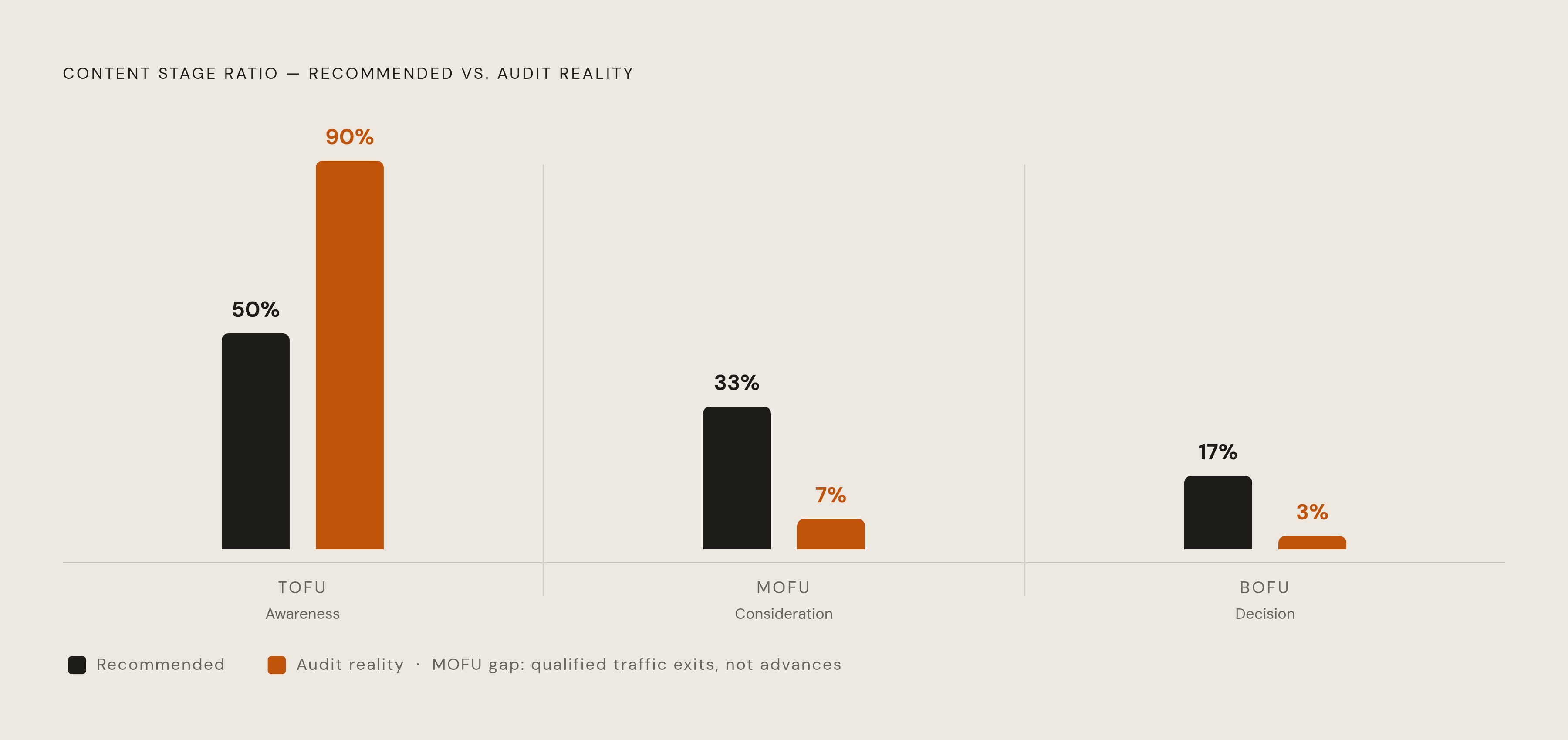
The most common failure mode is TOFU overload, and it is more pervasive than most teams want to admit. I have seen a B2B SaaS company at roughly €8 million in ARR producing 90% of its content as awareness-stage definition articles and tip lists. The result: 40,000 visitors per month, a 0.3% trial conversion rate, and a lot of internal celebration about traffic numbers that were not moving the business. The problem was not traffic. Nothing existed to catch buyers who were ready to go deeper. Fifteen TOFU posts for every two BOFU case studies, almost nothing in between. That ratio is more common than the exception.
The predictable consequence: TOFU investment generates traffic that exits rather than advances, because the next layer of content needed to convert attention into evaluation simply does not exist.
A common starting ratio runs roughly half TOFU, a third MOFU, and the remainder BOFU. The right ratio, though, is whatever matches where buyers actually stall in your specific pipeline, which requires looking at pipeline data, not just content output. The framework is a planning tool. It is not a conveyor belt, and treating it like one is how teams end up producing confidently, prolifically, and pointlessly.
Top-of-funnel content: earning attention before buyers know they need you
At this stage, the buyer's job is to determine whether a problem is real and worth prioritizing. They are not yet evaluating vendors. They are scanning for a clear answer from a credible source, and they will leave the moment the content starts to feel like a pitch.
Organic search is the primary TOFU channel. Most B2B buyers begin research with a search query, and a large majority review a blog post during their buying journey. The content that earns attention here is timely, role-specific material that answers the problem question directly, without promotional framing. Format options include blog posts, short educational videos, ungated research summaries, and social content built for the specific roles you need to reach.
The gating decision at TOFU has a right answer. If the goal is discoverability and AI citation, assets need to be ungated. Gating TOFU content sacrifices reach at the exact stage where reach is everything: before a buyer has identified a need, before they have encountered your brand, before an LLM has had a chance to index your framing of the problem.
That last point matters more than most teams currently give it credit for. TOFU content needs to be structured for AI citation, not just traditional SEO. Clear answers, named claims, original data. Content an LLM can surface with specificity when someone asks a general question about the problem your product solves. Keyword density is table stakes; citeability is the actual bar.
Demanding lead conversion at TOFU misunderstands the stage's job. The KPIs here are qualified organic traffic and early engagement signals. Inbound-driven pipelines fed by discoverable TOFU content produce measurably shorter sales cycles than comparable outbound-sourced deals, which is reason enough to protect this content from premature gatekeeping.
Mid-funnel content: giving your champion the tools to sell internally
MOFU is the most underinvested stage in most B2B marketing programs. Teams consistently under-resource it while over-indexing on awareness content and then wondering why qualified traffic does not convert.
At this stage, the buyer's job has shifted. They are no longer asking whether the problem is real. They are asking whether your solution understands the problem better than the alternatives, and they are beginning to build an internal case. More importantly: you are no longer selling to one person. You are equipping your champion to sell to a committee you cannot reach directly. The content that works here is the content your champion can bring into an internal review meeting and survive scrutiny with.
That means deep-dive demo videos, ROI calculators, how-to guides, webinar recordings, and comparison content that frames alternatives honestly and positions your differentiators with enough specificity that a champion can defend the framing without you in the room. Case studies become highly effective at this stage because a well-constructed one functions as proof that the solution has worked in a recognizable environment, and that is exactly what a champion needs when a skeptic across the table asks for precedent.
Interactive tools are particularly valuable at MOFU. An ROI calculator or self-assessment framework allows a champion to quantify the internal case without waiting for a sales proposal. A champion who walks into a finance review with a number derived from your calculator is more persuasive than one armed with a PDF and a vendor's word. More than half of B2B buyers, per available research, want more of these tools, and most vendor content libraries do not have them.
Gating logic at MOFU differs from TOFU. Selective gating makes sense here: playbooks, toolkits, and templates gated after multiple TOFU engagements capture higher-quality leads and feed sales-ready nurture sequences. The gate should come after demonstrated intent, not before it.
If your content audit surfaces strong TOFU and decent BOFU but thin MOFU, the fix is not more blog posts. It is evaluation-enabling assets built for committee consumption.
Bottom-of-funnel content: removing the final blockers before sign-off
By BOFU, the buyer is not seeking further education. They are managing risk. The question is no longer whether your solution is interesting; it is whether it can function in their specific environment, with their constraints, without creating new problems downstream. The emotional register shifts from curiosity to accountability, and the content needs to meet that shift.
The most influential content types at this stage are product specifications, direct solution comparisons, documented success stories, value demonstration materials, and product walkthroughs. Thought leadership does not belong here. Evidence does.
BOFU content also does double work: it enables reps and serves prospects conducting their own late-stage due diligence simultaneously. A case study in a follow-up email, a pricing page visited the morning before a demo call, an ROI calculator shared inside a proposal. These are all BOFU assets functioning as intended. The difference from TOFU is that this content is not sitting on your site waiting to be discovered. It is deployed by a rep at the right moment, to the right person.
What belongs in a complete BOFU set: sales enablement one-pagers, proposal-ready case studies formatted for committee distribution, product comparison sheets, implementation guides, and for enterprise deals, the security and compliance documentation that legal, procurement, and technical evaluators need to clear organizational risk. SOC 2 reports, GDPR documentation, architecture specs. These are not edge cases. In enterprise deals, they are gates, and buyers will not move past them without the documentation in hand.
The most common BOFU gap I see: teams produce solid case studies but fail to create stakeholder-specific one-pagers that allow a champion to share the right piece of evidence with each distinct decision-maker. The case study exists. The champion cannot deploy it effectively because it is written for a general audience, not for the CFO sitting across the table who wants to see financial framing, or the technical lead who needs to understand integration architecture.
Friction at BOFU kills warm deals. This content should be ungated or accessible behind a lightweight sales interaction. A buyer who has made it to final evaluation should not encounter a form.
Mapping content to the buying committee, not just the funnel stage
Forecastio's 2024 research found that deals with three or more actively engaged stakeholders close at 68%, compared to 23% for single-threaded deals, and close 2.4 times faster. The content implication is direct: a one-persona content strategy leaves most of that lift on the table.
The failure of single-contact mapping comes down to a basic reality of how enterprise buying actually works. Marketing's content serves two distinct audiences simultaneously: the people you can reach directly, and the people your champion must convince in rooms you will never enter. If the content map only accounts for the first group, the second group navigates without support. That is where deals stall and die, quietly, with no signal back to your team about why.
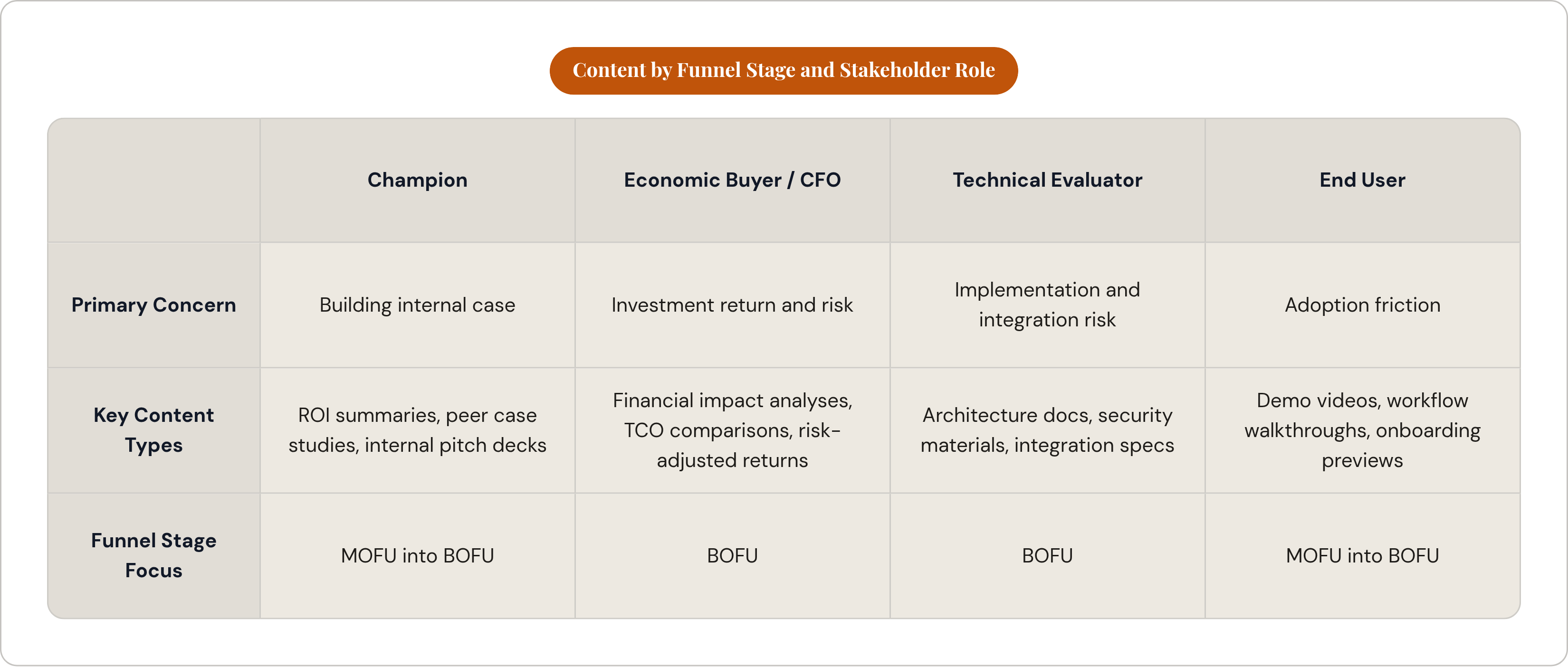
Champions need ROI summaries, peer case studies, and internal pitch decks — assets that help them build the case upward through their organization. Economic buyers and CFOs need financial impact analyses, total cost of ownership comparisons, and risk-adjusted return framing; they are evaluating an investment, not a product, and they will not respond to content that treats the interaction as a product conversation. Technical evaluators need architecture documentation, security and compliance materials, and integration specifications; their concern is implementation risk, not organizational strategy. End users need demo videos, workflow walkthroughs, and onboarding previews; their fear is adoption friction. Legal and compliance stakeholders need regulatory documentation specific to your industry and theirs.
Sales cannot multi-thread across a committee alone. Marketing's job is to produce the role-specific assets that make parallel stakeholder engagement possible, so that when a champion is in a room with a CFO, a technical lead, and a procurement officer simultaneously, they are equipped for all three conversations, not improvising one.
Account-level measurement becomes essential here. When three stakeholders from the same company visit your pricing page in the same week, that is a materially stronger buying signal than a single ebook download from six months prior. Pipeline intelligence needs to operate at the account level to surface patterns like that before they pass you by.
The practical audit question: for each stage on your funnel map, can a champion walk into a committee meeting with a specific, appropriate content asset for every stakeholder in the room? Where the answer is no, that is the next production priority.
Building the content map: from audit to assignment
Start with an audit, not a brief. Before producing anything new, catalog every existing asset and tag each by funnel stage and stakeholder role. The goal is to find the gaps before committing resources to filling them with more of what you already have too much of.
Most teams making this audit for the first time find the same three things. A TOFU surplus: multiple blog posts targeting effectively the same awareness-stage question with minimal differentiation between them. A MOFU gap: few or no assets that help a champion quantify value or frame alternatives for an internal audience. And a BOFU that is thin on roles: one or two case studies not formatted for committee distribution, and no stakeholder-specific one-pagers.
For each gap, assign a content job-to-be-done before assigning a format. The job is "helps champion justify cost to CFO" or "removes security objection from technical evaluator." Format follows from job, not from production convenience or channel habit. A single job can be served by a one-pager, a video, a calculator, or a documentation page, depending on where and how that stakeholder typically encounters information. Letting format drive the process is how you end up with another blog post when what your pipeline actually needs is a two-page comparison sheet.
Use the half-TOFU, one-third-MOFU, remainder-BOFU ratio as a starting hypothesis, not a target. Test it against your pipeline data. Where are qualified leads converting to opportunities but opportunities not advancing? Where are buyers going dark between stages? Those stall points are content gaps with a direct cost to pipeline, and they are more useful signals than any content production instinct.
Build TOFU content for AI discoverability from the start. Structure it with clear answers, named claims, and original data. An LLM surfacing your content to a buyer who has not yet visited your site is an early-stage competitive advantage, and it compounds.
Treat the map as a living document. Cycle length, committee composition, and deal complexity shift as your market matures and your buyer profile evolves. Revisit the map when pipeline data or buyer feedback surfaces a new stall point you have not planned for. The map is not a one-time deliverable; it is the diagnostic tool you return to every time pipeline behaves in a way you cannot explain from memory alone.