Pillar Page Strategy for B2B SaaS Blogs
How to organize ungated content clusters that rank and convert buyers.

A pillar page is a comprehensive, ungated piece, typically between 3,000 and 5,000 words, that covers a broad topic and links out to cluster articles that go deeper on specific subtopics. Those cluster articles link back to the pillar. Together, they signal to search engines that your site has genuine, invested expertise across a subject area, not a random accumulation of keyword-targeted documents. Think of it like a solar system: the pillar page is the sun, and each cluster article is a planet orbiting it — remove the sun, and nothing holds.
The Content Marketing Institute identifies three common formats: the 10x Content Page, an ungated ultimate guide built for education and comprehensiveness; the Resource Hub, a curated library of links and media organized around a topic; and the Hybrid, which combines educational content with curated resources. Each is legitimate. None is automatically correct for every situation.
Here is what most teams miss: a pillar page is a strategic decision before it is a content format. The same broad keyword could become a 9,000-word educational guide, a product-led resource hub, or a thought leadership piece anchored in proprietary data. Format should follow buyer stage, keyword intent, and the role the page is meant to play in the funnel. Convention alone is insufficient reason to choose anything.
What a pillar page is not: a long blog post, a gated whitepaper, or a product page retrofitted with headers to simulate depth. Gated content cannot be crawled by search engines, which means it has minimal direct ranking potential. The pillar must remain open. That is a structural requirement, not a preference.
The distinction between a pillar page and an elongated post comes down to architecture. A long post covers one topic linearly and ends. A pillar page is the center of a system — it distributes authority, creates navigable pathways, and builds topical density across a cluster. Remove the cluster, and what remains is just a long post with good intentions.
Choosing the right topics before writing a word
Topic selection is the highest-leverage decision in the entire strategy. Wrong topics mean months of disciplined execution that compounds into nothing. No amount of craft at the writing level recovers a bad topic choice. Choosing the wrong topic is like building a highway to a town that no one wants to visit.
A topical pillar is a cluster of keywords directly related to a specific subject, often sharing a root term. This shapes both content production and how search engines perceive a site's subject matter authority. The goal is for a search engine to recognize your domain as the authoritative source on a given topic area, not merely a participant in it.
Two filters determine whether a candidate topic deserves investment. The first is pipeline impact: does ranking here attract buyers who become customers, not just readers? Organic traffic that fails to convert to pipeline is a vanity metric with an editorial budget attached. The second is attainability: can the site realistically reach page one within 12 months given its current domain authority? Ambition is not a ranking factor.
The narrowing principle is critical, and teams routinely underestimate it. "Healthcare CRM" is winnable in ways that "CRM software" is not, at least not yet. The narrower pillar builds genuine authority that later enables competition on broader terms. If a topic is too competitive to rank for within 12 months given current domain strength, narrow the scope. Waiting for domain growth to solve the problem is a poor substitute for strategy.
Each topical pillar can function as a discrete campaign project. A CRM company could complete a "healthcare CRM" cluster in three to four months, then move to the next pillar in sequence, producing compounding authority across verticals rather than diffuse effort spread thin across too many fronts.
The tension worth naming: many SaaS content teams choose topics based on what the product team wants to talk about, not what buyers are actually searching for. These diverge more than most content calendars acknowledge, and that divergence is precisely where the pipeline gap begins.
How to structure a cluster that search engines and buyers both follow
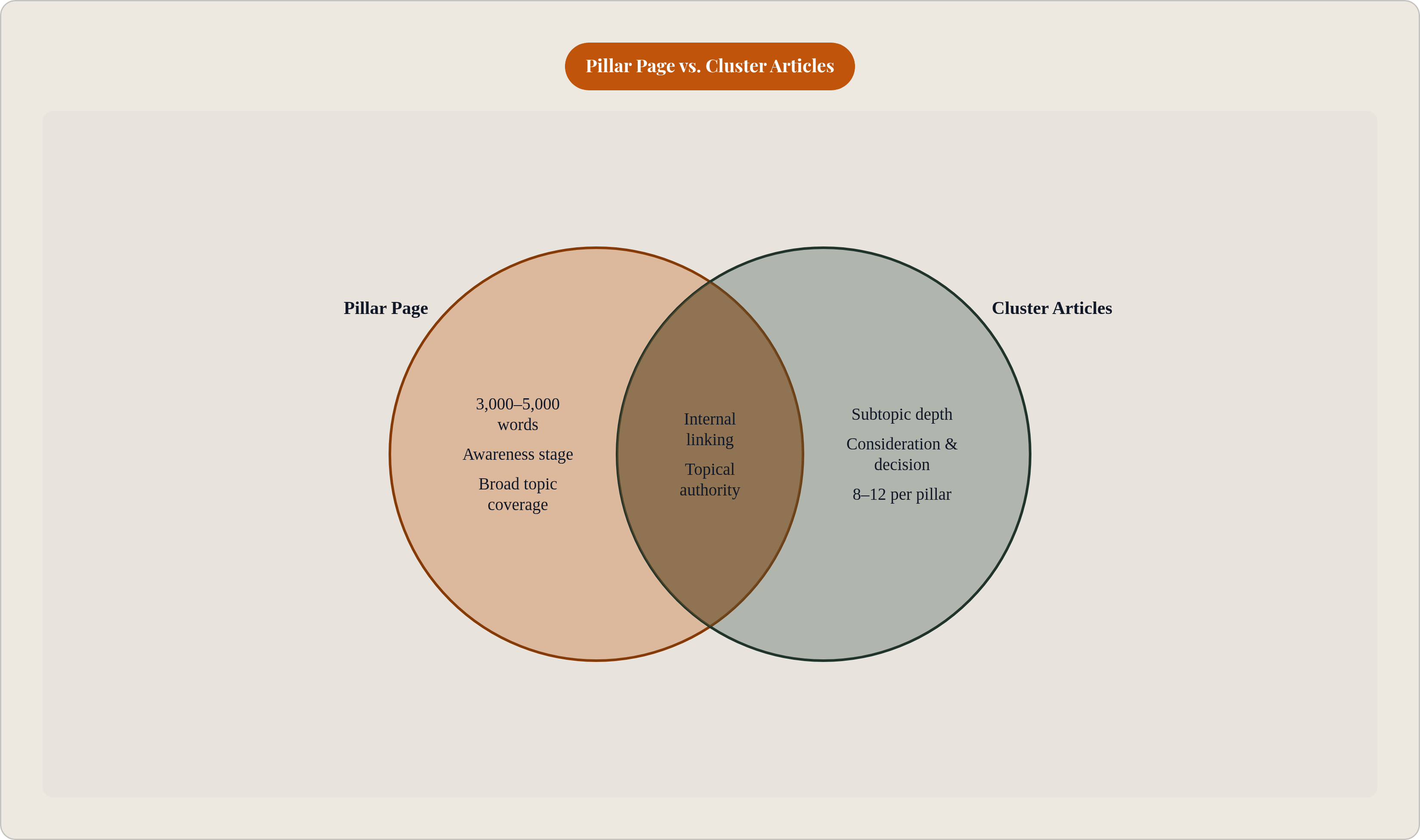
A practical starting point for cluster size is 8 to 12 articles per pillar. SE Ranking's 2024 research into AI citation behavior found that the average cluster generating AI citations comprises one pillar plus eight supporting cluster pages. Search Engine Land advises completing 10 to 15 articles before scaling. Full topic cluster architecture can eventually extend to 15 to 30 articles, but starting too wide dilutes the topical authority signal before the core cluster has established itself.
The pillar page itself should run 3,000 to 5,000 words. The actual driver is comprehensive topic coverage, not hitting a word count target — length is a byproduct of thoroughness. That said, Backlinko's analysis of 912 million posts found that long-form content of 3,000 words or more generates 77.2% more backlinks than shorter pieces. Depth earns trust, and trust earns links. A clear H2/H3 hierarchy is standard across top-ranking pillar pages; structure aids both crawler comprehension and reader navigation.
Build clusters in thematic batches, not one article per month spread across multiple unfinished clusters. Completing one full cluster before beginning another concentrates the topical authority signal and produces faster, more legible ranking results. A half-built cluster sends an ambiguous signal. A complete one sends an authoritative one.
Internal linking is the connective tissue that makes the cluster function as a system. Pillar pages link down to cluster articles; cluster articles link back to the pillar and to related cluster pages. Anchor text should be descriptive and drawn from body copy, not footers, sidebars, or generic phrases. Semrush has found that 25% of web pages have zero incoming internal links. Orphan content is invisible to search engines regardless of its quality, and pages buried more than four clicks from the homepage receive nine times less SEO traffic than those accessible within three. Google advises keeping internal links under 100 per page.
A pillar page published without its cluster is a page, not a system. Publishing the pillar first and building the cluster afterward is a workable production sequence, but the system only functions once the cluster is complete enough to create genuine topical density.
Mapping pillar content to where buyers actually are in their decision
The most common structural failure in B2B SaaS content is concentration at the top of the funnel. Educational posts on broad industry topics get produced because they are easy to justify and easy to write. Meanwhile, the middle and bottom of the funnel, where actual buying decisions form, go unserved. The traffic looks healthy. The pipeline does not reflect it.
A well-designed cluster covers all three stages. The pillar page functions at the awareness stage: broad topic, educational, designed to attract organic traffic and introduce the brand as a credible guide. Cluster articles in the consideration layer address specific challenges, compare approaches, and help buyers evaluate options. Decision-stage content includes comparison pages, ROI calculators, case studies, and implementation guides — material that validates the decision and reduces friction for a buyer who is nearly ready to commit.
Decision-stage content earns its place in cluster architecture. "[Product] vs. [Competitor]" articles capture high-intent searches and allow the brand to control the comparison narrative rather than cede it to a third party. These pages target buyers who are actively evaluating options, which is the highest-value traffic a content program can produce. Many SaaS teams omit this content because it feels uncomfortable to write, and that discomfort costs pipeline.
Hotjar's execution illustrates the principle clearly. Their heatmap ultimate guide uses broad keywords like "heatmap software" to attract awareness-stage visitors, while long-tail, high-intent terms targeting users near conversion live within the same cluster architecture. The same visitor who discovers the brand at the awareness stage can follow a structured internal path to decision-stage content without leaving the site or starting a new search.
When planning a cluster, map each article to a funnel stage before writing it. A visitor entering at the pillar page should be able to follow internal links progressively deeper into consideration content, then to decision content. Gaps in the middle and bottom layers are almost always where pipeline leaks.
What realistic results look like and when to expect them
Pillar pages with ten or more supporting cluster articles generate 3.4 times more organic traffic than standalone long-form posts, per HubSpot's Topic Cluster Research measuring 12-month post-publication performance. That figure assumes the cluster is complete. A pillar with two cluster articles does not produce the same topical authority signal as one with ten. The architecture has to be in place before the compounding effect materializes.
The timeline is predictable enough to plan around. Months one through three are foundational: indexing, initial crawl, early movement on long-tail keyword positions. The inflection point typically arrives in months four through six, when ranking jumps become visible across cluster articles. By months seven through twelve, page-one positions on core terms become achievable for well-executed clusters on attainable topics.
HubSpot's own implementation is the clearest case study available. After building topic clusters anchored by pillar pages on "Instagram Marketing" and "Email Marketing," they reported a 107% increase in organic traffic within six months and an 83% boost in organic lead generation. Those are not incremental gains; that is what a complete, well-structured cluster achieves when topic selection is sound and execution is disciplined.
Sites that maintain and expand clusters past the 12-month mark see 30 to 40% higher organic traffic compared to sites using standalone content strategies, per HubSpot's Topic Cluster Research. The compounding is in the continuation, not just the launch. Teams that publish a cluster and move on capture roughly half the available return.
Results vary by domain authority, cluster completeness, topic competitiveness, and content quality. The benchmarks above reflect well-executed implementations on viable topics. A cluster built on the wrong topics, with thin supporting content and broken internal linking, will not produce these outcomes.
Keeping clusters authoritative as content ages and AI search evolves
The most common mistake after publishing is treating a pillar cluster as a static asset: written once, left to accumulate outdated statistics. That approach degrades the asset rather than compounds it, and the degradation is not gradual. It accelerates.
Freshness matters in measurable terms. Content updated within the past three months receives an average of six citations in AI-generated answers, compared to 3.6 for outdated content, per SE Ranking's 2024 research. Quarterly reviews should be standard practice: verify statistics are current, confirm internal links are functioning, ensure the content reflects what practitioners actually do now rather than what was considered best practice two years ago. A freshness update is often the fastest way to recover cluster-level rankings that have softened, frequently faster than publishing entirely new content.
Original data is a durable competitive advantage. Cluster articles that cite proprietary survey results, firsthand product testing, or original research earn backlinks and AI Overview citations that content recycling generic industry statistics simply cannot replicate. Recycled figures produce content that is indistinguishable from every competitor doing the same thing.
The AI search dimension has grown consequential enough to require explicit planning. A pillar page must now be structured so that Google AI Overviews, Perplexity, and ChatGPT can extract clean, attributable answers from it, not just rank in traditional results. HubSpot research found that sites with well-structured topic clusters receive 3.2 times more AI citations than single-page competitors. AI systems intercept a growing share of search intent before users click through to a site, and a cluster that answers questions clearly, specifically, and attributably stays visible even as click-through behavior continues to shift.
A pillar cluster is not a project with a completion date. The editorial attention required to maintain it is the mechanism by which the initial investment keeps producing value. Teams that internalize this tend to see organic pipeline grow continuously as the cluster matures, rather than plateau after the launch quarter and slowly erode.