Gated vs Ungated Content Decision Framework for B2B Lead Gen
Gate high-value assets like research reports, but leave benchmark data open so AI can cite it.

The gated vs. ungated debate gets treated like a matter of taste, some marketers like forms and some don't. That framing misses the more useful question: whether to gate a piece of content should depend on where the buyer sits in their own research process, and whether the asset is worth enough to justify making them stop and type their email into a box. Gartner research puts direct vendor contact at just 17% of a B2B buyer's total purchase journey, which means roughly 80% of what happens before a deal closes happens where sales can't see it at all.
That invisible stretch matters more than it used to. 6sense's 2025 Buyer Experience Report found that in 85% of purchases, buyers end up choosing a vendor that was already on their shortlist from day one. Content encountered during that dark, anonymous phase shapes who makes the list and who gets quietly filtered out. Gate the wrong thing at the wrong moment, and you risk removing yourself from consideration before the buyer even knows your name, rather than qualifying a lead.
Sales cycles have gotten a little shorter too. 6sense reports the average cycle dropped from 11.3 months in 2024 to 10.1 months in 2025, but that dark research phase still eats up most of the window. Meanwhile Gartner's survey of 632 B2B buyers, run in August and September 2024, found 73% actively avoid vendors who send them irrelevant outreach. Put those two numbers together and a pattern emerges: aggressive gating followed by generic nurture emails works against the pipeline it's supposed to build.
How generative AI search has raised the cost of gating the wrong content
Here's a mechanical problem nobody solved for on purpose: AI crawlers like GPTBot, PerplexityBot, ClaudeBot, and Google-Extended cannot fill out a form. They can't click "continue" past a login wall. A gated PDF, no matter how good, earns exactly zero authority in an AI-generated answer, because the crawler never got past the gate to read it.
That would be a minor annoyance if AI search were a rounding error in buyer research. Forrester's Buyers' Journey Survey found 89% of B2B buyers had adopted generative AI as a top source for self-guided research in 2024, and the 2025 wave puts that figure at 94%, with twice as many buyers naming AI or conversational search as their most useful information source, ahead of vendor websites and ahead of sales reps. A gated asset that can't be cited by AI is invisible at precisely the moment buyers are forming the shortlist that, per 6sense, determines 85% of eventual purchases.
The data on citation frequency is blunt about it. Gated content, invisible to AI crawlers that cannot pass a form wall, earns far fewer citations in AI-powered search responses. Getting cited in AI-generated answers carries real downstream commercial value beyond a vanity metric. The content that actually earns an AI citation needs to sit in the open. The gate works better placed on the depth behind the answer, the proprietary data set, the interactive tool, rather than on the content whose entire job is getting you mentioned in the first place.
This produces a genuinely counter-intuitive result. Original research assets, benchmark reports, primary survey data, tend to generate stronger referring-domain growth and AI citations than generalist blog content. Your best, most expensive research might be the exact asset that deserves to be ungated, precisely because it's valuable enough that everyone wants to cite it. Gate it, and nobody can.
None of this is a fringe opinion anymore. Holding out for a gate-everything policy in 2025 runs contrary to where most of the market has already landed.
What buyers will actually trade their contact information for
Forms still have a place. Overall B2B content consumption on the NetLine platform rose 27% in 2024 compared to 2023, and total demand for B2B content has grown 84% since 2019. Buyers are consuming more gated and ungated content than ever; the gated content market isn't shrinking, it's getting more selective about what it rewards.
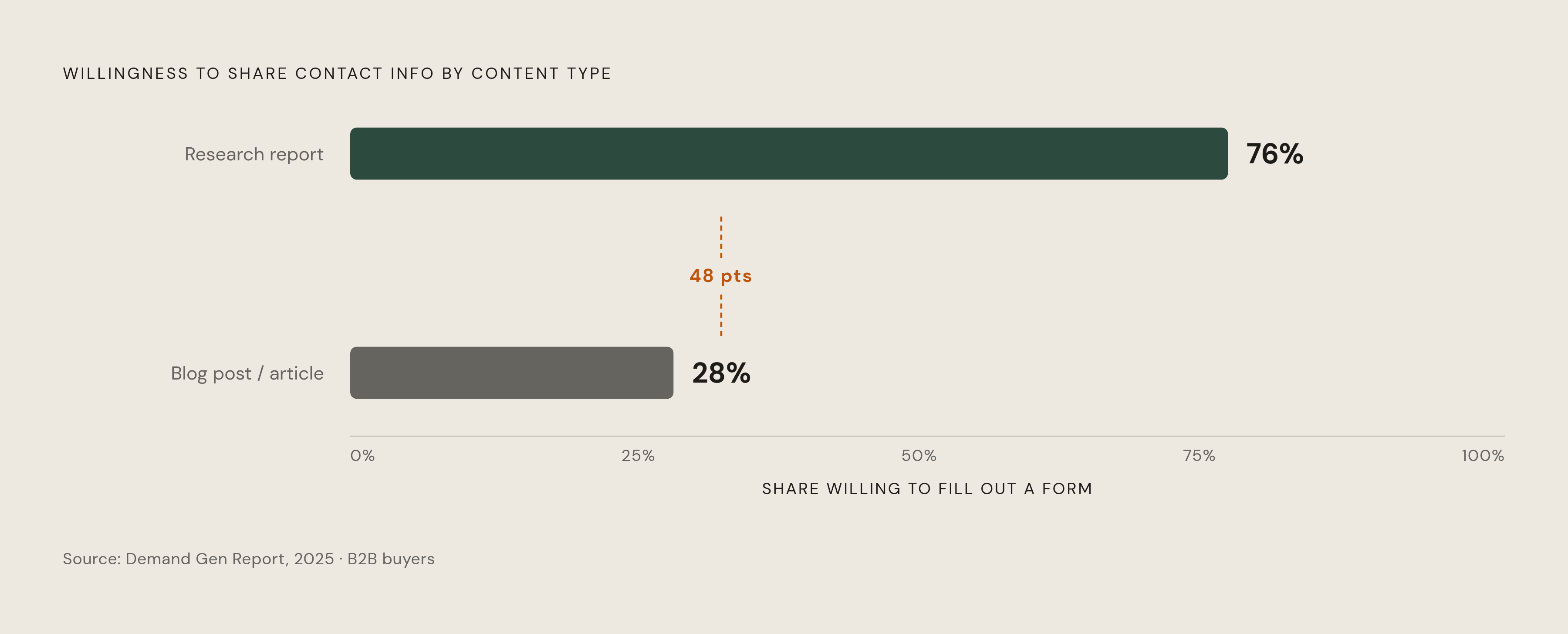
Here's the number that actually does the explaining: a 2025 Demand Gen Report survey found 76% of B2B buyers will hand over their information to access a research report, but only 28% will do it for a blog post or article. That 48-point gap is the whole argument in miniature. Buyers resist forms attached to content that isn't worth the five minutes it takes to fill one out, more than they resist forms on principle. Demand Gen Report's 2024 Content Preferences survey backs this up from another angle: 83% of buyers say they're at least somewhat likely to complete a form when the content behind it is genuinely high-value.
Format matters enormously here, maybe more than funnel stage alone. eBook registrations on NetLine grew 71% year over year in 2024, and eBooks have become one of the most requested content formats on the platform. But the format with the sharpest signal is the playbook: buyers who register for playbook content are 115.1% more likely to make a purchase decision within the next 12 months, per NetLine's 2025 data. Case studies, trend reports, and buyer's guides show similar, if smaller, associations with near-term purchases. The same person who won't touch a form for a blog post will actively seek out a gated benchmark report or playbook. Which means the decision framework can't just live at the funnel-stage level; it has to account for format too.
The conversion reality: what gated content actually delivers when used correctly
Gating clearly works, at least some of the time, for some content. The 2023 B2B Content Marketing Benchmarks report found marketing-qualified leads sourced from gated content convert to sales-qualified leads at a 36% higher rate than leads from other sources. That's not a marginal edge.
A Demand Gen Report Revenue Impact Study tracking 580 B2B pipeline sources found gated content paired with first-party behavioral intent data produced a 35% higher lead-to-customer rate than ungated sources, up from a range of 23% to 31% recorded the year before. The gap is widening, not narrowing, as intent data gets more actionable. Gating isn't losing relevance as AI search grows; it's getting more precise where it's used correctly.
But here's the number that should reframe the entire debate. Research from 2024 found companies using a differentiated gating strategy, gating some things and not others based on a deliberate rule, show a 34% higher marketing qualification rate than companies that gate everything uniformly. The lift comes from gating selectively rather than from gating more content. That's arguably the single most important data point in this entire discussion, because it settles the binary question before it's even asked: blanket policies, in either direction, leave performance on the table.
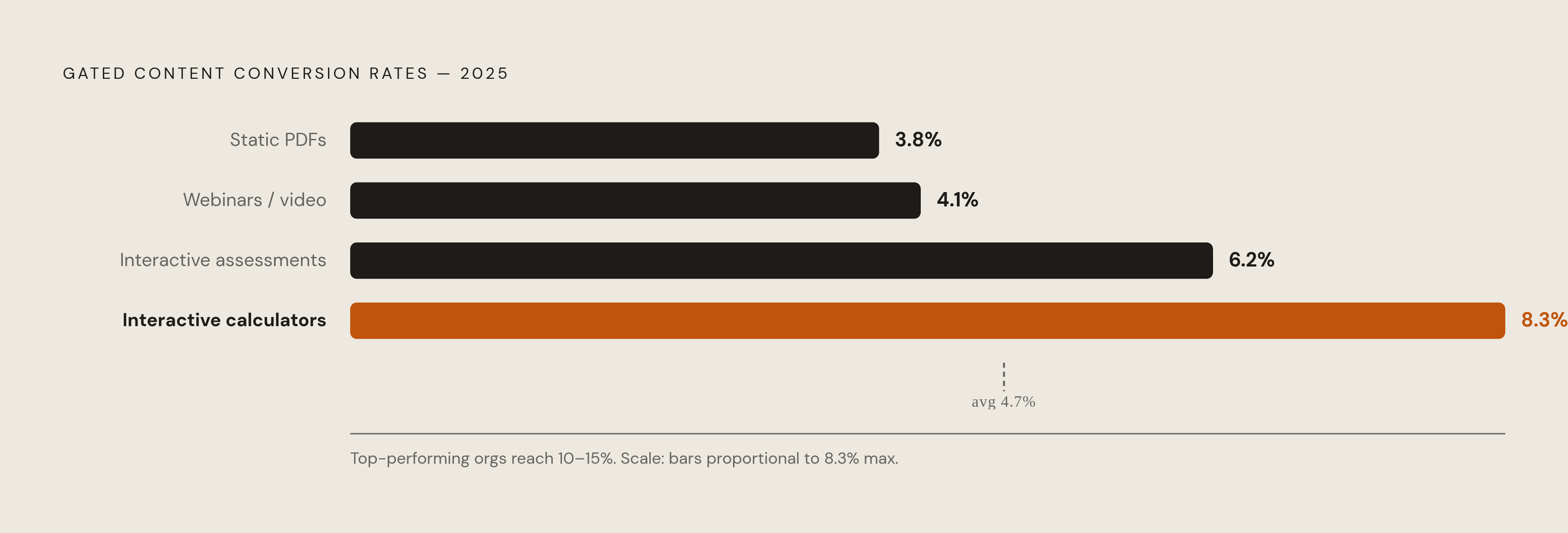
Format still governs conversion rate within the gate. Average 2025 conversion rates run about 3.8% for classic gated PDFs, 4.1% for webinars and video, 6.2% for interactive assessments, and 8.3% for interactive calculators, with an overall average of 4.7%, down slightly from 5.2% in 2023. Interactive tools roughly double the conversion rate of static documents. And the average hides real variance: top-performing organizations hit 10% to 15% conversion, which tells you asset quality and funnel alignment matter more than the simple decision to gate or not.
Now the counterweight. Companies that gate too aggressively lose up to 57% of potential leads during the early research phase, according to the data on over-gating. Whatever conversion lift you get from gating mid-funnel content gets wiped out, and then some, if your top-of-funnel gate collapses the number of people who ever reach the middle of the funnel in the first place.
Why ungating the right asset can generate more pipeline than keeping it gated
A useful case study: a leading CRM provider took its previously hard-gated annual market report and ungated it entirely. The results were 11 times higher distribution, a 329% increase in organic traffic, a substantial jump in backlinks, and a meaningful increase in demo requests, all while reducing the nurture cost of chasing unqualified leads who'd only filled out the form to get past it. Broad, frictionless distribution built trust at scale; the buyers who eventually asked for a demo arrived already educated, which made them easier to close.
A 2024 Orbit Media study found long-form ungated content earns three times more backlinks than gated equivalents covering the same topic, for a reason that's almost embarrassingly simple: writers and journalists can only cite what they can actually read. Backlinks compound over years. Gate a genuinely linkable asset and you're giving up domain authority you won't recover on any reasonable timeline, not just losing today's links.
G2's 2024 Buyer Behavior Report found 86% of B2B buyers prefer accessing educational content without a form standing in the way, and Turtl's 2024 engagement data shows interactive ungated assets generate roughly four times the time-on-page of a traditional PDF. Ungating the right asset, at the right stage, produces compounding returns, SEO, AI citation, referral links, accumulated trust, that the gated version of the identical asset simply cannot generate. Use the ungated content to earn reach and credibility at scale, then let that reach carry high-intent buyers toward the gated assets built to convert them.
The funnel-stage framework for deciding when to gate
So how do you actually decide? Treat it as a funnel-stage judgment first, a format judgment second, and a lead-gen goal judgment third, rather than one policy stamped across every piece of content you publish.
Top of funnel: ungate by default. The job here is discovery, shortlist presence, organic reach, and AI citation. Blog posts, thought leadership, educational videos, infographics, one-pagers, introductory guides, podcast content: all of it should sit in the open. Buyers at this stage are doing anonymous, self-directed research, 86% of them prefer it frictionless, and gated TOFU content earns no SEO value, no AI citations, no backlinks. If the asset's whole purpose is getting you onto a buyer's shortlist, gating it defeats its own purpose before it starts. The one exception worth noting: a genuinely proprietary research asset, an original survey or benchmark report, may still be worth ungating even after a heavy production budget, because its citation value and AI discoverability outweigh whatever form-fill volume you'd get by locking it up.
Middle of funnel: gate selectively, on demonstrated value. The goal shifts to identifying buyers in active evaluation and capturing intent signals worth nurturing. In-depth research reports, comprehensive eBooks, webinars with Q&A, competitive comparisons, buyer's guides, trend reports, case study collections: these are fair game for a gate, because 76% of buyers will trade contact information for exactly this kind of depth. Run every one of these through a simple fairness test: would the buyer who fills this out feel like they got a good trade? If the honest answer is no, the asset needs more substance before it earns a gate, or it should just stay open. And keep the form itself short; ask only for what sales can act on right away, because over-fielded forms suppress conversion without improving lead quality one bit.
Bottom of funnel: gate with intent-matching specificity. Here the job is surfacing purchase-ready buyers and accelerating the move from MQL to SQL. ROI calculators, interactive assessment tools, detailed product demos, playbooks, implementation guides, pricing tools: these are the assets built for the gate, and interactive formats consistently beat static ones, 8.3% conversion for calculators versus 3.8% for plain PDFs, because a personalized output makes the form feel transactional rather than extractive. Playbooks carry the strongest purchase signal of any format, that 115.1% figure again, so if a buyer registers for one, the form fill should trigger immediate sales follow-up, rather than a slow drip nurture sequence built for someone three stages earlier in the journey.
Before gating anything, four questions do most of the sorting: Is this the kind of content a buyer searches for while building their shortlist? Ungate it. Does it contain proprietary data or a framework a competitor can't copy? Strong gate candidate, though weigh the AI and SEO reach you'd sacrifice. Would a buyer in active evaluation find it valuable enough to identify themselves for it? Gate it. Does filling out the form trigger something sales actually does next? Gate it; if not, ask whether the gate is serving the buyer or just harvesting data for a spreadsheet nobody opens.
Hybrid models that capture both reach and lead quality
The shift toward hybrid models is well underway across B2B marketing. The remaining question isn't whether to hybridize, it's which version fits your content and your sales motion.
The content preview model publishes the opening section or key findings of a report in the open, fully indexed and AI-crawlable, then gates the full data set, methodology, or recommendations behind a form. The open section earns SEO and AI citation; the gate catches the buyers the preview already convinced.
The time-delayed ungate gates a report at launch, when it's most valuable for capturing active-evaluation pipeline, then opens it up entirely after three to six months once its urgency has faded, harvesting long-tail SEO and AI discoverability on the back end. This works especially well for annual benchmark reports, since the next edition will replace the old one anyway; there's no cost to giving away last year's model once this year's is out.
The format-split approach publishes a long-form ungated article carrying the core argument and key data points, fully discoverable and linkable, then gates a companion asset, a formatted PDF, an interactive tool, a deeper implementation guide, that extends the free content into something more actionable. The ungated piece builds trust; the gated piece does the qualifying.
Intent-signal gating shows the gate only to visitors who've already shown MOFU-level behavior: repeat visits, time on category pages, a look at pricing. First-time visitors see the same content wide open. It requires some basic personalization infrastructure, but it lets the same asset serve two very different jobs depending on who's looking at it and how many times they've already come back.
The through-line across all four models is the same one that data pointed to: selectivity beats uniformity. Whether you gate a given asset should trace back to funnel stage, format, and what happens the moment someone hits submit, not to a policy someone wrote into a brand guideline three years before generative AI search existed.