Case Study Format That Influences B2B Purchase Decisions
Most B2B case studies fail because they're built for believers, not skeptics.
Seventy-three percent of B2B buyers call case studies a key factor in their purchase decisions, and up to 80% go looking for them before they'll take a sales call. CMI's 2025 research puts the number of companies that actually pull this off well at 34%. Everyone's writing these things, most land flat, and the flatness traces back to a short list of fixable calls about structure, proof, and length.
I used to write the lazy version. Customer signed on, customer got results, slap it in a PDF, ship it to sales, move on to the next one. Took me way too long to notice the pattern: those case studies kept underperforming because they were written for the person who already believed, not the one who still needed convincing. A case study's actual job is persuading a skeptical, distracted, time-poor buyer that this exact outcome happens to people like them too. Documentation is a record of what happened; persuasion has to work on someone actually holding the thing, deciding whether it's worth forwarding to their boss.
The buying environment a case study must navigate before a reader ever opens it
The modern B2B buying group averages 7.4 people, according to Dentsu's 2025 research, and Forrester puts the share of purchases touching two or more departments at 89%. A single document rarely lands in front of a single person with a single question. Finance wants the ROI line. The end user wants to know if the tool makes Tuesday better or worse. Procurement wants to know what breaks and who takes the blame when it does.
That's three separate interrogations happening off one PDF, sometimes in the same conference room, sometimes in the same hour.
Here's the part that should needle anyone still writing these like late-stage sales collateral: Forrester's 2025 data has 67% of B2B purchase decisions effectively made before the first conversation with a sales rep, with buyers working through roughly 13 pieces of content along the way. 6sense found the eventual winner was already on the shortlist on day one, 95% of the time. So the case study is auditioning for a shortlist assembled quietly, in a room with no salesperson present, well before any closing call happens. Bury your best proof point on page three and you lose the reader who needed to self-qualify on page one.
It also means the customer has to do the talking. TrustRadius found that 83% of B2B buyers trust peer experience over vendor claims. Write the whole thing in the vendor's voice, however accurate every line is, and the format works against itself.
How the headline and executive summary determine whether the rest gets read
What does "Acme Co. Improves Efficiency with Platform X" tell you? Nothing verifiable, nothing a buyer can act on in the five seconds they're willing to spend on it.
Now put "Mid-Market Logistics Firm Cut Onboarding Time by More Than Half in 90 Days" next to it. Same underlying event, wildly different signal. The second version names a metric, a timeframe, a context specific enough that a buyer in a similar spot recognizes their own Tuesday sitting inside it. Precision beats cleverness here, more often than people want to admit when they're workshopping headlines in a meeting.
The executive summary carries that same discipline with a little more room to breathe. Keep it under 100 words no matter how long the full piece runs; the busiest, most senior person in the room isn't scrolling past it looking for something better written further down. If the summary can't signal relevance to a CFO, a department head, and a frontline user inside the same 90 words, part of the room is already gone.
The structural frameworks that consistently hold reader attention through to the results
Two frameworks dominate: Problem-Solution-Results, and its cousin CAR, which stands for Challenge-Action-Result. Narrative Science found CAR-structured case studies held reader attention 37% longer than conventional layouts. Fifteen minutes to rebuild a template around that number seems like a fair trade.
Why does it work? Because it mirrors the sequence a buyer's brain runs whether you design for it or not. First: do I have this problem? Then: does this approach make sense? Only after that: do I believe the result actually happened? Skip the first question and the third one falls flat, because the reader never once saw themselves in the story.
BAB, or Before-After-Bridge, is worth knowing too. It lines the customer's prior state against the current one, with the vendor sitting in as connective tissue, and it works especially well when the problem carries a little embarrassment: churn, cost overruns, the operational chaos nobody wants to admit they were living inside for two years. A good "before" section reads almost like a confession. Buyers trust confessions more than they trust polish.
The sequence that holds up across most well-built case studies: a headline carrying the leading metric, an introduction placing the customer and their industry, a problem statement specific enough to sting a little, a solution section explaining not just what got done but why that approach made sense, a results section with real numbers and a clear time-to-value, a quote in an actual human voice, and a call to action tied to where this particular reader sits in their own process.
The most common failure sits right at the seam between problem and solution. Jump too fast, and the reader never gets the "yes, that's my exact headache" moment before you're already handing them the aspirin. "Manual reconciliation ate 22 hours a week from two analysts" beats "inefficient processes," and not by a small margin. One of those is a sentence a real person could say out loud in a status meeting. The other is filler somebody's manager made them add.
Designing for three reading speeds so every stakeholder gets what they need
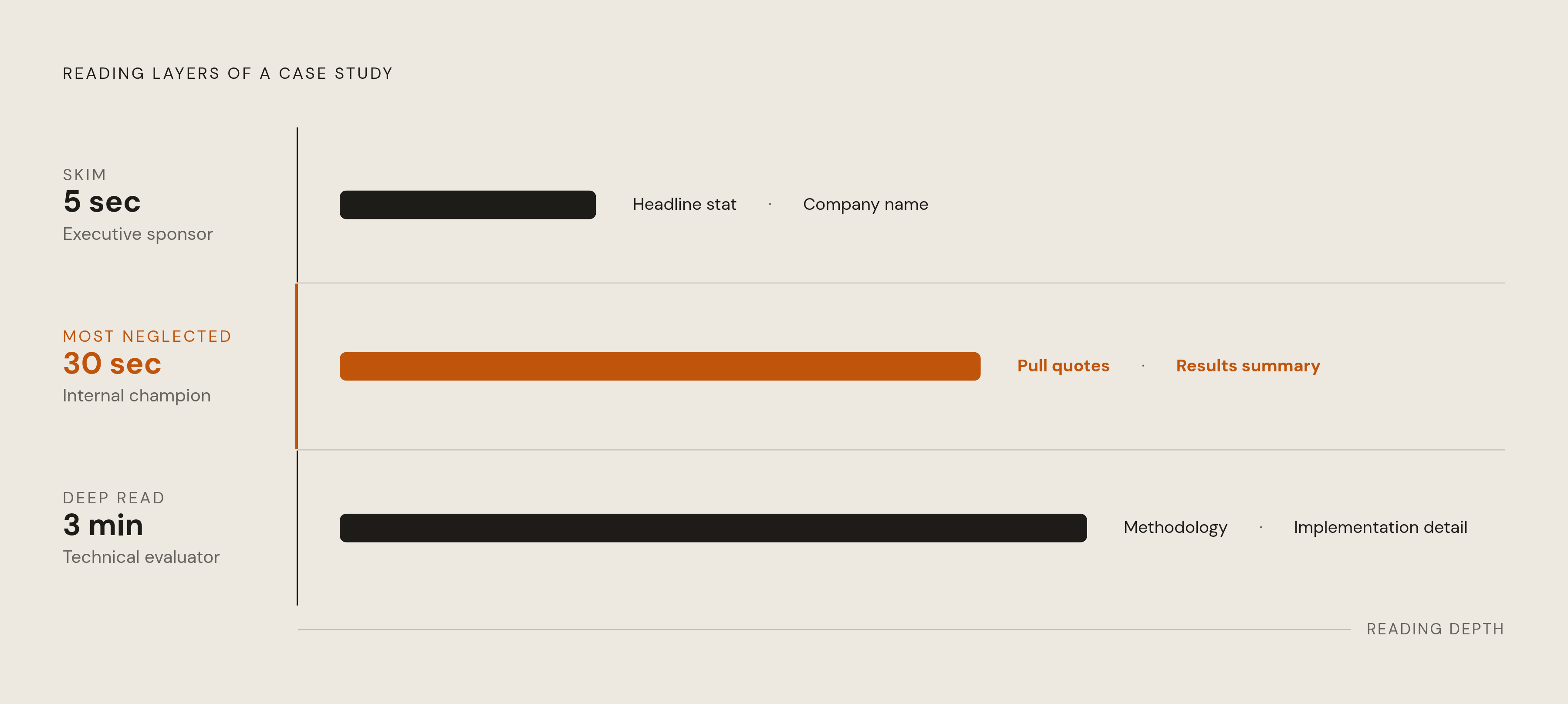
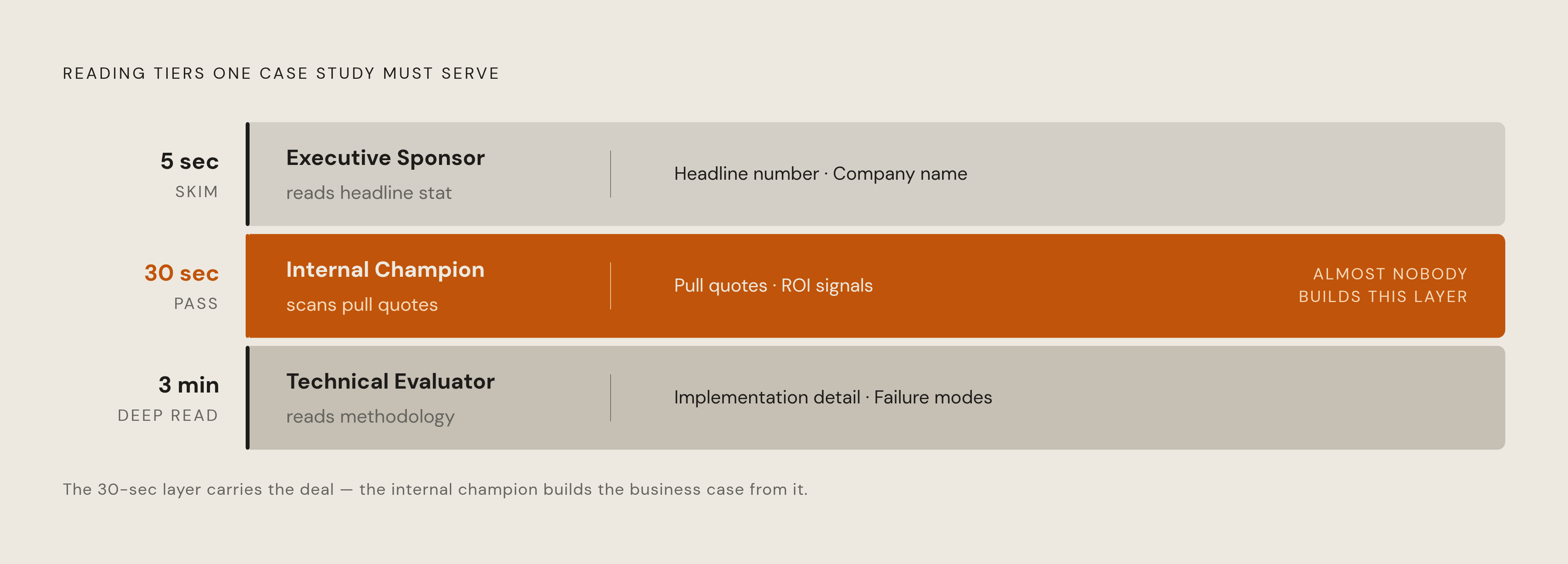
Buying committees keep stretching. Seven percent now run ten or more stakeholders, which means one document has to work at three speeds at once. Build for that from the start; bolting it on afterward rarely works.
There's the five-second skim: the executive sponsor who reads the headline stat and the company name and moves on, satisfied enough. There's the thirty-second pass: the internal champion scanning pull quotes while quietly assembling the business case for their own boss. And there's the three-minute deep read: the technical evaluator who wants the methodology, the implementation detail, the part where things got a little messy before they got better.
Almost nobody builds that middle layer well. Most case studies are either a wall of dense narrative built for the deep reader, or a single punchy stat with nothing behind it for the skimmer. The thirty-second reader, often the exact person pushing the deal internally, gets nothing built with them in mind.
Callout boxes for key metrics. Subheadings that state a conclusion instead of just labeling a topic. A results table before the narrative even starts. Small things, but each one fills a missing rung on the ladder.
Pull quotes need to carry actual information too. "We cut our reporting cycle from two weeks to two days" does real work. "The team was incredibly helpful" does none of it. That's a compliment you could copy-paste onto any vendor's site on the internet, and a buyer skimming at speed can tell the difference without slowing down to think about it.
What quantified proof must include to actually justify a purchase decision
G2 found 65% of B2B buyers name price or ROI as a top factor in the final decision. The results section can't gesture vaguely at value; it has to state it in numbers. Implied ROI doesn't hold up under scrutiny it hasn't earned.
Time-to-value might be the single most underused metric in the format. Buyers aren't only asking "will this work," they're asking "how fast will I know it's working." A great result eighteen months out is a much harder sell than a decent one in six weeks, and the implementation timeline deserves its own line near the top rather than a buried clause in paragraph four.
Good case studies quantify across more than one axis, since different stakeholders optimize for different things: revenue gained, cost avoided, hours saved, error rates down. Specificity is what makes any of it believable. "Reduced onboarding time by roughly half" reads like a number somebody rounded on the way to a slide deck. A named figure against a named timeframe reads like something that got measured. Because it did.
A few framings hold up: direct ROI, meaning revenue gained or cost avoided against spend; payback period, how fast the thing paid for itself; comparative baseline, measured against the old vendor or the manual process it replaced. What sinks credibility fastest is confusing outputs with outcomes. "Completed 40 hours of training" is an output. "Cut error-driven rework by a third" is an outcome. Nobody's finance team signs off on a renewal because of how many training modules got clicked through, however satisfying that completion bar looked on somebody's dashboard.
How customer voice and social proof placement affect credibility at the decision stage
That TrustRadius figure, 83% trusting peer experience over vendor claims, has a direct format consequence: every result needs a human name attached to it, not just a vendor's word for it. Peer voice isn't only a top-of-funnel thing, either. Only 19% of buyers say they start their evaluation with peer recommendations, but 58% report using them somewhere along the way. A well-placed quote works across the whole cycle, not just at the front door.
Placement changes the job a quote does. An opening quote builds credibility before the reader's spent real time on the page, which works well when the customer's own name carries weight on its own. A closing quote is the standard move, validating the results and giving the piece somewhere to land emotionally. A quote buried mid-narrative, tucked into the implementation section, answers the question skeptical readers are quietly asking: sure, but what was it actually like to live through this.
Quote quality has a floor, and it's not a high one: named person, named title, named company, a specific outcome referenced by name. Anonymous praise doesn't just fail to help; it works against the piece, since buyers have learned to read "a satisfied customer said" as code for "we couldn't get anyone to go on record." There's real value in admitting a little friction, too. A transition that owns up to a rocky first two weeks reads as more credible than a frictionless fairy tale, because everyone reading knows real implementations have bumps somewhere, and pretending otherwise asks for trust the piece hasn't earned yet.
Format variants — web page, PDF, and video — and the job each one does in the buying cycle
Forrester Research B2B Content Study found interactive, web-based case studies converting 28% better than static versions. Demand Gen Report put the engagement lift at 31%. Different formats, different jobs, different points in the cycle.
The web page is the anchor asset. Built for three-speed reading, indexable by Google, and the only version where interactive elements like an ROI calculator compound engagement instead of just sitting there looking nice. The PDF one-pager still earns its keep too, despite what you'd expect in an era of interactive everything: it's what a sales rep drops into an email mid-conversation, and it needs to stand alone as a summary rather than function as a shrunken long-form piece with the good parts cut off.
Video is where the newer numbers get interesting. Vidyard found personalized B2B case study videos converting 54% better than generic ones, and Lead Forensics found 87% of B2B marketers planned to invest in video marketing for 2025. Sixty to ninety seconds works for social and outbound; up to two minutes is fine on a website or during a sales call. B2B Decision Labs found a short video paired with a brief summary drove 64% of prospect meetings scheduled in their study, a big number for something a lot of teams still treat as a nice-to-have bolted onto the real deliverable.
The practical answer is a bundle, not a single format: an 800-to-2,000-plus word web page as the anchor, a one-page PDF for sales enablement, a 60-to-90 second video for social and email. The web page also pulls double duty for organic search. Lead Forensics put the average first-page Google result at in the thousands of words, meaning a substantive case study can bring in buyers who'd never heard of the vendor before landing on it.
Length decisions and how to calibrate them to the complexity of the story and the audience
There's no single right word count, and anyone selling you one is selling a template, not a strategy. Length tracks the complexity of the story and who's actually reading it.
A focused, single-outcome story aimed at time-constrained executives can run 600 to roughly 1,000 words and do its whole job without padding. The 800-to-around-1,500 range is standard for most B2B software case studies; a clean productivity win closes fine at the lower end, while a multi-stakeholder enterprise rollout needs the room the upper end gives it. Once the solution is genuinely complex or the buying committee is large, 1,500 or more becomes appropriate, and that longer format tends to also be the one that ranks well organically.
The 100-word ceiling on the executive summary holds regardless of total length. Some readers only ever touch that one paragraph before moving on with their day, so it isn't really negotiable. Worth saying plainly: writing every case study to the same length no matter what the story earns is its own failure mode. A padded 2,000-word piece with three paragraphs of throat-clearing background undercuts its own case worse than a tight 800-word one that gets to the point and stops. Length is a decision made after the structure fills in with real specifics, not a target written toward starting on page one.
How to match the case study's protagonist, industry, and outcome to the buyer you're trying to reach
Bain found 80% to 90% of B2B buyers already have a shortlist in mind before formal research even starts, and roughly 90% end up choosing from that original list. A case study that doesn't signal immediate relevance risks never getting considered at all, no matter how good the writing underneath it is.
Think of the featured customer as a mirror, not a trophy. The prospective buyer isn't asking "is this a good company." They're asking "is this company enough like mine that their result predicts mine?" Company size, growth stage, industry, the specific trigger behind the purchase, which team owned the decision: all of it needs stating plainly, not implied and hoped for quietly in the background.
A Fortune 500 logo can do wonders for brand awareness and mean absolutely nothing to a 150-person company trying to figure out if the tool fits its actual reality. Prestige and relevance are different currencies, and mixing them up is how vendors waste a genuinely great customer story on the wrong audience entirely. The fix for anyone selling across multiple segments is usually a library: several case studies segmented by industry, size, and use case, so different buyers find the mirror that actually reflects them back, instead of one flagship story polished to a shine.
The customer's own words matter here too. If the quote leans on the vendor's internal product jargon instead of the plain language the buyer would use to describe their own headache, the whole thing stops reflecting anything at all.
Producing case studies at the speed and volume the buying journey actually requires
DemandGen found 78% of B2B buyers are more likely to consider a vendor who provides case studies throughout the evaluation, not just one dropped at the very end. That's a volume problem as much as a quality problem, and it's where a lot of otherwise sound case study strategies quietly fall apart, usually without anyone noticing until pipeline reviews get uncomfortable.
Remember that average of 13 pieces of content buyers work through before ever reaching out. One hero case study, no matter how well built, covers one use case and one buyer type. Everyone else on that 7.4-person committee goes hunting for their own mirror and comes up empty-handed.
Most teams already have what they'd need sitting around unused: real customer relationships, real usage data, real results parked in a CRM nobody's queried in months. What's actually missing is a production process that turns that raw material into format-correct case studies at the pace the buying journey runs, across enough segments that most of the committee, not just the CFO and not just the end user, finds something that speaks to them directly.