Competitor Comparison Pages That Rank and Convert
Comparison pages convert at 3-4x the baseline rate when built to rank and convert simultaneously.

Comparison pages ("[Competitor] vs [Brand]," "[Competitor] alternatives," "best [category] software") are one strategic format wearing three different keyword costumes. The pages that actually work treat ranking and converting as the same design problem instead of handing them to two different teams. Someone typing "Competitor alternatives" into a search bar isn't poking around out of curiosity; they're already mid-decision, and the page either meets them there or gets skipped for the next tab. I've watched a lot of these pages rank fine and still convert badly, and it's almost always because whoever built the page won the search fight and forgot there was a second fight waiting.
How comparison page performance stacks up against everything else you could be writing
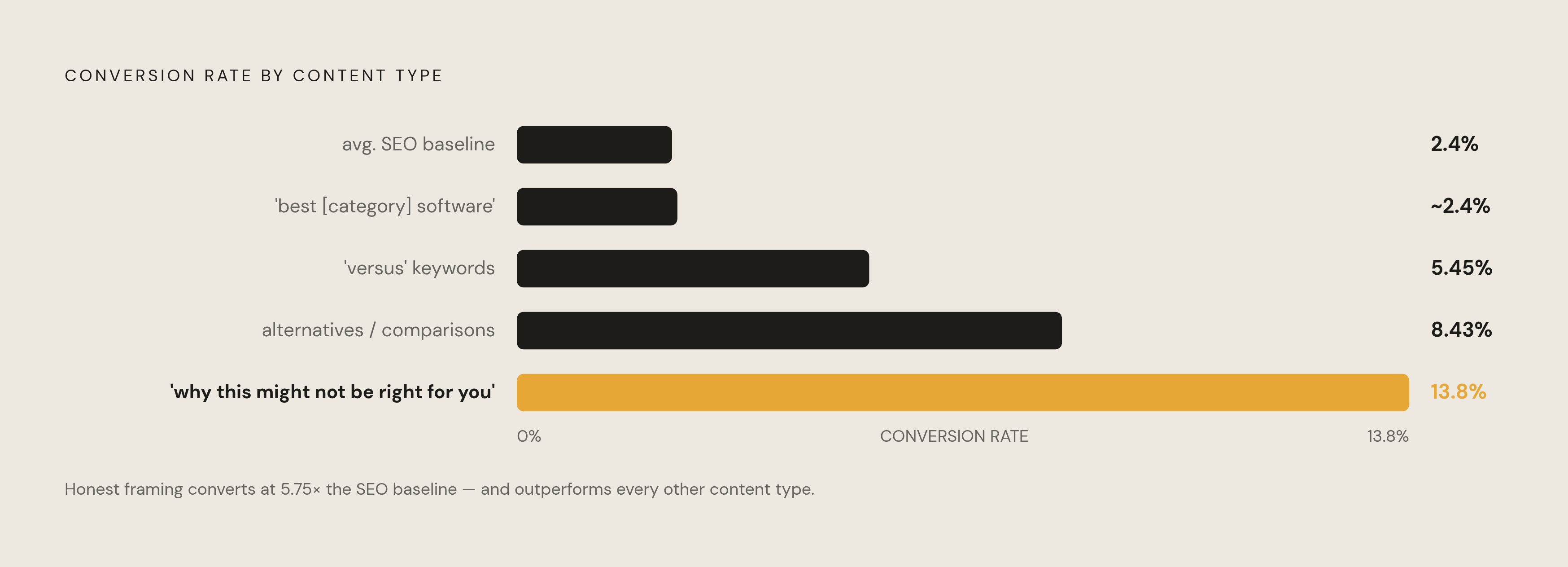
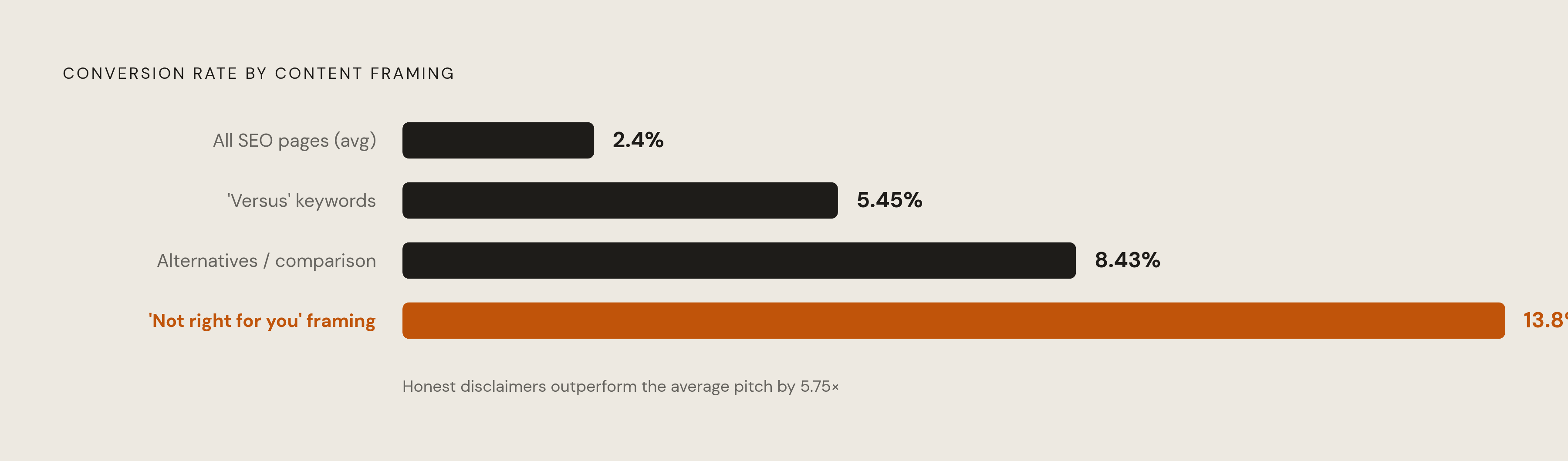
Start with the gap, because it's a big one. First Page Sage puts the average SEO conversion rate across all page types at 2.4%. Comparison and alternatives pages clear 7.5%, according to the agency Grow & Convert, which is more than three times that baseline.
Grow & Convert's own dataset, built from 95 client articles (not exactly a meta-analysis of the entire SaaS industry, so hold the exact numbers loosely), breaks it down further: alternatives and comparison keywords converted visitors to leads at 8.43%, "versus" keywords at 5.45%. Both numbers beat core product-category keywords, which should make anyone running a content calendar sit up a little. The multiplier, somewhere in the 3-to-4x range, is the part worth remembering. The decimal points are secondary.
Here's the part that trips people up. Pages framed honestly, along the lines of "Why this product might not be right for you," converted at 13.8% in that same dataset. The disclaimer outperformed the pitch. TripleDart's research across more than 250 B2B SaaS accounts found pages pairing comparison tables with first-party survey data averaged 47% higher conversion rates than pages that skipped that combination.
One project management SaaS company built a single page targeting "[competitor] alternative," took the top ranking spot, and pulled in $500,000 in ARR off that page alone, converting to trial at 23%, nearly four times its average landing page rate. A 2024 Intergrowth survey found 35.8% of respondents saying their comparison pages performed better than ever, against only 15.1% who saw a decline. The format is warming up while everyone argues about AI Overviews.
None of this happens by accident, though. These numbers belong to pages someone actually thought through, and the rest of this piece is about what "thought through" looks like once you get past the headline stats.
How the buyer's research path has shifted, and what that means for a page you thought was finished
The way buying decisions get made has changed. As of late 2025, 51% of B2B software buyers say they start research inside an AI chatbot more often than inside Google, up from 29% earlier that same year. Sixty-nine percent of those buyers say they ended up picking a different vendor than they'd originally planned, specifically because of something the chatbot surfaced.
That's a new step in the buying journey, one that happens before your sales team ever hears a name, and most vendors have exactly zero pieces of content built for it.
Google itself has shifted underneath everyone, too. AI Overviews now trigger on roughly half of all Google queries, per DemandSage's 2025 numbers. So a comparison page has to win two fights at once: rank in the regular blue links, and get quoted inside the AI summary sitting above them. Ahrefs' July 2025 analysis found that 76% of AI Overview citations came from pages already ranking in Google's top 10 for that query. Organic ranking and AI citation odds function as one scoreboard, read twice.
Siege Media's review of more than 100 B2B sites found "versus" comparison pages were the single strongest content-type predictor of AI referral traffic, ahead of blog posts, guides, everything else in the mix. And then there's Reddit, which nobody planned for and everyone now has to deal with. A Minuttia study covering thousands of comparison-query search results found Reddit threads showing up in 8.12% of them overall, climbing to 63.8% on the most competitive terms. Forums used to be background noise. Now they're shelf space, and you're competing for it whether you signed up for that or not.
Put it together and a comparison page has to earn an AI citation and an organic ranking with the exact same words on the page. One task, and the page's structure needs to reflect that from line one.
Picking keywords without falling into the volume trap almost everyone falls into
![Table: Comparison Keyword Types: Intent and Trade-offs. Compares Buyer State, Purchase Intent, Typical Search Volume, Volume Accuracy in Tools, and 1 more by [Competitor] vs [Brand], [Competitor] Alternatives and Best [Category] Software.](https://mcxtywzsmeezbwapdahq.supabase.co/storage/v1/object/public/article-images/259cb55d-45f0-4472-92b7-c5daf13cdc2f/73ea51b3-c84b-4797-a0c8-6c9e25e00b12/8f3c0680f3cdf17d9aba50c8c1d2888d.png)
Three keyword shapes, three different states of mind. "[Competitor] vs [Brand]" is a two-item shortlist: highest commitment, lowest search volume. "[Competitor] alternatives" signals dissatisfaction and an open mind, usually more volume than a vs query, still strong intent to buy. "Best [category] software" is the widest net of the three, and despite showing the biggest numbers in whatever SEO tool you're using, it carries the weakest intent of the group.
That last part matters more than it sounds like it should. SEO tools consistently underreport volume for comparison-style queries; actual traffic tends to run higher than the dashboard admits. Teams that sort their keyword list by tool-reported volume alone end up burying the exact pages they should have built first. I've seen this happen at more than one company, and it's often framed as a data problem when it's really a trust-the-tool-too-much problem.
Then there's the math nobody budgets for. Twenty competitors produce hundreds of unique keyword pairings once you account for search engines treating "A vs B" and "B vs A" as two separate strings. Try to cover that with a template and no real plan, and you land right at the intersection where thin-content penalties and spam policy live, waiting for you.
Better approach: lead with "alternative to [dominant competitor]" pages where real switching demand already exists, then rank the direct "vs" pages by how often that specific matchup comes up in actual sales calls and review threads, ahead of whatever number the keyword tool happens to spit out that day.
ClickUp's early SEO strategy, a systematic set of compare pages against nearly every major competitor in its category, was a core piece of how the company bootstrapped past $25 million. Eric Siu has credited similar "alternative" and "vs" targeting with driving Single Grain past $10 million. Both worked for the same reason: they went after demand that already existed instead of inventing some. Storylane built comparison pages programmatically and grew from 25,000 to over 150,000 monthly visitors in three months, targeting real, already-searched competitor queries rather than manufacturing new ones from scratch. Systematic coverage of genuine demand, built one page at a time rather than treated as a numbers game.
Building a page structure that works for the crawler and the human deciding whether to buy
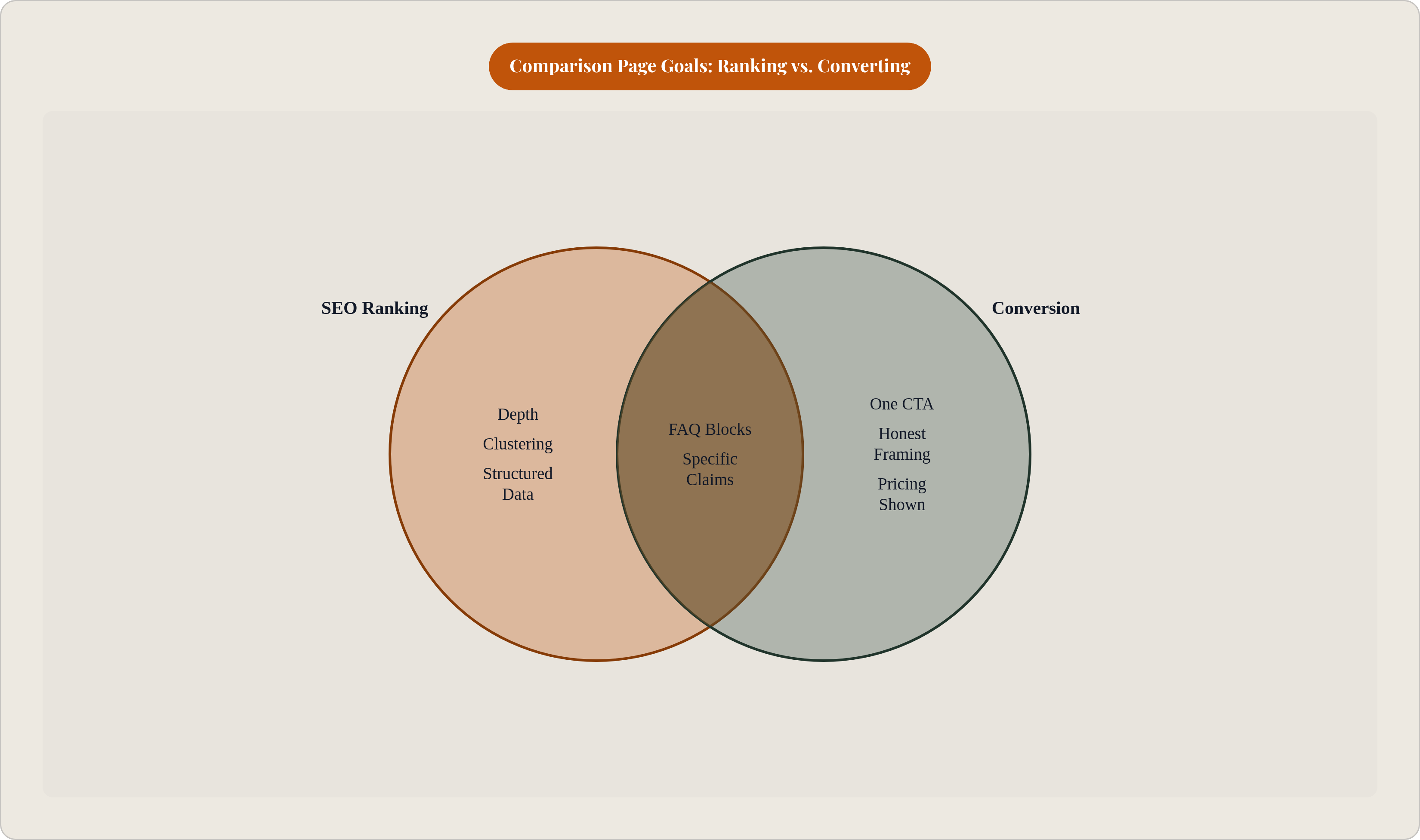
Here's the tension sitting at the center of all this: SEO rewards depth and coverage, conversion rewards clarity and a short walk to the "Start Trial" button. The structure that satisfies both puts the decision-enabling stuff up front and lets the depth sit behind it, available but not blocking the exit.
Start with the address. House these under a dedicated /compare/ subfolder, following something like /compare/brand-vs-competitor/. Search engines recognize that kind of topical clustering on sight, and it keeps a site's authority in one place instead of scattered across the blog.
The page itself, roughly in this order:
The hero section names the comparison outright and states the sharpest point of difference in the first sentence, not the fourth. AI chatbots tend to grab the first definitive line they find, so if your best point is sitting in paragraph three, it never gets quoted. It just sits there, unused.
A feature comparison table comes next: the one thing every buyer expects and every crawler indexes cleanly. Structured data (Product schema, ItemList markup) raises the odds of a rich snippet and an AI citation at once, which is a rare case of one line of code doing double duty.
Pricing gets stated directly, not hedged behind "contact us for a quote." Anyone reading a comparison page has already decided to buy something in this category. Withholding pricing at that point reads as evasive, no matter how the sales team feels about it.
A use-case fit section says plainly who each product actually serves, including the cases where the competitor is genuinely the better call. That's the honest framing that earns trust, and it's the same mechanism behind the 13.8% conversion number from Grow & Convert's data mentioned earlier.
Customer evidence follows, marked up with Review schema, and specificity does the heavy lifting here: a named company with a named result beats generic praise every single time. Then a named-competitor FAQ block, because Q&A format gets weighted heavily by language models. A question like "Is this a better fit than Competitor X for enterprise teams?" answered in two or three tight sentences tends to get lifted and quoted almost word for word in AI-generated answers.
Close with one CTA. Unbounce's data shows pages with a single link average a 13.5% conversion rate; add two to four more links and that number drops to 11.9%. CTA discipline works as conversion architecture, plain and simple.
Link each comparison page to relevant product pages, case studies, and neighboring comparisons, and link down from category pages into the specific ones. That builds topical authority across the site and keeps evaluation-stage visitors moving instead of dead-ending on a page with nowhere to go. Build separate pages per competitor rather than one sprawling mega-comparison, too; separate pages let you target keywords precisely and speak to the specific reason someone's leaving that particular tool.
The editorial calls that decide whether the page converts or just ranks and sits there
Someone lands on a vendor's comparison page already knowing the vendor wrote it. That's the credibility hole this format starts in, and the page has to climb out rather than assume goodwill it hasn't earned yet.
Saying plainly where your product isn't the right fit works as an editorial move that makes every other claim on the page more believable. That's the mechanism behind the 13.8% figure from earlier: honesty about limits is proof of honesty about strengths.
Accuracy about the competitor isn't optional, and not for some abstract ethics reason. Buyers cross-check comparison claims against G2, against Capterra, against the AI chatbot open in the next tab over. One factual slip about a competitor's feature set gets caught at exactly the moment the buyer is deciding whether to trust anything else on the page. It rarely survives that moment.
First-party evidence beats borrowed authority every time I've seen it tested. Comparison tables built on original survey data or actual customer interviews outperform tables assembled from public spec sheets and press releases; TripleDart's 47% conversion lift, mentioned earlier, comes specifically from pages pairing tables with first-party survey data. Every section should open with its conclusion and let the explanation follow after, which serves the buyer skimming on their phone and the AI model hunting for one clean sentence to quote, at the same time, off the same sentence.
Recency matters more here than almost anywhere else in content. Competitor features and pricing move constantly, and a visible "last updated" date tells a buyer that what they're reading is still true today, not from eight months ago when the competitor still had that pricing tier. A stale page is a conversion liability and, increasingly, an AI-citation risk, since models tend to favor sources that look current. Zonka Feedback updated and restructured one comparison article and saw an 85% traffic increase alongside a 25% jump in trial sign-ups over three months, gains that came from ranking improvement and on-page trust working together.
Getting comparison pages into AI-generated answers, not just Google's results page
Ahrefs' finding is worth repeating because it's the foundation of this whole section: 76% of AI Overview citations in July 2025 came from pages already ranking in Google's top 10 for that query. Organic authority is the base the citation gets built on top of.
So what actually gets a page cited? Answer-first sentences, differentiator stated in sentence one instead of buried after three sentences of throat-clearing. Named-competitor FAQ blocks in clean Q&A format a model can lift without needing to rewrite. Structured data (Product schema, FAQ schema, Review schema), which raises the odds of a rich snippet and an AI citation together. And specific, checkable claims: a vague superlative like "the best tool for teams" isn't citable because there's nothing in it to cite. A named outcome with a sourced number is something a model can actually grab.
Reddit deserves its own mention here, not as a footnote. With comparison-query threads showing up in 8.12% of results overall and 63.8% on the most competitive terms, actually participating in communities like r/SaaS, where people genuinely talk through switching decisions, is part of comparison-page distribution now, folded into the same job description as the on-page work.
The practical upshot for anyone writing these pages: write like a model is going to pull exactly one sentence to represent your position, because more and more, that's exactly what happens. Every key claim has to stand on its own, accurate without needing the paragraph around it to prop it up. The discipline that earns an AI citation, direct, specific, structured, turns out to be the same discipline that earns a buyer's trust, with one version of this page serving both at once.
Scaling a comparison page program without it turning into forty pages that all read the same
The combinatorial math from earlier, twenty competitors producing hundreds of keyword pairings, creates real pressure to templatize and mass-produce. That pressure is exactly what leads to thin-content penalties and a program nobody trusts, including the buyers it was supposedly built for.
Prioritize before you write a word. Rank competitors by actual switching demand: how often they come up in sales calls, how often they're mentioned on review sites, how much traffic their "alternative" query pulls. Build in that order. Ten pages done well beat forty pages done adequately, and this stops being debatable the moment you've seen both versions sitting next to each other.
A hub-and-spoke layout handles volume without watering down quality. A category-level "alternatives to [competitor]" page works as the hub; individual "vs" pages branch off as spokes. Internal links between them concentrate authority in one place and give buyers at different stages of decisiveness different doors to walk through.
Where the page actually lives on the site matters more than most teams assume, too. TripleDart found accounts surfacing comparison pages in product navigation, instead of burying them three clicks deep in a blog archive, saw 2.8 times the organic growth in evaluation-stage traffic and 35% higher internal conversion rates. That's a distribution decision that also functions as an information-architecture decision, and it deserves to be treated as such.
Maintenance isn't optional, much as everyone wishes it were. Competitor pricing and features shift, and a stale page bleeds ranking position and buyer trust at the same time. Build an update schedule tied to competitor release cycles, not to whatever your content calendar happens to look like that quarter.
AI tools can speed production up here, and speed doesn't have to come at the cost of quality, but only once the strategy is already set. The template, the editorial standards, the first-party survey data: all of that has to exist before generation starts. AI can accelerate a brief someone already wrote with care, but writing the brief itself still falls to a person, and treating it otherwise is exactly how programs end up with forty pages that all sound interchangeable.
Which brings up the last point, and maybe the one that actually matters most. Marketing teams that keep comparison pages as an owned, actively managed asset, rather than farming them out to an agency with no real feel for the competitive landscape, consistently produce pages with better factual accuracy and faster update cycles. That's a matter of proximity, not a knock on agencies. The page's credibility depends on how close the person writing it sits to the product and the customers using it, and that's a gap no amount of keyword research closes by itself.