Content Refresh Strategy for Declining Organic Traffic Pages
Diagnose why your pages are losing traffic before you refresh them.

Seventy-three percent of B2B websites saw significant traffic losses between 2024 and 2025, with an average year-over-year decline of 34%, according to Search Engine Land. That's not a niche problem affecting sloppy content teams. That's most of the industry, watching pages that used to work quietly stop working, and not always knowing why.
This piece is about diagnosis before treatment: why a content refresh strategy only pays off when you first figure out which of several distinct causes is behind a given page's decline, because algorithm shifts, stale data, intent drift, and zero-click erosion each demand a different fix, and treating them the same way is how refresh budgets get wasted.
What content decay actually looks like in the data
Decay doesn't announce itself. It's not a server outage or a manual penalty with a nice, official-looking notice in Search Console; it's a slow bleed, the kind of decline that drops a page from a strong month to a fraction of that over two or three quarters without ever tripping an alarm on any given Tuesday. According to Animalz, most websites lose 20 to 30% of organic clicks every six months from decay alone, no penalties or competitor sabotage required. It just happens.
Here's the part that should worry anyone who thinks a slip from rank #1 to rank #2 is no big deal: Animalz found that drop alone can cut traffic by half. Fall to position #6, and you're looking at something like a 90% loss. Position isn't a leaderboard vanity metric; it's closer to a light switch with a dimmer that goes dark fast.
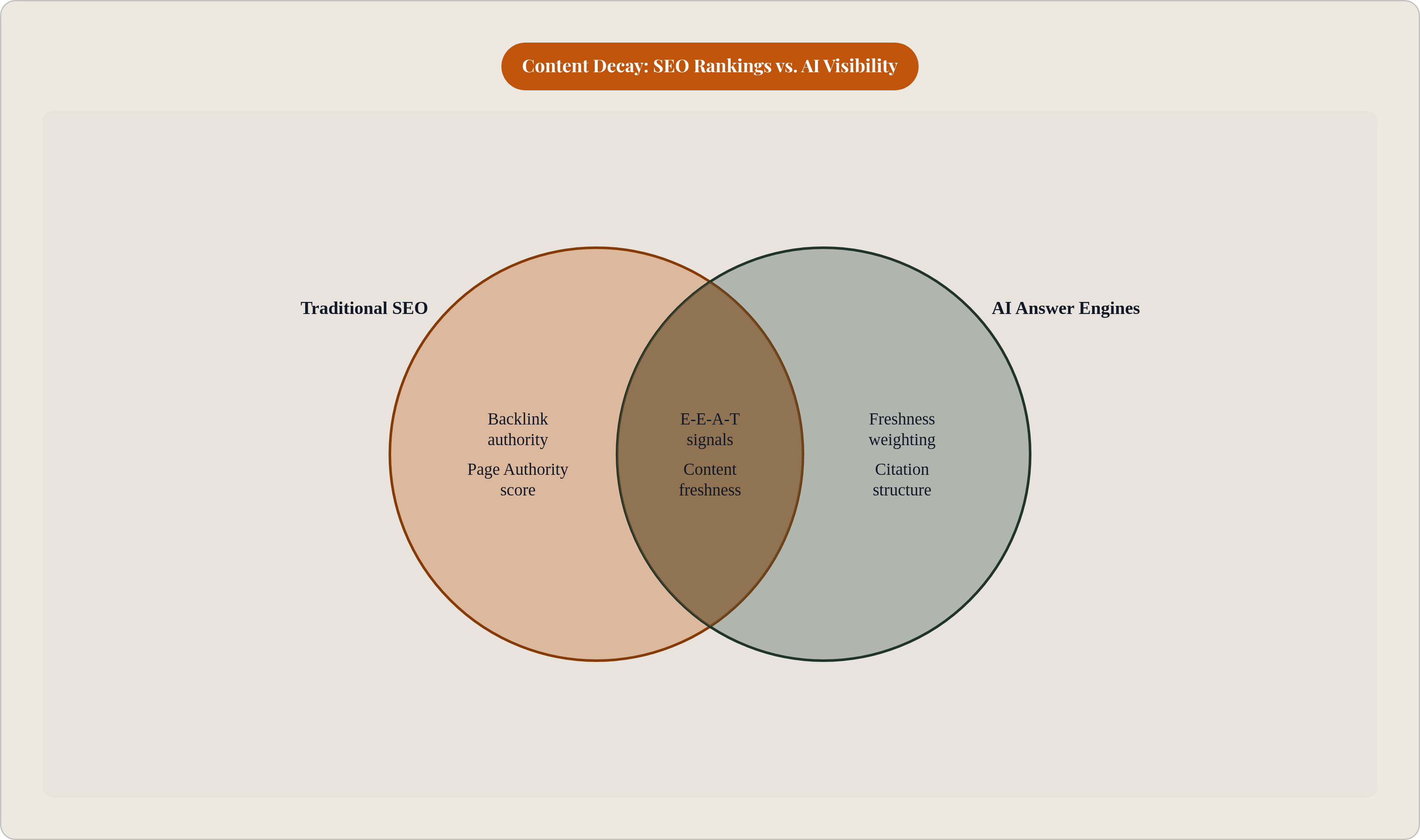
A SEMrush study of 12,000 declining pages found 81% of the traffic loss correlated directly with a decline in Page Authority score. Which tells you something uncomfortable: decay is often less about the words on the page and more about domain-level signals accumulating or eroding around it. You can polish a page all day, but if the domain's authority is sliding, the page slides with it.
And then there's the twist nobody fully priced in until recently. A page can hold its Google ranking steady, essentially unchanged, while vanishing from AI-generated answers in ChatGPT, Perplexity, or Google's own AI Overviews. Slate's first-party research, tracking five B2B SaaS brands over 90 days in the first half of 2026, found that even the best-performing brand was absent from 71.5% of relevant AI answers. Two visibility problems, running on separate axes, and a page can be fine on one and failing on the other without either metric telling you about the other.
So what's actually happening under the hood? Not every decaying page decays for the same reason, and that distinction is the whole ballgame.
The four causes of decline and why each requires a different response
Here's where teams go wrong most often: they see a decline, and the reflex is "refresh the content." Update it, add some words, hit publish, hope. But that's a shotgun approach to a problem that has at least four distinct triggers, and a team that skips diagnosis is basically guessing with extra steps.
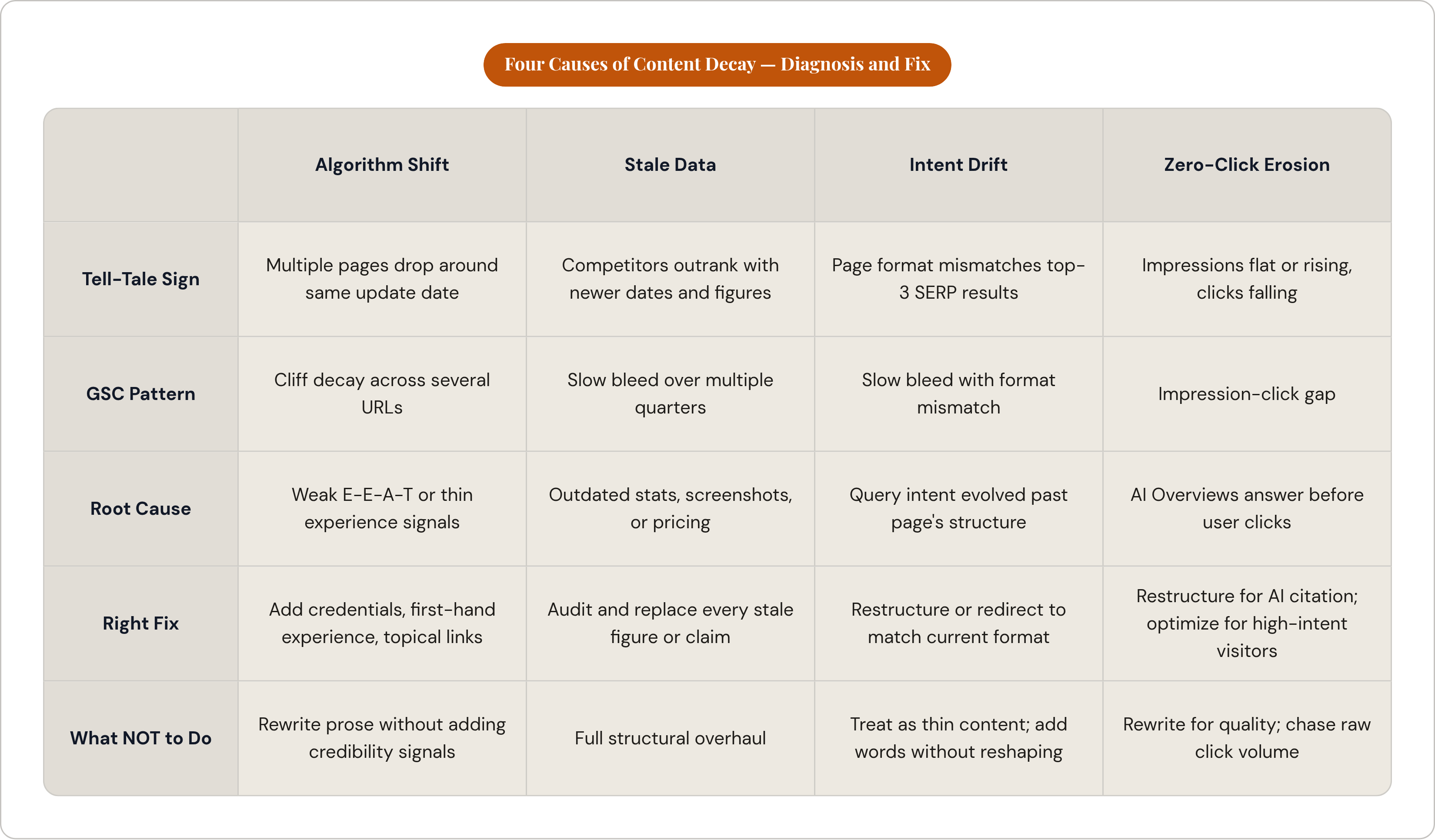
Algorithm shift. Google's core updates keep folding helpful-content signals into the main ranking algorithm; the March 2024 update did this explicitly, June 2025 refined relevance signals further, and by the March 2026 update, an estimated 55% of monitored sites saw some effect, with thin AI-generated content and weak E-E-A-T (Experience, Expertise, Authoritativeness, Trustworthiness) taking the hit. Digital Applied found sites lacking first-hand experience signals dropped an average of 8 positions in affected keyword sets after that March 2026 update. The tell here is simultaneous: multiple pages drop around the same date, one that lines up with a known update. The fix isn't a rewrite. It's reinforcing credibility: author bylines with actual credentials, first-hand experience, sourcing that holds up.
Stale data. This is the classic, almost boring cause, and it's exactly as unglamorous as it sounds: statistics, screenshots, pricing tables sitting there 18 to 24 months old while a competitor's version got updated last month. One software review site lost roughly 60% of its traffic in the August 2023 core update because its product comparisons hadn't been touched in a year and a half. They refreshed the data, added original screenshots, and recovered about 75% of the lost traffic within four months. The tell: competitors outranking you have newer publish dates and current figures. The fix: a data refresh, not a structural overhaul.
Intent drift. Search intent for a given query shifts over time, sometimes gradually, sometimes overnight. A keyword that used to reward a listicle might now reward a comparison table, or the reverse. The tell is subtle and requires actually looking at the SERP: the page's format no longer matches what's sitting in positions one through three. This is the cause most likely to get misdiagnosed as "thin content," because the content might be plenty thorough; it's just built in the wrong shape for what Google wants to surface now. The fix here can mean a genuine rewrite, sometimes a rethink of the whole angle.
Zero-click erosion. This is the newest and, frankly, the strangest of the four, because the page can be doing everything right and still lose. Pages answering definitional or "best of" queries are the most exposed, since AI Overviews increasingly just answer the question before anyone clicks through. UpGrowth's analysis across more than 150 client sites found a 15 to 25% CTR decline on informational queries between 2024 and 2026, while transactional query CTRs stayed relatively stable. The tell in GSC: impressions flat or rising, clicks and CTR falling. The page still ranks. It's just not getting chosen anymore, because the SERP already gave the answer away. The fix isn't rewriting the page for quality; it's restructuring for AI citation and rethinking what a smaller, higher-intent click pool actually needs from a CTA.
Four causes, four fixes. Mixing them up is like treating a broken arm and a head cold with the same prescription because both showed up at urgent care on the same day.
How to read your GSC data to match pages to causes
Start with the noise filter: one month of decline means nothing. Three months of sustained decline is the minimum signal worth investigating; anything shorter is probably seasonal wobble or a fluke in Google's indexing.
There are five decay metrics worth flagging on sight, per 2026 guidance from eastondev.com: CTR below a very low threshold, ranking dropped out of the top 20, bounce rate above a high threshold, traffic decline over 30%, and a Page Authority score drop of more than 20 points. Any one of these on its own might be noise. Two or three together, on the same page, over three months, is a pattern.
Three shapes show up in the GSC data, and each one points somewhere specific. Cliff decay looks like a page that held steady for months, then dropped sharply in a single quarter; that usually maps to an algorithm update or a major competitor launch stealing the SERP. Slow bleed is the gradual, quarter-over-quarter erosion; that's the signature of stale data or intent drift, things that degrade rather than break. The impression-click gap is the strange one: impressions flat or climbing, clicks falling. That's zero-click erosion, and it's the pattern most teams miss because the ranking itself looks fine.
For prioritization, the same source lays out a decision matrix worth borrowing wholesale. High priority: traffic loss over 500 clicks a month, ranking outside the top 20, last updated more than two years ago. Address it now. Medium priority: loss between 100 and 500 clicks, position sitting between 10 and 20, updated one to two years ago. Put it on next month's schedule. Low priority: loss under 100 clicks, still ranking top 10, updated within the past year. Save it for the quarterly audit.
One more layer, separate from GSC entirely: check AI visibility on its own terms. A page can have rock-solid rankings and still be a ghost inside ChatGPT or Perplexity's answers. That requires either dedicated tooling or, honestly, just manually running your target queries through the AI tools yourself and seeing if you show up. It's tedious. It's also the only way to catch decay on the second axis before it becomes obvious in a quarterly report.
The practical rule, and it's an easy one to skip when you're moving fast: don't mix causes in the same triage pass. Tag each page with its primary cause first. A page with cliff decay and a page with an impression-click gap are not the same patient, even if they showed up in the same spreadsheet on the same day.
Why Google's freshness signals now reward pages that update regularly
Freshness used to be a minor factor, something that mattered for news and not much else. That changed. First Page Sage's Q1 2025 analysis put freshness as the sixth-biggest ranking factor in Google's algorithm, worth roughly 6% of the overall weighting. That's not a rounding error anymore; that's a lever.
Pages updated at least once a year gain an average of 4.6 positions in search results compared to pages that never get touched, per the same research. Google's Query Deserves Freshness system, which has been around in some form for years, can push a genuinely fresher page above a competitor with a stronger backlink profile when the query itself signals that recency matters. Which means freshness can, in the right context, beat authority. That's a fairly radical thing to say out loud in an industry that's spent two decades prioritizing backlinks above nearly everything else.
AI answer engines take this further, and by "further" I mean noticeably more aggressive. An Ahrefs study of 17 million AI citations found AI-cited content runs 25.7% fresher than what shows up in traditional Google results, and ChatGPT specifically tends to cite URLs that are 393 to 458 days newer than the equivalents ranking organically. Ahrefs also found that 65% of AI bot crawl activity in 2025 targeted pages published or updated within the past 12 months. Bots are filtering by recency before quality even gets a vote.
AirOps research found pages that haven't been updated in over a year are twice as likely to lose AI citations entirely. So the implication isn't subtle: freshness stopped being a nice-to-have reserved for breaking news and became something closer to a structural requirement, at least for anyone targeting informational queries in a market with real competition.
Matching the intervention to the diagnosis
There's a spectrum here, running from a light touch on one end to a full rewrite, and sometimes a redirect, on the other. Pick too heavy an intervention and you've wasted a week of a writer's time on a page that needed twenty minutes of data updates. Pick too light one and the page keeps sliding, because you never touched the actual problem.
For algorithm-shift pages, the work is credibility, not prose. Add or upgrade author bylines with verifiable credentials. Inject first-hand experience wherever possible: original data, real case examples, a quote from someone who's actually done the thing. Strengthen internal linking so the page reads as part of a topical cluster rather than an orphan. Rewriting the same claims in nicer sentences does nothing here; the problem was never the writing.
For stale-data pages, audit every number, screenshot, and named tool against what's true right now. Replace outdated figures with sourced current ones, and where no current figure exists, cut the claim rather than leave a stale one standing. One caution worth repeating: update the publish date only after you've made substantive changes. Bumping the date without touching the substance is the kind of thing that gets noticed, and not in a good way.
For intent-drift pages, look at the current top three results and study their format, depth, and angle, not just their keywords. If the format has genuinely shifted, listicle to comparison table, or general guide to a narrow how-to, a structural rewrite is warranted. Sometimes the honest answer is that the URL itself isn't worth saving, and a redirect to a newly framed page will outperform trying to retrofit the old one into a shape it was never built for.
For zero-click erosion pages, the fix runs in a different direction entirely. Restructure for AI citation: clear definitions, well-labeled sections, direct answers to the follow-up questions a reader would naturally ask next, since that's the format language models tend to excerpt. And shift the conversion math: assume fewer clicks are coming, so optimize for the visitors who do arrive rather than for raw volume. Since transactional CTR has held up better than informational CTR, there's a real case for weaving a transactional element into informational content without gutting its usefulness.
One rule cuts across all four causes: keep the original URL. Content updates on a preserved URL tend to improve rankings meaningfully faster than publishing the same content fresh on a brand-new one, according to Ahrefs's 2025 data. The existing authority signals are doing work you don't want to throw away.
The ROI case for refresh over new content creation
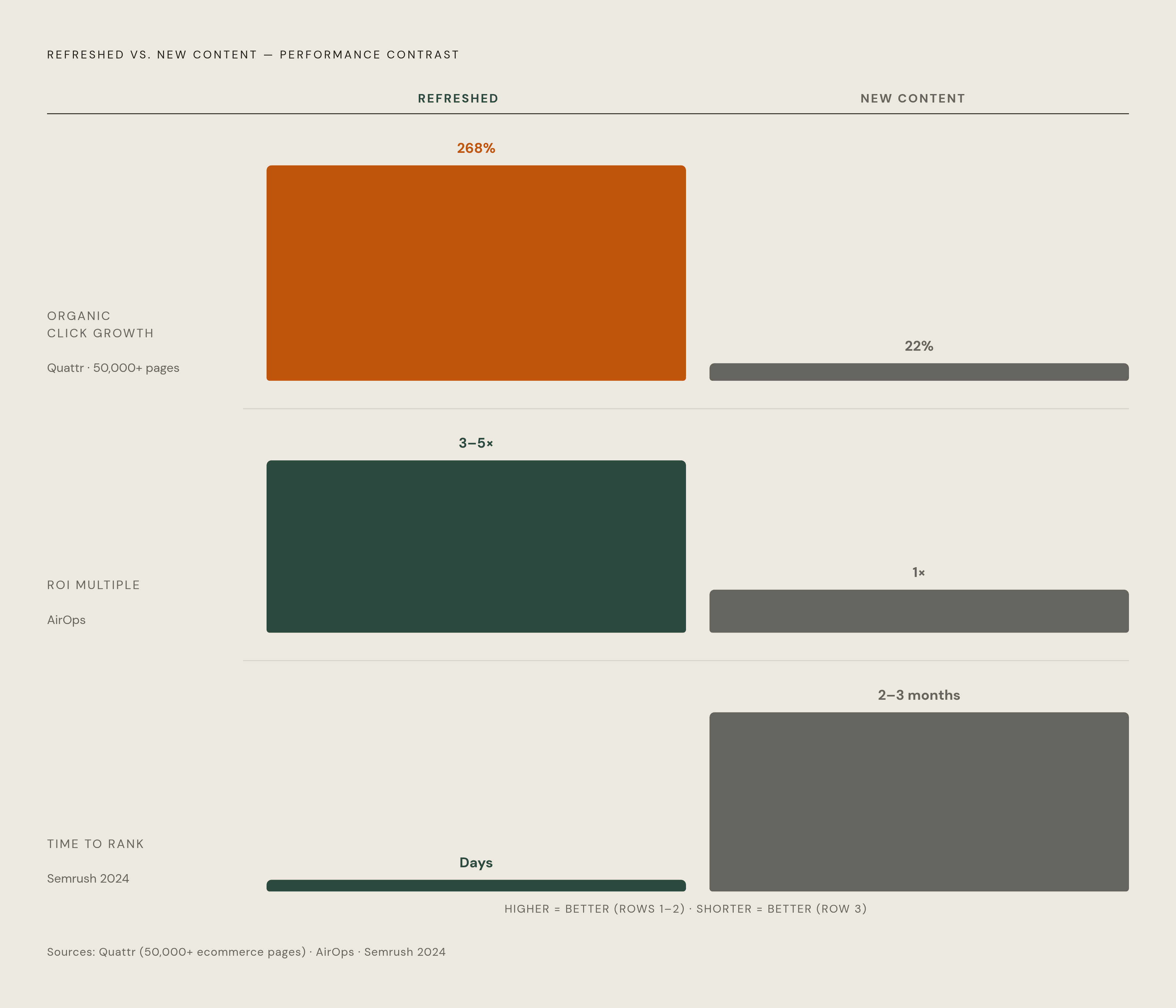
Here's the number that should reorder most content calendars: AirOps found refreshes deliver 3 to 5 times higher ROI than new content, simply because a refresh gets to borrow authority and backlinks the page already earned. New content starts from zero every time.
Quattr's analysis of more than 50,000 ecommerce pages found refreshed content delivered 268% organic click growth, against 22% for brand-new pages. That's not a marginal edge; that's an order of magnitude. One widely cited refresh program increased monthly organic visits to old posts by 106% and doubled monthly leads from those same posts. Backlinko reported a 260.7% traffic increase within just 14 days of updating existing content, which tells you something about how fast recovery can happen once the diagnosis is right and the fix actually targets it.
It's not only a traffic story either. MarketingProfs found in 2024 that strategically updated posts convert 27% better than new content on the same topic. So refresh work pulls double duty: more visits, and a better rate of turning those visits into something useful.
Frequency compounds the effect. Animalz found B2B companies updating their top content at least twice a year get roughly 37% more organic traffic than companies sticking to annual updates, and that gap widens further once AI visibility gets factored in. Speed matters too: Semrush found in 2024 that refreshed content on existing domain authority can see ranking improvements within days, while brand-new AI-generated content takes something like two to three months to rank at all.
Put plainly, for a team without unlimited bandwidth, which is every team, the math says refresh the highest-authority declining pages before chasing new topics. It's not the flashier work. It's the higher-return work.
Building a repeatable refresh process rather than one-off fixes
A page gets refreshed once, traffic recovers, everyone moves on, and eighteen months later it's decaying again, because the environment that caused the original decline never stopped changing. Google keeps rolling core updates. Competitors keep updating their own pages. AI answer engines keep raising the freshness bar. Standing still is, functionally, falling behind.
The cadence worth building toward: quarterly reviews for the top-traffic and highest-authority pages, and a full audit of the broader content library at least twice a year. That's not an arbitrary number pulled from a content calendar template; it's roughly what the frequency data above supports, given that twice-yearly updates already show a meaningful traffic edge over annual ones.
Webflow reported significant traffic gains tied to this kind of ongoing refresh discipline, rather than a single sweep through the archive. Which is really the point of this whole piece: diagnosis isn't a one-time exam you run when a page gets sick. It's a habit, built into the calendar, because the four causes covered above (algorithm shifts, stale data, intent drift, zero-click erosion) don't take turns waiting politely. They're all running simultaneously, on different pages, at different speeds, and the only real defense is checking often enough to catch each one before it compounds.