Freelance Content Writer Management at Scale
How to keep freelance writers loyal and productive as your team scales.

Managing freelance content writers at scale is a systems challenge that trips up even companies with access to plenty of good talent. Good writers aren't the bottleneck; the setup that works fine for two writers falls apart once you're running ten or fifteen. About 84% of companies outsource content now, and content marketing production climbed 49% year over year according to the IntelligenceBank 2025 Content Marketing Trends Report. Scale is already the baseline. This piece walks through what actually breaks as freelance operations grow, and what it takes to fix it before it costs you money or your brand voice.
One thing rarely makes it into the "how to manage freelancers" advice columns: about 72% of freelance writers work with at least three clients at once. Their attention is permanently split, and whichever client makes itself easiest to work with gets first crack at whatever's left of it. I've watched this play out with my own roster more times than I'd like to admit; a writer I loved simply drifted toward the client who paid faster and explained things better. Everything below is really an argument about how to become that client.
What the freelance writing workforce actually looks like in 2025
About 64 million Americans freelanced as of 2023, roughly 38% of the workforce, and that number is projected to hit 86.5 million (just over half of U.S. workers) by 2027. This labor pool has moved well past niche status. It's becoming the default way people work, whether companies have adjusted their management style to match or not.
It skews young, too. About 52% of Gen Z workers freelance, compared to 44% of millennials and 31% of Gen X, and roughly 70% of freelancers globally are under 35. If you're managing a freelance writing roster, you're mostly managing people who grew up with Slack and Notion instead of interoffice memos and cubicle small talk. That changes what "onboarding" even means, and I'll get into why later.
Blog posts make up about 77% of what freelance writers produce, which lines up with what most content marketing programs actually need. Supply and demand shape match up reasonably well on paper.
On paper is the operative phrase, though, because only about a quarter of freelancers report steady, consistent work. Around 60% deal with fluctuating demand, and a meaningful chunk describe their workload as genuinely erratic. Writing itself isn't even most of what fills their week; client communication, invoicing, pitching, and revisions eat up somewhere between 30% and 40% of a freelancer's working hours. A "full-time" freelancer has a lot less actual writing capacity than their calendar suggests, which is worth remembering the next time a deadline slips by two days and you feel the urge to fire off an annoyed email.
So what does this mean if you're the one hiring? The talent pool is deep and capable, but structurally scattered. Writers aren't sitting around waiting for your assignment; they're juggling multiple income streams at once, and the client who removes friction from that juggling act (fast payment, clear briefs, no chasing for feedback) earns loyalty that rate increases alone don't buy.
The cost structure that makes freelance teams worth the management investment
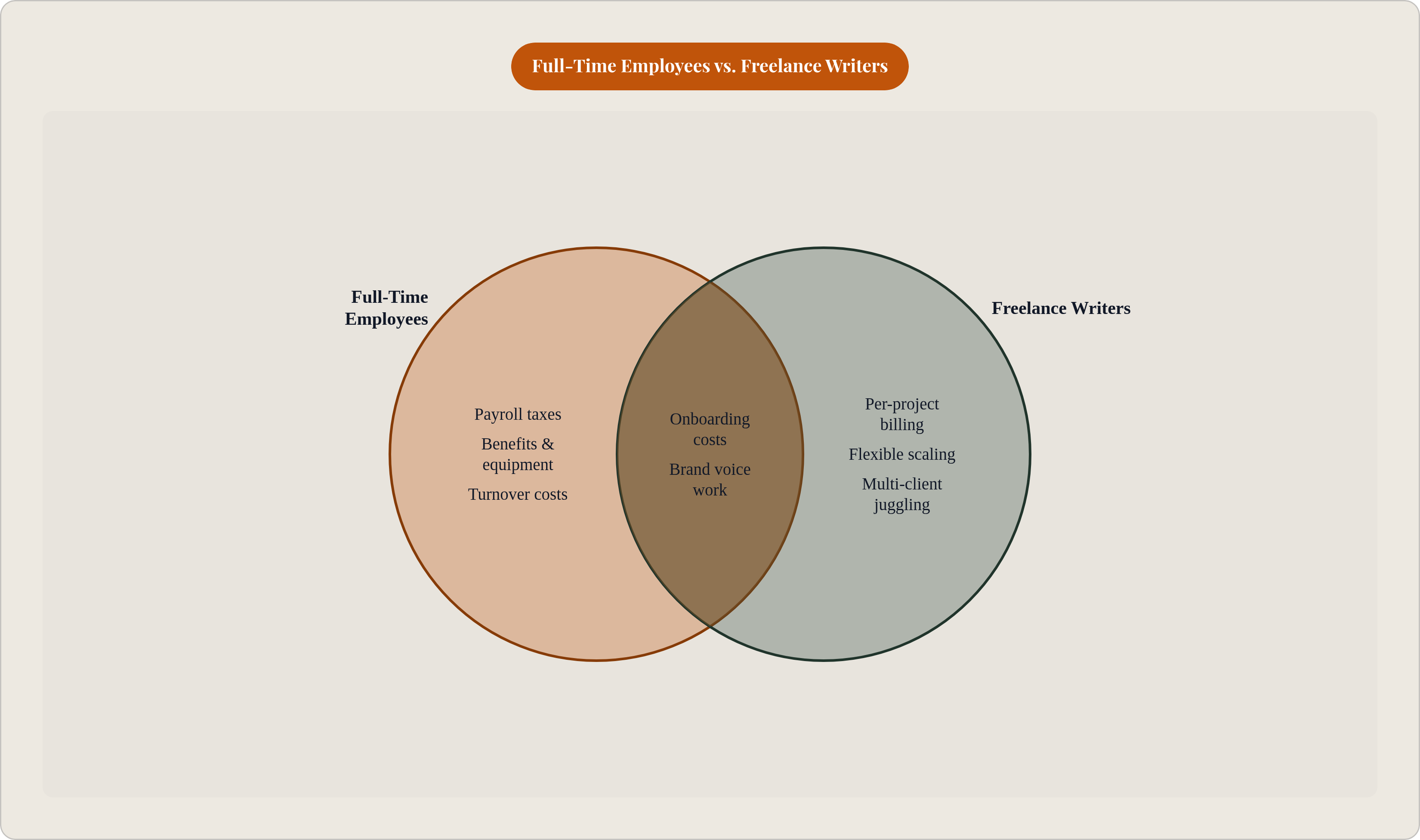
Let's talk numbers, because this is where the freelance argument either holds up or falls apart under its own weight. The median annual wage for writers and authors was $72,270 as of May 2024, according to the Bureau of Labor Statistics. Full-time hires cost considerably more than that base figure once everything else gets factored in. SHRM's 2025 benchmarking puts total first-year employer cost at 1.25 to 1.40 times base salary once payroll taxes, benefits, and equipment get added in. That's $90,338 to $101,178 for one writer, before anyone's opened a laptop.
Then there's turnover, the cost nobody budgets for until it lands on their desk. SHRM estimates replacing an employee runs 50% to 200% of their annual salary. Lose a trained content writer and you're looking at $36,000 to $144,000 in replacement and ramp-up costs. That's a mid-size marketing budget evaporating because someone took a better offer down the street.
Freelancers sidestep most of that. No payroll taxes, no benefits, no office chair to buy. You pay for the project, not the person, so when content needs slow down in a quiet quarter, your costs slow right down with them. Scaling up doesn't require a hiring cycle, and scaling down doesn't require a layoff meeting nobody wants to sit through.
Pricing runs a wide range depending on how specialized the work gets. Per-word rates at the low end sit around $0.05 to $0.10, where roughly 46.6% of surveyed writers land. Professional-tier ghostwritten blog work, per the Editorial Freelancers Association's 2026 Rate Chart, runs $0.25 to $0.40 per word. Per-article pricing spans $50 to $1,500 for long-form pieces, with ebooks and case studies averaging around $2,000. Specialized writers command real premiums: fintech writers can hit $0.95 per word, medical writers charge $60 to $150 an hour, and white paper specialists can bill $6,000 or more a month. Retainers lock in a set volume for a flat monthly fee, which is about as close as you get to full-time reliability without the full-time price tag attached.
And here's the part that actually matters, the reason this whole piece exists: those savings only show up on paper if your management overhead doesn't quietly eat them. Endless revision cycles, missed deadlines, constant re-onboarding of replacement writers; all of it generates hidden costs that can match or exceed what an employee's salary and benefits would've run you. The freelance model carries real savings on paper, but those savings depend entirely on how well the operation runs behind the scenes, and that distinction is where most of these programs quietly go sideways.
Where unmanaged freelance operations break down
Two writers, a Slack channel, and a shared Google Doc: that setup works fine, genuinely. Add eight more writers and it collapses, because coordination complexity grows faster than headcount does, not because anyone got worse at writing. Ten writers isn't five times harder to manage than two; it's closer to twenty times harder, because every miscommunication now multiplies across everyone who touched the project.
The failure points tend to repeat themselves in ways that end up costing real money. Vague briefs force writers to guess at intent, and those guesses drift further from strategy the longer they go uncorrected, until nobody notices how far off course the work has traveled. Without one clear source of truth for brand voice, every writer calibrates on their own, and ten writers reading the same style guide will produce something closer to ten different brands than one. Deadlines tracked only in email or chat threads vanish the moment somebody scrolls past them, and nothing about that is recoverable once things slip.
Editorial review that only catches typos lets the bigger problems through, the ones about strategy and alignment, because nobody's actually checking for those. And without an agreed baseline for what "good" means, every editor and every writer ends up grading on a different curve, which helps no one and confuses everybody.
Each of these problems generates its own cleanup work, and that cleanup eats into the time an editor should spend actually improving content instead of triaging it. Call it administrative management debt: the pile of routine oversight tasks that grows quietly until strategy work gets shoved aside just to keep the trains running on time, or at all.
The damage doesn't stay internal. Off-voice content that makes it to publication chips away at reader trust in a way that's hard to walk back, and quality control here carries real revenue implications well beyond simple editorial polish. Most of these breakdowns trace back to process gaps rather than any shortage of writing talent, which is actually good news, because systems problems have process fixes. That's what the rest of this piece covers.
Building an onboarding program that reduces first-draft failure rates
A well-built onboarding kit does its job before the first draft ever gets written, before it gets rejected and someone's scrambling to explain why. Align writers up front instead of correcting them after the fact; it's a lot cheaper that way, and less awkward for everyone involved.
Think of onboarding in four phases. First, the administrative stuff: contract, payment terms, an NDA if needed, a scope of work that leaves no ambiguity about what's actually being asked. Second, brand and knowledge transfer, ideally delivered as an actual conversation rather than a 40-page PDF nobody's going to read cover to cover: brand guidelines, examples of good and bad, audience personas, product details. Third, workflow and access: which tools they'll use, which channels they'll communicate through, who to escalate to when something's unclear, how feedback actually reaches them. Fourth, a short kickoff call, even async, just to bridge the gap between "I read the document" and "I understand how this actually works in practice."
The smartest operations build all of this into a single writer operations playbook, one resource covering standards, payment process, tool access, style rules, everything a new writer needs and everything a manager needs to track and pay them. Build it once and you're not reinventing onboarding with every new hire, which saves real time once a roster grows past a handful of people.
One practical guardrail: cap the first few weeks of workload. New writers routinely overestimate their own capacity, so starting them around 2,500 words a week lets you see how their actual delivery holds up before volume ramps, rather than handing them a full plate immediately.
Good onboarding buys fewer revision rounds on those early assignments and faster time-to-quality. It also does something harder to put a number on: writers who get a real onboarding experience feel like they're in a relationship, not a commodity tap somebody switches on and off as needed. And because the playbook is reusable, onboarding your fifteenth writer costs no more coordination effort than onboarding your fifth did.
What a content brief needs to do when editorial oversight can't be constant
When a writer is remote, working async, and juggling two other clients, the brief is the only editorial presence they'll consistently have. It has to do the job an editor sitting next to them would otherwise do, which is a lot to ask of a document, honestly.
A weak brief is expensive in a specific, traceable way. Vague direction leads to assumptions, assumptions drift from what the strategy actually needed, and that drift shows up as a draft that misses the mark, triggering a revision round that eats editor time and pushes back the publish date. It's a chain reaction, and it starts with about five minutes of laziness at the brief stage. Five minutes now, or an hour later; pick one.
A brief that functions needs a few specific things. A target audience persona specific enough that the writer knows exactly whose question they're answering, more precise than a vague "marketing professionals" label that could describe half the internet. SEO keywords paired with a clear statement of search intent (is this reader comparing options, looking for a how-to, ready to buy?), more useful than just a list of terms to cram in wherever they fit. Brand voice guidance built around concrete before-and-after sentence rewrites, which do far more work than adjective lists like "authoritative but approachable" ever will. Clear rules on sourcing, linking, AI use, and plagiarism standards, so the writer knows what a submittable draft looks like before they submit one. And explicit revision triggers, so a writer knows in advance what bounces a draft back, instead of finding out for the first time after they've already hit send.
Some of the better-run content teams build a short self-review checklist directly into the brief itself, something the writer runs through before hitting submit. It catches a surprising number of misalignments before an editor ever has to.
A reusable brief template turns all of this into infrastructure. The standards live in the process itself, more durable than one editor's memory on a good day, which matters a great deal once that editor goes on vacation. Worth being clear, too: a brief and onboarding aren't substitutes for each other. Onboarding sets the rules once; the brief applies those rules fresh to every single assignment. Skip either one and the other has to work twice as hard to cover the gap.
The editorial workflow that keeps a multi-writer operation from becoming a bottleneck
Content teams that function at scale tend to run through the same five stages, in roughly the same order. Ideation, where topics get pitched, checked against search intent and strategy, and prioritized (not every idea earns an assignment, and that's fine, most ideas shouldn't). Assignment, where the writer gets the brief, deadline, keywords, audience profile, and tone guidance all handed over at once, rather than dribbled out across three separate messages over two days. Writing, where the emphasis sits on how clean the handoff was rather than on hovering over the writer's shoulder. Editing, which needs to check accuracy, voice, structure, and strategic fit, not just typos; this is the last line of defense against off-brand content reaching an audience. Approval and publishing, with a clearly defined sign-off process so nobody's guessing who actually has the authority to hit publish.
None of it works without visibility, though. Centralized documentation, Notion or Google Drive or whatever the team actually uses consistently, means no writer ever has to ask where the style guide lives. Project management tools replace the endless email chain with real-time status tracking, so an editor looks at one screen and sees the entire pipeline instead of piecing it together from memory and a vague sense of dread. Writer scorecards, tracking on-time delivery, revision frequency, and how well someone responds to feedback, turn roster decisions into something based on data instead of gut feeling and whoever you happen to like best.
One trap worth naming directly: funneling every piece of editorial review through one person caps how much your whole operation can produce, no matter how many writers you add on top of it. At scale, the workflow needs to define who can approve what at each stage, saving true escalation for the actual exceptions instead of every borderline call.
A shared content calendar acts as the connective tissue holding this together. It surfaces scheduling conflicts before they become crises and gives writers and editors a shared sense of where things stand. Used well, that compresses production cycles without cutting corners on editorial standards. Used badly, it's just a faster way to produce off-voice content at scale, so the workflow discipline still matters more than whatever tool sits on top of it.
Maintaining brand voice consistency when a dozen writers are producing simultaneously
Voice is usually the first casualty once you scale past a handful of writers. Each person calibrates to the style guide alone, in their own head, and ten independent interpretations of the same document produce something closer to ten different brand voices than one consistent one.
The fix starts with documentation, though not the kind that just lists grammar rules and calls it a day. A living style guide should cover tonal intent, sentence-length norms, vocabulary choices, and topics to avoid entirely. Annotated examples, real published pieces marked up to show what worked and why, teach faster than abstract rules ever manage to. A "hall of shame" of anonymized examples, a sentence that missed the mark set next to its corrected version, teaches by contrast in a way that actually sticks with people.
The feedback loop matters just as much as the documentation itself. Editors get better results by flagging voice deviations specifically ("this reads formal where we're going for conversational") more than vaguely ("adjust the tone"), because vague feedback just produces another vague draft and a frustrated writer. Worth paying attention to patterns across revision notes, too: if the same issue keeps showing up across multiple writers, that's probably a gap in the style guide, not a string of bad writers who all happened to make the same mistake independently.
Here's an argument for retainers that doesn't come up often enough in these conversations: writers on ongoing retainer get more repeated exposure to editorial feedback over time, and that repetition builds voice alignment in a way one-off, per-piece assignments can't replicate. If voice consistency matters to you, that's a real point in favor of retainers for your core content, not just a line item in the budget.
Voice drifts, too, if standards only get mentioned once, at onboarding, and never again after that. A short check-in now and then, an updated example, a quick editorial note, keeps the calibration from sliding out of true. The payoff for getting this right goes beyond aesthetics: content that reads as one coherent voice is more credible to readers and more likely to bring them back. That's a business outcome, not just a matter of style.
Building and maintaining a tiered writer roster that doesn't have to be rebuilt constantly
Remember that SHRM replacement-cost figure, 50% to 200% of annual salary for a full-time hire? A similar logic applies to freelancers, even though nobody's paying benefits on their behalf. A writer who already knows your voice, your CMS, and your standards is worth protecting, because losing them means paying the onboarding cost all over again, on top of whatever quality dip happens while the replacement ramps up to speed.
A tiered roster structure handles this well. Core writers, maybe three to five of them, sit on retainer or high-frequency engagement; they're fully onboarded, voice-aligned, trusted with your flagship content, and worth actively investing in beyond just the per-piece rate. Mid-tier writers work project to project, reliable enough for volume work or secondary channels, but only partially onboarded and supervised a bit more closely than the core group. Trial writers are the newest additions, still working through probationary assignments while everyone figures out whether they're ready to move up a level.
Track performance with the same scorecard data mentioned earlier: on-time delivery, revision frequency, responsiveness to notes. That data tells you who's ready to move up a tier and who needs more support before they do, more reliable than leaving it to whoever shouted loudest in the last team meeting. Build the roster this way and there's no scrambling to find ten new writers every time volume spikes; there's a bench already built, already trusted, already speaking the brand's language. The real objective was never simply finding more writers, but building the systems that make the writers already on the roster worth keeping around.