Content Localization Workflow for Multi-Market B2B Companies
Match translation, localization, and transcreation to the right content assets and budgets.

B2B buying moved online, and 80% of the interaction was expected to happen in digital channels by 2025, according to Gartner. That statistic changes what content has to do. It used to carry half a job; now it carries the whole thing, since there's often no rep standing in the room to smooth over a bad match between what the buyer expects and what the page delivers.
Translation, localization, and transcreation — where each one belongs in a B2B content program
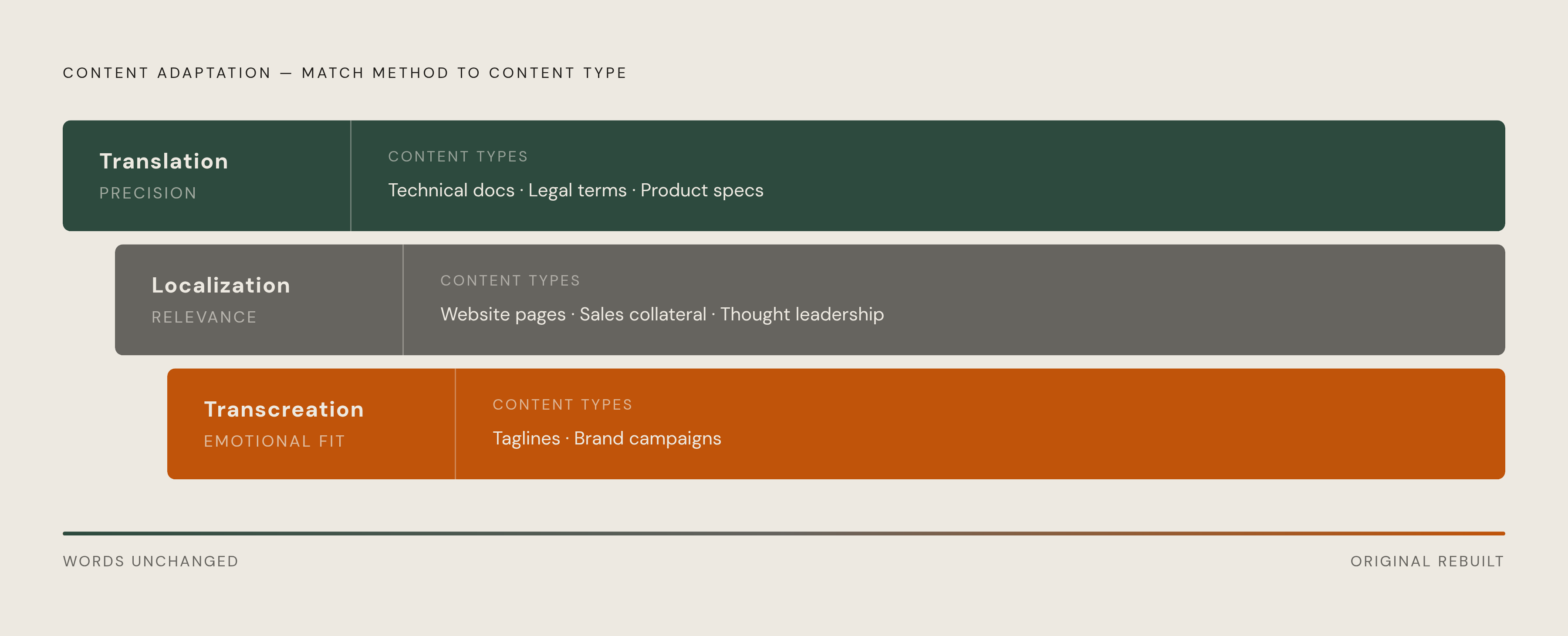
Three words get used interchangeably in vendor pitches and internal Slack threads, and that's the first thing to fix, because they aren't the same job and pretending they are is how budgets get blown by month two.
Translation renders meaning accurately from one language into another. It's the right call for technical documentation, legal terms, product specs; anywhere precision matters more than cultural nuance, because the reader needs exact facts, not a warmer tone. Localization goes further: it adapts content so it feels like it belongs in the target market, meaning the examples change, the trust signals change, the formats and imagery and even the level of directness in the writing change. This is the right operation for website pages, sales collateral, thought leadership. Then there's transcreation, which throws out the original almost entirely and rebuilds it in the new market's cultural language. Taglines, brand campaigns, anything where the whole point is emotional resonance, not information transfer, belong here. Trying to localize a tagline instead of recreating it usually produces something flatter than either the original or a proper rewrite would have been.
The rule of thumb: translate what needs precision, localize what needs relevance, and save transcreation for the handful of assets where cultural fit is the entire assignment. A US case study leaning on a Fortune 500 logo for credibility is a clean example of where this breaks down quietly. Translate it word for word into German or Japanese and the language is flawless, the logo is still there, and the signal it's supposed to send just doesn't land, because the local buyer has never heard of the company being referenced. Nothing is wrong grammatically. Something is wrong entirely.
This distinction matters operationally because each of the three requires different skills, different timelines, and different line items in a budget. Treat them as one undifferentiated "translation" task and you'll either overpay a translator to do a marketer's job or underpay a marketer's rate for work that actually needed cultural fluency nobody budgeted for.
There's also a structural reason this can't wait: English accounted for about 49.2% of web content as of April 2025 (W3Techs), while native English speakers make up roughly 16% of the world's population. Chinese speakers make up about 15% of the global population but Chinese-language content is only around 1.9% of the web. That's not a rounding error. That's a market sitting there mostly untouched.
Deciding which markets to localize for first
The most common way companies waste a localization budget is by trying to do everything at once: six languages, four paid campaigns, three regional hires, all in the same quarter, all announced in the same all-hands meeting with a slide that says "global expansion." What actually happens is thin coverage everywhere and real traction nowhere, because none of it gets the depth of adaptation or sales support it needs to convert.
A shorter list works better. Look first at revenue signal: is there pipeline or inbound interest from a market already, even with unlocalized, friction-heavy content? That's demand pushing through despite the obstacle, which tells you something a market-size chart never will. Market size still matters, of course; Asia Pacific held roughly 39.5% of global B2B e-commerce revenue in 2025, which is a real structural argument for prioritizing it if your product fits. But size without a plan to compete in it is just a bigger room to get lost in.
Competitive density matters too. A market crowded with entrenched local incumbents demands deeper localization investment just to get noticed; a quieter market might reward you for showing up early with lighter adaptation, simply because the bar is lower. And then there's the question nobody wants to answer honestly: do you have, or can you quickly get, someone who actually sells in that region? Localized content without a sales motion behind it tends to sit there looking pretty and converting nothing, which is its own kind of expensive.
Regulatory complexity belongs in this stage too, not later. GDPR in Europe, data residency rules in China, sector-specific compliance elsewhere. These affect the product and the content both, and factoring them in at the prioritization stage, rather than discovering them mid-adaptation, saves a launch date.
What comes out of this exercise is a short, ranked list: not alphabetical, not "wherever the CEO went on vacation last year," but ranked by the honest combination of opportunity and feasibility. One market done properly is worth more than five done halfway, if only because it produces the templates, glossaries, and workflow documentation that make market number two faster and cheaper.
Auditing your existing content catalog before any adaptation begins
Before anything gets adapted, someone has to know what actually exists. That sounds obvious until you try to produce the list and realize half the content lives in three different CMSs and nobody's touched the oldest pieces since a product rebrand two years back.
The audit needs to capture a handful of things for every asset. Funnel stage: is this awareness content, consideration content, or something closer to the decision point where a buyer is comparing vendors? Assets nearer the bottom of that funnel earn more localization investment, because that's where deals actually turn. Current performance in the home market matters just as much; a page converting poorly in English is not a strong candidate for an expensive rebuild in German, no matter how strategic the market looks on paper.
Cultural portability is the sneaky one. How many US-specific references, brand names, regulatory assumptions, or idioms does a piece lean on? The more anchored it is to one market's context, the more it costs to adapt, and some pieces will turn out to be more trouble than they're worth. Format plays into cost too: a video or an interactive calculator is a heavier lift than a blog post, and that has to factor into what gets prioritized. Freshness rounds it out. Outdated content shouldn't get localized at all; the audit doubles as a pruning pass, and that's not a bad thing.
The audit also surfaces gaps rather than just rating what exists. Maybe there's no procurement-facing ROI calculator, no compliance brief, no FAQ in the target language, and the home market's buying journey has one that the target market's doesn't. Worth noting those holes now, not three months into adaptation.
All of this belongs in a shared tracker, whether that's a spreadsheet or a project tool everyone actually opens. It becomes the operational spine for the tiering and adaptation work that follows. One more thing worth flagging at this stage: anything that will need legal or compliance review in the target market before publication. Catch that early and it's a checklist item. Catch it late and it's a delayed launch with an anxious VP asking pointed questions.
Tiering the catalog so adaptation effort matches content value
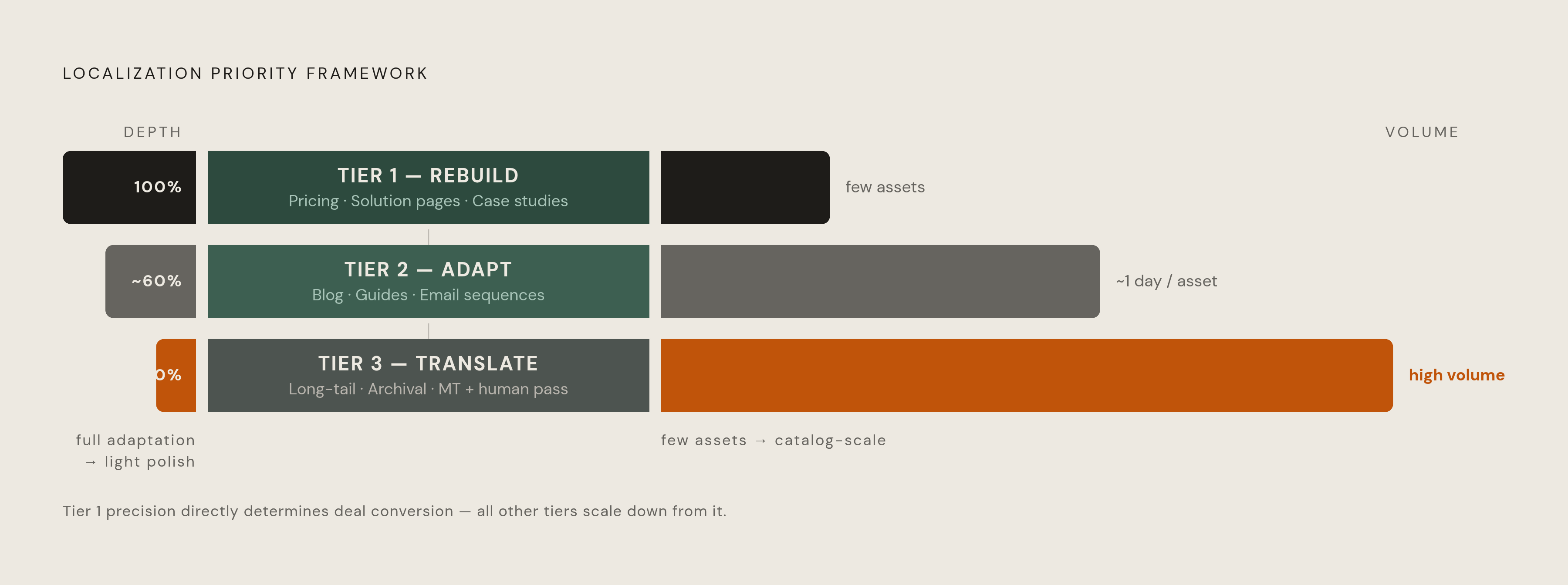
Full, careful adaptation of every asset for every market sounds thorough. It's also how a localization budget disappears by Q3. Tiering is the fix, and it's really just an honest admission that not all content deserves the same effort.
Three tiers do the work. Tier 1 is Rebuild: the small set of highest-intent pages, pricing, core solution pages, the one case study that actually closes deals. These get full market adaptation, reviewed by someone who sells in that region, because this is where cultural proof and regulatory framing and buying-motion alignment genuinely determine whether the page converts. Tier 2 is Adapt: educational content, blog posts, guides, email sequences. Translate the body faithfully, then swap the examples, the trust signals, and the opening objection for local equivalents. Call it a day of work per asset, not a week. Tier 3 is Translate: long-tail and archival content, where machine translation with a human pass is enough, because getting these pages indexed and findable in the target market matters more than polishing every sentence.
The audit tells you which asset lands in which tier. Whatever drove pipeline at home moves to Tier 1. Supporting content moves to Tier 2. Everything else moves to Tier 3, and there's no shame in that; not every page needs to be a masterpiece in four languages.
For Tier 1 specifically, there's a checklist worth running every time. Regulatory framing first: a claim that's fine to make at home might not be fine elsewhere. Trust signals second: a certification badge that reassures a buyer in Ohio might mean absolutely nothing to a buyer in São Paulo. Proof and examples third: a local case study will almost always outperform a translated one from a different geography, so that's worth the sourcing effort. Buying motion fourth: does the call to action match how purchases actually get approved in that market, who signs off, what procurement expects to see.
The tiering framework doubles as the brief for whoever's doing the adaptation. It tells a translator or editor exactly how much transformation is expected, which prevents two opposite failure modes: over-translating a Tier 3 archive page nobody will read closely, and under-localizing a Tier 1 page that needed real cultural rework.
Setting up the governance structure before work begins
Someone has to own this before the first asset gets touched, and the shape of that ownership comes in roughly three flavors.
Centralized governance puts one global team in charge of everything. Terminology stays consistent, accountability is clear, and it works well for regulated content or companies only operating in a handful of markets. The tradeoff is speed; a local team waiting on a central queue for approval on a small edit can feel like waiting at the world's slowest DMV. Decentralized governance flips that: regional teams own their own vendors, messaging, budget. Faster, more locally attuned, and the risk is brand fragmentation, where the German site and the Brazilian site start to feel like they belong to different companies.
Hybrid governance splits the difference, and it's the most common setup for companies scaling across several markets. A central team sets the standards, owns the core technology and terminology resources, negotiates vendor contracts; regional teams execute and make the local judgment calls within that framework. It balances consistency against speed, but only if roles are spelled out clearly, because vague ownership is exactly where review cycles start slipping.
Whichever model you pick, the same core roles need to exist somewhere: a Localization Manager, a Translator, an Editor, a QA Specialist, a Terminology Manager, a Localization Engineer, and a Subject-Matter Expert Reviewer. Skip one of these and you'll feel the gap eventually, usually at the worst possible moment.
For a company testing a new market without a large upfront investment, a centralized core team supported by local consultants for cultural review and market intelligence is a reasonable starting point. The quality ceiling is lower than hiring locally, sure, but the cost and speed tradeoff often makes sense for a first pass at a market you're not fully committed to yet.
And regardless of model, someone needs final sign-off authority, especially on regulated industries or Tier 1 content. That should include a local subject-matter expert or legal reviewer in the chain before anything goes live. Document who owns what before the first piece of content enters the pipeline. Ambiguity at the review stage is where timelines quietly die.
Building the style guide, glossary, and source material that make adaptation consistent
Build this before adaptation starts, not after. Build it retroactively and the first few assets set a precedent nobody chose deliberately; terminology decisions made under deadline pressure tend to be inconsistent, and fixing that later costs more than getting it right the first time.
A market-specific style guide needs to cover tone register, which sounds abstract until you remember that some European languages have formal and informal address built into the grammar itself, the tu/vous or du/Sie distinction, and getting that wrong reads as either overly stiff or oddly familiar depending on which direction you err. It needs to define how brand terms behave: does the product name stay in English, get transliterated, or get a local equivalent? Format conventions belong here too: date formats, currency symbols, units of measurement, number formatting with commas versus periods. Small stuff, individually, but it adds up to a signal of either care or carelessness. And it needs an off-limits list: terms that carry an unintended meaning in the target language, competitor references that mean nothing locally because that competitor doesn't operate there.
The glossary is probably the single most reusable thing this whole program produces. Every term defined once is one fewer decision a translator has to make on the fly, asset after asset, market after market.
Source material matters here too, and it's an easy thing to overlook. Before content goes out for adaptation, clean it up: pull the idioms that won't survive translation, reduce how much it leans on US-specific cultural shorthand, write it with adaptation in mind from the start rather than as an afterthought. That one habit alone cuts the cost and turnaround time of every downstream localization job, which is a strange kind of leverage for something that costs nothing but attention.
Package all of it, the style guide, the glossary, a preferred vendor list, the tier definitions, the review checklist, into a single localization kit. That kit is what lets the second market move faster than the first, and the third faster still.
The adaptation stage: what changes at the content level and in what order
Adaptation takes the tiered asset, the style guide, and the glossary, and turns them into something ready to publish. Order matters here more than it looks like it should, because an early decision changes what every later step has to work with.
Start with structural review. Does the format match how buyers in this market actually consume information? Some markets favor dense, detail-heavy long-form content; others respond better to something more hierarchical, with clear signposting and shorter sections. Decide whether to restructure before translating, not after, because restructuring a translated document means paying for the translation twice.
Then comes translation or adaptation of the body itself. Tier 1 and Tier 2 assets get human translation; Tier 3 gets machine translation with a human review pass. The glossary governs word choice throughout, which is exactly why it had to exist before this step began.
Next, trust signal and proof swaps. Replace logo bars with recognizable local names where you can find them. Swap analyst citations for ones that carry weight locally; a Gartner reference lands well in North America and much of Europe, but analyst preferences shift elsewhere, and using the wrong one is a bit like quoting a critic nobody's heard of. Replace case studies with local examples where they exist; where they don't yet, use the closest geographic proxy and start sourcing a real one in parallel.
Regulatory and compliance edits come fourth, and this step is non-negotiable for Tier 1 content. Any claim, data handling statement, or pricing reference needs a market-specific compliance check, because what's a safe claim at home can be a liability elsewhere.
Fifth is the call to action and conversion path. Does the offer match how buying actually happens in this market? A "start your free trial" button makes sense where self-serve buying is the norm; a "talk to a specialist" prompt fits better where the buying process is expected to be consultative from the first contact.
Last, SEO localization, and this one gets skipped more often than it should. Keyword research in the target language is its own separate task, not a byproduct of translation. The phrase a buyer in Tokyo actually types into a search bar is not the literal translation of what a buyer in Chicago types. Local search behavior needs its own research, every time.
The review cycle and who needs to be in it
Two different review jobs happen here, and collapsing them into one person or one pass is where quality slips through.
Linguistic review asks whether the content reads naturally in the target language, whether the register is right, whether the glossary got applied consistently. That's a translator's job, or a second linguist checking the first one's work.
Market review asks a different question entirely: does this reflect how buyers in this market actually think and decide? Are the examples credible to someone reading them locally? Does the proof actually carry weight, or is it proof that only mattered somewhere else? Is the call to action matched to how this market buys? That review needs someone with commercial understanding of the market itself, ideally someone who has actually sold there, because a fluent translation can still be commercially tone-deaf, and no amount of grammatical correctness will catch that.
Run both reviews, in that order or in parallel, but never as the same checklist performed by the same person wearing two hats. A page can pass linguistic review with flying colors and still fail the only test that matters: whether the buyer on the other end recognizes themselves in it.