Bottom-of-Funnel Content Types That Accelerate B2B Deals
Case studies and demos work best when each addresses a different stakeholder's fear.
Forrester's 2024 State of Business Buying report found that most B2B deals that stall out don't stall because a competitor won. They stall because the buying process itself falls apart somewhere between "interested" and "signed." That reframes what bottom-of-funnel content is actually for: it's supposed to reduce risk for a room full of people who each define risk differently, and most of them never say so out loud.
The room has gotten harder to please. Buying groups keep growing, deal cycles keep compressing, and somewhere in the middle sits a CFO who wasn't on any of the sales calls but still gets a veto. Most purchases now need finance sign-off, and a good chunk pull in someone at VP level or above, which means the financial objection and the executive objection have to get answered inside the content itself, because there often isn't a meeting where everyone with a stake actually shows up at once. Even when deals close, a striking share of buyers end up unhappy with the vendor they picked. That's not a sales failure. That's a content problem wearing a sales costume.
This piece walks through the formats doing the real work at the bottom of the funnel: case studies, demos, trials and proof of concept, ROI calculators, and pricing pages. Each one answers a different stakeholder's version of "am I taking a risk here?" The interesting part isn't any single format. It's how they function as a system, and what happens to a deal when that system has a hole in it.
How buying committees actually consume content before a final decision
Buyers finish most of their research on their own, long before a salesperson enters the picture. By the time sales gets a meeting, the room already has a shape, and that shape was drawn by whatever the committee read and watched while nobody from the vendor was in the room to shape the narrative live.
Here's the part that stings a little: most buyers start their search with a vendor already in mind, and the vendor that wins is almost always the one that was already on the shortlist on day one. So bottom-of-funnel content isn't really persuading anyone from zero. It's reinforcing, or failing to reinforce, a preference that's already forming. That's a different job than top-of-funnel awareness content, and it's exactly why generic "why choose us" pages tend to fall flat at this stage. Nobody needs convincing that you exist. They need convincing that choosing you won't blow up in their face internally, in front of people whose opinions of them matter.
Most buyers won't talk to sales until they've read several pieces of content first. Picture that as parallel processing, not a queue: the technical evaluator is reading documentation while the economic buyer skims a case study while the end user watches a demo clip, and none of them are waiting their turn for the others to finish. Content works on a deal roughly the way weather works on a stadium, hitting everyone at once, differently, depending on where they're sitting. A large share of buyers say content led them to request a demo, and most say it sped up their decision. Those are behaviors tied to specific assets, not vague brand-lift numbers nobody can act on.
So if the committee has close to a dozen people in it, all reading in parallel, does one case study or one demo actually do the job? Structurally, no. The economic buyer wants a business case and a defensible ROI story. The technical evaluator wants proof the thing works as described, ideally without taking the vendor's word for it. The end user wants to know if it fits into their actual Tuesday, edge cases and all. One asset built to please everybody tends to please nobody particularly well, which is the whole argument for the map that follows.
Case studies: the format that closes economic buyers when structured around measurable outcomes
Case studies carry outsized weight at the decision stage; a large share of buyers name customer success stories as the content that shaped their final call more than anything else. That's not shocking on its face. What's shocking is the size of the effect once you isolate the economic buyer specifically. Gartner and CEB found deals where the economic buyer engaged with a case study closed at meaningfully higher rates than deals where they didn't, a gap that holds up across multiple studies. A separate Gartner study backs the pattern from another angle: buyers who read a case study during evaluation showed a higher win rate and a shorter sales cycle than buyers who skipped it.
What makes a case study land at this stage, specifically, versus earlier in the journey when someone's just browsing for reassurance that the category makes sense? A few things separate the ones that close deals from the ones that just sit there looking professional. The outcomes need to be quantified, not just warm and fuzzy; a CFO can't walk into a budget meeting and say "the customer felt really good about the partnership," they need a number they can repeat and defend if pressed. The industry and company-size match matters more than most marketing teams want to admit, because a committee member needs to look at the story and think "that's basically us," or the whole thing reads as aspirational rather than proof. And named customers carry more weight than anonymized ones, though a specific enough metric can compensate for a missing logo.
Here's a wrinkle: gating a case study behind a form tanks how many people actually read it. Ungated versions get far more view-through than gated ones pull in conversions. For a piece of content whose entire job is reaching as many committee members as possible, gating works against the goal. You're trading reach for a lead capture you probably already have by this point in the deal.
And yet case studies barely register in direct site traffic; an analysis of 80 B2B SaaS companies by HockeyStack found they attract less than 1% of total site visits on average. Some platforms built around the full content lifecycle handle the curation and publishing side precisely because distribution through sales is where case studies actually do their work. That's a strange contradiction until you realize the influence isn't happening through organic browsing. It's happening because a rep pulls the right one out of the CRM and drops it into an email at exactly the moment a stalled deal needs a nudge. The case study's real distribution channel is sales, not SEO, and marketing teams that treat it purely as a website asset are missing where the actual persuasion happens.
Video testimonials address a related but distinct problem: committee members with limited time for long-form reading may engage more readily with a short peer testimonial clip. Same social proof, lower time cost. The mature version of all this is a case study library organized by industry, use case, and outcome type, so a rep isn't digging through a shared drive on a Friday afternoon trying to find something that fits. That sounds like a small operational detail. It stops sounding small the moment the deal that needed it goes quiet.
Product demos: where "seeing it" converts the technical evaluator and accelerates the whole committee
Demo-to-close conversion rates vary a fair amount by industry; SaaS companies tend to do well, manufacturing and enterprise segments trail behind, which tracks with how many more hands touch an enterprise deal before it closes. A decent chunk of demos turn into closed business as a baseline. That's not the ceiling, though.
Interactive demos, the kind where the prospect clicks through the product themselves instead of watching someone else's cursor move, convert noticeably better than static or live-only formats, based on data from thousands of B2B sales engagements tracked by Walnut. Why would clicking a button yourself convert better than watching someone else click it for you? Think about what a live demo actually asks of one rep: one screen, one narrative, serving eight or more people with wildly different priorities inside a single thirty-minute window. That format was never built for a committee this size. Someone's question gets answered thoroughly and someone else gets a rushed "great question, let's follow up on that" that never actually gets followed up on.
An interactive, self-serve demo sidesteps the bottleneck entirely. Each stakeholder explores the piece relevant to them, on their own schedule, and can go back to it after the call when they're trying to remember what exactly the tool did with their specific use case. That async quality matters more than it sounds like it should. Committee members revisit content outside the scheduled meeting far more than sales teams tend to plan for, and a live demo, no matter how well it goes, ends the moment the call ends.
Demo-to-opportunity conversion for average performers sits well below what top performers manage, and that gap is mostly explained by personalization, not by better slides or a smoother script. Tailoring which features get emphasized and which use case gets framed as the hero story produces measurably better outcomes than a generic screen share treating every prospect the same. It's also worth considering what happens before the demo even starts: social proof elements positioned early in the process can shape a prospect's confidence before they've even booked the meeting.
The setup that tends to work in practice: a live discovery call paired with a self-serve interactive version the prospect can forward internally. The live call builds rapport and handles unscripted questions. The interactive version is what actually gets passed around the committee between meetings, doing quiet persuasion work while sales is busy with the next call on the list.
Free trials and proof of concept: letting the product argue for itself with the people who will use it
Free trials sit in the same tier of influence as demos and peer reviews when buyers are narrowing their final options, according to TrustRadius 2024 research. Free trials have become a standard entry format across B2B SaaS, which makes them a mainstream acquisition mechanism rather than some niche tactic for cheap tools.
What separates a trial that converts from one that quietly expires unused, with the account manager sending increasingly desperate check-in emails nobody answers? Time to first value is the variable that matters most. Buyers who hit something meaningful early, a report that surfaces a real insight, a workflow that actually saves the fifteen minutes it promised, convert at meaningfully higher rates than buyers who spend the first week just hunting for the settings menu. Trial length matters less than activation rate; a fourteen-day trial where the buyer gets value on day two beats a thirty-day trial where the buyer never makes it past setup. The in-app onboarding, the nudging email sequences, the use-case templates that get someone to a result fast: that's bottom-of-funnel content too, even though nobody labels it that way on the content calendar.
One thing worth sitting with, because it cuts against the instinct to strip out all friction: some friction qualifies intent instead of killing it, and the instinct to remove every barrier can work against conversion if the friction that remains is the kind that signals genuine commitment. That's a more nuanced read than the usual "remove every barrier" advice marketing decks love to repeat.
For products too complex to hand a stranger and say "have fun," a structured proof of concept does the same job the trial does for simpler tools. It gives the committee something concrete to evaluate together instead of a set of claims to take on faith. Here's the part no case study or demo fully replicates: a good trial or POC creates internal advocates. The end user who actually used the thing and liked it becomes the person arguing for it in the budget meeting the vendor isn't even invited to. That's persuasion no outside content asset can manufacture, because it's coming from inside the building, from someone with nothing to sell and no reason to spin it.
Conversion rates vary enough by category that a one-size approach doesn't hold up, and that variance should shape how much a team invests in trial optimization relative to everything else on this list.
ROI calculators and business case tools: giving the economic buyer the internal pitch they need to make
The vendor that makes the business case easiest to build internally often wins before the final decision is ever called. Sit with that for a second, because it's stranger than it first sounds: the vendor doesn't win by having the best product. The vendor wins by handing the buyer their own internal pitch before a competitor even schedules the follow-up call.
That's what makes the ROI calculator structurally different from every other format here. A case study describes value that happened to someone else. A demo shows capability. A calculator computes value using the buyer's own numbers, and the output functions as the buyer's homework, already done, rather than as marketing collateral they have to translate for someone else. The CFO who never sat through a demo and skimmed the case study for thirty seconds now has a quantified, customizable document they can carry into a board meeting without relaying anyone else's claims secondhand.
People tend to stick around longer with a tool that gives something back than with a document that just tells them things and expects gratitude — and that engagement difference is part of what makes the calculator format worth building.
The format branches by role, which is worth treating as a small taxonomy rather than one calculator trying to cover everyone at once. Operational ROI speaks to ops and IT: efficiency gained, cost removed. Sales ROI speaks to revenue leadership: close rate lift, cycle compression. Marketing ROI speaks to the CMO: pipeline and lead volume impact. Customer success ROI speaks to whoever owns retention: churn reduction, lifetime value gained. Four distinct calculators for four distinct conversations beat one calculator trying to be everything to everyone and landing unconvincingly for all of them.
There's a sequencing insight buried in here too. Cold outreach leading with an ROI calculator tends to outperform outreach leading with a request for a sales call, on basic click-through terms. That suggests a flow worth testing on stalled deals specifically: calculator first, case study second, discovery call third, using the calculator as the re-entry point instead of another "just checking in" email that everyone in sales has sent and everyone in procurement has already ignored twice.
One caution, though. A calculator only works if its inputs are realistic and its methodology conservative enough to survive scrutiny. An inflated number that a CFO mentally discounts the second they see it does more damage than skipping the calculator altogether, because now the vendor looks like they're selling fiction dressed up as math.
Pricing pages: why hiding price extends sales cycles and what transparent pages actually need to include
Here's a statistic that should make most B2B marketing teams a little uncomfortable: pricing pages draw a bigger share of total site traffic than almost any other page, according to HockeyStack's analysis of 80 B2B SaaS companies. It's frequently the most-visited page on the entire site. It's also, often, the page treated with the least care, sometimes reduced to a "contact us for pricing" button that answers absolutely nothing.
That avoidance carries a cost, and buyers are vocal about it. Lack of transparent pricing is one of the most common frustrations buyers cite, and a growing majority of decision-makers now rate price transparency as very important or crucial to picking a vendor, according to Gartner's 2025 B2B Buying Experience Study, a sharp jump from just a few years earlier. Forrester and Salesforce data puts an actual number on the cost of that gap: opaque pricing extends sales cycles by more than a third on average. The tactic meant to protect deal value by keeping negotiation leverage close to the chest ends up doing the exact opposite. Everything just slows down instead.
So what does a transparent pricing page actually need, given that most complex B2B products can't just slap a single number on a page and call it a day? Ranges help more than most teams assume; a "starting at" figure or a tiered breakdown lets a buyer self-qualify without booking a call just to discover they're off by 10x on budget. Clear language about what's included at each tier removes a specific anxiety that stalls deals in procurement, the fear of a hidden cost surfacing in month three. An FAQ addressing contract length, implementation cost, and upgrade paths answers exactly what procurement and legal ask, without a rep relaying each answer secondhand across three separate email threads.
That last group matters more than most sales teams give them credit for. Procurement, finance, legal: these people often visit the pricing page on their own, independent of whatever the champion is doing internally, and if the page doesn't answer their question, they don't ask it out loud. They just quietly become the reason the deal stops moving. A pricing page that actually explains itself doubles as a qualification tool too; buyers who self-select against visible pricing show up to the first sales call already scoped correctly, which trims discovery time and shortens the whole cycle in one move.
How these content types work together rather than in isolation
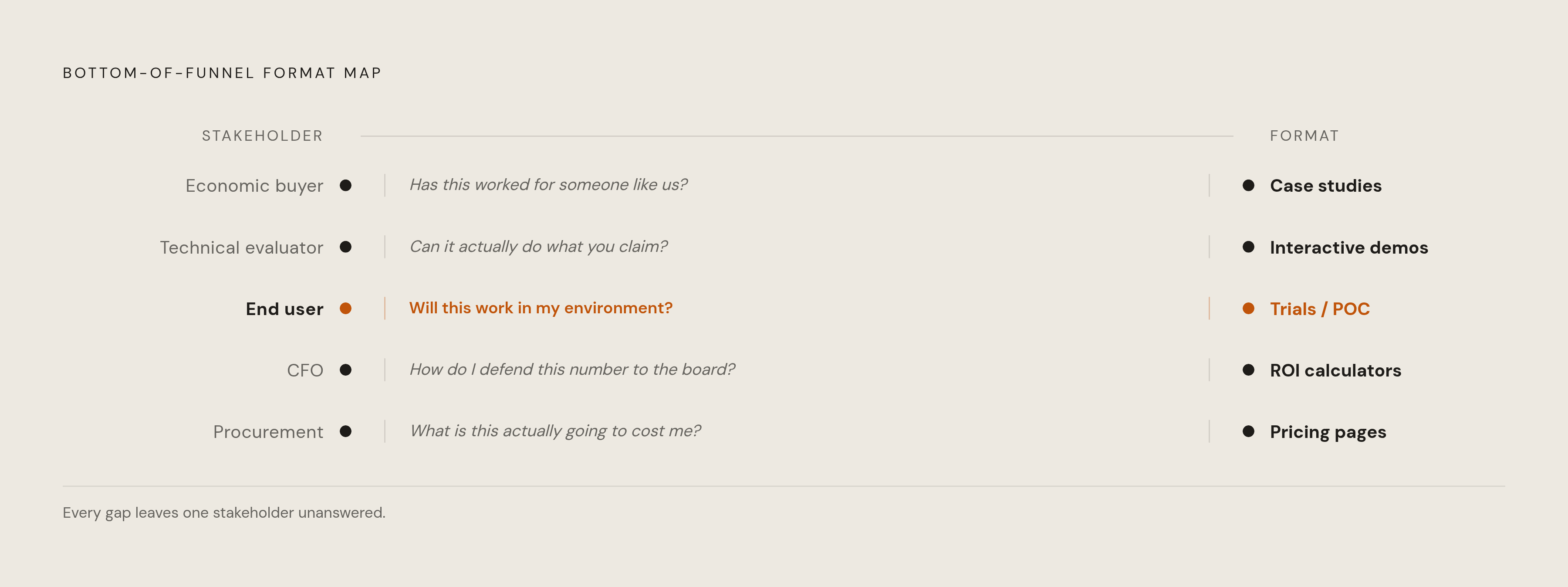
Lay all five formats side by side and a pattern shows up: each one answers a different person's version of the same underlying question, "am I about to make a mistake here?" Case studies answer the economic buyer's "has this worked for someone like us?" Interactive demos answer the technical evaluator's "can it actually do what you're claiming it can?" Trials and proof of concept answer the end user's "will this work in my environment, with all my weird edge cases?" ROI calculators answer the CFO's "how do I defend this number to the board?" Pricing pages answer procurement's "what is this actually going to cost me, including the parts nobody mentions upfront?"
None of these substitutes for the others. Worth stating plainly, because the instinct on a lot of marketing teams is to over-invest in whichever format is easiest to produce and hope it covers the whole room. A brilliant case study does nothing for the procurement lead who never reads it, because their question was never about outcomes. It was about contract terms.
The highest-leverage move isn't deploying every format at once, either. It's watching for signals: which pages someone's visiting, what they open from an email, which section of the demo they replayed twice, and using that to figure out which stakeholder is stuck on which question, then serving the exact format that answers it. That requires sales and marketing sharing one library instead of running out of separate systems that don't talk to each other: case studies living in the CRM where reps can actually find them fast, interactive demos sitting behind a shareable link a champion can forward without asking permission, ROI calculators embedded directly in follow-up emails instead of buried three clicks deep on some resource page nobody bookmarks.
Speed is the part that gets underweighted constantly. A committee that waits two weeks for a custom case study, or a demo configured to their specific use case, loses whatever momentum got them to ask for it in the first place. Deals rarely stall because nobody knew what content to make. They stall because nobody could make it fast enough while the window was still open, and a committee this size, with a CFO somewhere in the loop, does not wait around patiently for a content team's next sprint to wrap up.