Editorial Calendar Structure for Demand Generation Teams
Strategy is the difference between a content calendar and a demand generation program.

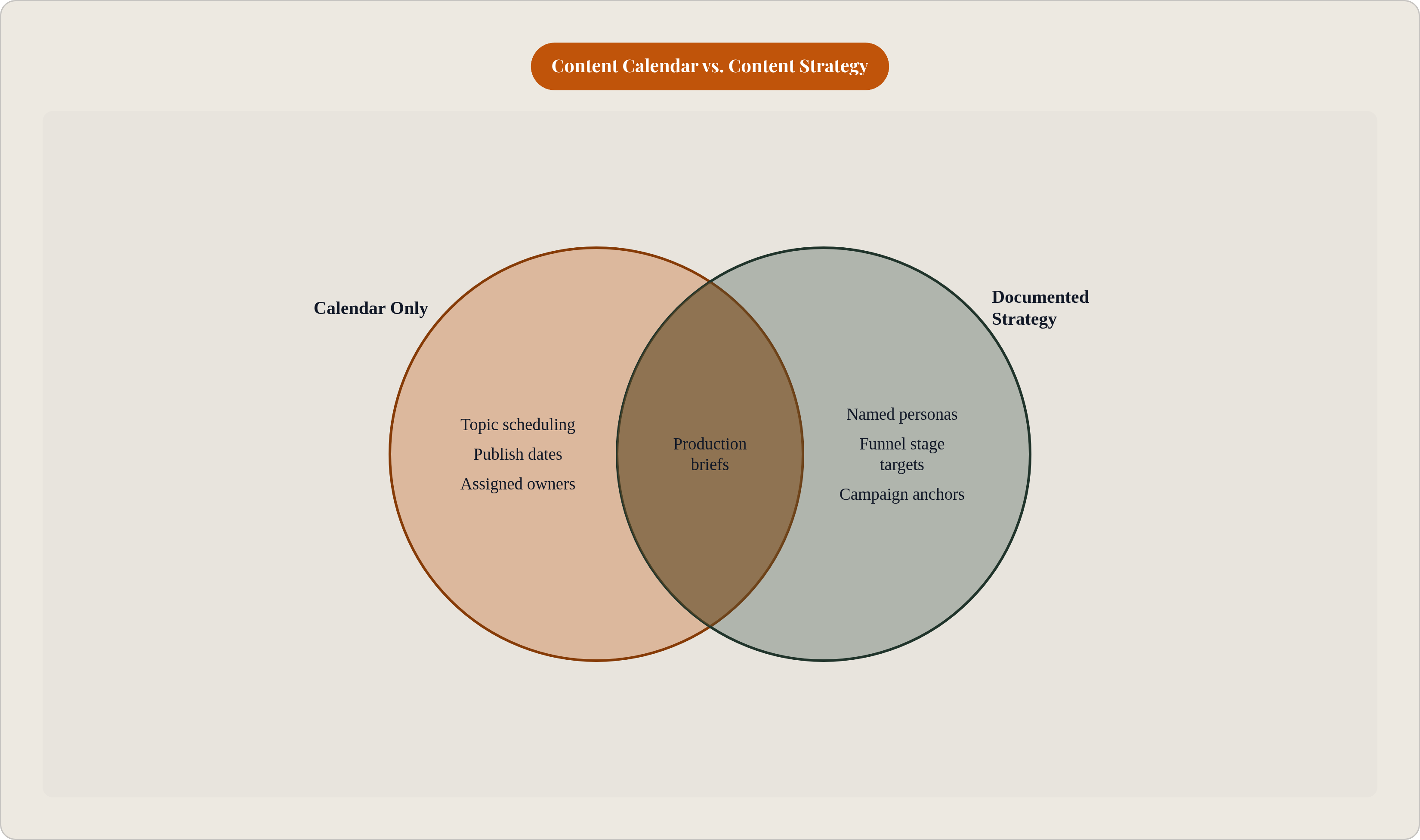
Most teams skip straight to the calendar. They open a spreadsheet, start entering topics, assign owners, and call it planning. What they've actually done is schedule content with no strategic anchor, which means every planning meeting starts from scratch and every quarter's output reflects whoever had the loudest opinion that week rather than a coherent program.
The documented strategy gap compounds over time. The Content Marketing Institute's annual B2B Content Marketing report has tracked a slow rise in teams with a documented strategy, and here's what that trend actually signals: having a strategy is now the minimum. The quality of that strategy is what separates teams generating outsized returns from those publishing into a void.
What a documented strategy means in practice is more specific than most teams realize. It means named personas with enough granularity to produce a useful brief. Not "Marketing Manager" but "Series A Marketing Director who can't connect content output to revenue attribution and is about to lose budget because of it." Vague personas produce vague briefs. Vague briefs produce content that could have been written for anyone, which means it resonates with no one in particular.
It also means explicitly defined funnel coverage: which stages the team is accountable for filling and how those stages connect to pipeline goals. And it means named campaigns and initiatives that the calendar must support, so that every piece has a home before it's assigned.
Thought leadership and content marketing consistently rank among the most effective demand generation channels, a finding reflected in the Edelman-LinkedIn B2B Thought Leadership Impact Report, and that effectiveness is cumulative. Topical authority builds over time through sustained, coherent coverage of a domain. One-off posts don't accrue. The strategy document is what keeps the team building in the same direction across quarters, rather than rotating toward whatever felt urgent last Tuesday.
Without that document, the calendar is just a list of things to write. With it, the calendar becomes the operational expression of an intentional program.
The two-layer architecture: big rocks and the operational calendar beneath them
The calendar works best when it's structured in two distinct layers, populated in the right order.
The first layer is what most experienced planners call "big rocks": the fixed commitments that anchor the calendar to external and internal deadlines with no flexibility. Major industry conferences. Product launches. Annual research reports with external publishing windows. Budget cycles. These items have hard constraints, often require significant cross-functional coordination, and consume disproportionate team bandwidth when they arrive. They go into the calendar first, before any other content is assigned. Full stop.
The second layer is the operational calendar: recurring content cadences, campaign-specific pieces mapped to flight dates, and always-on SEO content that builds authority between campaigns. This layer fills the space around the big rocks, not the other way around.
The order matters more than most teams appreciate. The common failure mode is filling the operational layer first, running at or near capacity, and then absorbing a major product launch mid-quarter with no bandwidth remaining. The launch suffers, the recurring program slips, and the team spends two weeks in reactive triage. I've watched this happen at organizations of every size, and it is entirely preventable. Filling the operational layer around the big rocks is a sequencing discipline, not a scheduling preference.
The practical output of this stage is a quarterly map with fixed anchors visible before a single individual piece is assigned. That map is the context within which every subsequent planning decision gets made.
How to connect every calendar entry to a funnel stage
B2B buyers consume multiple pieces of content before making a purchase decision, and each of those pieces sits at a specific stage in the funnel. The calendar needs to make that stage explicit for every entry, or the team will produce content without knowing what gap it fills.
Top-of-funnel content builds awareness. Educational, non-promotional, broadly distributed, search-optimized. Industry trends, pain point framing, foundational explainers. It should represent the highest volume of output. The signal for TOFU content is reach: wide distribution and broad keyword targeting.
Middle-of-funnel content is where most B2B programs are chronically underinvested, and it's the stage where pipeline actually forms. This is the consideration layer, where prospects are evaluating whether your category of solution is the right one and whether your specific approach fits their situation. Case studies, comparison pages, webinars, solution overviews, nurture email sequences. Buyers who fall out between awareness and decision do so because that consideration layer is thin or absent. When sales tells you they're getting good leads who aren't converting, look at your MOFU first.
Bottom-of-funnel content reduces friction and accelerates close: demos, ROI calculators, pricing pages, customer testimonials, third-party validation. This content is often produced in collaboration with sales, which means it belongs on the shared demand generation calendar, not buried in a sales enablement folder that marketing built once and never revisited.
A useful calibration framework is a roughly 20/60/20 mix across the funnel: approximately one-fifth TOFU, the majority MOFU, one-fifth BOFU. A calendar skewing heavily toward TOFU generates traffic without pipeline. One skewing toward BOFU burns the audience before earning sufficient trust. Enforcing funnel stage as a required field on every calendar entry, and reviewing the overall mix in quarterly planning, is what keeps the program balanced rather than accidentally lopsided.
The required fields that turn a calendar row into a production brief
A title and a publish date are not a brief. They're a placeholder. The moment a writer is assigned a placeholder, the team has introduced ambiguity at the worst possible point in the production process: right before execution begins.
Every calendar entry needs to carry enough information to answer the questions a writer or producer will ask before starting. That means a named owner who is accountable for delivery, not just whoever ends up writing the draft. It means a specific audience persona, not a job title category. It means the funnel stage, enforced from the prior planning layer. It means a content type and format stated explicitly, because format drives resourcing: a blog post, a video script, and a webinar require different teams and different timelines.
It also means a campaign association, so that every piece is visibly connected to an active initiative. It means due dates for each stage of production: brief, draft, edit, design, review, publish. And it means a primary keyword, even for pieces that will primarily be distributed through paid or social channels, because SEO hygiene at the brief stage costs almost nothing and occasionally delivers unexpected organic returns.
The field most calendars omit entirely is the distribution plan. A dedicated column asking, per piece, where else this content goes. If that column is blank when the piece is ready to publish, the piece isn't actually ready. Distribution is part of the asset, not a task someone picks up when they have a spare hour on a Friday.
Writers produce faster and with fewer revision cycles when the strategic context is resolved before they start. Every clarifying question that gets asked mid-draft is a question that could have been answered in the brief. Completeness at the brief stage is not bureaucratic overhead; it's the variable that most directly controls production velocity.
Building SEO architecture into the calendar through topic clusters
The hub-and-spoke model is well established as an SEO tactic. It's less commonly applied as a calendar structure, and that's exactly where teams leave authority on the table.
Hub pages target the broad keyword groupings that prospects most often search when entering a category. They're comprehensive, authoritative, designed to anchor an entire topical domain. Spoke pages target long-tail, transactional, and decision-stage queries: specific use cases, product comparisons, audience-specific variations. The calendar's job is to map which spokes support which hub, so that topical authority becomes a planned outcome rather than something that happens accidentally when someone publishes enough posts.
Frequency matters within this model. Publishing cluster content in batches, rather than as isolated posts scheduled months apart, is what actually moves authority metrics. It takes a body of spokes to meaningfully reinforce a hub. Scheduling one cluster post per quarter and expecting domain authority to shift is optimistic to the point of magical thinking.
The underlying multiplier is consistency, and the calendar is the mechanism through which consistency is either protected or eroded. That's not a metaphor; it's a literal description of what happens when planning discipline slips. Teams that publish on a sustained cadence outperform sporadic publishers on inbound lead generation by a margin that compounds over time.
What the calendar makes visible that a one-off assignment doesn't: which topic clusters are underdeveloped, where the team has been producing without a hub anchor, and where a pillar page is overdue. Without the cluster map embedded in the calendar, those gaps are invisible until the SEO audit at the end of the year, when it's too late to matter for the current budget cycle.
How distribution planning is built into the calendar before publishing, not after
The well-researched article is source code. One substantive piece should generate social cuts, email angles, quote graphics, and short video scripts. The question isn't whether to repurpose; it's whether that repurposing is planned in advance or scrambled after the fact.
Assets that reach publishing without a distribution plan are rarely promoted effectively. The moment passes, the team moves to the next piece, and the content enters the archive generating whatever organic traffic it can attract, which for the majority of published content is close to zero. Not because the writing was poor. Because no one planned how it would reach an audience.
Planning distribution before publishing also shapes format decisions upstream. If LinkedIn is the primary distribution channel, the original piece needs to be structured differently than if email is the primary vehicle. Those decisions affect how the content is written, not how something that already exists gets repurposed.
A few channel-level realities worth internalizing: LinkedIn consistently ranks as the highest-value distribution channel among B2B marketers, according to the Content Marketing Institute, and LinkedIn's own platform data shows that personal profiles drive substantially more engagement than company pages. That finding has direct implications for who is listed as the distribution owner in the calendar; it should be a person, not a brand account. Email delivers strong ROI per dollar spent, making the newsletter distribution tied to every major publish non-negotiable rather than optional. And video investment is increasing across the industry, which means the format field in the calendar should reflect that shift as a planning input, not as a post-hoc note added when someone has budget left over at the end of the quarter.
The calendar column that enforces all of this is simple: per channel, per piece, who posts it, when, in what format, and what the call to action is. Small teams using this model produce at the apparent scale of larger ones.
Planning cadence and how to preserve flexibility without losing accountability
Annual calendar lock-in fails demand generation teams because the conditions that make a piece of content relevant in January are rarely the same conditions in October. Product launches slip. Competitors make moves. Sales surfaces a conversation pattern that needs content support immediately. A calendar that can't absorb those inputs becomes irrelevant within weeks of being built, which makes all the upfront planning feel like wasted effort, and it is.
The quarterly planning model is the right unit of commitment for most demand gen teams. It provides enough horizon to sequence campaigns, align with sales, and make resource decisions without locking in content that will be obsolete by month three. Some teams structure this further into six- to eight-week sprints, each focused on a specific topic or campaign, mapped across personas, formats, and channels before production begins.
Built-in slack is intentional design, not poor planning. A sound content calendar should not consume the team's full capacity for the quarter. The unreserved capacity is the team's ability to respond: to a competitor announcement, a viral trend, a sales request that could close a specific deal. Teams that plan to one hundred percent of capacity have no room to respond to anything. Their calendar is also their ceiling.
That said, the distinction between planned flexibility and undisciplined drift is worth preserving. Reactive content should still pass through the same required fields as planned content: funnel stage, distribution plan, owner, campaign association. The brevity of the production timeline doesn't exempt a piece from the structural requirements. Ad hoc additions that displace planned pieces should require an explicit trade-off decision, not a silent reprioritization that surfaces only when something doesn't publish on time.
A weekly review is the operational check that keeps this honest: what ships this week, what's at risk, what just entered the queue, and what has to move to accommodate it.
Where sales alignment enters the calendar — and what it actually requires
The gap that kills pipeline is not bad writing. It's content planned in isolation from what sales is actually hearing on calls. When demand gen builds the calendar without sales input, the program produces TOFU volume without MOFU and BOFU support, precisely the stages where sales needs air cover to move deals forward.
Structural alignment requires more than a shared Slack channel. It requires named fields in the calendar that connect every piece to an active sales campaign or initiative, so that both teams can see, without asking, what's in production and when it ships. It requires MOFU and BOFU content to be reviewed with sales before production begins, not sent over after publishing with the expectation that reps will independently discover and use it. And it requires a shared calendar view that sales can access without requesting a status update from marketing.
Sales is also a content signal source, not just a content consumer. This is the part most demand gen teams underutilize. Objections that surface repeatedly in sales calls are MOFU gap indicators: the questions buyers ask before engaging a rep often reveal exactly which pieces are missing from the consideration layer. Win and loss patterns reveal which funnel stages are underperforming and should trigger direct adjustments to the calendar's mix. If the same question keeps coming up in discovery calls and you don't have a piece addressing it, that's a calendar failure, not a sales failure.
The Content Marketing Institute has found that B2B organizations reporting meaningful lead generation improvements from content marketing tend to be those where content and sales teams operate in close alignment. The mechanism that makes that possible is a standing monthly sync between demand gen and sales: what's scheduled, what's missing, and what the field is asking for right now.
How to tell whether the calendar is working as a production system
Whether content published on time is the wrong metric. On-time publishing measures execution against a schedule. It says nothing about whether the content reached its intended audience, supported the right campaign stage, or contributed to pipeline in any measurable way. A team can achieve perfect on-time delivery while producing content that does none of those things. I have seen it happen, repeatedly, at companies that considered their content operation mature.
The right indicators are upstream of publishing and downstream of it simultaneously. Upstream: are briefs consistently complete before production begins? Is the funnel mix across the quarter aligned to the program's stated objectives? Is distribution planned before assets go live? Is the cluster architecture building visible topical coverage over time? If any of those answers are no, the calendar is functioning as a schedule.
Downstream: is MOFU content being used by sales? Are assets appearing in nurture sequences, not just on the blog? Is organic traffic growing within planned topic clusters, not just across random posts? Are sales and marketing in regular conversation about what the calendar should contain next quarter?
A calendar that functions as a production system generates compounding returns because its structure enforces the behaviors that produce those returns: consistent cadence, funnel coverage, distribution discipline, sales alignment. A calendar that functions as a schedule generates the appearance of activity. The difference is invisible until you look at pipeline, and by then, a quarter or two has already been lost.