Content Gap Analysis Against Competitor Blogs
Identify five distinct gap types so you prioritize the right content fixes.

Not every gap requires the same response. Conflating them wastes time and budget. The typical failure mode looks like this: a team pulls a keyword list, spots a topic their competitors cover, and starts writing. Weeks later, they have new content that fills space without closing anything real. It's like patching a leaky roof by repainting the ceiling — busy work dressed up as progress.
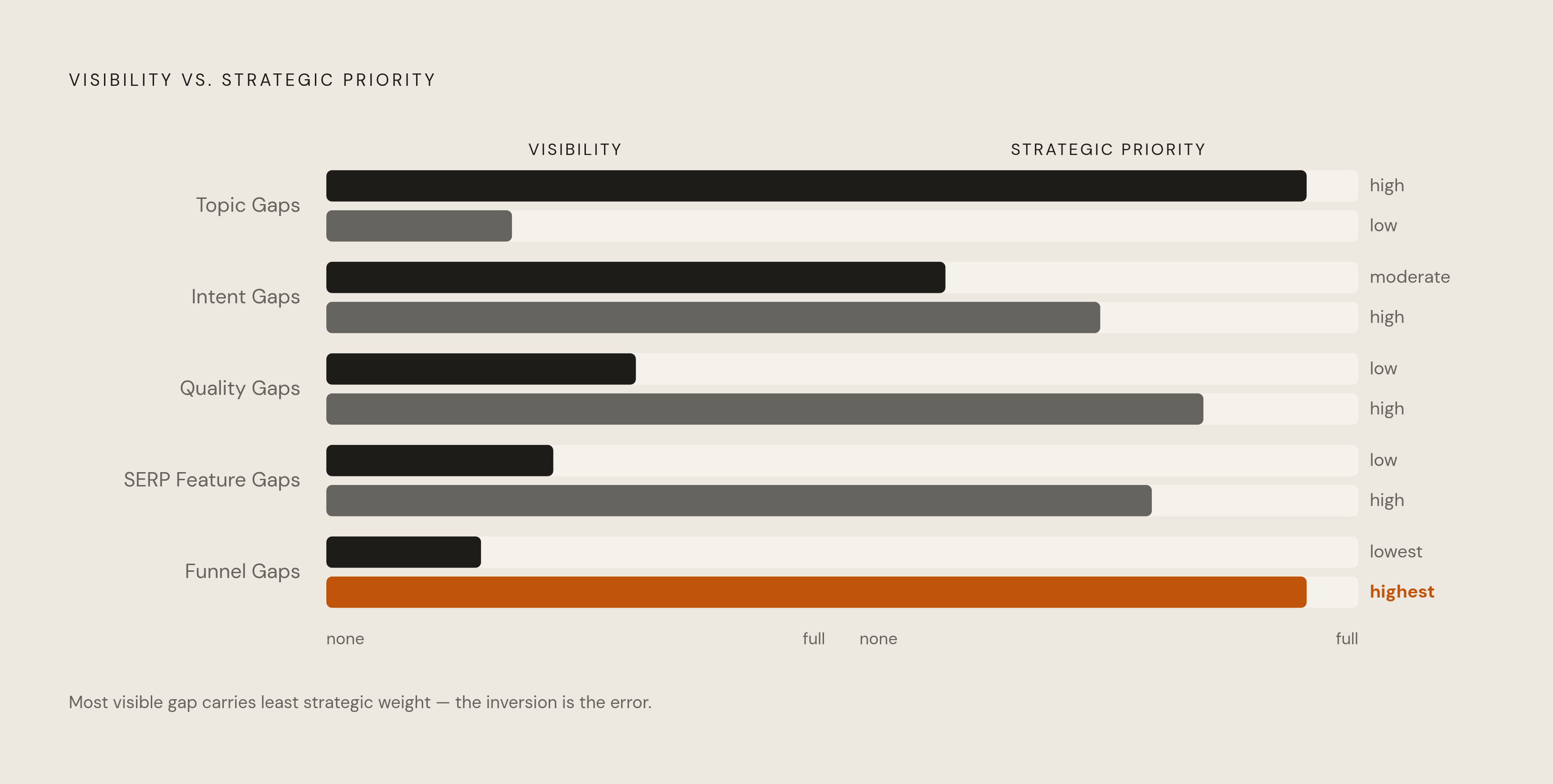
Topic gaps are the most visible. A subject your competitors rank for that you simply haven't published on. They feel urgent, and that urgency is misleading. Urgency is not the same as priority.
Intent gaps are subtler and usually more damaging. You've published on the topic, but the format doesn't match what searchers expect. If the SERP rewards a comparison table or a step-by-step guide and you've published a narrative blog post, you're misaligned with the query. The fix is restructuring, not rewriting from scratch.
Quality gaps are the ones that quietly bleed traffic. You cover the topic, but more shallowly, or with older evidence, than the pages ranking above you. This isn't a word count problem. It's a thin-argument problem: missing statistics, no original examples, claims assembled by someone who clearly never touched the thing they're describing. Quality gaps connect directly to how search engines evaluate Experience, Expertise, Authoritativeness, and Trustworthiness. More on that in a later section.
SERP feature gaps get overlooked almost entirely, which is a strange neglect given how consequential they are. A competitor sitting at position three with a featured snippet can out-click your position-one result. People Also Ask boxes, image packs, video carousels: these represent real estate where a competitor captures attention you're not seeing. Closing this gap is often a formatting fix, not a content creation task.
Funnel gaps surface late and uncomfortably. Most sites over-index on Awareness content and under-index on Consideration and Retention, and a quick URL-level audit tagging each piece by funnel stage typically makes this imbalance obvious before any competitor data enters the picture. Any stage with fewer than three strong pieces signals a structural problem, not a content volume problem.
Know which gap you're facing before you open a text editor. That single discipline separates systematic improvement from spinning wheels.
Choosing Which Competitors to Analyze, and Who Actually Counts as a Competitor in Search
Business rivals are the companies that come up in sales calls and lost deals. They matter enormously for positioning. They are not automatically your most important competitors in search, and treating them as if they are is a category error that produces a flawed analysis from the start.
SERP rivals are whoever occupies the pixel space for your target queries. In most categories, that includes affiliate sites, software directories, and "best of" roundup pages that dominate high-intent keywords. Reddit and Quora have accumulated substantial visibility for informational and comparison queries. YouTube frequently ranks first for how-to intent. None of these are businesses you compete with commercially. All of them compete for the attention of the same audience you're trying to reach.
The starting point is simple: begin with the names customers mention unprompted, then add whoever consistently appears on page one for your three or four most important queries. Focused analysis on four to six direct competitors produces more actionable insight than monitoring dozens of tangential players. A thorough read of four domains surfaces gaps you can actually act on. A shallow read of twenty surfaces a spreadsheet nobody uses.
Step 1: Audit Your Own Content Before Touching a Competitor's Domain
The consequence of skipping this step is duplication. You identify a gap, build content to fill it, and eventually discover you already had a piece on that topic, just poorly optimized or buried in a different section of the site. Cannibalization and wasted effort follow. This isn't a hypothetical risk; it happens on most sites that skip the inventory step.
For every URL in your content inventory, capture the primary keyword and current ranking position, the funnel stage, the content format, the last updated date, and current organic traffic alongside any SERP features you already hold. The output is a tagged inventory that makes gaps legible once competitor data layers on top. A predictable finding at this stage: most blogs have strong Awareness coverage and thin Consideration coverage, nearly every time.
The audit also surfaces content that should be pruned or consolidated before anything new is added. Gap analysis and content pruning are complementary processes, not sequential ones. Removing weak, outdated, or redundant pages concentrates authority on the pieces that remain, improving competitive position without publishing a single new word. Sometimes the most productive thing you can do in a given month is delete content.
Step 2: Running the Keyword Gap Analysis With SEO Tools
With your own inventory mapped, the comparison is straightforward. Ahrefs Content Gap lets you enter your domain alongside two to four competitor domains and surfaces every keyword those competitors rank for that you don't. Content Explorer extends this to topic-level discovery, which is useful for identifying clusters rather than individual terms.
Semrush's Keyword Gap tool breaks results into three categories: keywords you don't rank for at all, keywords where you rank but poorly, and keywords where competitors rank but you have a foothold. That breakdown maps cleanly onto the gap taxonomy above.
When the raw output appears, resist the temptation to treat it as a to-do list. Filter branded and navigational queries first; these aren't winnable gaps. Group remaining terms into topic clusters rather than treating each keyword in isolation. Note which clusters appear across multiple competitors, because overlap signals established demand, not one rival's idiosyncratic coverage.
One signal worth adding at this step: competitor pages with both high organic traffic and a strong natural backlink profile indicate topics search engines have already confirmed as authoritative. A competitor page with both is a high-signal gap worth investigating closely, not just flagging.
Keyword tools show rank data. They don't show why a page ranks. Understanding whether you're facing a topic gap, a quality gap, or an intent gap requires looking at the actual pages.
Step 3: Analyzing Competitor Pages to Understand What's Actually Working
This is where the analysis stops being mechanical. It's also where most of the strategic insight lives, and where practitioners stop spending time because it doesn't produce a clean spreadsheet output. That discomfort is exactly why it's worth doing carefully.
On each top competitor page, examine the content format and structure: general blog post, comparison, step-by-step guide, tool page, or a hub with spokes linking to supporting content. Look at the quality of evidence: original data, proprietary examples, and named expert quotes versus generic restatements of common knowledge. Note the visual elements, because original photography, custom diagrams, and embedded video represent a quality signal that stock imagery simply doesn't. Examine internal linking patterns, because how a competitor connects pieces reveals the architecture of their topical authority.
Look for vulnerabilities, too. Topics where they rank but their content is thin, outdated, or poorly structured are more winnable than their strongest pages. People Also Ask boxes where none of the ranking pages directly answers the question are a structural opening you can exploit through precise, well-formatted responses.
A competitor's highest-traffic content categories also reveal their go-to-market priorities. What they're publishing most signals what they believe wins with the shared audience, which tells you something useful about audience expectation that keyword data alone won't surface.
At the end of this step, you should have a shortlist of gaps confirmed by keyword data and understood at the content level. That combination is what makes prioritization mean anything.
Step 4: Prioritizing Gaps by Strategic Value Rather Than Search Volume Alone
Search volume is one variable, not the deciding variable. The three factors that matter together are search volume, keyword difficulty, and business relevance. Ignore any one of them and the prioritization produces a distorted list that sends your team toward work that doesn't convert.
Competing head-on for a competitor's highest-traffic pages before you've built topical authority in adjacent areas is rarely the right first move. More productive targets are topics where they rank but the content is weak, and topics in emerging subtopics or long-tail variations they haven't covered.
A tiered structure makes this concrete, though "concrete" shouldn't mean rigid. Treat it as a working framework, not a formula.
Tier 1 covers topics missing entirely from your site, with high business relevance and moderate difficulty. These represent the fastest path to new organic traffic because you're not fighting an established URL's accumulated authority.
Tier 2 covers topics that exist on your site but have a clear format or quality gap. Update or restructure these before creating new content. The existing URL has whatever authority it's accumulated, and building on that is more efficient than starting fresh.
Tier 3 covers high-volume terms dominated by strong competitors. Build toward these after establishing topical authority in adjacent areas. Competing here before that foundation exists produces low results for high effort — like showing up to a marathon having only trained for a sprint.
One check before finalizing: make sure the prioritized list doesn't replicate the Awareness-heavy imbalance from the initial audit. Deliberately include Consideration-stage gaps in the final roadmap. The output of this step is a ranked gap list with each item tagged by gap type, tier, funnel stage, and estimated effort.
Why Quality Gaps Are Harder to Close Than Topic Gaps, and How E-E-A-T Raises the Bar
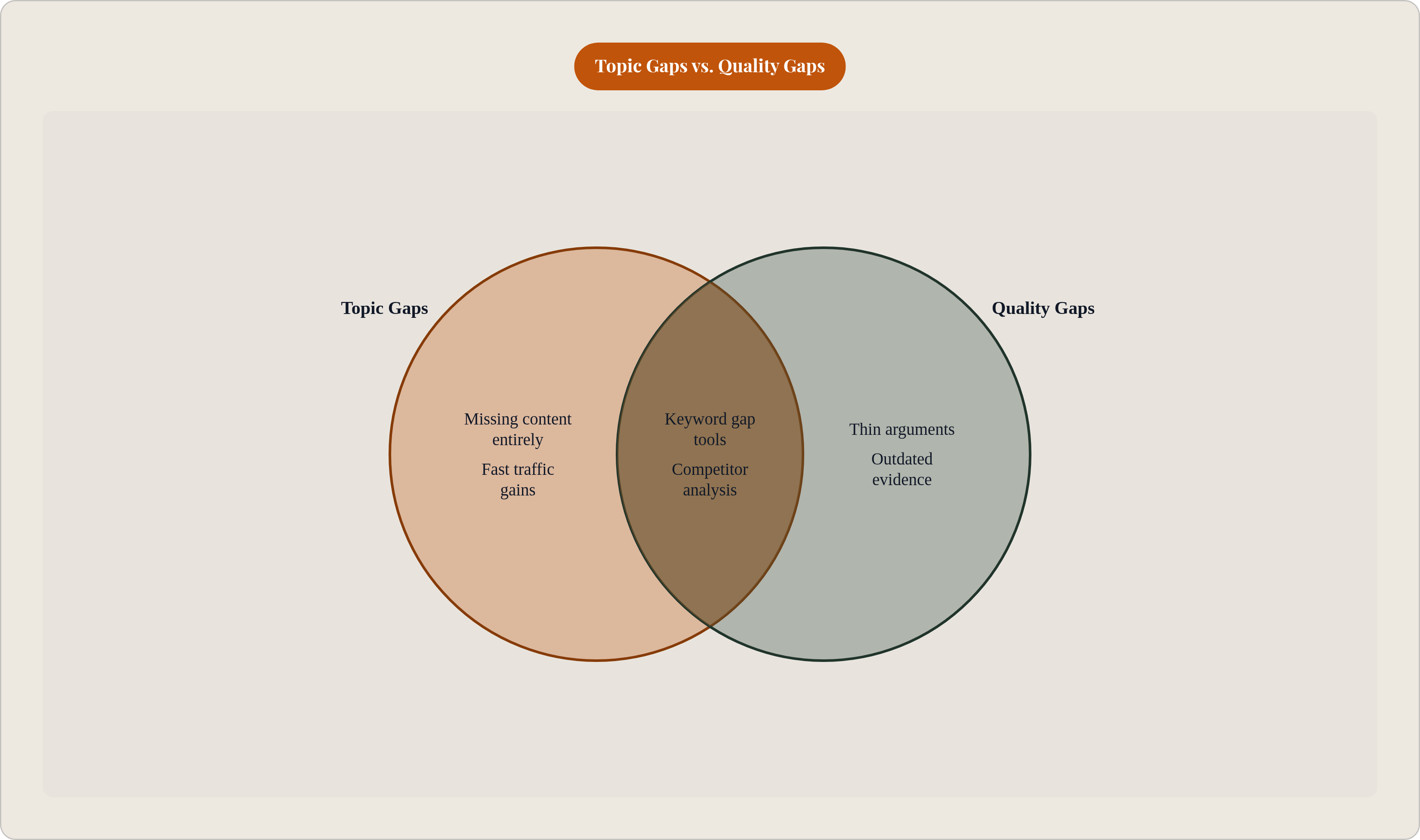
A topic gap is a presence-or-absence problem. You either have the content or you don't. A quality gap is a proof problem, and proof is substantially harder to manufacture. You have the content, but it doesn't demonstrate that anyone with actual expertise wrote it. That distinction matters more now than it did three years ago, and the gap between these two types of problems is widening.
Google's December 2022 Helpful Content Update and subsequent core updates explicitly targeted what Google categorizes as scaled content abuse, with particular emphasis on the Experience signal within E-E-A-T. Sites that filled keyword gaps using mass-produced generic text saw notable visibility drops, particularly in product review segments. The implication is direct: filling a topic gap with thin content doesn't close the gap. It creates a quality gap in its place.
Google's Information Gain patent reinforces this logic. Content that repeats what every competitor already says carries lower signal value. Content that adds original data, a new angle, or a meaningfully deeper explanation scores higher. The practical test is blunt: if your draft says nothing a reader couldn't find on the top three ranking pages, you haven't closed anything.
Visual quality is part of this calculus. When competitor pages rely on generic stock photography, original high-fidelity visuals, real product screenshots, authored diagrams, and documented use cases represent a concrete quality advantage. This isn't a design preference; it's a trust signal, and search engines treat it accordingly.
Running a quality gap audit on existing content asks a few direct questions: Are the statistics current? Is there first-hand experience or original data, or only aggregated claims? Does the structure match what the SERP is rewarding in terms of format, depth, and subheadings? If the answer to any of those is no, updating existing content will almost certainly produce faster results than publishing something new.
The AI Visibility Gap, Where Competitor Analysis Needs to Extend Beyond Google Rankings
Ranking well in Google no longer guarantees visibility in ChatGPT, Perplexity, or Google AI Overviews. The sourcing criteria differ in ways that matter, and the divergence has widened enough that treating Google rankings as a proxy for total search visibility is a meaningful strategic error, not a theoretical concern.
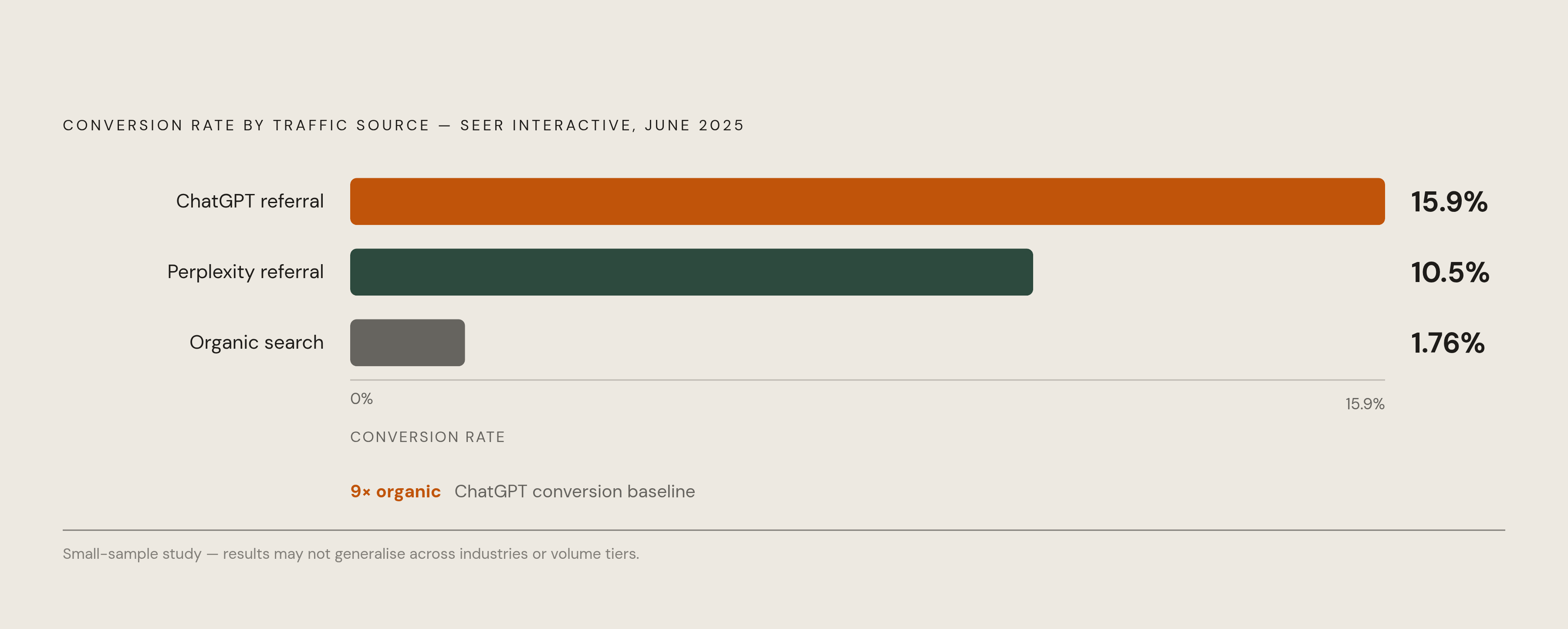
A Semrush study found that nearly 90% of pages ChatGPT cited fell outside Google's top 20 organic results for related queries. AI Overviews reduce click-through rates for top-ranking pages; Ahrefs has published keyword-level data on this trend. On the conversion side, research from Seer Interactive published in June 2025 found that visitors arriving from ChatGPT converted at 15.9% and from Perplexity at 10.5%, compared to a 1.76% organic search conversion rate. Those figures are striking enough to warrant scrutiny of the original study's sample size and industry context before applying them to a specific situation, but the directional signal is hard to dismiss.
Running an AI gap audit is a newer but manageable process. Build a list of twenty to fifty prompts matching buying-intent questions a real customer would actually ask. Generic head terms perform poorly here; AI rewards specificity and direct answers, which reflects a real difference in how these systems retrieve information. Run each prompt through ChatGPT, Perplexity, and Google AI Overviews, record which pages get cited, and flag any query where a competitor is cited and you aren't. That's your AI content gap list.
What earns AI citations overlaps substantially with what closes quality gaps in traditional search: original data, named frameworks, direct answers to questions the top Google results don't address, concrete examples. The strategies reinforce each other, which means you're not building two separate content programs. You're building one program that performs across both surfaces.
One additional variable worth tracking: research analyzing AI citation patterns has found that a substantial share of brand mentions in AI search originates from third-party pages rather than brand-owned domains. A content roadmap that includes third-party placement alongside owned content reflects how AI sourcing actually works, not how we wish it worked.
The toolset for this dimension is still maturing. Semrush, Peec AI, Otterly AI, and Ahrefs Brand Radar all offer visibility into AI citation patterns. None of them are perfect yet, but the signal they provide belongs in a complete gap analysis. Waiting for the tooling to mature before paying attention to AI visibility is a way of ceding ground to competitors who aren't waiting.