Competitive Content Positioning for Crowded SaaS Categories
Most B2B buyers decide before sales enters, so positioning must win in channels you don't control.

By the time a buyer appears in your CRM, the decision is mostly made. Research from 6sense puts the share of the B2B buying journey that happens anonymously, before any vendor contact, at 73%. Their 2025 data goes further: 83% of buyers fully define their purchase requirements before speaking with sales, and 92% start their journey with at least one vendor already in mind.
The journey is long and diffuse. Dreamdata and LinkedIn's 2025 B2Believe Benchmarks put the average B2B buying journey at 211 days and 76 touchpoints. Most of those touchpoints are content encounters you will never see in your attribution model. Gartner's 2025 research found that 61% of buyers prefer a completely rep-free buying experience, which means they are actively constructing their shortlist through content, peer recommendations, and community signal, not through your sales team.
Peer channels are doing substantial trust work here. Roughly a third of software buyers use Reddit to research products. Similarweb data puts direct traffic at 72% of visits for Gong, 71% for Outreach, and 64% for Salesforce. That traffic didn't come from campaigns. It came from years of being the thing people recommend when nobody's tracking the recommendation.
The newest wrinkle is AI-assisted research. 6sense's 2025 Buyer Experience Report found that 94% of B2B buyers now use large language models during their purchase journey, using them to compare vendors, summarize reviews, and pressure-test shortlists. When a vendor is invisible in those LLM-generated summaries, that's not a metadata problem. It's a content substance problem, and it traces back to positioning.
So here's the actual brief: content that positions a vendor must work in channels the vendor doesn't control, for buyers the vendor cannot see, against alternatives the vendor is being compared to without knowing it. Publishing three blog posts a week addresses none of that.
What positioning actually means before it touches content
Positioning is not a tagline. It is not a value proposition sentence. It is a deliberate, explicit set of decisions: who you serve, which category you compete in, which alternatives you displace, and what unique value you deliver. Those decisions must then be encoded across every customer-facing surface so the market understands you on your terms, not the category's default terms.
A useful test before any content gets written: every claimed point of difference must be provable with data or customer evidence, relevant to what your ICP actually cares about in a buying decision, and differentiated enough that competitors cannot make the same claim credibly.
"Best-in-class support" fails all three tests. It's not provable in any specific way, it's not meaningfully relevant to a buying decision where every vendor says the same thing, and it's not differentiated because every vendor does say it. Contrast that with something like "implementation in 72 hours versus an industry average of six weeks." That claim is specific, verifiable, and competitively meaningful. A buyer can act on it.
The most common failure mode in SaaS positioning is a statement that describes the category rather than a specific place within it. "The AI-powered platform for modern teams" tells a buyer you exist. It does not tell them why you, why now, why not the other seven tools on their shortlist.
Positioning is upstream of content. Until these decisions are made explicitly, content has no anchor. It defaults to describing features, mimicking category leaders, or chasing search volume that has nothing to do with the buyers you can actually win. Skipping the positioning step feels like efficiency. It isn't.
Why most SaaS companies should sharpen within a category rather than try to create one
Category creation is the most seductive and most expensive mistake in SaaS positioning. ICONIQ Growth's 2025 GTM research found that companies attempting category creation too early burn two to three times more capital than peers and reach the same revenue milestone twelve to eighteen months later. Creating a category means educating an entire market about a problem they do not yet know they have, and that is largely a strategy for well-capitalized companies at scale, not a growth-stage startup burning runway.
For the vast majority of B2B SaaS companies, buyers want to know how you solve their specific problem today. They are looking for the best answer to a question they've already formed, not a new mental model. Trying to reframe that question at the point of sale is friction, not differentiation.
Niche dominance is faster and more defensible. Toast built for restaurants. Veeva built for life sciences. Procore built for construction. Each encoded its positioning into product, language, and go-to-market around a specific industry rather than the general market. The result: their content, their sales conversations, and their product roadmap all pull in the same direction, because someone made a deliberate decision early about whose world they were entering and stayed in that lane.
Jungle Scout offers a different version of the same lesson. When competitors were building generic keyword research products, Jungle Scout narrowed its focus to Amazon seller tools. That narrower positioning made marketing more resonant, the product more tailored, and sales cycles shorter. The category didn't get smaller. The competition for that specific buyer did.
When you own the language of a specific buyer's world, including their job title, their operational constraints, their industry terminology, your content reads as written for them rather than at them. That perceptual shift changes conversion, retention, and referral behavior in ways that broad positioning simply cannot produce. The first question before any content strategy is not "what should we publish?" It's which sub-segment you can be the only credible answer for, and what winning looks like there.
How to translate a positioning decision into a content strategy that holds together
Positioning sets the constraints. Content strategy decides how to express those constraints across formats, topics, and buyer stages. These are sequential decisions, not parallel ones, and treating them as parallel is where most content programs quietly unravel.
The first content decision is editorial focus, not channel selection. Which problems, questions, and situations belong inside your positioning, and which ones, however high-traffic, do not? Publishing outside your positioning to capture volume is precisely how content becomes generic. Every topic you cover should be one that only a vendor with your specific vantage point could address credibly. If anyone could have written it, you have already lost the differentiation argument.
Audience specificity is the differentiator, not production quality. Content written for "B2B marketers" competes with everything. Content written for demand generation managers at vertical SaaS companies under 200 people navigating their first category rationalization cycle competes with almost nothing. The narrower the audience definition, the more the content feels like it was written by someone who knows the reader's actual situation, because it was.
A few structural decisions encode positioning into content in ways that accumulate over time. Point of view comes first: what does your brand believe that the category consensus does not? State it explicitly, not obliquely. Then there is proprietary vocabulary. Named models, coined terminology, and distinctive ways of framing problems become assets when buyers begin repeating your language to describe their own situation. A competitor can copy your blog format; they cannot credibly adopt your vocabulary without undermining their own positioning. Evidence standard matters too: specific customer outcomes, original research, and product-generated data carry more weight than recycled best-practice lists, and they are far harder to replicate.
Content should also be doing displacement work, not just informational work. Each piece should implicitly answer the question "why not the other options on my shortlist?" without making that the explicit frame. Buyers are asking that question whether or not you address it.
One timing note: buyers are rationalizing their software stacks right now. Reports from Okta's Businesses at Work and Productiv's SaaS Trends research track the trajectory of application consolidation. Content that speaks directly to consolidation decisions, switching costs, and measurable value is well-positioned for this moment in a way that evergreen best-practice content is not.
Thought leadership as the mechanism for reaching buyers before they're reachable
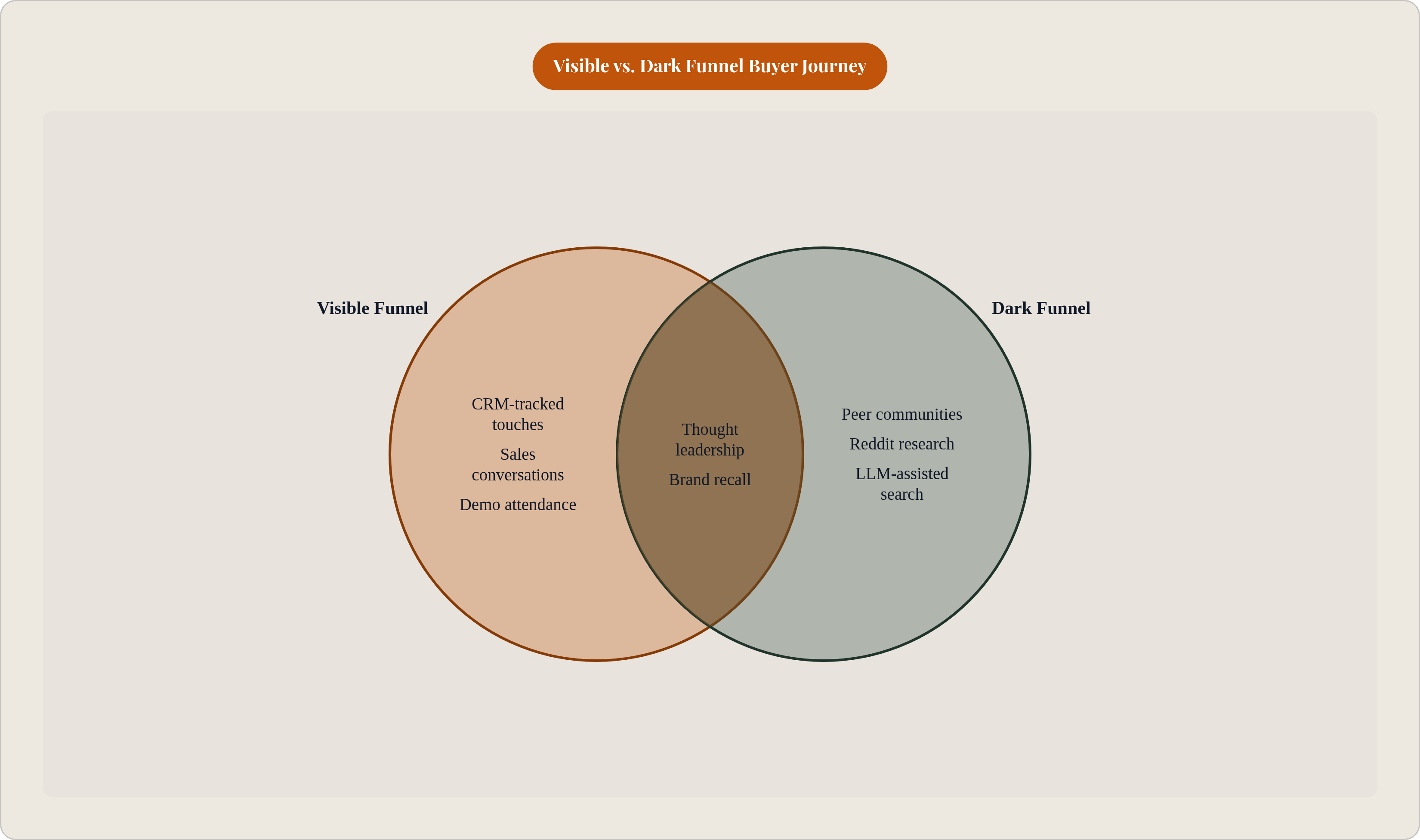
The dark funnel is not a tracking problem. It is a trust-building problem. The solution is not better attribution. It is content that earns presence in buyer conversations before a vendor relationship exists.
Edelman and LinkedIn's 2025 B2B Thought Leadership Impact Report surfaces something most vendors miss entirely: the stakeholders who influence decisions without appearing in CRM data or attending demos, what Edelman calls "hidden buyers," consume thought leadership at nearly the same rate as visible target buyers. Sixty-three percent of them spend more than an hour per week on it. These are the people who will shape the internal conversation about your product before you ever meet them. Influencing them is not optional; it just isn't measurable in the way most teams want it to be.
What hidden buyers want from that content is also worth understanding. They want insights that challenge assumptions and reframe thinking. Eighty-one percent say high-quality thought leadership helps them recognize previously unidentified challenges or opportunities, per the same Edelman and LinkedIn report. They are looking for the thing that changes how they think about the problem, not validation of what they already know. That is a meaningfully different editorial brief than most SaaS content teams are working from.
Thought leadership also functions as a buying-committee alignment tool. Seventy-one percent of hidden buyers say thought leadership is more effective than traditional marketing at demonstrating vendor value; a large majority say they are more likely to advocate for a vendor's proposal in the RFP process if that vendor has consistently produced high-quality thought leadership. Those are not marginal numbers.
There is also an LLM visibility dimension here that is increasingly practical. Content that earns citations, links, and mentions across authoritative sources surfaces in AI-generated category summaries. Thought leadership that shapes category vocabulary gets included. Generic, derivative content gets excluded. The same qualities that make thought leadership valuable to human readers also make it visible to the models now synthesizing vendor comparisons for buyers who haven't spoken to anyone yet.
Fifty-three percent of hidden decision-influencers, per the same Edelman and LinkedIn report, say strong content can outweigh brand recognition alone. A smaller, sharper vendor can displace a better-known competitor through sustained editorial quality. That is a structural advantage available to any company willing to do the strategic work before the writing starts.
What makes competitive content positioning durable rather than easily copied
Surface-level content is easy to copy. The underlying positioning decisions that generate it are not. A competitor can replicate your blog format, your content cadence, your topic distribution. They cannot replicate your point of view, your customer evidence, or the trust your audience has already extended to you over time.
Durability comes from compounding assets, not individual pieces.
Proprietary data and original research are the clearest example. Content built on data only you can generate, from your product, your customers, your category observations, cannot be replicated without that same source. A competitor who publishes a study on the same topic without it produces something that looks similar but does not carry the same authority. Buyers who have read the original notice the difference, often without being able to articulate why.
Community and peer signal work similarly. A brand that earns organic mentions in peer communities has positioned itself in a channel competitors cannot manufacture. You cannot buy your way into genuine Reddit recommendations or Slack community endorsements. You earn them through sustained relevance and a clear point of view that buyers find worth repeating to someone else.
Named frameworks and vocabulary may be the most underrated. When buyers begin using your language to describe their own problem, the category has reorganized around your positioning. It compounds with every buyer who adopts the vocabulary, every sales conversation that starts from your frame, every piece of content that references your model. Competitors can see this happening and still cannot replicate it credibly.
Consistency is the thread connecting all of it. The average B2B buying journey runs 211 days, per Dreamdata and LinkedIn's 2025 B2Believe Benchmarks. A vendor that maintains a coherent, recognizable point of view across that entire window builds cumulative familiarity that a late entrant cannot shortcut. Paid campaigns can generate awareness in weeks. They cannot generate the ambient presence that comes from showing up consistently, with something specific to say, for years.
Building the positioning audit before writing a single piece of content
The most common reason content fails to differentiate is not poor writing. It is the absence of the positioning decisions that would give the writing something specific to say. A talented writer with an ambiguous brief produces competent, generic content. That is an upstream problem, not a writer problem, and it stays unsolved until someone does the positioning work first.
Before any content planning, four questions need real answers, meaning specific ones, not directionally correct ones.
Who, precisely, is this for? Not a persona with a stock photo and a job title. A real description of the buyer's situation: their operational constraints, what they need to believe to choose you, and what they almost certainly believe right now that works against that choice. That last part is the one most teams skip.
What specific alternatives are you displacing? "The status quo" is not an answer. Name the competitors or approaches, and state the specific reason your solution is the better answer for this buyer in this situation. If you cannot name what you are replacing, the positioning work is not finished.
What can you say that competitors cannot credibly say? Apply the provable, relevant, differentiated test to every candidate claim. Most of what SaaS companies believe about their own differentiation fails this test. The ones that pass are the foundation of everything.
What does your content need the buyer to believe after reading it, and does the category already believe that, or are you actively trying to shift a belief? These are different editorial tasks. Reinforcing an existing belief requires evidence. Shifting a belief requires a clear argument and a reason to update, and most content tries to do neither explicitly.
Beyond those four questions, map the dark-funnel touchpoints honestly. Where does this buyer consume content before they are visible to you? Peer communities, LinkedIn, LLM searches, industry newsletters. Assess your current presence there accurately, not aspirationally.
Check for AI visibility explicitly. If an LLM summarizes your category today, does your brand appear? If it does not, that is a positioning gap, not a technical SEO gap. The fix is content substance and genuine authority, not metadata adjustments.
The output of this audit is not a content calendar. It is a set of positioning constraints that every piece of content must satisfy before anyone writes a word. When those constraints are explicit, production accelerates. Writers have a clear brief. Editors have a clear standard. The bottleneck in most SaaS content operations is not production capacity; it is upstream ambiguity about what the content is supposed to make the buyer think. Eliminate that ambiguity first, and the rest of the work gets measurably easier.