Content-Led SEO for Product-Led Growth SaaS
Organic search drives more revenue than paid ads for PLG companies at half the cost.

Two terms get thrown around like they mean the same thing, and they don't.
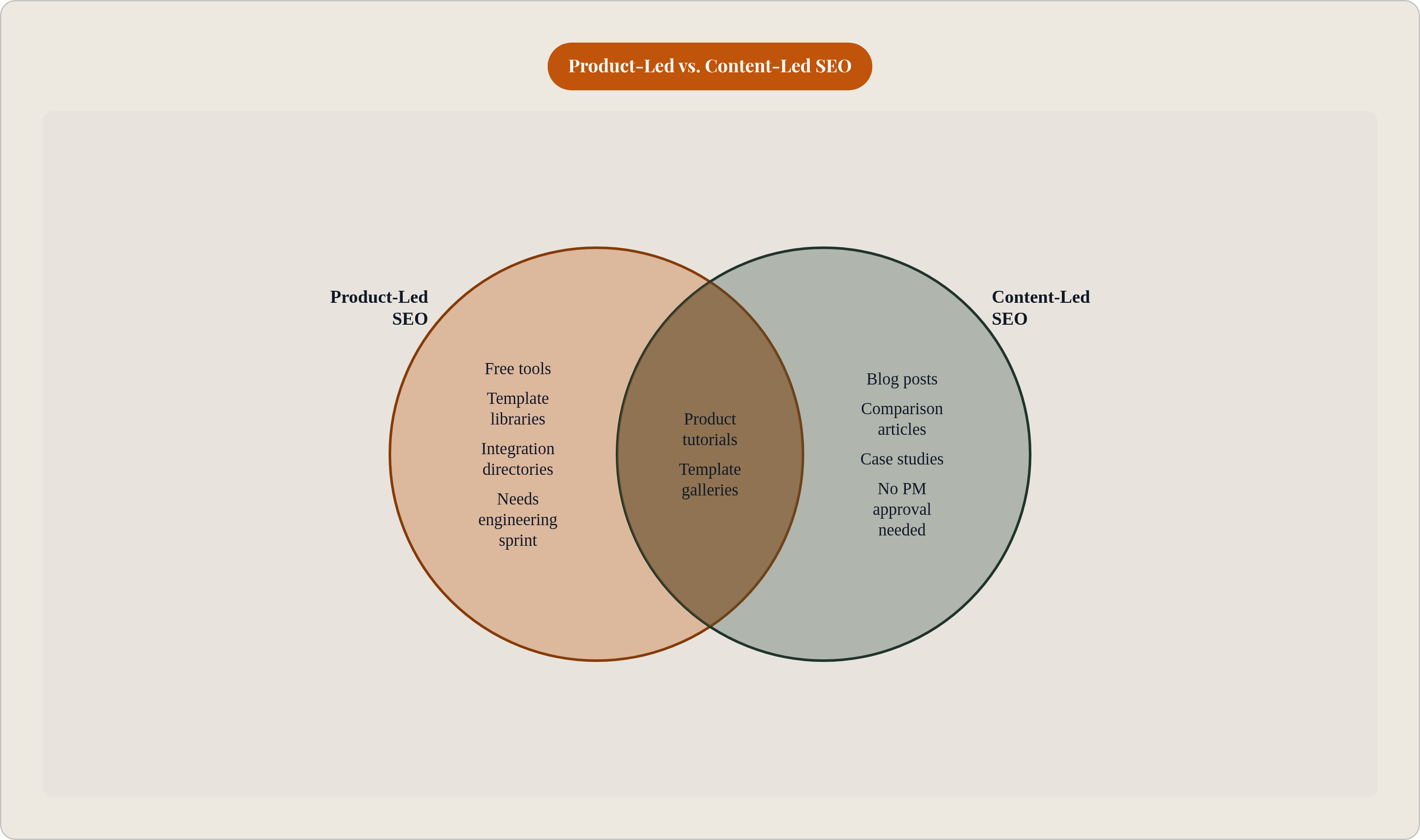
Product-led SEO is stuff built inside or alongside the product that happens to earn organic traffic: free tools, template libraries, integration directories, use-case hubs. These are product surfaces first and content second, which means somebody has to convince an engineering team to burn a sprint on them before they exist at all. I've had that conversation more than once, and it usually ends with "let's revisit next quarter."
Content-led SEO is the more familiar animal: blog posts, feature pages, tutorials, comparison articles, case studies. Words on a page that rank for what people search.
The strongest PLG content engines run both, and the two blur together at the edges. A product-integrated tutorial is basically half tool, half article. A template gallery functions like a landing page with content layered on top. But the price tags differ, and content-led SEO is the one a marketer can actually start on Monday morning without waiting for a product manager to say yes.
What separates the PLG version of this from a generic content playbook is the job each piece has to do. A blog post that ranks and gets read but never points anyone toward a trial has done maybe half its job. Content mapped to awareness, the "what is X" and "how do I do Y" queries, has to introduce the category to someone who doesn't yet know a product like yours exists. Content mapped to activation is written for someone who already has a trial open in another tab and just needs to figure out the one thing they came to do. Content mapped to expansion talks to the free user eyeing the paid tier, or the single user about to loop in the rest of the team.
Get that stage-mapping wrong and it costs you more than you'd think. Organic search drives a large share of all B2B revenue, more than any other channel. Miss the mapping on that channel and you're misallocating the biggest lever in the business.
The compounding economic argument for organic over paid in PLG
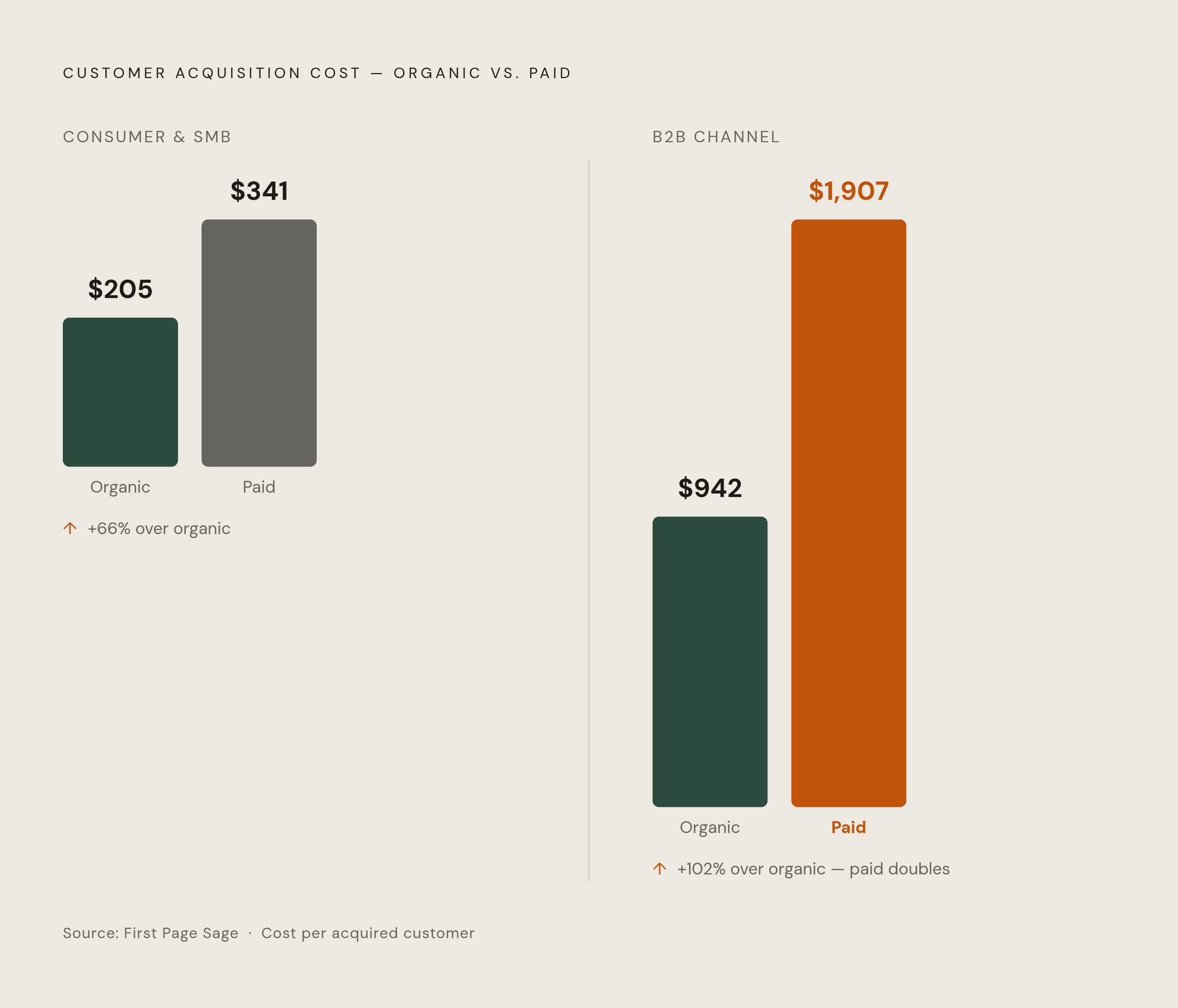
Start with the cost math, because it isn't close. Organic customer acquisition runs somewhere around $205 on average, against $341 for paid, roughly a 40% gap. Zoom out to the B2B channel level and it widens further: First Page Sage put organic CAC at $942 versus $1,907 for paid. Paid is basically double the price for the same customer.
That gap isn't closing either. CAC climbed somewhere between 40% and 60% industry-wide from 2023 to 2025. Blame more competitors bidding on the same terms, blame the privacy changes that gutted ad attribution, blame plain old inflation; Google Ads hit an average CPC of $5.42 in 2025 across most industries, up from $4.66 the year before. Organic behaves on a different clock entirely. An article published this quarter can pull in trial signups two years from now without another dollar spent on it, which is the whole appeal and also the whole patience problem, since you don't see the payoff on day one. One analysis puts three-year ROI on B2B SaaS SEO at 702%, a number that dwarfs most paid-media budget lines.
There's a scale pattern worth sitting with too. High Alpha's 2025 SaaS Benchmarks Report found companies clearing significant ARR thresholds lean harder into organic and existing-customer channels as they grow. Around 60% of new ARR at that stage comes from existing customers and organic discovery rather than fresh paid spend.
So why does this matter more for a PLG company than for, say, an enterprise motion closing seven-figure deals one at a time? Volume. Nobody closes a single seven-figure contract off a comparison page. PLG companies stack up thousands of $20-a-month subscriptions, and at that scale a small lift in organic conversion moves the whole business.
How organic traffic converts differently when it lands in a PLG funnel
Organic traffic costs less and it converts better too, because the search itself does filtering work an ad never manages. Someone typing "free invoice template" has already told you exactly what they want before they've seen a single pixel of your site.
The numbers back this up, though not cleanly across the board. Around 8.5% of organic visitors sign up for an opt-in free trial, which is a decent sign that the landing page and the search intent are talking to the same person. From there, trial-to-paid conversion swings hard depending on the trial model: opt-in trials with no credit card convert around 18.2%, opt-out trials that require a card upfront convert closer to 48.8%. Freemium sits way out on the other end, converting roughly 2.6% of organic users to paid. Low per-user, sure, but freemium was never trying to be efficient; it's built for volume rather than conversion rate.
PLG also brings a metric a standard SEO report never mentions: the Product Qualified Lead, a user whose in-product behavior signals buying intent instead of a form fill signaling it for them. Companies that track PQLs see conversion rates around 25%, versus 9% for companies that don't bother. That's roughly a 177% jump just from measuring the right signal. Freemium products separately see a median visitor-to-signup rate of 12%, well ahead of standard free trials. Companies built on self-serve revenue score meaningfully higher on time-to-value delivery too, meaning users hit the useful part of the product faster.
Category matters here, and comparing across categories is a trap. A CRM tool converting trials at 29% and enterprise software converting at roughly 18.6% aren't in competition with each other; they serve buyers on completely different evaluation clocks. Cybersecurity sits in between, around 22%. None of these numbers mean much in isolation, only against the buyer sitting on the other end of them.
Here's the architectural point that falls out of all this: every piece of content in a PLG engine needs an actual door into the product, not just a link to a demo request form. An inline CTA that opens a free tool. A template preview embedded right in the article. A "try this in-app" button sitting where the reader's cursor already is. Skip that step, and the content generates attention while generating exactly zero usage.
Building a keyword strategy around PLG funnel stages, not generic intent tiers
The standard TOFU/MOFU/BOFU framework has its uses, but it's too blunt for what a PLG funnel actually needs. What matters more is mapping keywords to product motion stages, something closer to the real buyer journey than to intent tiers borrowed wholesale from a sales-led playbook.
Awareness keywords are the classic top-of-funnel stuff: problem-aware searches, category education, "what is" and "how to" queries from people who've never heard of your product and have no reason to yet. Activation keywords run narrower and product-specific, closer to "free project timeline creator" than "best project management software," built around a job someone wants finished in the next few minutes, not researched over a weekend. Expansion keywords show up later in the story: advanced workflow searches, "[product] for teams," ROI comparisons, the query typed by someone quietly wondering whether free is still good enough for what they're now trying to do.
PLG shifts the weight of the whole strategy toward that middle activation layer. Instead of chasing the broad, expensive "best X software" query that every competitor is also bidding on, chase the narrow one that drops someone straight into a feature they can use in the next ninety seconds.
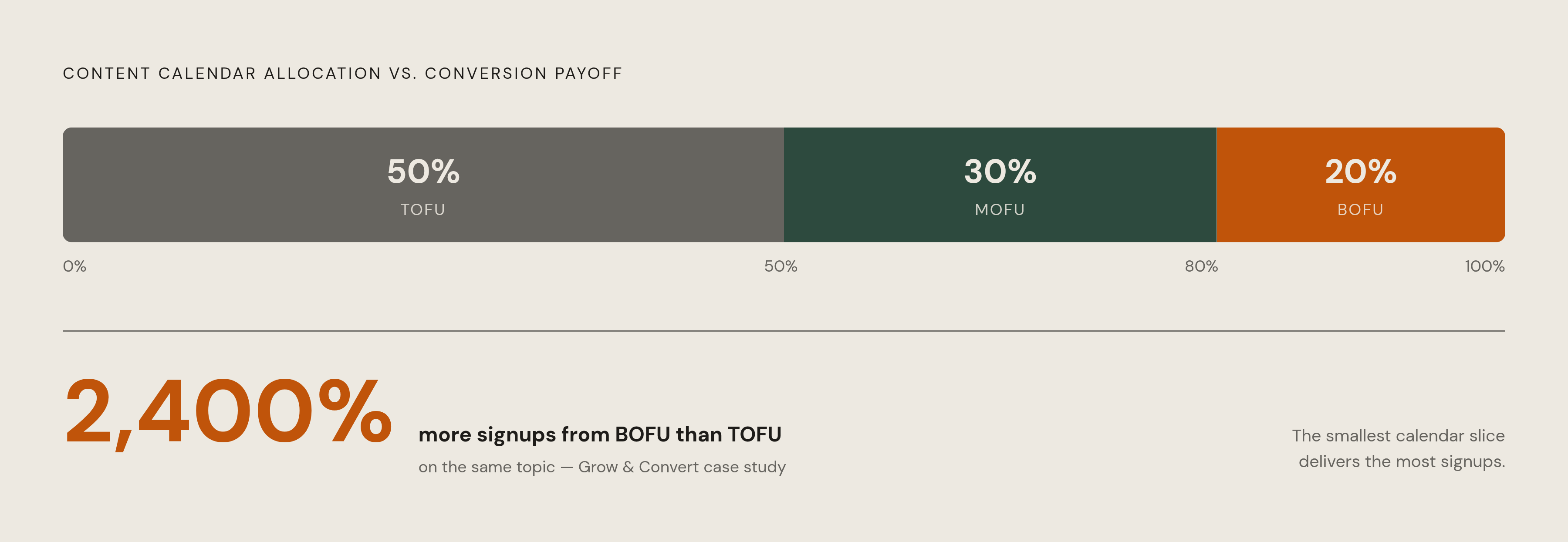
BOFU content is where the real leverage sits, though, and it's the part teams underinvest in most. Comparison pages, alternatives pages, integration pages like "X for Slack," these punch well above their weight class. One case study from Grow and Convert found BOFU articles generating 2,400% more signups than top-of-funnel pieces on the exact same general topic. BOFU also survives Google's AI Overviews better than most content does; Overviews tend to swallow informational queries whole, but decision-stage searches, the "X vs Y" type, stay more or less intact on the page below.
A reasonable starting split for the content calendar looks something like 50% TOFU, 30% MOFU, 20% BOFU. Most PLG teams overshoot on the awareness end anyway and starve the bottom, leaving the highest-converting pages on the site chronically understaffed relative to what they actually deliver.
Clustering compounds the payoff further. HireGrowth found content organized into topic clusters holds rankings roughly 2.5 times longer than standalone pages. That matters even more in PLG, because activation and expansion queries cluster naturally around specific features and use cases. The content structure ends up mirroring the product's own structure, which makes sense given how closely the two are meant to work together.
The four content surfaces that connect search intent to product activation
Four formats carry most of the weight in a mature PLG content engine, and they don't do the same job. Worth separating them out, because teams tend to lump them together and then wonder why nothing converts consistently.
Programmatic pages built on product utility. Template plus variable content, generated at scale, each page targeting one narrow job someone showed up to finish. Canva is the textbook case: its templates hub pulls in roughly 505,000 US visits a month, sub-pages covering a wide range of everyday tasks. Search "create a poster," land on a page, and the page already is the tool. No detour, no second click needed. Canva's SEO strategy is estimated to account for close to $100 million in revenue, with around 270 million monthly visitors and over 180 million monthly active users. This surface needs real product and engineering resourcing, and it only makes sense once the conversion mechanics have been proven on hand-built pages first.
Product-integrated tutorials and blog content. Editorial writing that teaches a task using the product as the actual instrument, screenshots and in-product walkthroughs included, with a natural moment where the reader is one click from the feature they just read about. Ahrefs takes this logic to its logical endpoint: instead of writing a generic article about rank tracking, the company optimized its own product page to rank directly for "rank checker" and "SERP checker," on the theory that the product page satisfies the search intent better than any article could. Refreshing old content is the cheap, underused cousin of this lever, and teams overlook it constantly. Refreshing old content regularly can recover and grow traffic that would otherwise quietly decay.
Template galleries mapped to real jobs-to-be-done. Each template functions as content and product at once, since it represents a task someone's already mid-way through trying to finish. Done well, this play can drive meaningful growth in both leads and organic traffic simultaneously. Here's a failure worth naming because it happens constantly: content teams keep cranking out keyword-mapped blog posts while the template gallery, arguably the single highest-intent surface the product owns, sits completely unoptimized and barely linked from anywhere on the site.
Comparison, alternatives, and integration pages. These target buyers close to deciding: "X vs Y," "[competitor] alternative," "[product] + [integration]." Buyers at this stage are usually weighing three to five options over a period of weeks, reading reviews the whole way through, so the content has to show up across that entire research window and not just at the start of it. These pages tend to have the shortest distance between a search click and a trial signup, which is exactly why they should get built before the TOFU library is finished, not treated as the thing you get to eventually.
Mapping content to the post-signup journey to drive expansion revenue
A lot of PLG content strategies just stop the moment someone signs up for the free plan. That's a mistake, and the High Alpha number from earlier explains why: roughly 60% of new ARR at scale comes from existing customers and organic discovery, not net-new signups. Content that drives expansion deserves the same attention as content that drives new signups. Treat it as an afterthought and there's real revenue sitting on the table, unclaimed.
Activation content picks up right where signup ends: in-app help articles, quick-start guides tied to specific use cases, feature tutorials that are actually indexed and searchable instead of buried behind a login wall where Google can't see them. The whole point is time-to-value, and content is one of the few levers that shortens that path without an engineer having to touch the onboarding flow at all.
Expansion content looks different in tone and target. Case studies and ROI framing pitched at a team, not an individual, because the upgrade moment in PLG often arrives when one power user wants to bring three colleagues into the fold. Advanced workflow content aimed at the ceiling free users eventually hit, content that makes the paid tier's value obvious without reading like a sales pitch dressed up as a tutorial. And integration content: "how to connect [product] with [tool]" is, functionally, someone telling you they're building their stack around you and are close to paying for the privilege of staying.
Regular publishing has a retention angle too, one that's easy to miss if you're only counting new-visitor traffic. Companies that blog consistently see meaningfully more leads per month, but for PLG the more interesting question is whether existing users come back to content that teaches them to squeeze more out of what they already pay for.
None of this works if the content lives in a silo, cut off from the product it's supposed to be selling. Content built for in-trial or already-paying users needs to link both to the help center and to the upgrade path directly, not one or the other. A blog that free users never see contributes little beyond a rankings report nobody outside the marketing team ever opens.
What a functioning PLG content operation actually looks like week to week
The real tension inside a PLG content team is speed versus sequencing, and most teams get it backwards. Publishing three posts a week means very little if the BOFU comparison pages, the ones actually converting people into trials, sit in a backlog behind another six top-of-funnel explainers that nobody asked for and nobody's searching for either.
A strategy-first workflow starts from the product outward, rather than from a keyword tool inward. Map the product's core use cases first, then build keyword clusters around them, so every content brief connects to an actual product surface or a real conversion path instead of existing because a tool said the search volume looked decent that week. Use case first, keyword second. That ordering sounds like a small operational detail, and maybe on paper it is, but it's also the difference between a content team publishing into the void and one publishing into a funnel that's already waiting for the traffic to show up.