Content Marketing Budget Allocation for Series B Companies
Organic search drives half of B2B revenue but gets a quarter of the budget it deserves.

Series B marketing budgets sit in an awkward middle. Product-market fit is proven and revenue is real, but the company hasn't earned the right to spend like an enterprise brand, and it can't keep operating like a seed-stage shop testing five channels on a shoestring either. The specific question worth settling is how much of that budget content should get, because the honest answer is that most Series B companies actually give it less than they should, and the enterprise benchmarks everyone benchmarks against are actively misleading them into cutting it further.
What the overall marketing budget looks like at Series B ARR
Scaling-stage companies, the bracket that covers most Series B firms, generally put 15% to 25% of revenue into marketing overall. That range moves depending on one variable more than any other: the go-to-market motion. Product-led growth companies often run marketing at 10% to 15% of revenue, because the product does a chunk of the selling on its own. Sales-assisted motions run hotter, often 25% to 35%, because marketing has to generate and warm pipeline that a sales team then closes by hand.
There's a second way to anchor the number, and it's arguably more useful than a flat percentage: work backward from the ARR target. A company sitting on $15M in ARR that wants $3M in net new revenue over the next year might land on a marketing budget of $2.5M to $2.9M annually, which happens to fall in that same 17% to 19% band. Two different math problems arrive at the same answer. That convergence is what makes the range a planning tool rather than a guess pulled from a deck.
Where operators get tripped up is the broad B2B benchmarks that show up constantly in those decks: the Gartner CMO Spend Survey figure showing roughly 7.7% to 8% of revenue going to marketing. Those numbers come almost entirely from companies with a billion dollars or more in revenue, where the median sits at 6% or below and the average gets dragged up by a handful of large, brand-heavy spenders. A Series B company benchmarking against that data is comparing itself to a population it doesn't belong to yet, and 8% would be a starvation diet at this stage. The 15% to 25% range is the right neighborhood. For context on how aggressive things can get at the top end: venture-backed growth-stage companies sometimes push sales and marketing combined to 30% to 50% of revenue when customer lifetime value supports it. That ceiling is worth knowing about, though not worth climbing toward on purpose.
How the total marketing budget typically breaks down by function
Every dollar that goes into content comes from somewhere else. That's the structural fact under this whole conversation: content gets funded by not funding paid media, not funding another hire, not funding the tools budget or the agency retainer. The content line is a claim on resources that other functions want just as badly.
Per Gartner's 2025 CMO Spend Survey, paid media takes the largest single slice of the average B2B marketing budget at 30.6%. Labor, meaning people on payroll, accounts for 24.9%, per Gartner's 2024 survey, a figure worth sitting with because it means headcount decisions are budget decisions wearing a disguise; hiring a fourth content writer isn't separate from the allocation debate, it is the allocation debate. Agencies absorbed 23% of budgets in 2024. MarTech came in at 19% in 2024, down from 25% the year before, a compression that looks like it's continuing rather than reversing.
Content and SEO, by Gartner's measure, get only 10% to 15% of the total. That's the number this piece argues against, and the next section is the argument. But there's a trap in copying these averages directly: they're built from enterprise companies with enormous paid and headcount lines already in place. Mirror that same ratio on a fraction of the absolute dollars, and every line ends up too thin to do anything well. What should actually drive the split is the balance between what's already fixed, meaning headcount already hired and contracts already signed, and what's still discretionary this quarter.
The long-run case for weighting content higher than the averages suggest
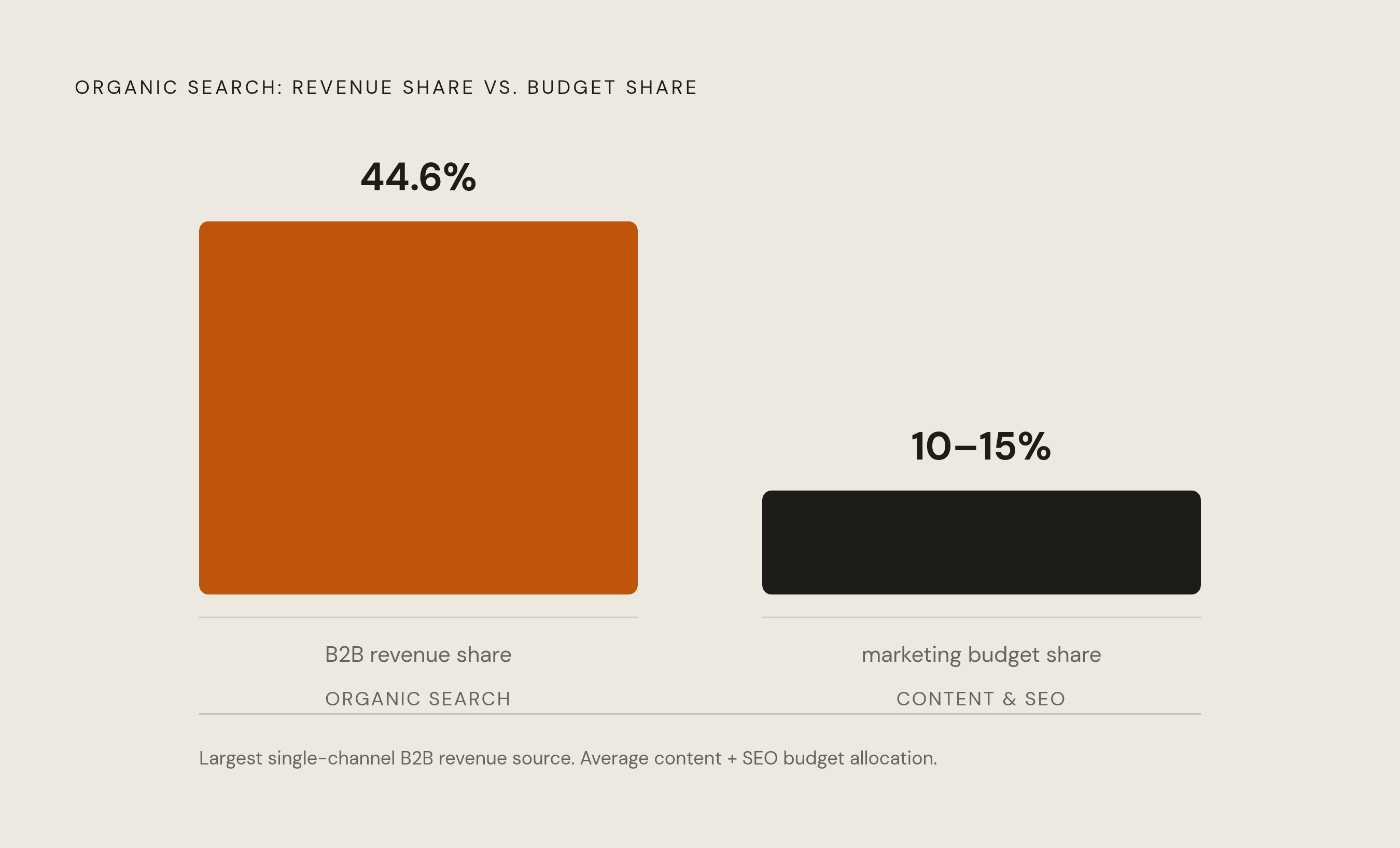
Organic search generates the largest share of B2B revenue of any single channel, at 44.6%. That gap alone, a channel producing nearly half of revenue while receiving 10% to 15% of budget, is the core case for weighting content heavier than Gartner's numbers suggest. The comparison that tends to stop people mid-sentence: long-form SEO content for B2B companies shows an average three-year return of 748%, against 33% for Google Ads and 79% for Meta Ads over the same period.
Reading that as content simply beating paid across the board misses the mechanism, though. Content takes 12 to 18 months to compound into meaningful traffic and pipeline; paid campaigns show results in weeks. Comparing a three-year content return against near-term paid performance is comparing a bond to a day trade. Both can be the right instrument, each answering a different question about time horizon rather than competing for the same job.
For a Series B company specifically, that timeline is the whole strategic point, not a footnote. If content needs 12 to 18 months to pay off, and the next fundraise, Series C, is typically 18 to 24 months out and the moment growth velocity gets scrutinized hardest, the content investment has to start now to land inside that window. Wait a year, and the compounding curve simply hasn't had time to bend before the board is asking questions.
There's a cost argument sitting alongside the return argument: organic channels run roughly 40% cheaper than paid in SaaS benchmarks and convert at meaningfully higher rates. Long-term ROI plus lower cost per unit of pipeline is the combination that tends to land with boards, more than either number alone.
None of this should get oversold, though. Roughly 83% of marketing leaders say demonstrating ROI is a top priority, but far fewer say they can actually measure it with any accuracy. That gap between wanting to prove the case and being able to prove it is exactly where content budgets go to die in board meetings, a subject the final section comes back to directly. And the 748% figure deserves a grain of salt on its own terms: it's a multi-year average pulled across a diverse set of companies, and any individual result depends on keyword competitiveness, publishing consistency, and how crowded the category already is. Averages describe a population; a single company's outcome inside that population can land well above or below it.
Where content budget underperforms: what the effectiveness data actually shows
Here's the uncomfortable part of this argument, the part that keeps it from being a simple spend-more pitch. Only a small minority of B2B marketers rated their content strategy as extremely or very effective in 2024, in a survey of 980 B2B marketers. Most describe their own programs as moderately effective at best, a polite way of saying the content is unremarkable and falling well short of the trajectory the 748% figure implies it should follow.
Part of that traces to a staffing gap: A notable share of B2B organizations have no dedicated content marketing team or staff member at all. Money is going out the door for content with nobody specifically accountable for the strategy behind it. Separately, many B2B marketers report they don't actually know their organization's content marketing budget, which raises the obvious question of how anyone makes an allocation decision about a number they can't see in the first place.
That points to the real risk for Series B teams tempted by the last section's argument: spending more on content without fixing strategy, production process, and measurement produces more mediocre content spread across a wider surface area, arguably worse than spending less and doing it well. The budget question and the operational question aren't separable. Increasing the content line without a system to absorb the increase is just paying more for the same 29% effectiveness rate.
One clear exception cuts through the mediocrity, though: Research consistently finds that decision-makers report higher trust in thought leadership than in standard vendor marketing material. That trust attaches to content built on a strategy layer, produced with intent rather than at volume for its own sake, a fairly direct rebuttal to the volume-first instinct that shows up the moment a budget line grows.
A working allocation model for Series B content budgets
The 70/20/10 framework is the dominant lens for structuring budget across risk levels, and it maps cleanly onto the content line specifically. The majority goes to proven approaches, a meaningful share to scaling bets already showing early signal, and a small slice to pure experiments that might not work at all.
The 70% for a Series B content program is unglamorous by design: long-form SEO content built around active-demand keywords the ICP is already searching, email nurture sequences built on assets that already exist, and content that sits directly in the sales cycle, meaning case studies, comparison pages, and ROI calculators. That's most of the budget, and it should be; this is the layer that actually generates the 44.6% revenue share cited earlier.
The 20% starts to look more like bets than infrastructure: account-based content personalized for top-tier ICP segments, video, and content built to support conference and event presence, roughly the stage where event investment starts paying off for most Series B companies. Video in particular is graduating out of the experimental bucket; A majority of B2B marketers have pointed to video as an area of increasing investment.
The 10% is where the genuinely uncertain stuff lives: AI-assisted content creation and optimization, both relatively new named categories in content marketing planning, and generative engine optimization, meaning structuring content so it surfaces well in AI-powered search, which has no established benchmarks yet because the category is that new. One reference point worth arguing with rather than adopting outright: a growth-stage benchmark model that puts 25% of total marketing budget into content and SEO/GEO combined, inside a broader split of 30% paid and ABM, 15% events, 15% headcount, 10% tools, and 5% PR.
The go-to-market caveat matters more than it sounds like it should. A PLG company's 70% should weight self-serve onboarding content and organic discovery heavily; a sales-assisted motion should weight that same 70% toward content that influences pipeline directly. Same framework, different center of gravity, and mixing the two up is how a perfectly reasonable allocation model produces the wrong content mix anyway.
How to staff the content function without over-hiring ahead of budget
Practitioner guidance for Series B companies generally points to lean marketing teams where content specialists sit alongside product marketing, demand gen, and marketing ops. That's a lean team, and every hire has to be justified against what the same dollars could do as tools or campaign budget instead.
Practitioner guidance here is consistent on one point: ensure meaningful non-headcount spend is in place before hiring anyone new. A person walking into a role with no tooling and no campaign budget can't execute on day one, whatever their résumé says.
There's a labor-market shift worth naming plainly, too. Marketing job postings have grown modestly in the 2025–2026 window, while marketing output has grown considerably faster over the same stretch, a gap widely attributed to AI absorbing work that would previously have required another hire. A small content pod can produce meaningfully more today than the same headcount could two years ago.
The design implication follows directly: the pod should own strategy and editorial quality first, volume second, because volume without a strategy layer is exactly how a program lands in the 71% bucket rated only moderately effective or worse. AI-assisted writing paired with real editorial structure, meaning strategy-first workflows and brand context alongside faster output, holds quality steady while output scales, a balance that tends to break down when volume gets prioritized first.
One line item deserves harder scrutiny than it usually gets: agencies absorbed 23% of marketing budgets in 2024. At Series B, that's not just a cost question, since a slow agency carries a pace risk on top of its retainer, at a stage where the entire point of the content bet is landing before the Series C conversation starts, not sometime after.
How to defend the content budget when the board asks for faster payback
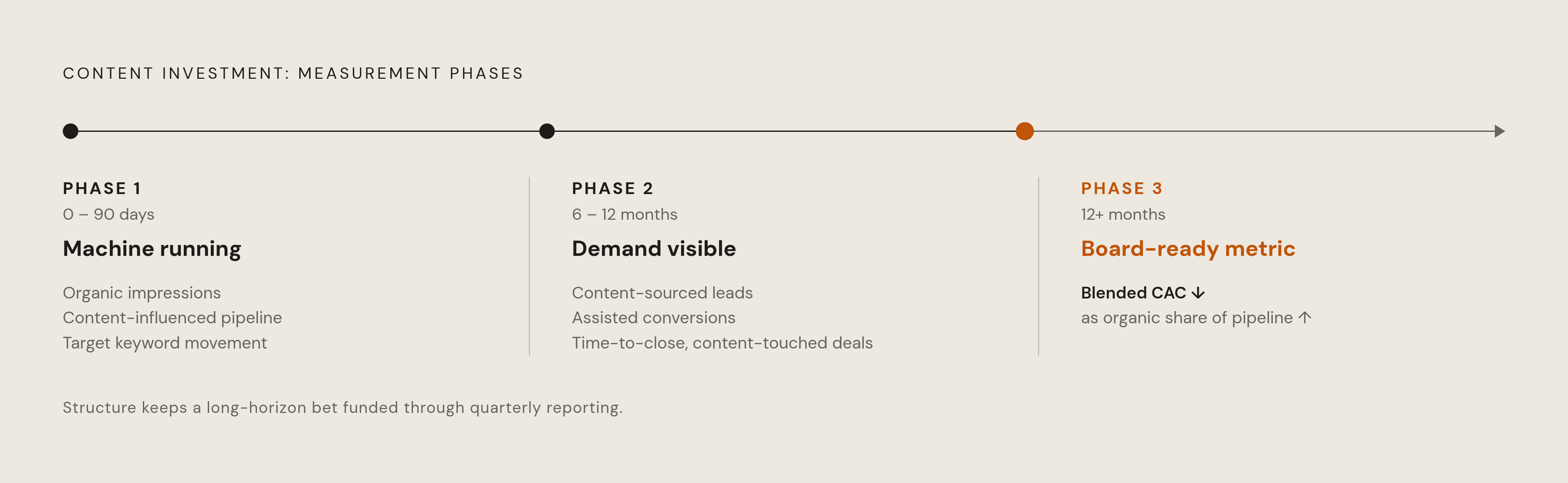
The tension here is structural, not a communication failure: content compounds over 12 to 24 months, and board reporting runs quarterly. A CMO who can't bridge that mismatch loses the budget before the investment gets a chance to pay off, regardless of whether the underlying strategy was sound.
The fix is a three-layer measurement framework that reports different signals depending on how far into the investment the company sits. In the first 90 days, the signals are organic impressions, content-influenced pipeline, and movement on target keywords, which together prove the machine is running ahead of any direct revenue proof. Between six and twelve months, mid-term indicators take over: content-sourced leads, assisted conversions, time-to-close on deals where content played a visible role. Past a year, the long-term payoff shows up as blended customer acquisition cost falling as organic's share of pipeline grows, which is the one a board can actually model against the next fundraise.
There's real confidence building around this bet industry-wide: a growing share of B2B marketers expected their content budget to increase in 2025 relative to 2024. The companies making that call generally aren't doing it on faith; they're doing it because they built the measurement layer above and can point to it when asked.
The framing that lands best in the boardroom treats content at Series B as an asset under construction ahead of the next raise, where every month it goes unfunded is a month of growth that doesn't happen and can't be bought back later on a rush timeline. Page views or social impressions that never connect to pipeline make a much weaker defense of the line; boards see through that every time, and they're right to.
One closing wrinkle worth adding to that conversation: AI-assisted production and strategy-first workflows have compressed the ramp time between funding a content program and seeing its first measurable output, so the 18-month wait isn't the fixed cost it used to be. The whole board conversation about patience is shifting under everyone's feet, and the CMO who knows that walks in with a genuinely stronger case than the one still arguing from a 2019 timeline.