AI-Generated Content and Google Search Quality Guidelines
Google rewards quality and experience over AI use itself, penalizing low-effort content.

Google's public position on AI-generated content has been surprisingly stable since February 2023, when the Search Quality team confirmed that AI use is permissible and quality governs the outcome. The framing has tightened considerably since then; the core logic has not.
The more telling shift came in September 2023, when the guidelines language moved from content "written by people" to content "created for people." That single-word substitution is doing a lot of work. Google was acknowledging, fairly openly, that AI-produced material passes muster if it genuinely serves the reader, which is a different thing than simply being written by a human who was also, arguably, just rearranging what already existed online.
March 2024 brought a core update explicitly targeting unoriginal and unhelpful content, with Google stating a goal of reducing such content in results by 40%. The Helpful Content system, previously a standalone signal, absorbed into core ranking at the same time, which meant every page on a domain gets evaluated continuously rather than during periodic sweeps. Three new spam categories also entered formal policy simultaneously: scaled content abuse, expired domain abuse, and site reputation abuse. The timing was not coincidental; AI tooling had already made it trivially easy to produce content at a volume that would have required a small newsroom five years earlier.
January 2025 expanded the Search Quality Rater Guidelines significantly. For the first time, generative AI received its own definition in the document: "a useful tool that can be abused." Filler content got its own named section, the sort of editorial specificity that signals enforcement rather than aspiration. By April 2025, quality raters were directed to flag pages where the main content appears generated by AI tools and to rate them potentially lowest quality when other signals confirm low value. Those ratings feed algorithm training directly.
Each update narrows the viable space for low-effort AI content. Each also leaves room for AI-assisted work that clears the quality bar. Google's position targets lazy execution, not AI use itself.
E-E-A-T as the Practical Standard AI Content Must Clear
Experience, Expertise, Authoritativeness, and Trustworthiness form Google's primary evaluative filter, with Trust identified as the most critical of the four. Google added the first "E," Experience, in December 2022 specifically to reward first-hand knowledge: actually testing a product, visiting a location, living through a medical situation. AI cannot produce that kind of content independently, which is the most structurally significant thing about the framework from a practitioner's standpoint. You can prompt your way to a coherent paragraph about hiking the Appalachian Trail; you cannot prompt your way to having hiked it.
E-E-A-T operates as a constellation of signals across many dimensions simultaneously, not as a single ranking factor with a number attached. Google's systems learn to recognize all of them together, which makes gaming any one dimension in isolation a fairly futile exercise.
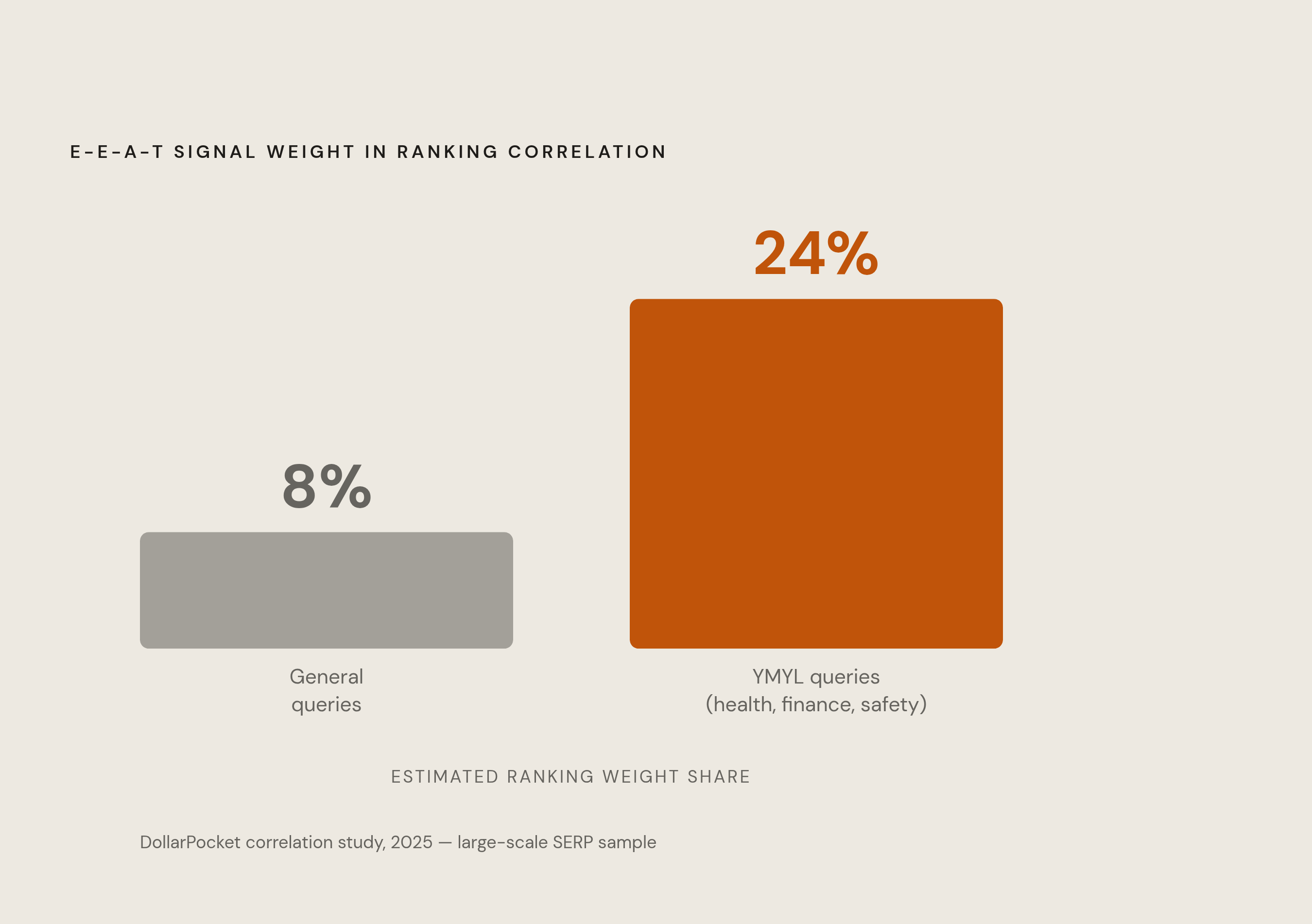
A 2025 correlation study by DollarPocket analyzing a large set of search results found that E-E-A-T-related signals correlate with approximately 8% of ranking weight across all queries, rising to roughly 24% for YMYL topics covering health, financial stability, and safety. For categories where the stakes are highest, E-E-A-T signals carry roughly three times the relative weight. AI content in health, financial guidance, or safety categories faces a substantially higher bar because demonstrable human expertise matters far more to the reader in those verticals, and Google's systems have been calibrated accordingly.
Accurate text and experienced authorship are different things, and Google's raters are trained to distinguish between them. Accurate text is a capability question; experienced authorship is a provenance question. AI assists with research, structure, and drafting; the expertise and experience signals need to originate from human contributors whose credentials can actually be evaluated.
The Specific Signals That Trigger a Lowest-Quality Rating
The January 2025 guidelines define filler content with unusual precision: material that "artificially inflates a page, creating the appearance of richness but lacking value website visitors find valuable." That is a polite way of saying the output you get when you prompt an LLM to "write a long article on topic X" and publish it unreviewed now has its own named category in the document Google uses to train raters. Wordiness without substance is now a formal quality failure, which is both appropriate and slightly embarrassing for the SEO industry as a whole.
Quality raters are also trained to identify specific AI fingerprints: phrases like "As a language model, I don't have real-time data" or "As an AI, I don't have opinions." Finding those phrases in published content is a strong signal that no human reviewed the output before it went live. It is the content equivalent of submitting a report with the tracked-changes comments still visible.
Inaccurate, misleading, or unsubstantiated information earns a Lowest rating regardless of whether AI produced it. Expired domain abuse and site reputation abuse both appear as formalized spam categories now. The former involves buying lapsed domains to repurpose for thin content; the latter involves publishing third-party content on established sites to exploit existing ranking signals. Both of these predate AI as tactics; AI just made them cheap enough to run at industrial scale.
SpamBrain deserves mention here. Google's AI-powered anti-spam engine received continuous model updates through 2024 and into 2025, improving its ability to detect thin and manipulative content materially over that period. Policy describes the violations. SpamBrain finds them at scale, automatically, across millions of pages simultaneously.
What Enforcement Actually Looks Like: Sites That Lost and Sites That Gained
Izoate.com lost 89.14% of its traffic in March 2025 after being penalized for content that failed E-E-A-T standards. That is a sharp, documented outcome, not a gradual algorithmic drift. On the other side of the ledger, a tech news publication that used AI for initial research but layered in expert interviews and editorial review saw a 25% traffic boost in early 2025, with strong placements on competitive queries.
Same tooling, wildly different outcomes. The determining variable is whether human expertise, editorial review, and genuine judgment were added on top of the AI output before publication.
Glenn Gabe's June 2025 observation adds another layer of complexity worth sitting with: sites whose AI content is actively ranking can still receive a Scaled Content Abuse manual action. A few well-performing pages do not immunize a domain with a broader pattern of low-value AI output. Google evaluates site-level quality, not just individual page performance, which means volume strategies without editorial standards carry compounding risk across the entire domain. When a manual action touches your whole property instead of a single URL, the consequences scale accordingly.
John Mueller's August 2025 warning rounds this out. Aggressive pursuit of GEO and AEO tactics, meaning content optimized primarily to appear in AI Overviews rather than to serve human readers, signals spam activity by itself. The optimization-first mindset turns out to be exactly the thing Google is trying to filter.
How AI Overviews Change What "Ranking" Means for Content Marketers
AI Overviews now appear across a large and fluctuating share of queries, with the majority of triggering queries being informational in nature, per Semrush analysis. Zero-click behavior has accelerated considerably from 2024 to 2025; when an AI Overview is present, the vast majority of those queries end without any visit to an external site.
That raises a genuinely uncomfortable question for content marketers who built programs around organic traffic volume: if the click never happens, what does a successful piece of content actually accomplish?
A May 2026 spam policy update clarified that tactics used to manipulate AI Overviews, AI Mode, or other generative AI features in Search fall under the same spam framework as traditional manipulation. These surfaces share the same policy framework as traditional search, which will disappoint everyone who assumed the new format created a new loophole.
As zero-click rates rise, being cited inside an AI Overview becomes a visibility event even without a click. Author credentials, original data, and cited expertise function as citation signals, not just ranking signals. E-E-A-T becomes more strategically significant at the exact moment that traditional organic click volume becomes less reliable as a primary metric. The content that earns citations inside AI Overviews is demonstrably the same content that clears Google's quality bar: original, expert-driven, and authored by someone with verifiable credentials. The signals that mattered in the sections above on E-E-A-T and lowest-quality ratings arrive at the same conclusion here, just from a different direction.
What Meeting Google's Standards Actually Requires in an AI-Assisted Workflow
Google's own guidance implies a clear operational model. AI is appropriate for researching a topic, structuring an approach, and accelerating the drafting process on content where a human with genuine expertise contributes the insight and reviews the output. Generating finished pages without that editorial layer is the use case Google's systems are designed to catch.
Named authors with verifiable credentials, first-hand experience signals like original testing or proprietary data, and editorial review that catches inaccuracies and removes AI fingerprint language before publication: these are the categories of human contribution that actually register in the signal landscape Google's raters are trained to evaluate. Slapping a byline on unreviewed output does not clear the bar.
Site-level quality compounds the stakes. A pattern of thin AI output across a domain affects the whole property, not just the pages where the thin content lives. The domain is the unit of trust, not the individual URL.
The workflow question worth asking is whether the process starts with what the audience needs and what expertise the brand can genuinely offer, with AI used to accelerate production inside that frame, or whether it starts with AI output and reverse-engineers a justification around it. The sequence matters because it determines whether human judgment shapes the content or merely rubber-stamps it after the fact. Contentatscale structures around the former model, integrating strategy, subject-matter input, and quality review into the workflow rather than treating them as optional finishing steps.
The practical test before publishing any AI-assisted piece is straightforward: does this content demonstrate something a person with genuine experience or expertise contributed, or does it read like a well-organized summary of what already exists online? Google's raters ask that question on every page they evaluate. Worth asking it yourself before they get the chance.