AI Tools for Repurposing Long-Form Content into Social and Email
AI can cut content reformatting time by two-thirds when matched to the right task.

Once upon a time, there was a content team—let's call them the Reformatters—who had everything they needed to succeed. They had whitepapers stacked like firewood, case studies polished to a shine, and a library of webinar recordings stretching back three fiscal years. What they didn't have was time. Reformatting a single whitepaper into social captions, an email sequence, and a sales one-pager was eating two to three days of writer and designer hours. They had struck gold and couldn't afford to mint the coins.
So they turned to AI. And that's where things got interesting—and, for a while, a little embarrassing.
The stakes were not trivial. Forty-six percent of marketers identify content repurposing as their single best-performing content marketing strategy, ahead of both creating from scratch and updating old content. HubSpot research puts repurposed content ahead of original content on lead generation. And across the B2B distribution channels that actually move buyers, including social media, email newsletters, and blogs, a single strong long-form asset deployed systematically across formats outperforms anything a team produces from scratch at equivalent volume. The constraint had never been ideation or quality of the original. It had always been the labor required to reformat.
AI changes the labor equation, and platforms like Letterstory, an end-to-end content automation platform, are built around exactly that lifecycle. But only if the tool matches the task.
What Makes Repurposing Hard at Scale, and Where AI Changes the Equation

The Reformatters were not struggling because they lacked ideas. They were struggling because the conversion bottleneck was swallowing their calendar whole. They were a team managing 200-plus assets per quarter across six or more channels, and forty-eight percent of B2B marketers name insufficient repurposing as one of their biggest challenges in scaling content production. The bottleneck is not the asset; it is the conversion.
Semrush data illustrates the time compression AI creates. Marketers who do not use AI spend two to three hours on a single long-form piece; those who do spend less than one hour on the same task. Repurposing benefits even more than creation, because the source material already exists. The model is not generating from nothing; it is transforming something.
That distinction matters more than it first appears. Manual reformatting is structural: shorten it, reformat the layout, adjust the paragraph breaks. AI repurposing is semantic—like the difference between trimming a hedge and teaching someone what a garden is supposed to look like. The model identifies the core argument, extracts the claims that serve a given format, and rewrites from the inside out to fit the target channel natively, not just truncated. A LinkedIn post generated by a well-prompted model reads like a LinkedIn post. A paragraph copy-pasted from a whitepaper and manually trimmed reads like a whitepaper that has been mistreated.
The more sophisticated implementations use retrieval-augmented generation, sometimes called grounded AI, which forces the model to work exclusively from approved source material rather than its general training memory. This reduces the fabrication risk and keeps repurposed output factually anchored to the original. Worth noting: sixty-one percent of organizations using generative AI currently lack formal guidelines for its use. A grounded model inside a broken process still produces unreliable output. Tool choice is necessary but not sufficient.
The Reformatters learned this the hard way. They adopted a tool, pasted in content, and published whatever came out. The output was fast. It was also generic, off-brand, and occasionally drifted so far from the source material that a senior editor called it "the whitepaper's fever dream." The tool was not the problem.
The Matching Problem: Why Picking the Wrong Tool for the Task Undermines the Whole Workflow
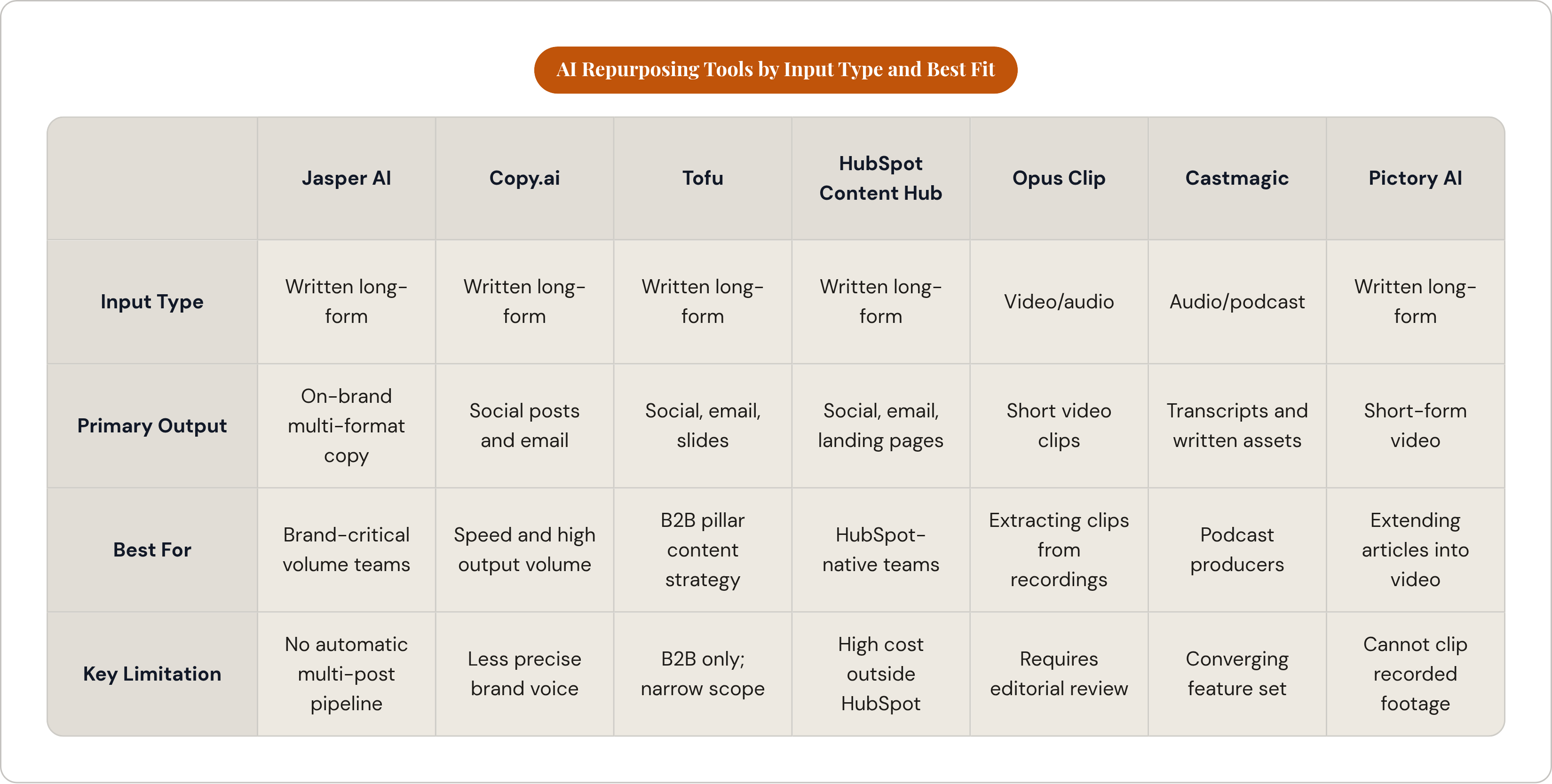
There are two fundamentally different repurposing problems, and they require different tools. Picking the wrong one is like bringing a snow shovel to a sandcastle competition—technically you're moving material, but nobody's impressed with the result.
The first problem is written long-form—a blog post, whitepaper, or case study—being converted into social captions, email newsletters, or LinkedIn posts. The second is audio or video long-form—a webinar, podcast recording, or interview—being converted into short clips, show notes, social pull-quotes, or email recaps. Tools optimized for text input perform poorly on transcripts that require speaker awareness and timing cues. Video clipping tools do not produce polished written copy. Using one where the other belongs means significant manual cleanup that erodes the time savings you bought the tool to capture.
Beyond input format, three secondary variables determine fit. First, team size and workflow: a solo creator and a coordinated marketing team have different needs even with identical source material. Second, brand voice requirements: some tools let brand voice persist across every session and asset; others require re-prompting every time, which creates consistency risk at volume. Third, output volume: occasional repurposing and systematic multi-channel publishing are different problems at different scales.
Ninety percent of content marketers plan to use AI to support content marketing in 2025. Planning to use AI and selecting the right tool for a specific task are categorically different decisions. The framework that should precede every tool evaluation is simple: identify the input type first, then the target output channels, then volume and brand requirements. Then match.
AI Tools Built for Written Content: Blog Posts, Whitepapers, and Case Studies into Social and Email
Jasper AI
Jasper is best suited for marketing teams that need on-brand consistency across large asset volumes. Its core mechanism is brand absorption: feed it your style guides, product catalogs, and voice documentation, and output sounds like the brand rather than a generic language model. That is useful and difficult to replicate with a lower-cost tool when brand fidelity is the non-negotiable requirement.
The limitation worth flagging honestly: Jasper is strong at rewriting and adapting individual pieces, but it does not offer a one-click pipeline from a blog post to five social posts unless users build custom workflows manually. It is a strategic platform for orchestrating campaigns, not a repurposing button. Teams that also use it for original content extraction get the most value from the investment. Creator plans start at $39 per month billed annually.
Copy.ai
Copy.ai is built for fast, high-volume social post generation from written source material. Its template library converts blog sections into tweets, captions, and carousel copy; email templates convert feature articles into launch copy. Practitioners report generating several days' worth of social posts from a single blog post in well under twenty minutes.
The tradeoff is calibration. Copy.ai is less suitable when brand voice precision is the primary concern. It produces output quickly; it produces distinctly branded output only with more deliberate setup than the tool's interface encourages. For teams where speed and volume are the constraints, it earns its place.
Tofu
Tofu is purpose-built for B2B teams executing systematic content strategies anchored to a single pillar piece. Upload an asset, and Tofu generates social posts, email drip sequences, and slide outlines with brand context already encoded. Derivative pieces require materially less editorial cleanup than outputs from generic prompt-based tools, because the tool understands source context rather than merely processing text.
The limitation is scope. Tofu is designed for B2B workflows. Consumer brands and creator-economy use cases will find it less relevant and likely find better fit elsewhere.
HubSpot Content Hub
For teams already operating on HubSpot, Content Hub's Content Remix feature is the most frictionless repurposing option available because it is embedded in the existing stack rather than requiring a parallel tool. Content Remix, which is HubSpot's most-used AI feature, transforms a single blog post into social posts, emails, landing pages, and podcast scripts while maintaining brand tone. The Breeze Content Agent works as an autonomous drafting layer inside Content Hub, researching and generating across formats, best used with a human editor in the loop.
The caveat is pricing. Content Hub Professional or Enterprise tiers represent a significant step up from standalone tool costs. The integration value justifies the investment only if the team is already HubSpot-native. For a team not running on HubSpot, building that dependency to access a repurposing feature is the wrong order of operations. Forty-nine percent of marketers already use AI to generate email copy according to HubSpot's own research, which explains why email output is where Content Remix performs most consistently.
AI Tools Built for Audio and Video: Podcasts, Webinars, and Interviews into Short-Form and Email
Opus Clip
Opus Clip is the category leader in AI-powered video clipping, with more than twelve million users. Its Gen-4 engine analyzes transcripts, tonal shifts, and visual engagement signals to extract high-engagement moments from longer recordings, then automatically converts landscape footage to 9:16 vertical format using Active Speaker Detection. Each clip receives an AI Virality Score, a predicted engagement rating based on training data from a large corpus of viral content, which functions as a useful prioritization signal rather than a guarantee.
The realistic expectation: expect to review and discard a meaningful share of what it generates. Opus Clip narrows the field significantly; it does not eliminate editorial judgment. Pricing ranges from a free tier with watermarks to paid plans in the mid-double digits per month.
Castmagic
Castmagic serves podcast producers and audio-first content teams who need transcription plus downstream written assets in a single workflow. It uses OpenAI's Whisper model to generate transcripts from audio uploads, then applies customizable AI prompts to extract summaries, pull-quotes, social media drafts, show notes, and email newsletters. The practical value proposition competes directly with a part-time content writer for audio-to-written conversion tasks.
Castmagic, alongside tools like Swell AI and Capsho, operates in a category that has converged toward a similar output set. The meaningful differentiation is now in transcript accuracy and the depth of prompt customization rather than feature breadth.
Pictory AI
Pictory occupies a distinct position in this category. Where Opus Clip converts video to video, Pictory converts written long-form into short video, assembling clips, captions, and visual highlights from a blog post or article without requiring video editing experience. The output is suited for YouTube Shorts, Reels, and similar short-form video channels.
That directional distinction matters for matching. Teams that want to extract clips from recorded footage need Opus Clip. Teams that want to extend written content into video need Pictory. Using one where the other belongs produces predictable frustration.
A consistent caveat applies across this entire category: none of these tools produce finished copy ready to publish without review. They compress the production timeline significantly. They do not replace the human editor who checks for accuracy, tone, and brand fit before anything goes live.
Where Narrato and Strategy-First Platforms Fit Teams That Need More Than a Repurposing Button
There is a gap the previous tool categories leave. Fast output is not on-strategy output, and confusing the two is a bit like mistaking a full inbox for a productive day. Teams generating high volumes of repurposed content still need a system that enforces consistency, tracks what has been repurposed, and ensures every derivative asset connects back to a campaign goal. Without that, you get content volume without content coherence, which is its own kind of waste.
Strategy-first platforms address three things that output-speed platforms do not. First, brand voice at the system level, persisting across assets and teams rather than requiring re-prompting per session. Second, workflow templates that encode editorial decisions before generation begins, so the inputs are strategic rather than reactive. Third, human review checkpoints built into the pipeline rather than bolted on afterward, which is where the published output tends to diverge from what the brand actually intended.
That raises an important question: why do most teams not default to this category? The answer is friction. Strategy-first platforms require more setup than a paste-and-generate tool. They ask for brand documentation, brief inputs, and defined workflows before they produce anything. That upfront investment is exactly what makes them valuable at scale, and exactly what makes them feel slower in a single session.
Seventy-two percent of B2B marketers use generative AI, but sixty-one percent lack formal organizational guidelines for its use. Strategy-first platforms matter precisely because they encode the guidelines into the tool itself rather than relying on each writer to apply them consistently from memory or a shared document nobody reads.
This is where platforms like Narrato earn their place in the conversation. Not because they are faster than Copy.ai on a single post; they are not. But because they produce output that does not need to be rebuilt before it publishes, because the strategy inputs and brand context are part of the generation process, not a corrective step after it. For teams managing systematic multi-channel publishing at any meaningful volume, that distinction is worth more than it sounds on a feature comparison table.
The Workflow Logic That Determines Whether Any of These Tools Produce Usable Output
The Reformatters eventually figured this out, though not before one memorable incident involving a webinar transcript, Copy.ai, and seventeen LinkedIn posts that all opened with the phrase "In today's fast-paced world." The tool was not the problem.
Four workflow inputs determine output quality regardless of which tool is in use.
Source quality. The model can only work with what is there. A poorly structured original produces poorly structured derivatives. Tighten the source before repurposing, not after the output disappoints.
Output format specificity. "Write a LinkedIn post" produces worse output than "write a 150-word LinkedIn post for a B2B decision-maker audience that opens with a counterintuitive claim and ends with a question." The more format context the prompt encodes, the less cleanup required. This is not a limitation of the tool; it is the nature of the task.
Brand voice anchoring. Feed the tool style examples, persona descriptions, or a brand voice document before generating. Not after. The sequence matters.
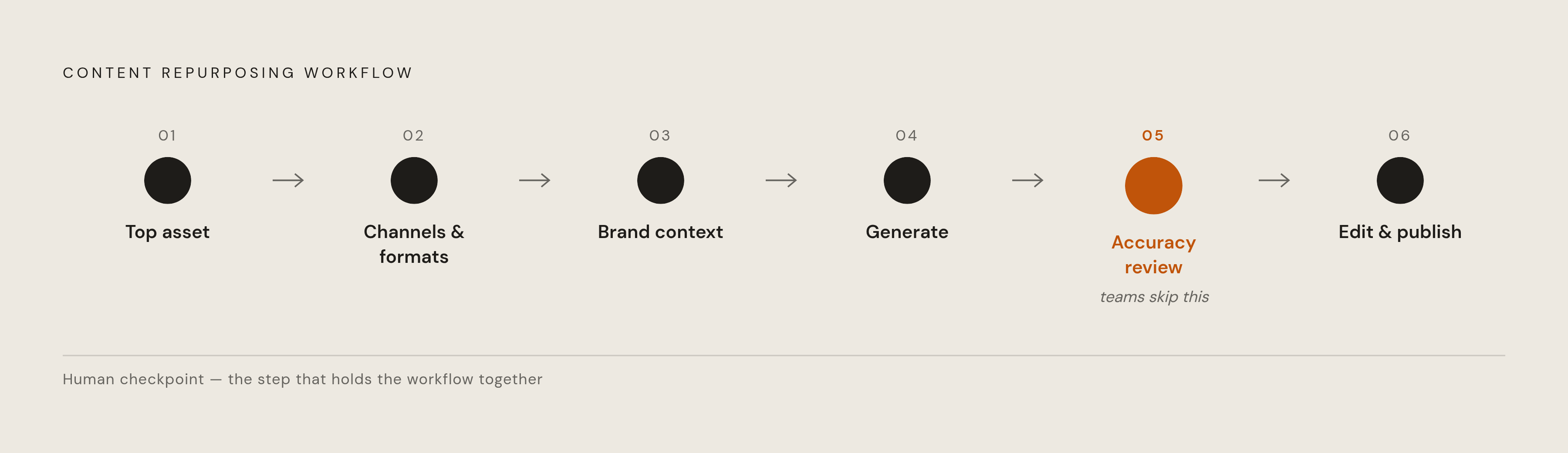
Human review checkpoints. Repurposing is a draft accelerator, not a publish button. The workflow should have a named editor reviewing for accuracy, tone, and channel fit before anything goes live. This is not optional at any volume.
The practical sequence: identify the highest-performing original asset, define the target channels and formats, set brand context, generate, review against the original for factual accuracy, edit for channel fit, publish. That sequence is not complicated. It is also not what most teams do, which is why most teams are disappointed with their results.
Fifty-one percent of marketers currently use generative AI primarily for brainstorming. Repurposing is a more structured, higher-leverage use case that requires more deliberate workflow design. The time savings compound when the workflow is repeatable, which is the actual goal.
How to Build a Repeatable Repurposing System Rather Than a One-Off Experiment
The Reformatters, by the end of their story, had done something most teams do not: they stopped treating repurposing as a button to press and started treating it as a machine to build. The difference between a repurposing experiment and a repurposing system is operational, not philosophical. A system has defined triggers: when does a piece qualify for repurposing? It has assigned roles: who runs the tool, who reviews output, who approves and publishes? And it has a feedback loop: which repurposed formats are actually driving conversions, and which are producing impressions that go nowhere?
The evidence shows that teams that start with a broad channel matrix and attempt to systematize everything simultaneously produce a lot of mediocre content across many channels rather than strong content on a few. The better approach is to start with one asset type and one output channel, prove the workflow, measure what matters, and then expand. Boring advice. Demonstrably correct.
The content audit step that most teams skip is also worth naming explicitly. Before building the repurposing system forward, identify existing long-form assets that have never been repurposed. These are immediate candidates with no new content investment required. Every team has them. They are the highest-efficiency starting point because the creative lift is already done; only the conversion remains.
Measurement closes the loop. The top metrics that determine whether a repurposing system is working are the same ones that assess any content program: engagement by format, lead attribution by channel, and conversion rate by asset type. If repurposed social posts from a particular whitepaper consistently outperform repurposed blog posts on the same topic, that is a signal about what the original asset contains, not just about what format converts. The system, over time, tells you what to create next. That is the actual return on the investment.
The Reformatters started with one whitepaper, one channel, and one honest workflow. Then they expanded. The tools in this article are the inputs. The workflow is the machine. Neither produces results without the other.