Building a Content Operations Function Inside a Marketing Team
Systematic process keeps content strategy from collapsing under volume.
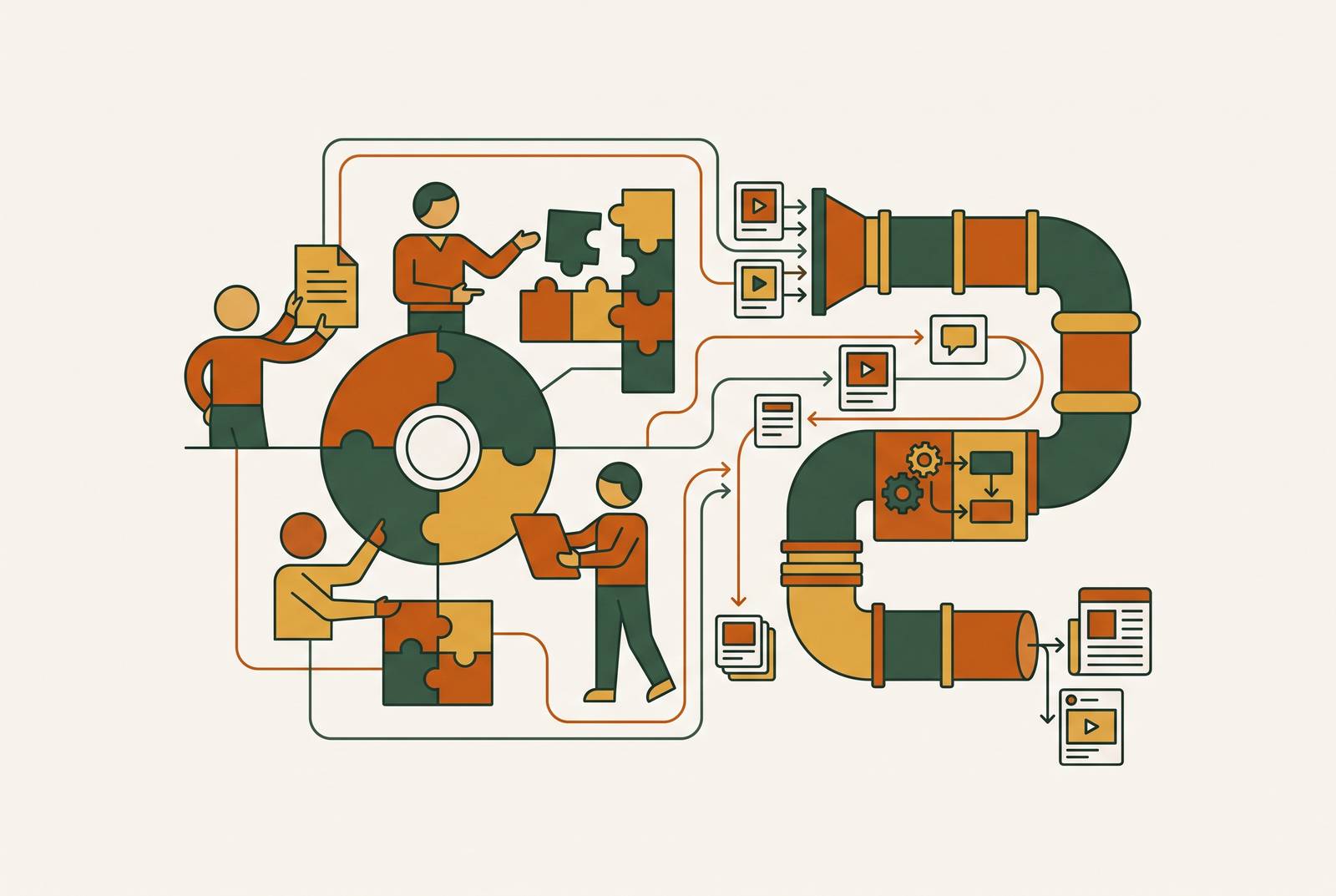
Content operations is the operational layer beneath content strategy: the people, workflows, and tools that turn a strategy document into published, consistent, measurable output. Most marketing teams have a strategy. Far fewer have built the system that makes the strategy actually happen at scale, and that gap is where most content programs quietly die: a slow drift into missed deadlines and mystery Google Docs rather than a dramatic collapse.
Content strategy answers what to say and to whom. Content ops answers who builds it, how it moves, which software touches it, and what standards apply so it doesn't fall apart under volume. A content ops framework has to nail down four things: who owns each stage of the lifecycle, how work hands off between people, which tools support which stages, and what rules apply everywhere regardless of team or channel. Skip that design work and the strategy deck looks great in a slide review, then vanishes the moment someone has to produce forty pieces of content a month against it. The rest of this piece walks through why that gap opened, what it looks like from the inside, and what actually closes it, layer by layer.
Why the pressure to build this function has intensified now
Marketers aren't imagining the volume increase. Eighty-one percent say content demand has doubled over the past two years, and 65% expect growth of five to twenty times over the next two. Staffing hasn't come close to keeping pace with that curve.
The Content Marketing Institute's 2025 B2B benchmarks found that 54% of dedicated content teams run with just two to five people, and 24% of organizations have no dedicated content staff at all. The math doesn't work on paper, and the coordination layer, the informal Slack threads and shared drives standing in for real process, is usually the first thing to give out once volume actually hits.
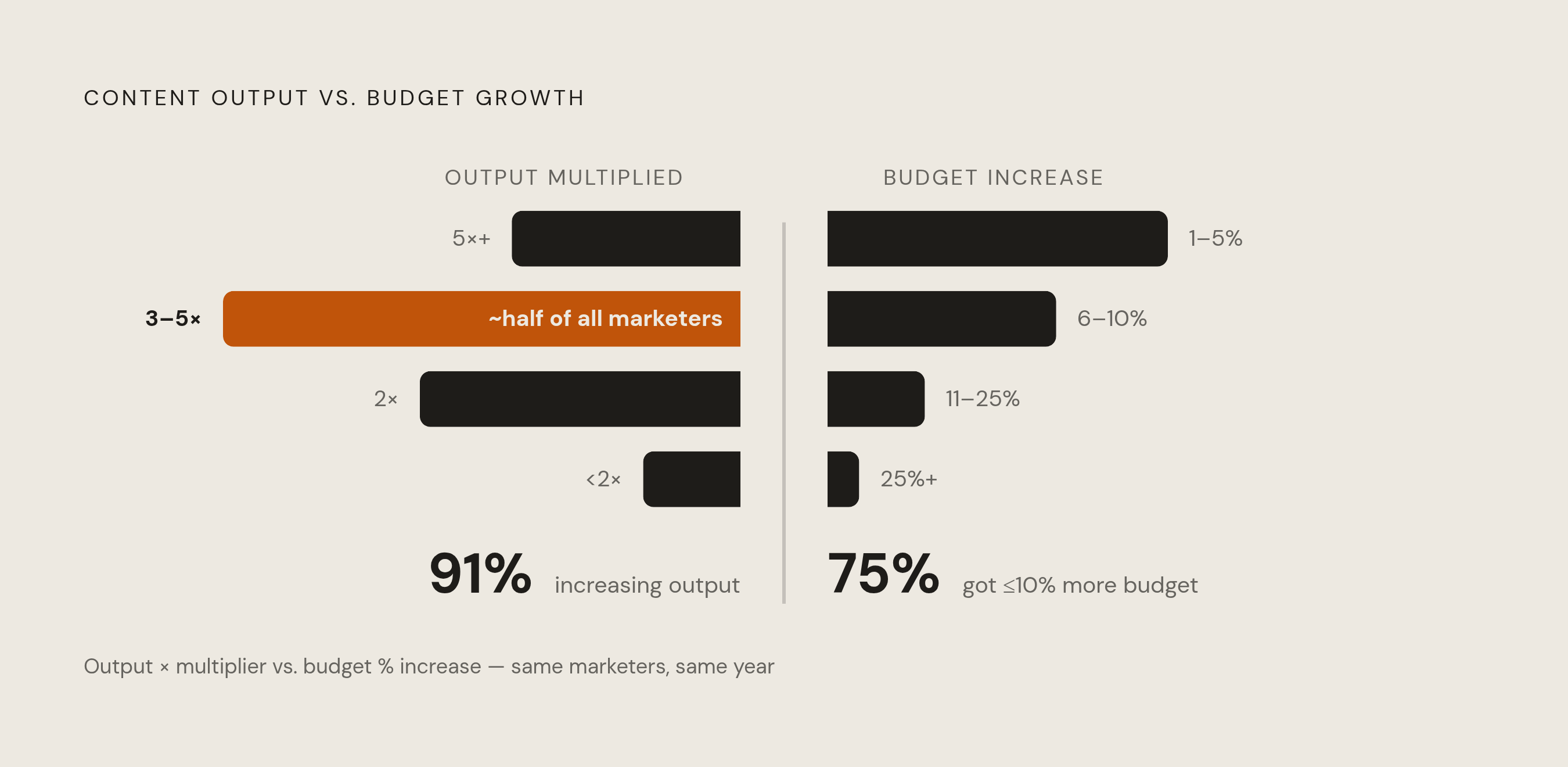
Budgets aren't rescuing anyone either. A 2025 study from 10fold found 91% of marketers increasing output, with close to half producing three to five times more than the year before, while 75% got budget increases of only 1 to 10%. That gap between output demanded and money supplied is the whole story in miniature: more work, thinner staffing, and flat budgets, running straight into each other.
Content marketing's effectiveness is rarely in question anymore. What's in question is whether the team producing it is actually built to handle what's being asked of it, and most teams answer that question by hoping.
The symptoms that reveal a content ops gap before the diagnosis is obvious
Spotting a broken content operation doesn't require a survey. Watching a Tuesday tells you enough: someone burns forty minutes hunting for an asset that already exists somewhere in a shared drive under a filename nobody remembers, an approval stalls at the same desk it stalls at every single week, and nobody can draw a straight line between what got published and what it actually did for the business.
The attribution problem shows up in the numbers too. Sixty-three percent of marketers say they struggle to attribute ROI to their content work, and 66% of enterprise marketers have trouble tracking the customer journey through it. A dashboard can be tagged as carefully as anyone likes; without governance around what gets tracked, starting from the moment a brief gets written, the data downstream never had a chance.
Call it the manual glue problem, and it has a specific shape. A file gets pulled out of one platform, renamed on somebody's desktop, something like final_v3_ACTUALFINAL.docx, and then re-uploaded into a second platform with the metadata rebuilt from memory or lost outright. That renaming ritual is what's holding a lot of content operations together right now.
The people closest to production feel this hardest, and a lot of companies misdiagnose the problem entirely. Forty-five percent of marketing directors point to inadequate technology for cross-channel delivery as their single biggest operational headache, compared with 29% of brand directors, who sit one level removed from the daily grind. That sixteen-point gap isn't cosmetic. It's the difference between someone fighting the tools every day and someone reading a summary of the fight once a quarter, and it explains why so many fixes get approved by people who never feel the actual pain. Poor visibility between teams also produces a subtler mess: pages that quietly compete against each other in search results because two teams wrote about the same topic without knowing the other one existed. The industry calls this keyword cannibalization, and it's a symptom of the same underlying issue as everything else in this section.
Different symptoms, same root cause. The people, the workflows, and the tools got assembled separately, often years apart, by different people solving different fires, and nobody ever went back to check whether the three pieces actually fit together.
The people layer: who the function needs and how the org chart is shifting
Three roles anchor a functioning content ops team, and the most important one is also the one everyone skips hiring for first. A Content Operations Manager runs the daily machinery, keeping people, workflow, and tools lined up behind the strategy; this is the job nobody notices exists until it's missing, at which point everyone notices, usually quickly and loudly. A Content Strategist sets the direction: audience, themes, channels, the actual "why" behind the work. A Content Performance Analyst owns measurement and decides where resources shift next, though at smaller teams this often gets folded into marketing ops rather than staffed as its own seat.
Here's the mistake worth naming directly, because it's close to universal: teams hire writers before they hire an operations manager, every time, because a writer produces something visible in week one and an ops hire produces a functioning system in month three, and month three doesn't show up on anyone's dashboard yet. That ordering is backwards. A writer without a system to run inside just produces more raw material for the same pile of confusion. Governance and process optimization live inside ops, separate from strategy entirely, and that distinction determines who gets asked why an approval took three weeks when it inevitably does.
A newer title is showing up at bigger organizations: Chief of Content Operations, a cross-functional executive who oversees content wherever it's produced, not just inside marketing. That includes customer success writing help docs, support teams answering the same fifty questions in slightly different words every time, recruiting drafting job posts, and partner teams generating co-branded material nobody in marketing has laid eyes on. Content creation has spread well past marketing's original boundaries, and the org chart is starting to catch up to that fact.
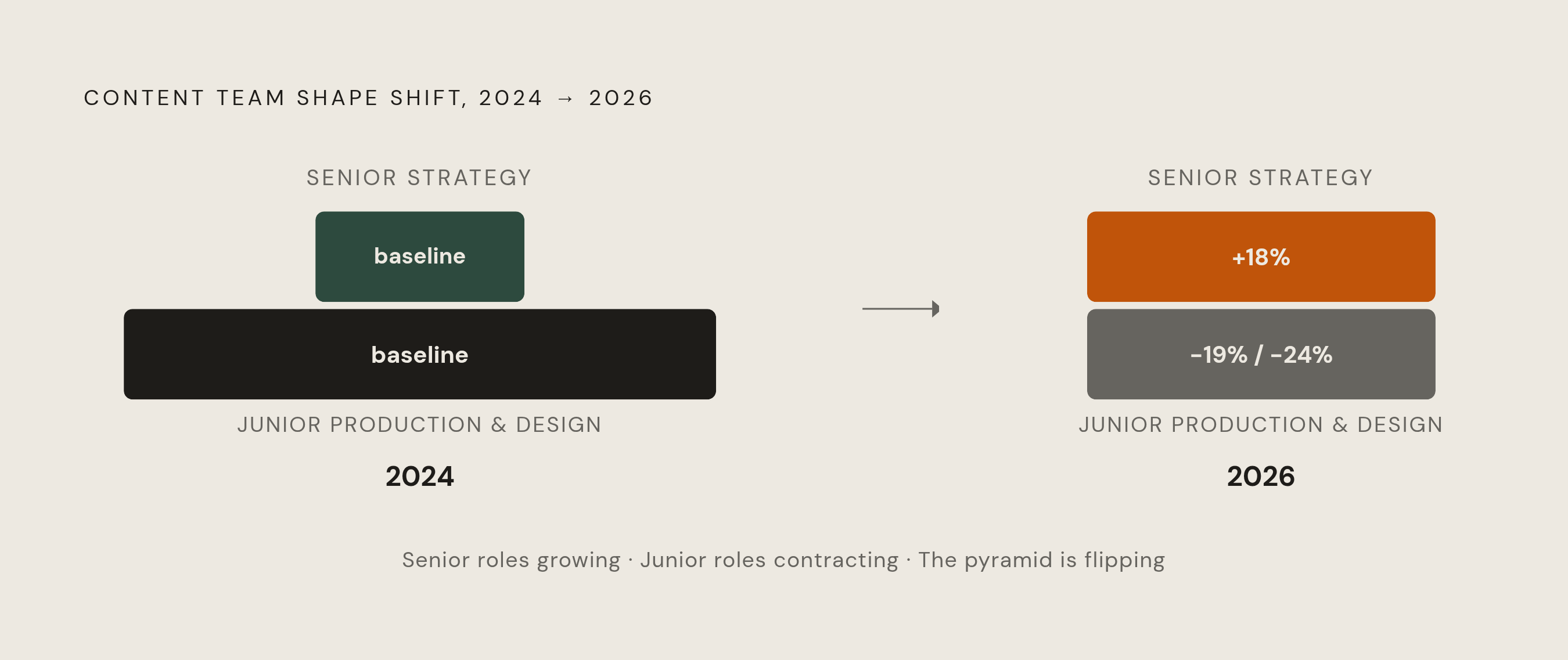
AI is reshaping the staffing pyramid faster than most headcount plans account for. Junior production and design roles saw a 19% reduction in 2025, with another 24% cut projected for 2026, while senior content strategist roles grew 18% year over year. Junior seats are shrinking while senior, analytical, AI-literate roles expand, and that's not a minor rebalancing. A hiring plan written two years ago almost certainly assumed the opposite shape, which means it's already outdated, whether anyone's noticed yet or not.
Plenty of people who touch content aren't on the content team at all: subject-matter experts, compliance reviewers, regional leads, sales reps fielding customer questions on a call. Defining roles means defining where each of those people's input enters the process, not just deciding who gets the byline at the end.
The first hiring question worth asking is who is accountable for workflow, governance, and measurement, rather than whether the team needs another writer. If nobody can answer it, the writer who does get hired just ends up doing content ops badly in their spare time, on top of the writing they were actually hired for.
The process layer: designing workflows and governance that don't collapse under volume
Every stage of the content lifecycle needs a named owner. That sounds obvious, and it's also the single most commonly skipped step anyway. When ownership is fuzzy, work doesn't slow down evenly across the board; it falls into the crack between two people who each assumed the other one had it, and that crack calcifies into a permanent bottleneck instead of staying a one-off delay somebody eventually notices and fixes.
There's a specific and common mistake worth naming here: treating brand and quality review as a single gate at the very end, right before publish. Research into high-performing programs finds that they build governance in at multiple points, briefing, creation, adaptation, and publishing, instead of stacking every check at the finish line. Teams that skip this spend a disproportionate share of their production time on rework, and the annoying part is that rework cycles slow everything down without even reliably catching every violation. Slower and still imperfect is a bad trade by any measure.
Repurposing deserves to be a designed process, decided at the briefing stage rather than remembered after a webinar airs when everyone's already onto the next deliverable. Repurposing improves ROI by roughly 32% on average, turning a webinar into three blog posts or a research report into a month of social content. Yet 48% of content marketers cite the lack of a repurposing workflow as a major obstacle to scaling. Read those two numbers side by side and the point makes itself: repurposing only works as a growth lever when it's a built-in output path decided at the briefing stage, not an afterthought somebody gets assigned three weeks later.
Distributed production adds another wrinkle worth taking seriously. When sales reps, regional marketers, franchisees, or partners create branded content of their own, old templates keep circulating long after they should have been retired, off-brand material shows up in the wild, and the brand team spends its week fixing instead of building anything new. Process design has to account for who's creating content outside the core team and what guardrails exist at the point of creation itself, since guardrails added only at review arrive too late to prevent the mess and can only clean it up after the fact.
Carry this point into the next section, because it's the hinge the whole piece turns on: process should decide what technology a team buys, ahead of the purchase, never after. Buy the tools first and all that happens is the existing chaos gets automated, faster than before.
The technology layer: what a content ops stack actually needs to do
Three kinds of systems get lumped together constantly, and they are not interchangeable, no matter what a sales deck implies. A CMS manages and publishes web content. A CMP, a content management platform, runs the workflow itself: briefing, drafting, review, approval. A DAM, digital asset management, handles the full life of an asset: version history, usage rights, whether a file is actually cleared to go out the door or still sitting in legal limbo.
The failure mode isn't subtle, and it's worth stating plainly: the mistake is buying one of these systems and expecting it to do the other two jobs as well, or buying all three and never connecting them, so they sit next to each other duplicating effort instead of removing it. That second version, three tools bought with good intentions and zero integration, is arguably worse than buying just one and living with its limits, because at least the single-tool version doesn't pretend to be solved.
Integration is the capability actually worth chasing, ahead of acquisition. When a CMS and a DAM talk to each other, version confusion mostly disappears and brand consistency gets enforced automatically at the point of publishing, not policed after the fact. When they don't talk to each other, the manual glue problem from the earlier section shows back up right on schedule, because a disconnected stack doesn't remove the coordination work; it just relocates it onto a human who now has to do it by hand.
There's a broader shift underway worth naming even though it's still taking shape: platforms from vendors like Sitecore, Adobe, and Sanity, along with various composable stack providers, are pushing past basic CMS functionality toward something closer to an operating layer for content, built around workflow orchestration and a shared data structure everything else sits on top of. The direction favors tighter integration in the infrastructure over more tools bolted on at the edges, and that direction should shape what a team buys next, not what happens to be cheapest this quarter.
That shift matters because of how the stack decision gets made higher up the org chart now. The tech stack has moved from a procurement line item to a strategic bet, a shift visible in how much organizational weight now sits behind the tools decision.
How AI changes what content ops can do (and what it doesn't change)
Adoption has gone from common to close to universal in a couple of years, which is a fast climb for any technology. AI adoption has gone from common to close to universal in a couple of years, which is a fast climb for any technology.
AI is doing real, measurable work inside content ops: drafting first passes, spinning up variations for testing, and powering personalization at scale, with personalization at scale now a widely cited primary use case. AI content drafting has been widely reported to deliver strong returns on investment on average, with personalization engines landing around 2.7 times. Those aren't rounding-error numbers, and they're the strongest case in this entire piece for why AI belongs in the stack at all.
Here's the catch, and it's the one that matters most in this whole piece: only 19% of content marketing teams track AI-specific KPIs. Most teams use AI every single day and have no framework for knowing whether it's producing better results or just producing more content, faster, which is a genuinely different thing and sometimes a worse one.
That gap points to a governance failure more than a technology one, and it's worth being blunt about which side of that line the problem sits on. AI speeds up output, but it does nothing on its own to create accountability for what that output is supposed to achieve; that accountability is precisely the job the people and process layers exist to do. More volume without governance just means bigger messes, generated faster than before. Pair AI with a strategy-first workflow, clear briefs, defined audiences, editorial standards built into the process rather than bolted on afterward, and it produces speed and quality together. Skip that infrastructure and AI produces speed, full stop, with quality left entirely to chance.
Putting the system together: how the three layers connect in practice
None of the three layers works in isolation, and that's the whole argument of this piece compressed into one sentence. Roles without a defined workflow create accountability gaps, because someone's always assumed to be covering a task nobody actually assigned to them. Workflows without the right tools create manual overhead, the endless renaming and re-uploading described two sections back. Tools bought without clear roles or process just end up automating the wrong things, quickly and at scale, which is arguably worse than doing them wrong slowly, since at least slow mistakes give someone time to notice.
The sequencing matters more than most teams assume going in, and most teams get it backwards. Map the lifecycle stages and assign real owners before shopping for software, not after the contract's already signed. Put the ops function in place before content volume scales up, because the entire point of the function is to make growth sustainable rather than to chase after it once it's already outpaced the team. Choose tools to serve workflows that already exist on paper, rather than inventing workflows retroactively because a vendor demo looked slick in the room.
Governance is the thread tying all three layers together, and CMI's 2025 research is fairly direct on this point: what separates high-performing programs is how tightly they govern each stage along the way, not simply how much content they manage to push out the door. Governance is what turns three separate efforts, people doing their jobs, a workflow existing on a whiteboard, tools sitting in a stack, into one actual system instead of three adjacent activities that happen to share a Slack channel and not much else.
The financial argument isn't abstract, either. Content marketing already returns roughly $7.65 for every dollar spent on average, and organizations that document their strategy generate about three times more leads per dollar than the ones that don't bother writing anything down. Operational infrastructure is what keeps a strategy from becoming a document nobody opens again after the kickoff meeting; it's what lets the plan stay a plan that's actually running, month over month, instead of an aspiration quietly aging on a shared drive somewhere.
When the system works, the shape of the work changes in a way that's actually noticeable day to day. Strategy turns into clear briefs, which move through a workflow everyone understands without having to ask, and assets get reused instead of quietly recreated from scratch for the third time by someone who didn't know the first two versions existed. Performance data flows back into strategy decisions instead of dying in a dashboard nobody opens after the campaign wraps. The lifecycle closes into a loop rather than restarting cold every campaign, which is, in the end, the entire point of building it.
Building this system isn't free, and it takes real design time upfront, the kind that never shows up as a line item anyone gets excited about in a budget meeting. The payoff is that the team stops rebuilding its own capacity from zero every time demand spikes, and starts compounding on infrastructure that's already there, waiting to be used again the next time volume doubles, because it will.