Onboarding a New Content Agency Without Losing Momentum
Rushed handoffs kill momentum more than bad agencies do.

Onboarding a new content agency without losing momentum comes down to one thing: how fast and how honestly the old context gets handed over. Most brands treat the handoff like paperwork, a folder of login credentials tossed over the fence on the way out the door, and that habit alone accounts for more stalled quarters than any actual skill gap between agencies.
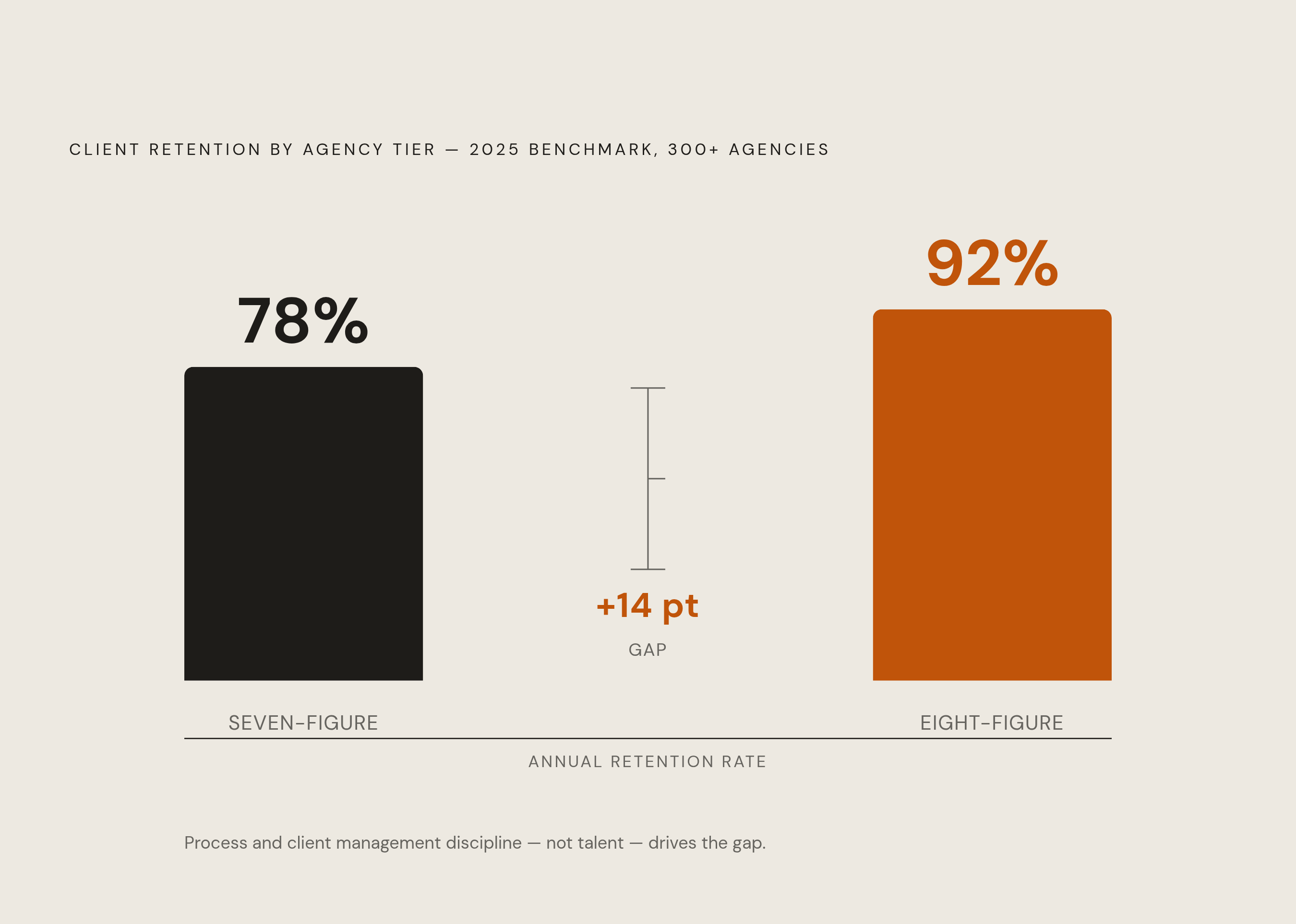
Content marketing agency churn runs around 35% annually as of 2025. Lower than paid media or social, sure, but still high enough that plenty of brands burn through two or three agencies before finding one that sticks. Predictable Profits' 2025 benchmark of over 300 agencies invites a cleaner explanation than "bad luck": seven-figure agencies retain clients at 78% annually, eight-figure agencies at 92%. A first instinct might be to read that fourteen-point gap as a talent story, better copywriters clustering at the bigger shops. But that instinct didn't survive a second look. The retention gap is large enough that output quality alone is an incomplete explanation, so that theory collapses. Once you rule out talent, the data points toward process and client management discipline as the more likely explanation, and that gap is the entire subject of this piece. Organic content runs on its own clock no matter who's steering it: 3 to 6 months before momentum shows up, 6 to 12 before it's measurable. Botch the transition and the bill comes due in quarters, not weeks.
What actually stalls a new agency in the first thirty days
Four things kill momentum in month one, and none of them announce themselves on the same day. That's exactly why they're hard to catch until the damage is done. By the time someone notices, it's week five and the numbers have already slipped, and the postmortem starts with "wait, when did this start."
Lost institutional knowledge does the most damage of the four, and it does it quietly. What got tested, what got killed, what campaign angle flopped in March for reasons nobody wrote down: none of that lives in a shared doc. It lives in someone's head, or in an old Slack channel the new team will never get access to. A new writer can read every blog post a brand has ever published and still have no idea the "customer story" format got tried twice and buried twice, both times for legal reasons that never made it into any brief.
Then there's the digital asset gap. Ad platforms learn cumulatively; pixel data, conversion history, and account age all feed the algorithm's sense of who to target. Hand a new agency a freshly spun-up ad account and there's no signal to optimize against, no machine that already knows the audience. They rebuild that signal from scratch, by trial and error, on the client's dime.
Pausing active programs mid-transition does real damage while looking, on the surface, like caution. Organic search compounds; stop publishing for six weeks and rankings can slide back months. Paid media runs on a tighter clock, and a significant account change to paid search or paid social typically needs 2 to 4 weeks of re-optimization before performance settles again. Every week of that is a week of worse numbers that has nothing to do with the new agency's actual competence, though it rarely gets read that way internally. Somebody in a Tuesday status meeting is going to blame the new team for a slump the old team's absence caused.
Expectation mismatch is the one that turns a rocky onboarding into a full churn spiral, and it's the most avoidable of the four by a wide margin. Poor onboarding is widely cited as a leading driver of client churn in B2B service businesses, and it usually starts with someone expecting the new team to outperform the old one by week two, before the new agency has had any real time to find its footing. Nobody schedules a meeting to set that expectation badly; it accumulates instead, in hallway comments and Slack asides, until it's load-bearing and nobody remembers building it.
One sequencing error deserves to be named outright, because brands make it constantly and it's entirely within their control: securing full admin access only after giving the outgoing agency notice. Once an agency knows it's losing the account, its incentive to cooperate with handover requests evaporates fast. Pair the late-access mistake with skipping a documented performance baseline before the switch, and the brand loses any fair way to tell whether the new agency is actually better, or just different and lucky. Get the access and the baseline locked before the notice goes out, in that order, not the reverse.
Setting a transition timeline the new agency can actually deliver against
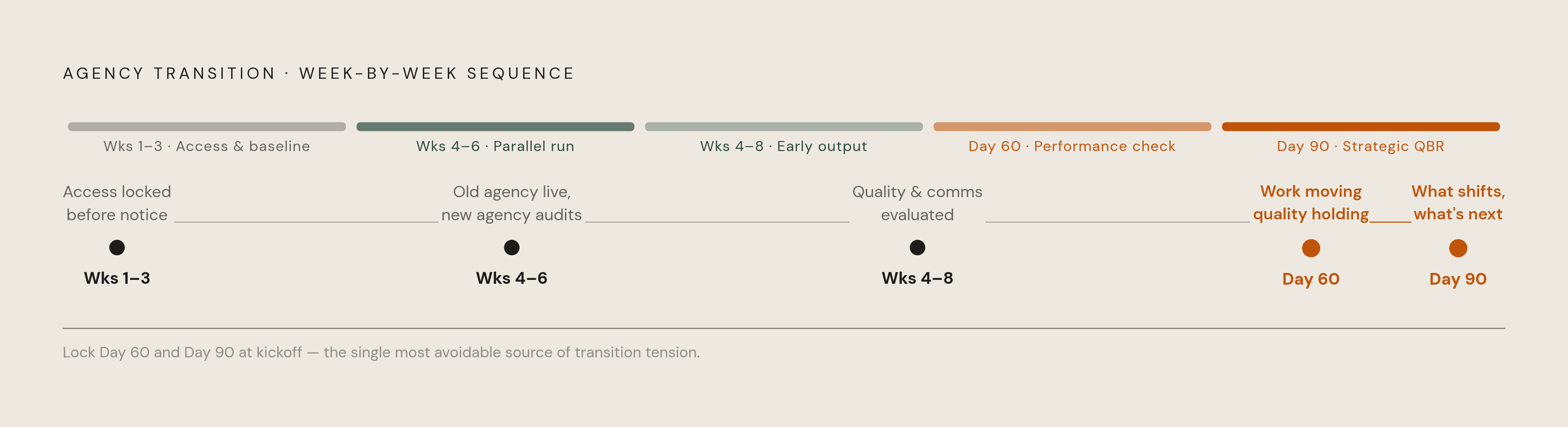
A properly run transition takes 60 to 90 days from decision to full handoff. Compressing that window causes most of the damage described above, and the instinct to shrink it shows up in nearly every kickoff meeting anyway, usually from someone who means well and is about to cause a problem. Resist it on principle, because the math behind the timeline doesn't bend to good intentions.
Weeks four through eight are where early content output becomes realistic, but that output hasn't had time to generate rankings or real engagement data yet. Judging it on performance means judging it on a number that doesn't exist. A six-week-old article hasn't accumulated enough traffic to prove anything either way, so evaluate quality and communication instead: is the work matching the brief, is the team asking good questions, is anything slipping through the cracks unnoticed.
Brandon Hall Group found employees who rate their onboarding experience poorly take 40% longer to reach full productivity. That's a hiring statistic, not an agency one, but sitting with it, the mechanism transfers cleanly: a team working without context takes measurably longer to hit stride than a team that got a real briefing on day one. Whether the new hire wears a badge or bills by the hour, the ramp-up math barely changes.
Two dates belong on the calendar at kickoff, before anyone has a reason to dodge scheduling them. Day 60 is a first performance data review: is the work moving, is quality holding, is communication actually working the way it was supposed to. Day 90 is a strategic quarterly business review: what's working, what needs to shift, what next quarter looks like. Locking both dates in during the kickoff meeting means neither side has to be the one to awkwardly raise it three weeks in, which sounds small and removes an entire category of avoidable tension.
The timeline gives the relationship room to prove itself as real data comes in. Shrink it at every opportunity and the very problem it exists to solve just shows back up.
The parallel-run window and when it's worth the budget
The cleanest transition method, and the one most brands skip to save a line item, runs the old and new agency in parallel for 4 to 6 weeks. The outgoing team keeps live programs running while the incoming one audits, absorbs context, and either rebuilds or inherits what's already working. It costs more for a defined stretch, and working through the math is what makes the position worth stating plainly: skipping it to dodge a few weeks of double billing is usually the more expensive call, once the parallel-run cost gets measured against a quarter of stalled organic growth. The overlap functions as insurance against exactly that scenario.
What that overlap actually buys: campaign continuity, ad platform learning that doesn't reset to zero, lead flow that doesn't stall, and a real baseline to measure the new agency against instead of a cold start with nothing to compare it to. For most brands running organic channels, the cost of the overlap is cheaper than the cost of losing a full quarter of compounding momentum, and that comparison, not the sticker price of two simultaneous invoices, is the one that should decide the budget conversation.
When a full parallel run isn't possible, whether that's contract terms or plain budget limits, a structured two-week shadow period gets most of the same result for a fraction of the price. The new agency watches live campaigns before taking the wheel. A hard cutover leaves the incoming team guessing at context nobody handed them from hour one.
For content specifically, this overlap window is where the real work happens: the new agency reads through existing content, figures out what performed and what didn't, absorbs the editorial calendar already in motion, and asks the outgoing team questions while there's still someone around who remembers the answers. It's also the best window to transfer brand voice, which is a big enough problem to earn its own section further down.
What a structured knowledge-transfer package actually contains
Before a new agency writes a single sentence, four kinds of knowledge need to change hands. Skip any one of them and it shows up in the work within weeks, usually as a tone that's slightly off or a campaign angle that's already been tried and buried once, quietly, by someone who left before writing down why.
Audience and positioning comes first: who the best customers actually are, what problems they're solving, how the brand stands out in a crowded market. The working version matters most here, the messy one the old agency actually used to make day-to-day calls, rather than whatever polished version lives in the sales deck. Those two documents are rarely the same, and the gap between them is exactly where a new agency gets lost.
Campaign and content history is second, and it needs actual structure, not a link to a Google Analytics dashboard and a shrug. What's published, what performed, what got tested and retired, what's sitting half-finished in a draft folder. If the new team has to reverse-engineer campaign history purely from traffic charts, the handoff already failed somewhere upstream.
Brand voice is third, and it deserves more than a PDF style guide gathering dust in a shared drive nobody opens twice. Annotated examples do the actual work here: content that nails the tone, content that missed and a note on why it missed, specific phrases the brand leans on and specific phrases it avoids. This gets its own section below, because it's the one most brands underinvest in and the one that shows up first when it's missing.
Technical infrastructure rounds it out: platform access, pixel and tracking setup, editorial calendar tools, reporting dashboards, and clear ownership for each one, down to who's actually responsible, not just who happens to hold the password.
An onboarding questionnaire works as structured intake for all of it: business goals over the next 12 to 24 months, audience definition, current channel mix, what's worked, what hasn't, communication preferences, who actually makes the final call. The common failure treats sales-stage conversations as a substitute for this questionnaire. Whatever got discussed informally during a pitch is rarely systematic enough to build a campaign on, and the gaps tend to surface mid-campaign, which is the worst possible moment to discover them.
Worth saying plainly: the agency has homework too. Project workspace, folder structure, naming conventions, task templates, all of it should exist before the first kickoff call, not get assembled during it. An agency still organizing its own internal systems after onboarding starts lets that disorganization bleed straight into the client relationship, and clients notice fast, the way anyone notices a contractor still unpacking tools on day one of the job. Harvard Business Review found structured onboarding increases client retention by up to 16%, a fairly blunt argument that the process pays for its own overhead.
Transferring brand voice without losing it in translation
Companies with consistent brand voice see revenue increases, yet few companies actually pull off real consistency across channels and time. Sitting with that gap for a while, it doesn't read as an effort problem; most teams try. It reads as a specificity problem. The onboarding window is exactly when voice consistency is most fragile, because a new writer with no calibration is, functionally, guessing, and guessing at scale is how a brand ends up sounding unrecognizable to itself within a month.
Vague directives are the failure mode here, and they're everywhere. "Professional but friendly" tells a new writer nothing concrete to work from; that phrase could describe half the brands in any given industry, which is exactly the problem. A useful voice brief runs on examples, not adjectives, and if the brief in front of the new agency is all adjectives, that's the mistake to fix first, before anything else on this list.
A real voice package includes two or three annotated pieces that get the tone right, with specific notes on why: sentence length, vocabulary level, how the brand handles humor against formality, how pieces tend to open and land. It should include a short "what we don't do" list too, which sounds like an afterthought and is actually one of the highest-signal inputs a new agency can get; knowing what to avoid often does more calibration work than knowing what to copy. A terminology list rounds it out: preferred terms, banned phrases, jargon the brand leans into versus jargon it deliberately avoids. Voice usually isn't static across channels either, so it's worth spelling out whether tone shifts between LinkedIn and the blog, or between a piece meant to draw someone in and one written to close a sale.
AI-assisted drafting raises the stakes here, and working through this one changes where the risk actually sits. Writers often worry the tool will make everything sound the same. When writers lean on AI tools for first drafts, a vague voice brief is the actual gap that lets generated language drift toward the generic middle, the tone that sounds like everyone and therefore no one. A specific, well-documented brief is the only thing that keeps that drift from happening; the missing brief is the real failure point, and the tool just makes the absence visible faster than a human writer would have.
This works best as an ongoing loop, not a one-time handoff. Build that loop into the first 30 days specifically for voice, where early drafts get checked for tone before anyone even looks at strategy or accuracy. Contenive, one example worth naming, structures its workflow around this idea, treating voice consistency as a built-in feature checked continuously, reviewed on an ongoing basis rather than reread once a quarter and forgotten.
Running the first ninety days without losing the thread
Roughly 63% of customers factor the onboarding period itself into whether they stick with a service provider. Flip that logic onto agencies and it holds just as well: a team that feels under-briefed or unsupported during ramp-up isn't going to do its best work, no matter how good the writers actually are on paper.
Three principles carry the first ninety days, and they apply in a specific order, not all at once. Communication quality matters more than output volume in weeks one through four, because the job in that window is catching misalignment before it compounds, not maximizing how many pieces get published. The day-60 review should judge process and communication, since a piece published in week six hasn't had time to rank or build any real engagement data yet, no matter how good it reads. The day-90 QBR needs to function as an actual strategic reset, what's working, what needs to shift, what next quarter looks like, with the depth that name implies rather than a routine status update.
What does "things are moving" actually look like at day 30? Quality holding steady against the brief, deadlines met without last-minute scrambling, and fewer clarifying questions from the agency than there were in week one. A communication cadence that's turned predictable instead of reactive is easy to overlook and probably the clearest signal available: it marks the difference between an agency that's found its footing and one that's still guessing under a calm surface.
This accountability runs both directions. Agencies that set realistic KPIs during onboarding hit retention rates 15 to 20 percentage points above industry averages, a fairly direct signal that the agency has just as much riding on getting this right as the client does.
The throughline holds across every section here: brands that front-load context, voice, history, goals, and access compress the ramp-up and protect momentum that took months to build in the first place. The first ninety days are the foundation the next twelve months get built on. Rush the foundation and the crack shows up later, usually right around the time everyone's stopped looking for it.