Fractional CMO vs Full-Time CMO for Early-Stage Startups
Fractional CMOs cost a fraction of full-time hires and ramp faster for early-stage startups.

Figuring out marketing leadership for a new startup feels like a math problem people would rather not discuss. According to Gartner’s 2025 CMO Spend Survey, companies now allocate just 7.7% of their revenue to marketing, down from 9.5% three years ago, and fully 59% of CMOs report their budgets are too tight to execute the plans they’ve already promised. Early-stage startups face an even tighter marketing budget pinch, as they usually need to allocate 12 to 20 percent of their revenue to marketing in the first two years, which is when their revenue is just starting to grow. Many companies making less than $20 million in annual recurring revenue might benefit more from a fractional approach than they realize, and this article will explain the reasons behind that.
What a fractional CMO actually does, and what the role is not
A fractional CMO is a top-level marketing professional who partners with a company on a part-time basis, typically on retainer, offering the strategic leadership of a full-time C-suite executive without the formal employment agreement. It might seem like a minor difference at first, but when you see how the role is set up in daily operations, it becomes clear why people often mix it up with three other positions that it only somewhat resembles.
A marketing consultant offers advice tied to a specific project and leaves once that work is complete, without taking responsibility for how those results play out over time. A marketing agency executes campaigns but isn't in the leadership meeting deciding what the company's positioning should even be. A full-time VP of Marketing hired at reduced scope is still a full-time employee, just a cheaper one, which solves a budget problem more than a flexibility problem. Founders who confuse the two find out the hard way, six months in, when the "cheaper VP" still needs a full severance conversation to exit.
The responsibilities of a fractional CMO are akin to those of a full-time executive, but condensed into a shorter timeframe: they include crafting go-to-market strategies and positioning, establishing the demand-generation infrastructure expected in a pipeline review, participating in leadership discussions as the top marketing expert instead of an external consultant, and overseeing the hiring and guidance of junior marketing personnel or agencies on behalf of the company. They manage the department without dedicating their full time to it. Running the function, without occupying it full time.
Understanding what’s not included is just as revealing. Daily availability, deep on-the-ground team management, single-company focus: none of it is part of the deal. By its very nature, a fractional CMO also works for other companies. This tradeoff is one founders should consider carefully, as it challenges the notion that a fractional CMO is merely a cheaper alternative to hiring a full-time executive.
From about 2,000 in 2022, LinkedIn profiles mentioning "fractional leadership" increased to more than 110,000 by 2024, showing a labor market was taking shape.
The true cost of a full-time CMO hire at the early stage
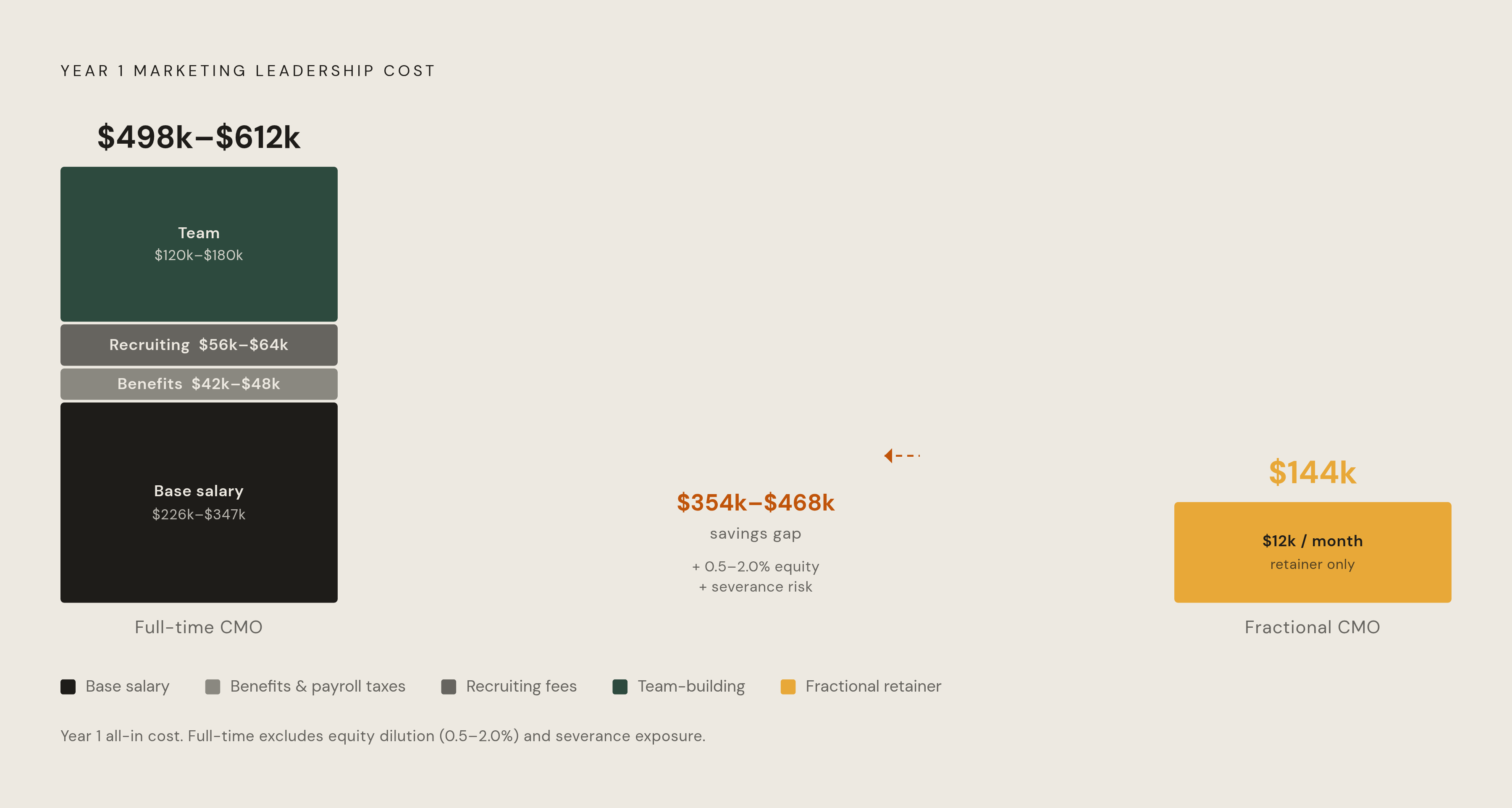
This is the point where the numbers become troubling, and many founders tend to stop paying attention too soon. Different sources give different numbers for a CMO's base salary: Built In's 2026 data says it's $225,908 on average in the US, while Glassdoor's 2025 figures suggest it's closer to $347,000. Choose the figure that seems less shocking, as the base salary accounts for just 60 to 70% of the actual expense, with the remainder being where the real cost bites.
Employer-side benefits run 28 to 35% above base, per 2025 Bureau of Labor Statistics data. In addition to the base salary, benefits and payroll taxes will add between $42,000 and $48,000. A senior executive search typically runs 20 to 25% of first-year salary in recruiting fees, another $56,000 to $64,000. Building a team for the new CMO typically costs between $120,000 and $180,000. After that, equity usually ranges from 0.5% to 2.0% in a startup, which can dilute the ownership structure even before the new hire has launched their first campaign.
Add it up and Year 1 lands between $498,000 and $612,000, before the role has generated a dollar of measurable return. The wait for a full-time CMO to become productive can be lengthy, typically taking longer to ramp up. During this period, growth strategies may be delayed while the hiring process is underway and the new executive gets up to speed.
Tenure is the part that should actually worry a founder. Tech companies often see CMO tenures of under two years, and many new CMOs do not complete their initial contract period. Calculating the total expense over a seven-year growth period reveals how many startups end up shelling out the Year 1 CMO price tag two or even three times, yet rarely see a complete payoff from any one of those hires. This situation highlights a deeper issue, and it's the statistic that should concern a board more than the initial salary figure.
What fractional CMO engagement actually costs, and what that buys
Fractional CMOs in the US usually bill between $10,000 and $25,000 each month, which breaks down to around $200 to $350 per hour. In Western Europe, fractional CMOs charge less, typically between $6,000 and $18,000 per month. The typical market retainer is around $12,000 monthly, which amounts to about $144,000 annually, and it comes without benefits, payroll taxes, equity dilution, or complicated severance discussions if the arrangement doesn't work out.
Scope is the lever that moves the price. A startup needing 10 hours a week of strategic oversight sits at the low end. Startups that require their fractional CMO to juggle team oversight and take full ownership of a product launch end up paying the top-tier rate, and for good reason, because it’s far more demanding than the term "fractional" suggests.
However, the most significant difference in structure is speed, which is often underestimated. Fractional CMOs often ramp up more quickly than full-time hires, whereas hiring a full-time CMO can take considerable time to deliver results. For a startup, this time difference directly impacts the budget: each month a full-time hire takes to get up to speed is a month of expenses without any marketing results to justify it.
Hiring a fractional CMO has its benefits, but it also means compromises: fewer hours each day, split attention, and a diminished influence with investors or big clients compared to a full-time C-suite executive. These are genuinely different engagement models, and the bank account tends to make the decision feel more urgent than the strategy memo does.
The four variables that determine which model fits a given startup
When deciding which approach to take, four factors are key, though money is the least helpful one to consider first.
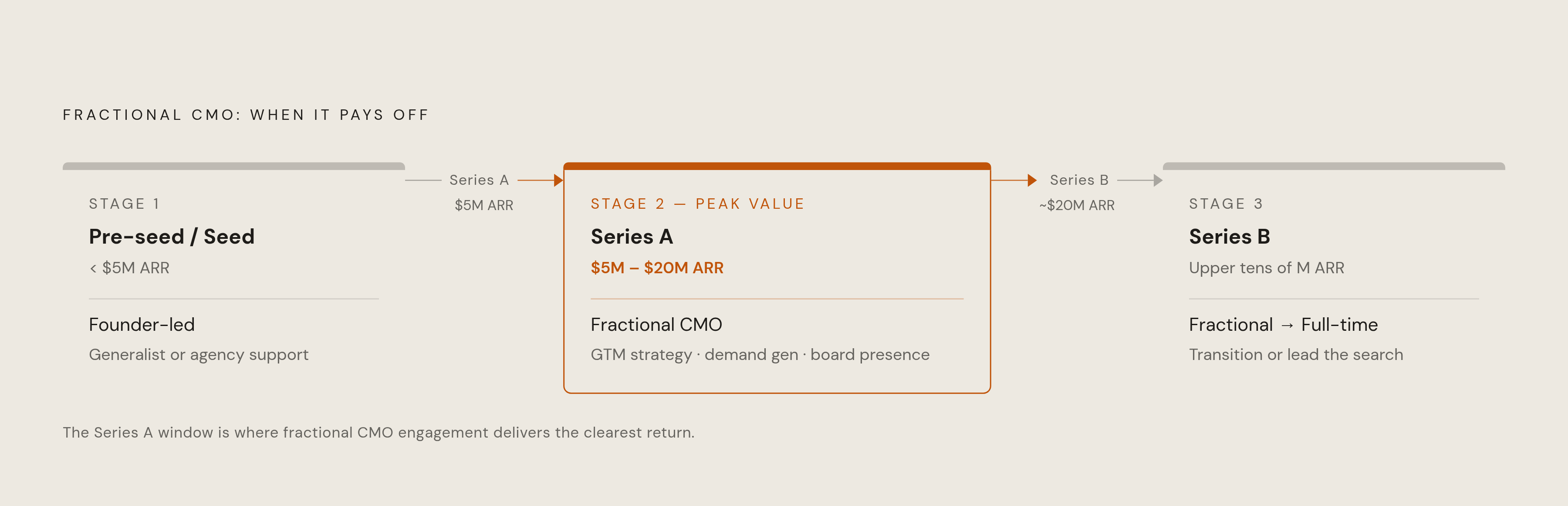
When considering which model works best, the startup's growth stage and revenue take top priority. Startups in the pre-Series A or seed stage, which typically have revenues in the very early range, generally shouldn’t invest significantly in either model; instead, relying on marketing led by the founder with some support from less experienced team members is the best approach at this stage. For Series A companies, usually with $5 million to $20 million in annual recurring revenue, the fractional model is ideal. It offers high-level strategy without the cost of a full-time executive, right when founder-led marketing begins to struggle. After the Series B stage, when a company is bringing in well into the tens of millions in revenue, the situation changes. When marketing tasks take up more than about 40 hours per week, or when the company is building a sizable in-house marketing team, it makes structural sense to hire a full-time CMO.
What are the marketing team's immediate priorities? The areas of strategy, positioning, and go-to-market architecture are typically where a fractional CMO can provide expertise. Managing the day-to-day operations of an expanding team is inherently a full-time role. Preparing for a fundraise falls somewhere in between, and both models can be effective, but having a full-time title often carries greater influence with investors, whether that's deserved or not.
Next, it's important to consider budget runway and how sensitive the company is to financial losses. A business with a 18-month runway, spending between $498,000 and $612,000 on CMO costs in the first year, is taking a fundamentally different risk compared to one with a 36-month buffer. Using a fractional CMO keeps your options open, as you won't face severance costs or equity issues if you need to expand the role or end the engagement.
The fourth variable is the one companies skip constantly: does anyone actually know what the CMO is supposed to build? A fractional CMO is most effective when a founder can clearly state the exact issue. "We have product-market fit but no repeatable acquisition channel" is a brief. "We need more marketing" is a wish. Fractional executives operate based on a clear set of goals; if the company truly can't identify its marketing issue, an audit must take place before choosing a model. Neglecting this step often leads to companies incurring costs unnecessarily.
Where the fractional model underperforms, the cases founders overlook
Fractional models face genuine structural challenges in certain areas, and their increasing popularity hasn't solved these issues.
Enterprise sales cycles are one. Many enterprise buyers and procurement teams want a full-time, on-site marketing leader sitting across from them in meetings, and when a fractional CMO splits time among multiple companies, that arrangement can strain the very relationships where consistent presence and deep trust are essential.
Another situation where this model falls short is with large or rapidly growing in-house marketing departments. Fractional leadership works cleanly when the team underneath it is small. When a team grows beyond a certain point, requiring daily management and clear accountability, a part-time leader at the top can create gaps that go unnoticed until a deadline is missed.
Creating a new category is one of the most challenging situations, and it’s likely where the fractional model is used excessively. Creating an entirely new category requires months of focused, uninterrupted dedication to a single competitive story. The wide range of clients that usually makes a fractional CMO so useful in other situations turns into a drawback in this case. The ability to spot patterns from handling various market entry issues becomes a problem because creating a new category needs deep focus, which doesn't allow for juggling four other clients at the same time.
According to Averi.ai’s 2025 analysis, a large share of full-time CMOs leave or are let go within 18 months, and one key reason is mismatched role definition: when a full-time CMO’s responsibilities aren’t clearly aligned with the company’s actual needs, that misalignment causes failure just like it would for any other poorly defined role, whereas a precisely scoped CMO delivers increasing returns the longer they remain in place. The real question is whether the company's complexity, the size of its team, and how tough the competition is have already surpassed what a leader working part-time can manage. If they have, adding hours to a fractional retainer is a patch, and everyone involved usually knows it before they admit it.
How to sequence the decision as the startup grows
Typically, venture-backed startups that get this right tend to follow a similar pattern, even if their approach was unintentional or developed over time.
In the pre-seed and seed stages, the founders lead the company, often bringing on a generalist or hiring an agency to manage content and generate demand. After a startup raises its Series A funding, a fractional CMO usually steps in to develop the go-to-market strategy, set up the necessary tools for customer acquisition, and provide a steady marketing perspective in discussions with the board and investors, which were previously lacking. At the point when a startup hits the Series B stage, with annual recurring revenue in the upper end of the Series B entry range, the fractional CMO typically either moves into a full-time role or, equally common, leads the search for someone to fill that role. Most people don’t give enough credit to that second option. Because a fractional CMO is already familiar with the company's situation, its customers, and past unsuccessful efforts, they are often the best person to draft the job description for the person who will take over their role, a unique form of job security that goes unmentioned.
The transition succeeds because the fractional CMO’s work creates three key assets: a clear, written strategy and brand positioning so the new hire starts with a roadmap rather than guessing from scratch, a fully operational demand-gen system that keeps sales flowing during their first nine to twelve months, and a much tighter job description, because companies who’ve used a fractional CMO already know exactly what they’re missing. This clear direction is what reduces early turnover; when a job description is unclear, it usually reflects a lack of understanding about the actual issues, merely presented as a job title.
The decision to switch is triggered by operational needs, not by a predetermined schedule. The switch happens when the workload exceeds the capacity of a part-time CMO, and the reporting structure requires a dedicated, full-time leader to manage it daily.
What to look for when evaluating fractional CMO candidates or platforms
The number of fractional professionals grew quickly, jumping from around 60,000 in 2022 to nearly 120,000 by 2024, as reported by the Frak Conference 2024 data. More talent on the market is generally a positive development, but it also makes careful vetting more critical than in the past. A bigger pool comes with a wider range of quality tucked inside it.
When evaluating candidates, sector-specific experience is the top consideration, and it carries significant weight. A fractional CMO with experience growing a B2B SaaS company from early-stage to a meaningful revenue milestone has valuable insights that apply directly to similar situations; in contrast, someone who has only worked in consumer packaged goods lacks that same relevance, regardless of how impressive their resume may seem.
Pay close attention to how a candidate responds to the initial brief. A skilled fractional CMO challenges ambiguity and turns the request into a clear strategic issue, as this analytical approach is central to their role. When checking references, skip the soft questions about whether the person was “easy to work with” and zero in on results instead: ask past clients exactly how many days or weeks passed before they saw something concrete from the engagement, and what that tangible outcome was. Check concurrent client load directly, too. A fractional CMO juggling six clients simultaneously cannot structurally provide the focused strategic input a growing startup requires, irrespective of their skill level, because there are only so many hours in a week, and basic math applies regardless of how sharp someone's insights are.
When you go through a platform that screens and connects you with fractional CMOs, you’ll cut down on the wait time and get a built-in check for quality right from the start. Referral networks can connect you with independent fractional CMOs who have specialized knowledge of your industry, but this approach requires more research and evaluation on your part. It's important to note that for businesses relying heavily on content and SEO for growth, platforms that integrate content creation with marketing leadership should be prioritized. This is crucial since viewing strategy and execution as distinct vendor roles can lead to confusion in fractional partnerships.
No matter which option you pick, discuss and finalize the contract details before committing: specify what the fractional CMO will achieve in the initial 90 days, set their weekly hours or availability in writing, and include an exit clause that doesn’t demand a six-month notice. The main reason companies hire a fractional CMO is to get agility, and a rigid contract that traps a founder from day one defeats that purpose entirely, making it an odd use of a six-figure annual retainer.
The decision, summarized as a practical checklist
Pick a fractional CMO if your annual recurring revenue is in the early growth stage, enough to have survived Series A funding but not yet big enough to justify a full-scale Series B push. Opt for a fractional CMO when your company's main requirements are crafting strategy, defining your market position, and building your plan for reaching customers, rather than overseeing daily team tasks. Choose it when runway is limited and a $498,000 to $612,000 Year 1 hire would meaningfully bend the burn rate. Consider choosing a fractional CMO when the company has a clear, specific marketing issue to address, and when a faster ramp-up is often more valuable than the longer onboarding of a full-time hire.
Opt for a full-time role when the marketing work requires a full-time commitment and the team has grown beyond what part-time guidance can effectively oversee. Opt for a full-time CMO when your company operates in enterprise sales, as the title holds significant influence with potential buyers during negotiations. Opt for a full-time CMO when your company's annual recurring revenue reaches a scale where full-time leadership becomes practical, and the marketing organization's complexity warrants the full expense. And choose it once a fundraise has actually closed and the runway comfortably absorbs the Year 1 total, rather than straining against it from month one.
The real question, which this article has been leading up to, is which model best fits the company's current problem, judged on its own merits rather than which one looks better on a pitch deck. This question deserves a straightforward answer before contracts are signed, whether you’re the one making the offer or the one evaluating it.